Although the primary aim of this site is to give you information on current and future workings and to demonstrate that there is still plenty out there of interest, I will occasionally dip into the past too and lament the fascinating railway scenes that are now gone forever.

My favourite Irish loco, 077, at Dublin Connolly. Incidentally, Gary Thornton of Six Bells Junction accompanied us for the particular bash this photo was snapped on, and his top review of that day can be found here. 29/12/00 (JW)
18 years ago this week (at the time of writing!) it was the school half-term holiday and I was 11 years old. Thanks to my Dad, I had a superb childhood on and around railways, and our most regular haunt in the mid and late 1990s was Ireland – floating across the Irish Sea and through a wave of insomnia one night when I was about 13 we worked out that I’d already made 64 trips to the Emerald Isle for a total of over 200 days, which was far more than I did on the trains at home.
The reasons for this were legion – but for a start, why would you hang around the UK railway (that was even then severely sanitised and unit-ised), when just 50 miles away there was a land where loco haulage, steam heating, vacuum braking, semaphore signalling, jointed track etc etc still ruled supreme? On top of that, it was a land unburdened by much of the “red tape” found in the UK, and unofficial cab rides and depot tours and other such privileges unimaginable today were in fact easier to come by as a child than as a grown-up! I certainly credit many of those early experiences of kindness shown to me by Irish railwaymen as part of the reason I was driven to pursue my own career on the railway in later life.
Additionally – and this is a tip that still has relevance today – if you are cranking on the Continent with your young children then returning home in an emergency (or simply if said children decide to “play up”!) can sometimes be difficult; but from even the furthest reaches of Ireland’s railway network, we could have been home in Kidderminster by hook, crook, air or sea within just a matter of hours.
Sadly, I don’t feel there’s much to tempt you to travel to Ireland for a train-related holiday these days, but there are at least a number of railtours each year that allow us to briefly relive the good old days – and these are listed in the Haulage Calendar on this site.
Sunday 20/02/00
I recall this day well, having watched Villa beat Everton in a televised FA Cup quarter-final, we set off on our overnight journey to Ireland. Added interest in such journeys through the 1990s and until December 2000 was provided by class 37 haulage directly to the ferry, and tonight was no exception, with 37415 taking us through the night (topped by “Mary” as far as Crewe).
| 37401 + 37415 |
Birmingham New Street |
Crewe |
23:30 NEC – Holyhead (1D99) |
| 37415 |
Crewe |
Holyhead |
23:30 NEC – Holyhead (1D99) |
Monday 21/02/00
In 2000, if you wanted to travel overnight from Holyhead across the Irish Sea, you had two options: either Stena Line’s “HSS” (High Speed Service) fast catamaran, Stena Explorer, to Dun Laoghaire, or Irish Ferries’ Sulzer-powered Isle of Inishmore to Dublin. Our usual move was the former on its 04:10 sailing, as the HSS was timed to make the crossing in just 99 minutes (more on that later…) and got you to Ireland and on the move sooner. However, this sailing was seasonal, and didn’t run on this day, so the green ferry it was! Irish Ferries also offered a fast-cat sailing, but that only ran during the daytime.
It is fair to say that such rancid overnights were made far more bearable by the fact that you could get to Holyhead loco-hauled, and I would certainly point you in the direction of air travel if heading for Ireland today – particularly with the budget airline possibilities that you have today. However, should you indeed wish to travel by ferry, you still have the choice between Stena Line and Irish Ferries – the Stena Superfast X (now to Dublin), or the Ulysses or Jonathan Swift of Irish Ferries.

This rover saw me get two new locos for haulage, one of which was 192. I had previously had an opportunity to ride behind that one – when it worked the Ballina branch shuttle on 29/03/99 – but as we were behind 075 on its first working in several years at the time, we gambled and stayed behind it to Westport (where this was taken) and back. It took me 11 months to finally catch up with 192! (JW)
Anyway, on with the 2000 rover. Those who know me will know that my favourite Irish loco was, and is, 071 Class machine 077. This dates back to very early in my childhood and will doubtless form the basis of a future article on this site. It was certainly not unknown on a week’s Irish rover for us to find 077 and simply stick with it for the rest of the holiday. However, at the time of this trip, we knew that 077 was still undergoing an overhaul in Inchicore Works, as it had been since mid-1999, so we knew that we were unlikely to cross paths with “the machine” (again, more of that later…). As such, rather than focusing on the 071s, this rover was ideal for heading up country and enjoying some Bo-Bos around the two operational centres of Limerick and Cork.
“Irish Explorer” five-day all-line rover ticket purchased from Dublin Connolly booking office (a slightly cheaper alternative to a EuroDomino, and still offered today – and still slightly cheaper than the equivalent Interrail), we first enjoyed the 100-odd mile round trip to Mullingar on the two 071s out on the Sligo line that day, which were 072 and one of my favourites, 083. We then took a Mark 3 push-pull set hauled by 218 out to Howth Junction to come back in on the “Arklow”, the 10:32 Dundalk to Dublin Pearse, a rake of Cravens booked to be hauled by an 071 but in practice often produced Bo-Bos either in singles or in pairs. On this day, it was 081. We took it through to Pearse before returning round the corner to Tara Street on another 201-hauled outer suburban working. From here, it was the number 90 “Stationlink” bus – the precursor to the Luas tram in linking “Connolly side” with “Heuston side”. This of course is now done by a number of service trains via Phoenix Park Tunnel too, but back in 2000, there was no rail-based option open to passengers transiting between the two separate railways in the capital.
Despite the fact that you would usually see only a small number of enthusiasts during a week’s roaming of the Irish rails – and even then, they were generally Brits on holiday! – Ireland was not entirely “genless”, although the nature of the gen varied and it was a case of who, rather than what, you knew. On this day we had established that there were no 071s booked out of Dublin Heuston, so it was “first available apparatus” (the ubiquitous 201 Class) to the Limerick area to find some little engines.

085 heads round the back of Limerick Junction to the “Waterford bay” on an ITG tour, 09/10/04. This was the last time I ever did that move, the track is now long lifted. Back in 2000, it was done daily by 141 or 181 Class-hauled 15:45 Limerick to Rosslare. (JW)
A curious feature of most Irish rovers I ever did was that there were one or two locos that would “follow you around” for the duration. For this week, the machines in question were 167 and 219 – with a total of 12 runs racked up behind these two alone. Of course, we didn’t know this when we elected to “enjoy” 219 out to Portarlington on the 13:05 Westport in order to drop back onto our intended taxi, 215 on the Cork.
From Limerick Junction, three journeys between there and the station in the city of that name, 22 miles distant (abbreviated to “City” in my notes for brevity, although it was officially Limerick Colbert – along with Dublin Connolly, Heuston and Pearse, Cork Kent, Sligo MacDiarmada, Waterford Plunkett etc, named after executed leaders of the 1916 Easter Uprising) were enjoyed with three separate Bo-Bos (two 141s – 149 and 157 – and one 121 – 128 – on the push-pull diagram that shuttled up and down that line seemingly continuously!).
The train around which most Limerick area evenings was planned at this time was the 17:25 Dublin Heuston to Ennis. This was booked for haulage by a 201 Class loco to Limerick, from where a pair of Bo-Bos (usually both 141s) backed on to take it the 25 miles up to Ennis. These were kick-outs off the shed, so sometimes this provided the only opportunity to travel behind the machines in question that week. The train then returned ECS from Limerick to Ennis – a friendly word to the guard before departure from Limerick, and an offer to go round with a binbag or equivalent usually ensured a place on this, but there was a dodgy Bus Éireann fallback move via Shannon Airport that got you back if this was denied!
We headed up to Thurles on a 201 to board this train on its inbound working – passage on the ECS agreed, we settled in towards the back of the train to enjoy 147 and 151 into County Clare and back.
One other aspect of bashing in Ireland that was a throwback to an earlier age was that you never really knew for sure where you would end up. Although the fact that every loco class had booked passenger work and there was no formal sectorisation meant that theoretically everything was available for haulage, some machines were rarer than others, some classes deputised for others, and the element of surprise therefore still existed. Consequently, we’d rarely book accommodation before we travelled, but had a list of “approved B&Bs” at which we were regulars that we tended to ring up during the day. Our usual in Limerick was Boylans at 22 Davis Street, a stone’s throw from the station, and this night was no different – indeed, it transpired, we spent the full rover based there!

147 turned out to be one of the last locos to carry the 1987-vintage “four rails” logo and – along with fellow survivor 169 – it worked an ITG tour in 2002, which is photographed here at Waterford. 12/10/02 (JW)
| Isle of Inishmore |
Holyhead |
Dublin Port |
03:45 Holyhead – Dublin |
| 98-D-20423 |
Dublin Port |
Dublin Connolly |
bus |
| 072 |
Dublin Connolly |
Mullingar |
08:28 Connolly – Sligo |
| 083 |
Mullingar |
Dublin Connolly |
07:40 Sligo – Connolly |
| 218 |
Dublin Connolly |
Howth Junction |
11:07 Pearse – Drogheda |
| 081 |
Howth Junction |
Dublin Pearse |
10:32 Dundalk – Pearse |
| 228 |
Dublin Pearse |
Tara Street |
12:14 Pearse – Drogheda |
| 99-D-520 |
Tara Street |
Dublin Heuston |
bus |
| 219 |
Dublin Heuston |
Portarlington |
13:05 Heuston – Westport |
| 215 |
Portarlington |
Limerick Junction |
13:20 Heuston – Cork |
| 157 |
Limerick Junction |
Limerick |
15:10 Limerick Junction – City |
| 149 |
Limerick |
Limerick Junction P4 |
15:45 Limerick – Rosslare |
| 128 |
Limerick Junction |
Limerick |
16:25 Limerick Junction – City |
| 216 |
Limerick |
Thurles |
17:45 Limerick – Heuston |
| 205 |
Thurles |
Limerick |
17:25 Heuston – Ennis |
| 147 + 151 |
Limerick |
Ennis |
17:25 Heuston – Ennis |
| 151 + 147 |
Ennis |
Limerick |
21:54 Ennis – Limerick (ECS) |
Tuesday 22/02/00
The Monday had seen us bump into two top men of the Class 31 bashing fraternity (Andy & Dave) and, indeed, we were to enjoy their company for much of the rover as the best moves wrote themselves! Each morning, one of the four of us would go over to the station to see if the first two Limerick to Dublins “had handrails” (i.e. were class 071/121/141/181 instead of the booked 201!) – if it did, we’d come back over the road, wake the others up at whatever hotel they were in, and go for a run to the capital. Spoiler alert: it was a 201 all week! A leisurely breakfast it was, then, before making the acquaintance for the millennium of our other “stalker” for this rover; 167, on the 08:35 to the Junction.
A phone call to Cork had established that one of the few Irish locos I still required at the time – 192 – was due to work a round trip on the Cork to Cobh branch that lunchtime whilst the booked “Arrow” DMU was being fuelled, and this dropped you very nicely onto the 13:30 Cork to Tralee – that week curtailed to Mallow as the Kerry Road was closed for engineering works – which was an 071, 085. As I said, the best moves wrote themselves!
Consequently, we had time to enjoy 167 back to Limerick and to the Junction again before our 710-engined taxi to Cork. You guessed it, it was 219… Interestingly, although this was the usual rake of plug-door Mark 3s, it included BREL “International” coach no.6208 (ex-99529, I think), in which we ensured we sat – something a bit different.
The move worked beautifully, and with a gap in the service from Mallow, we had time to head back into Cork with 230 before 219 (again) returned us to Limerick Junction. For reasons I don’t fully remember, the four of us took 154 on the Rosslare. The obvious move on this was to do it all the way to Rosslare for a different loco of the same class all the way back, arriving very late. However, wanting to cover the Ennis, we instead tapped up a bemused taxi driver before departure from the Junction to drive to the next station along the line, 3 miles distant, at Tipperary. He thought we were mad, and insisted on telling us so, but was indeed waiting for us when 154 bumbled in with its tiny rake of Cravens, collected us and took us straight back to where we’d just come from!
This is where the wheel dropped off the day. The plan was to take 128 on the 18:34 to Limerick, but we walked back from the pub to find that this “overgrown shunter” (I jest, I miss them very much now they’re gone) had failed, the railway had collapsed and a minibus was en route to convey us to Limerick. This actually occurred with a minimum of fuss, but the Ennis was long gone when we arrived there. Day over.
| 167 |
Limerick |
Limerick Junction |
08:35 Limerick City – Junction |
| 167 |
Limerick Junction |
Limerick |
09:13 Limerick Junction – City |
| 167 |
Limerick |
Limerick Junction |
10:10 Limerick City – Junction |
| 219 |
Limerick Junction |
Cork |
09:05 Heuston – Cork |
| 192 |
Cork |
Cobh |
12:25 Cork – Cobh |
| 192 |
Cobh |
Cork |
12:55 Cobh – Cork |
| 085 |
Cork |
Mallow |
13:30 Cork – Mallow |
| 230 |
Mallow |
Cork |
11:25 Heuston – Cork |
| 219 |
Cork P3 |
Limerick Junction |
15:00 Cork – Heuston |
| 154 |
Limerick Junction |
Tipperary |
15:45 Limerick – Rosslare |
| taxi |
Tipperary |
Limerick Junction |
|
| 99-D-30645 |
Limerick Junction |
Limerick |
bus replacing 128 |
Wednesday 23/02/00
The aims of this day were much the same – view the Dublins (both junk), enjoy some little engines and make sure we were in position for the Ennis. Another of my five or so required Irish locos – 142 – had been spied on a freight in the area so we hoped that this might be in with a chance of dropping out for it.
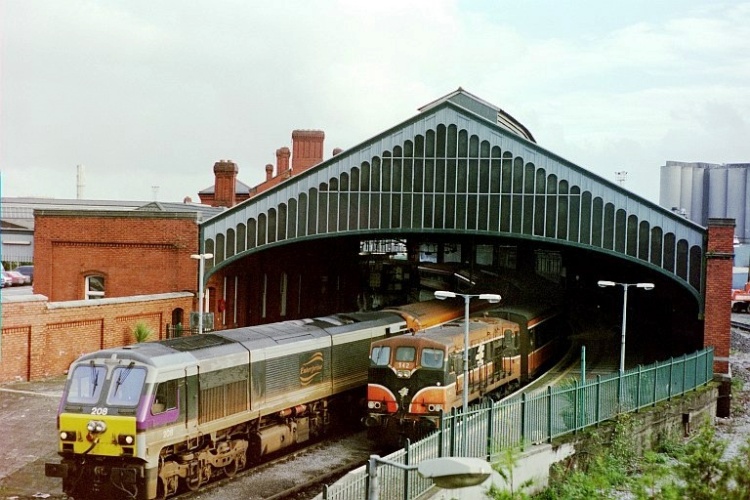
23/02/00 saw me score 142 for haulage, albeit in the dark! The next time I enjoyed a run with it was in the October 2001 school holiday, out of Cork. I wasn’t tall enough to see over the bridge (hence this dodgy “point and hope” shot!) but I’m happy I took it. Enterprise-liveried 208 is seen adjacent, which didn’t see Belfast all week! (JW)
For a change of scenery, we took 167 on the Ballybrophy round via Nenagh. Although I considered this “brain death” at the time, I look back on that country branch line with fondness, and that run on a freezing cold February morning with the sun just rising, steam everywhere (except where it should’ve been, leaving the vestibules a sauna) and a little engine stridently chugging away at the sharp end particularly so.
128 was back in action so that was taken for another run, by which time 167 had returned to Limerick and to the Junction, so we had 167 back to Colbert. Here, we took a little break from the bashing. In complete contrast to what you would find today (police sirens, probably) the depot staff were entirely welcoming to an 11-year-old paying a visit, and when said child asked as politely as he could if there was any chance 142 might make an appearance on the Ennis that evening, the man said “wait and see”…
He also kindly phoned through to his colleague at Cork and established that the previous day’s scratch, 192, was in line for the 17:10 departure. With the opportunity to increase the mileage a little bit, with a hellfire departure through the steep tunnel out of the “rebel city” guaranteed, it was a no-brainer to head back up to the station, get behind 167 again and head south.
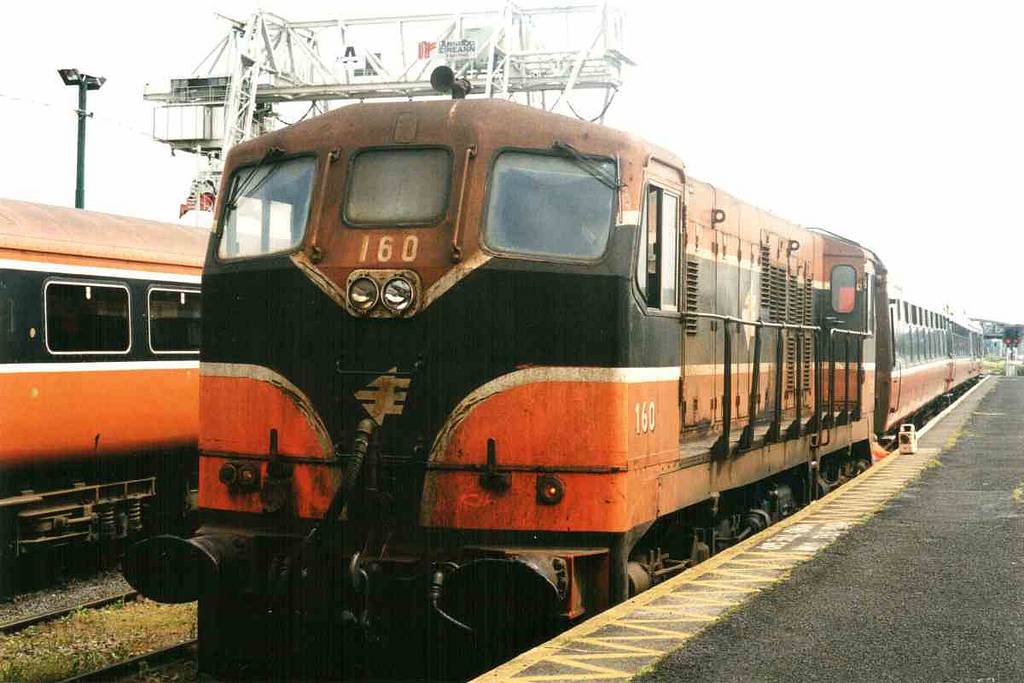
One “part of the furniture” in my childhood that I took completely for granted was the sight, sound and smell of 141 Class locos hauling steam-heated trains around Limerick. (This brings it back instantly!) Here is 160 on 30/05/98. (JW)
Heading back into Limerick on 128, peering through the grimy windows of the push-pull set into the dark as we passed the depot, I was delighted to see 141 and 142 paired up, lit up and looking promising for the Ennis. I was even happier to see them back onto the stock! Interestingly, this pair are both preserved by the RPSI and have worked as a pair on railtour duty in recent years.
| 167 |
Limerick |
Ballybrophy |
07:15 Limerick – Ballybrophy |
| 201 |
Ballybrophy |
Portlaoise |
08:00 Limerick – Heuston |
| 215 |
Portlaoise |
Limerick Junction |
09:05 Heuston – Cork |
| 154 |
Limerick Junction |
Limerick |
11:00 Limerick Junction – City |
| 128 |
Limerick |
Limerick Junction |
11:40 Limerick City – Junction |
| 203 |
Limerick Junction |
Thurles |
11:05 Cork – Heuston |
| 223 |
Thurles |
Limerick Junction |
11:25 Heuston – Cork |
| 167 |
Limerick Junction |
Limerick |
13:01 Limerick Junction – City |
| 167 |
Limerick |
Limerick Junction |
14:20 Limerick City – Junction |
| 222 |
Limerick Junction |
Cork |
13:20 Heuston – Cork |
| 192 |
Cork |
Mallow |
17:10 Cork – Mallow |
| 222 |
Mallow |
Limerick Junction |
17:30 Cork – Heuston |
| 128 |
Limerick Junction |
Limerick |
18:34 Limerick Junction – City |
| 142 + 141 |
Limerick |
Ennis |
17:25 Heuston – Ennis |
| 141 + 142 |
Ennis |
Limerick |
20:58 Ennis – Limerick (ECS) |
Thursday 24/02/00
After the previous day’s use of the red pen it stood to reason that this day would be more sedate on that front, and so it proved. I seem to recall that the 07:15 was 167 again, so we had a more leisurely breakfast and started our day’s bashing on 147, which was the 08:35 to the Junction, and then headed south.
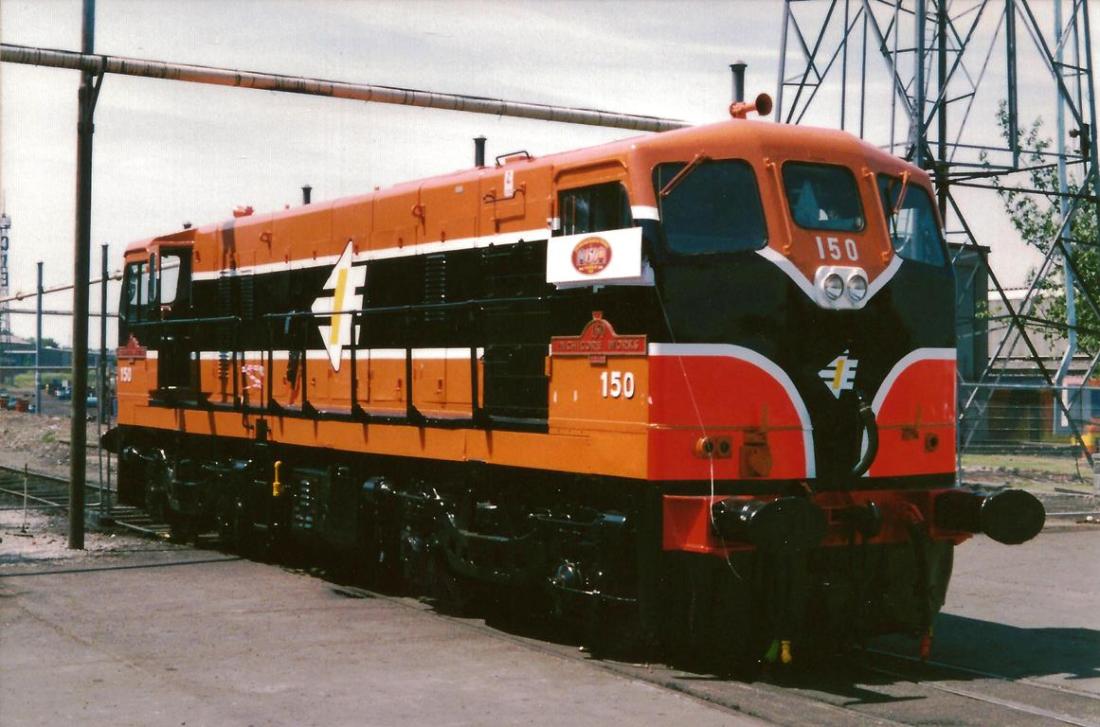
150 was the only 141 which was named, at Inchicore Open Day in 1996. Four years later it had lost its plates (they had in fact been stolen much, much earlier than that – they didn’t last long!), but I did at least enjoy it to Ennis! 16/06/96 (JW)
The Cobh lunchtime turn was 162 on this day, and it did two round trips, so we visited the former Queenstown (final port of call of the RMS Titanic) twice. With not much more in the way of proper GM on offer, and presumably a plethora of 167 followed by 167 passing 167 (or so it felt!), we headed back to Limerick for yet another 22 miles with 128 and then the Ennis. On this night, it was 141 again, but this time mated with 150 – a loco I was quite pleased to have as I had not enjoyed a run with it since mid-1996.
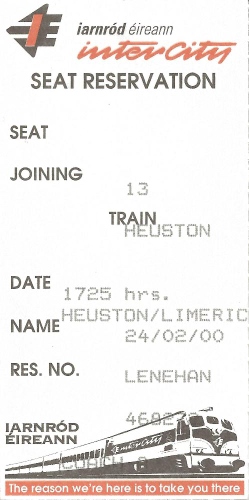
I worked my passage with 141+150 on the empties back from Ennis. I was happy to see them using a proper loco on the reservation slips…
| 147 |
Limerick |
Limerick Junction |
08:35 Limerick City – Junction |
| 219 |
Limerick Junction |
Cork |
07:30 Heuston – Cork |
| 162 |
Cork |
Cobh |
11:25 Cork – Cobh |
| 162 |
Cobh |
Cork |
11:55 Cobh – Cork |
| 162 |
Cork |
Cobh |
12:25 Cork – Cobh |
| 162 |
Cobh |
Cork |
12:55 Cobh – Cork |
| 225 |
Cork P3 |
Limerick Junction |
15:00 Cork – Heuston |
| 128 |
Limerick Junction |
Limerick Junction |
16:34 Limerick Junction – City |
| 210 |
Limerick |
Thurles |
17:45 Limerick – Heuston |
| 220 |
Thurles |
Limerick |
17:25 Heuston – Ennis |
| 141 + 150 |
Limerick |
Ennis |
17:25 Heuston – Ennis |
| 150 + 141 |
Ennis |
Limerick |
20:47 Ennis – Limerick (ECS) |
Friday 25/02/00
And so to the last day of the rover. Fridays were always good fun as there were plenty of Fridays Only services across Ireland, and these were a good bet for 071 Class haulage. We already knew that 080 – my second favourite of the class, after 077 – was in Cork and a phone call established that it was allocated to the 10:35 FO service to Dublin – which was normally a train from Tralee, amended to run from Cork on this day due to the closure of the route west of Mallow. The move was a no-brainer then.
We had a 141 on the 08:35 to the Junction and then a 201 on the taxi to Cork. Can you guess which ones they were?!
080 was sat there ticking over at the head of the rake of Cravens, but actually against the blocks as it was in Platform 1, a south-facing bay. The train propelled out of the platform towards Cobh and then took the avoiding line behind the station, before crossing over and, once clear and well into the tunnel, giving us the thrash of the trip on what I recall as a beautiful sunny day. What a fine machine 080 was.
What I have not yet mentioned is that we were returning home on the Friday afternoon, as the Saturday was seeing Deltic 55019 “Royal Highland Fusilier” work a railtour from Newcastle to London and back. This loco has always been very close to my family’s heart and I hope to clear it for 10,000 miles this year – hopefully before I’m 30 in December! Back in 2000, though, that railtour was unmissable for me and therefore the plan was to cross the water on the 16:05 “HSS” sailing, which connected into the class 37-hauled 1G79 18:22 Holyhead to Birmingham. Quick trip home for a few hours’ kip then a fast car to Newcastle for the Deltic. What could go wrong.
The first spoke in the day’s wheel occurred passing Inchicore Works. We knew that the stock was meant to do a round trip to Limerick (the 13:45?) but, as we were heading home, we had not troubled the usual contact to find out if that was booked for an 071. On rolling past the depot, there was what can only be described as a blindingly shiny 071 sat waiting to head towards Heuston. Getting closer… it was only 077!!! My Lords! The machine was quite clearly coming out to work the Limerick – which it duly did – and we believe this to have been its first passenger run of the millennium. After much soul-searching, however, we decided to stick with the plan and headed back for the UK. Nonetheless, it had been an absolutely fantastic rover, and as school holidays go… I’m sure the like will never be seen again.

I’ve included this photo, taken in low light in absolutely deplorable (but, in my experience, normal for County Longford!) weather, as it includes the two locos that starred in 25/02/00 for me – 077 and 080 – and I also like the fact that the single-line token can be seen in mid-air! Edgeworthstown, 22/10/01. (JW)
Just as an aside, the Dart down to Dun Laoghaire for the ferry was the first and only unit travelled on in Ireland that trip – how times change.
If you fancy a bit of schadenfreude, have a look at our journey home. I mentioned that the HSS was advertised to make its crossing in 99 minutes, which would give a +30 or so onto 1G79. That was when the ferry was on four jets. It was often on three, including today. Long story short, as we were getting off the ferry we heard the Type 3 erupt and take its doubtlessly empty train towards Birmingham. Along with several hundred other people, we endured a selection of units home. I would rather have been out to my ankles behind 077 howling down the Cork main line! “Welcome home”.
| 167 |
Limerick |
Limerick Junction |
08:35 Limerick City – Junction |
| 219 |
Limerick Junction |
Cork |
07:30 Heuston – Cork |
| 080 |
Cork P1 |
Dublin Heuston |
10:35 Cork – Heuston |
| 99-D-519 |
Dublin Heuston |
Dublin Connolly |
bus |
| 8313 |
Dublin Connolly |
Dun Laoghaire |
14:45 Howth – Bray |
| Stena Explorer |
Dun Laoghaire |
Holyhead |
16:05 Dun Laoghaire – Holyhead |
| 153316 |
Holyhead |
Llandudno Junction |
18:45 Holyhead – Llandudno Jn |
| 158752 |
Llandudno Junction |
Chester |
19:46 Llandudno – Piccadilly |
| 153358 |
Chester |
Crewe |
21:00 Chester – Crewe |
| 323241 |
Crewe |
Wolverhampton |
20:49 Lime Street – New Street |
Saturday 26/02/00
Just to bookend the rover with Vulcan Foundry products, here’s the Saturday moves. No fuss, no drama, no book-filling up rusty sidings. My kind of day.
| 55019 |
Newcastle |
King’s Cross |
09:50 Newcastle – KX (1Z49) |
| 55019 |
King’s Cross |
Newcastle |
18:10 KX – Newcastle (1Z48) |
I hope you have enjoyed reading this article as much as I have enjoyed the walk down memory lane writing it. I am truly grateful to my Dad for making sure that I got to know a railway that, to British eyes, was a window on the past, and is now only something that old fools happily reminisce about over a Guinness or several. We didn’t just travel to Ireland, by the way (many of you will know me better as a devotee of German diesel-hydraulics) but it is those formative years travelling so regularly to Ireland that have ensured that I feel more at home on overseas railways than those on my doorstep!
This was by no means unusual in terms of an Irish rover in 2000. I enjoyed many better ones, and many more that weren’t so good! But 18 years ago this week, this is what you could have chosen to have done, and although these days are irretrievably gone, you can still travel behind some of the old Irish locos on occasional railtours or at the Downpatrick & County Down Railway. If you haven’t yet done so, I would highly recommend it.


 European Traction