Italy has had a fascinating array of electric locomotive types over the years; some of the pre-war classes even lasted in main line service until the 21st century, but these are all now just museum pieces.
Happily, a number have passed into preservation, so they have not totally disappeared. One of the most famous classes of “prehistoric” electric loco in Italy are the E626s, and there are numerous opportunities through 2018 to ride behind them on relatively cheap specials.
The above is a link to a YouTube video of E626-266 in action last year, uploaded by Michele D’Alterio.
A series of Sundays right through 2018 are advertised to see top-and-tail E626s work with vintage carriages on recurring tourist specials organised by “Fondazione FS” in the Napoli (Naples) area. This itinerary is called the “Pietrarsa Express”, and consists of two round trips from Napoli Centrale to Portici-Ercolano, calling at Pietrarsa en route, which is home to the Italian national railway museum. The train ticket includes entry here, which looks well worth a visit (list of exhibits here).
Traction
The publicity for these workings specifies top-and-tail E626s. However, of the four such machines that performed on these workings in 2017 – E626-185, E626-266 (both built 1927), E626-294 (1928) and E626-428 (1939), two of them suffered serious vandalism damage. Both ‘266 (27th February 2017) and ‘185 (4th August 2017) were robbed of their copper – leaving just ‘294 and ‘428 operational. In the event of either being unavailable, I would expect E646-028 or E646-196 to substitute.
Tickets
A return ticket on the “Pietrarsa Express” costs €12 adult or €6 child, single fares are half that but do not include museum entry. Under 4s go free.
Tickets for these can be purchased in advance from the Trenitalia website, where they are listed alongside normal service trains, but with the annotation “Treno Storico”. Some dates have already sold out; others are not yet on sale.
Times and Dates
The diagram is as follows:
96059 11:12 Napoli Centrale to Portici-Ercolano
96058 13:54 Portici-Ercolano to Napoli Centrale
96061 14:35 Napoli Centrale to Portici-Ercolano
96060 17:33 Portici-Ercolano to Napoli Centrale
Operating dates for 2018 are advertised as:
Sunday 7th January 2018
Sunday 21st January 2018
Sunday 4th February 2018
Sunday 18th February 2018
Sunday 4th March 2018
Sunday 18th March 2018
Sunday 8th April 2018
Sunday 22nd April 2018
Sunday 6th May 2018
Sunday 20th May 2018
Sunday 3rd June 2018
Sunday 17th June 2018
Sunday 1st July 2018
Sunday 15th July 2018
Sunday 5th August 2018
Sunday 19th August 2018
Sunday 2nd September 2018
Sunday 16th September 2018
Sunday 7th October 2018
Sunday 21st October 2018
Sunday 4th November 2018
Sunday 18th November 2018
Sunday 2nd December 2018
Saturday 10th February 2018 sees the next in the series of “Liliputy” charters around the Polish city of Wrocław, using a 1958-built diesel loco. The day’s itinerary will then be repeated in full on Saturday 7th April 2018.
Three very reasonably-priced circular trips will operate from Wrocław Główny (the city’s main station), each via a different circular route. All will be formed of three carriages hauled by SM30-507, a 300hp diesel shunter built by Fablok in 1958.
The above is a link to a YouTube video uploaded by user Kolej w moim obiektywie, showing SM30-507 engaged in similar duties on 16th December 2017.
The three trips will operate as follows:-
10:00 departure – “Odkrywca” – 39 PLN (£8.31)*
Wrocław Główny – Osobowice – Sołtysowice – Swojczyce – Nadodrze – Główny
13:00 departure – “Podroznik” – 29 PLN (£6.18)*
Wrocław Główny – Zachodni – Gądów – Główny
15:00 departure – “Wedrowiec” – 39 PLN (£8.31)*
Wrocław Główny – Kuźniki – Brochów – Główny
* prices in GBP as of 2nd January 2018.
Further information, including a booking form, can be found on the promoter’s website here.
The city of Wrocław
The short, “cheap and cheerful” nature of these trips mean that they would lend themselves to being incorporated easily into a non-railway family holiday. Wrocław is certainly a viable destination for a weekend break.
The fourth-largest city in Poland, Wrocław – known as Breslau prior to its return to Poland under the terms of the Potsdam Conference in 1945 – is the cultural hub of western Poland; indeed, it was the 2016 European Capital of Culture. There is plenty to occupy the tourist.
Its airport (WRO) sees direct flights to and from numerous cities in the UK with both Ryanair and Wizz Air.
Across Europe there are a number of locomotives now to be found in quite surprising places; ones you may not “stumble upon” unless you know where to look.
One example that springs quickly to mind in this respect is French centre cab electric loco CC14161.
102 locos of the CC14100 class entered traffic with the SNCF between 1954 and 1957. One of a number of similar classes built by a variety of different companies and nicknamed “fers à repasser” (“flat irons”), these machines were synonymous with the Grand Est region of France, and particularly Thionville depot, for their entire career. These were powerful, low-geared machines ideal for the abundance of heavy freight traffic that existed in the area in their day – from the Lorraine coalfields, or the steelworks of Luxembourg, and so on.
Above is a link to a YouTube video uploaded by user Maurice Testu showing a CC14100 engaged in some shunting operations at Lille-Délivrance marshalling yard in 1989.
The destruction of the French coal mining industry, and the wide-ranging social problems it caused, are well documented elsewhere. Suffice to say, the late 1980s and early 1990s saw the process of closing all of the country’s mines gather speed (the last one closed in 2004), and France’s industrial focus naturally shifted. Combine this with the collapse of much of Luxembourg’s steel production in the mid-to-late 1970s (prior to this, the tiny Grand Duchy had been the world’s 9th biggest producer of steel) and these aging locos rapidly lost much of their raison d’être. The last of the CC14100s was out of traffic by 1997.
The negative impacts of the loss of north-east France’s coal mines will be felt for at least a generation. However, efforts have been made to commemorate this in a more positive manner, too, and as a part of the bigger picture involved, this has involved CC14100s.
Of the 102 machines, just 2 are thought to remain. One, CC14183, along with BB12083 was intended from 1998 as an exhibit of the mining museum at Petite-Roselle, however it is reported to have suffered badly from unprotected outdoor storage. The last I heard, in early 2015, both were for sale – but with the buyer needing to arrange their transport, scrapping was a real prospect at the time. Disturbingly, there is no longer any reference to either on the museum’s website, and I am not aware of them having moved on – please do contact me if you’re able to provide an update on them!
The other surviving CC14100 is just as “under the radar”, but is at least cared for and is on public view – even if it does seem unlikely that it will ever draw power from overheads again. CC14161 also has a role as a memorial to the mining industry of the area. After withdrawal in 1994, SNCF offered it to the town of Conflans-en-Jarnisy, approximately 20 miles west of Metz, as a static exhibit.
CC14161 resides essentially in the car park of the E.Leclerc shopping mall in the west of the town, with whose financial assistance it was repainted by enthusiasts into original livery a few years ago – and if you’d like to see a CC14100, it looks like you may well have to travel there…
The view of CC 14161 in its current resting place, as per Google Maps!
You can find it here – about half an hour’s walk from Conflans-Jarny station, about half way between Nancy and Longwy.
Similar loco BB12114 is also owned by the town, but is currently under restoration at a private location near the station, and is likely to join CC14161 at some point in the future – at which point hopefully some covered accommodation will hopefully have been arranged for these important machines.
The December 2017 timetable change sees the commencement of a modest new operation involving top-and-tail class 218 “rabbit” diesel-hydraulics.
The route in question is the 23 mile (37 km) route from Aschaffenburg to Miltenberg – east of Frankfurt am Main – part of the “Westfrankenbahn” – and five days a week, top and tail 218s sandwiching 3 double deck carriages will make six round trips.
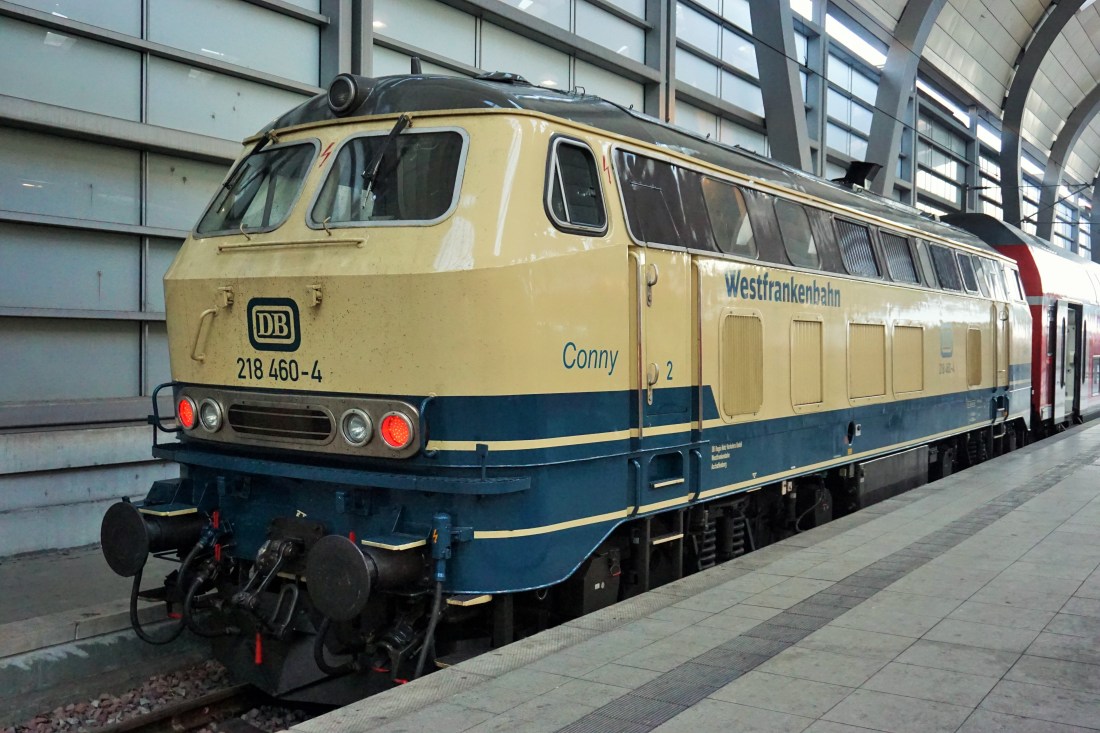
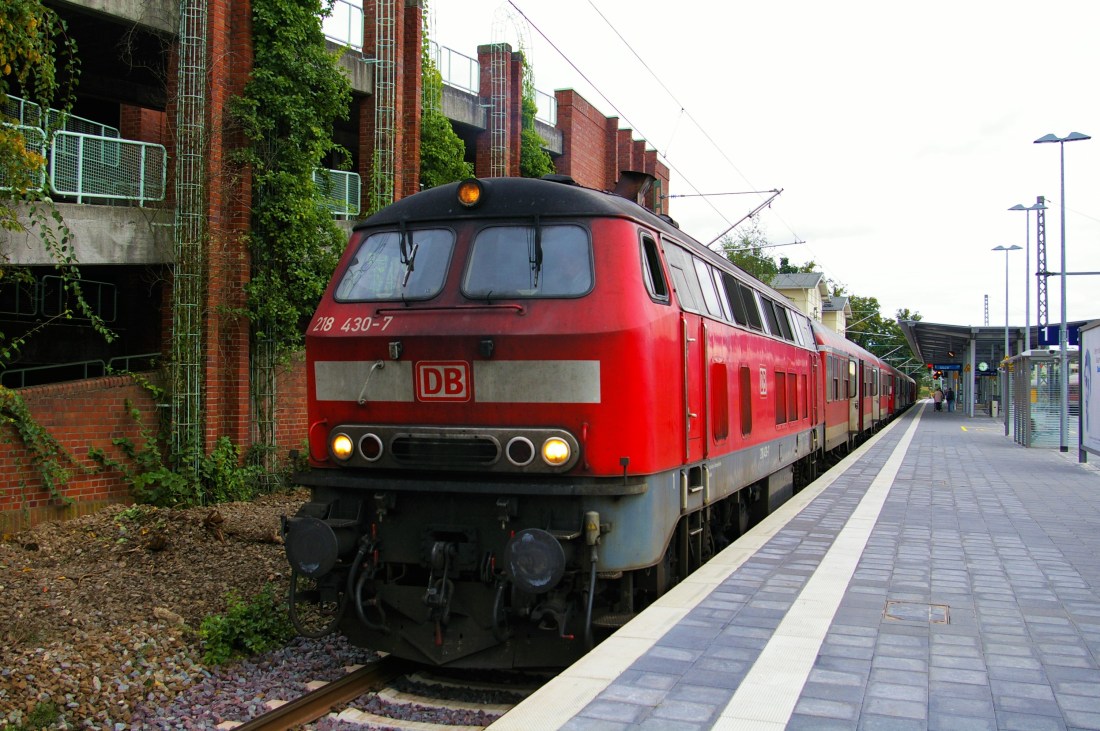
The nominated locos are ozeanblau-beige livered “celebrity” 218 460 – nicknamed “Conny” – and one loaned from the Südostbayernbahn at Mühldorf. This is currently 218 430, although it may of course be subject to a swap during the course of the operation. 460 has a 4000-series MTU power unit, whereas 430 has a TB11.
Edit Dec 17: TB11-engined machines 218 443 and 218 496 (of Ulm and Kempten depots respectively) were moved to Aschaffenburg at various points in the month, ostensibly as cover while 218 460 returned to Bremen works for attention. 460 returned on Boxing Day, and although all four are now at Aschaffenburg, 430 and 460 will remain the “intended” pair.
Heritage-liveried 218 460 “Conny” at Kiel Hbf, 18/06/17 (JW)
430 and 460 are no strangers to operating together, however. Both were built in 1978, both entered traffic at Lübeck depot and both remained allocated there until 2007, at which point they were transferred together to Kempten – although they went their separate ways soon afterwards. 430 then led something of a nomadic existence for several years (including being allocated to Chemnitz for DMU replacement work and snowplough duties on the Erzgebirgsbahn), before settling back into regular use at Mühldorf.
Most notably, however, both were in the pool of 12 Lübeck 218s that were renumbered into the 210.4 series in the mid-1990s and replated from 140km/h (87mph) to 160km/h (99mph) to work in pairs on Hamburg to Berlin expresses prior to the electrification of this former cross-border route.
218 430 was something of a celebrity itself when this photo was taken, as it was the final remaining Pielstick-engined 218, which she lost in favour of a TB11 just two months later. Here she is seen at Ahrensburg on a Bad Oldesloe to Hamburg local, 01/09/07 (JW)
There is currently no end date specified for this operation, but it is expected to last for at least a few months, and may well run until the December 2018 timetable at least. The reason is that the Kurhessenbahn are borrowing 5 class 642 DMUs that are normally used on this route to cover for a rolling stock shortage, hence the 218s and double deck carriages are being drafted into the Westfrankenbahn to fill the gap.
For now, the diagram will be weekdays only from Monday 11th December 2017 until further notice*, and consists of:-
Additionally, Sunday 10th December 2017 sees a one-off “taster” diagram showing off the double deck stock in the new environment, powered by both 218s, and travel on these will be free!
RB23341 11:39 Aschaffenburg – Miltenberg
RB23356 13:37 Miltenberg – Aschaffenburg
RB23349 15:39 Aschaffenburg – Miltenberg
RB23362 17:37 Miltenberg – Aschaffenburg
*Footnote: diagram concluded on 10th April 2018, but retained on here for historical interest. I am told that it may resume.
Saturday 24th February 2018 will see a fairly long-distance main line day tour across the width the former East Germany – from Löbau to Wernigerode and return – in the hands of class 228 diesel-hydraulic loco 228 552 (back carrying its pre-reunification number of 118 552).
The tour will then feature a steam-hauled run up the Brocken mountain on the world-famous Harz metre-gauge railway.
The train is now shown as sold out on the website of the promoter – the Ostsächsische Eisenbahnfreunde – but it may still be worth contacting them if you are interested.
Notably, this loco, as V180 052, along with sisters 048 and 050 were built for the Deutsche Reichsbahn as the dedicated fleet for the GDR governmental train.
Below is a link to a photo showing 052 along with 048 over the inner-German border in Bebra in May 1970, hooking off from that train which was conveying GDR Prime Minister Willi Stoph to Kassel to a landmark meeting with West German Chancellor Willy Brandt, an event that held the world’s attention in the midst of the Cold War. This loco will have doubtless carried out many more equally prestigious jobs in its time.
The German city of Nürnberg (Nuremberg) contains a loco-hauled operation that is garnering increasing amounts of interest among enthusiasts – particularly as the alternatives are rapidly disappearing.
The S2 route of the Nürnberg S-Bahn runs from Altdorf, 15 miles east of the city at the end of a branch line, through Nürnberg Hbf in the middle, out to Roth a further 15 miles to the south.
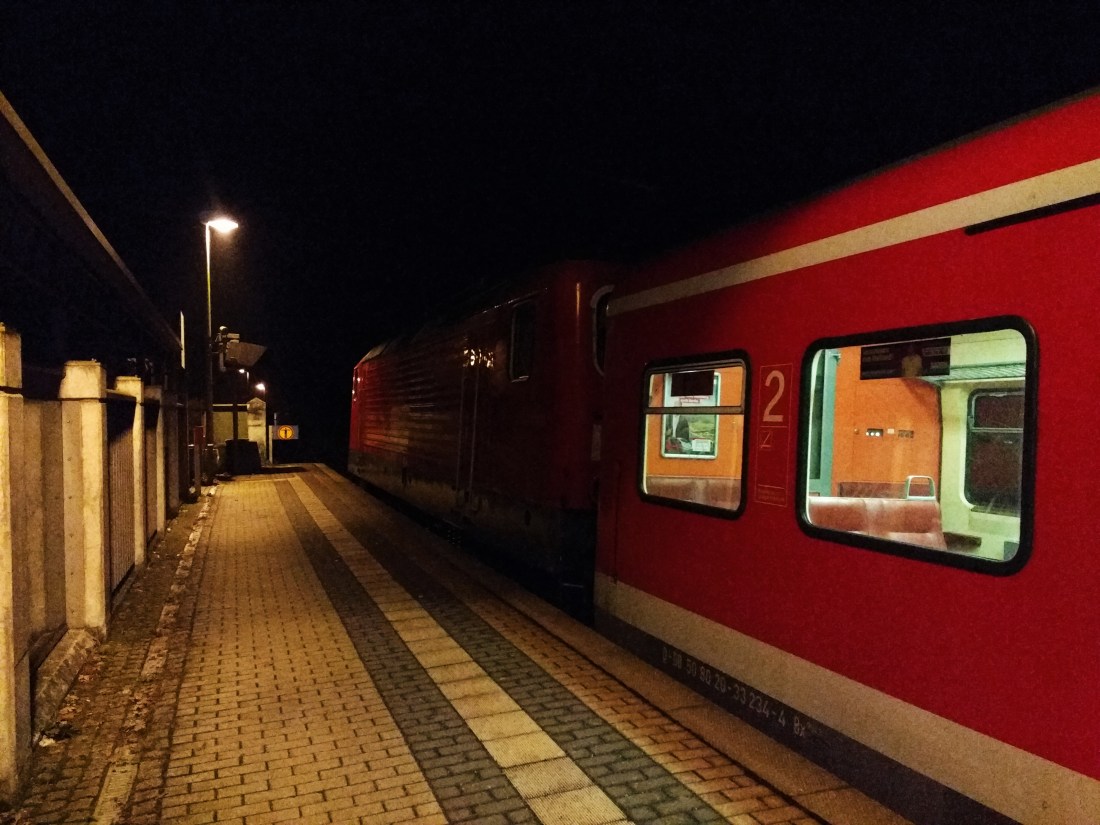
All of the trains on the route are booked for haulage by class 143 “Trabant” electric locos hauling rakes of push-pull x-Wagen. Some of the latter are still in their original interior condition, complete with brown vinyl seats! There are nine diagrams – which can be found on the gen group “European Rail Gen” (to which I encourage you to join and contribute) – although one of these tends to be worked by a class 442 “Hamster” plastic EMU on most days. Stations are close together, with 23 of them in total, so the character of the running is very much of a “full power or full service” nature!
143 119 at Reichelsdorfer Keller, with the x-Wagen carriage behind the loco (50 80 20 33 234-4) showing off its “orange” interior, now quite a rare sight on DB. 17/11/17 (JW)
The city of Nürnberg is perhaps not one that lies on the tourist trail for those “doing Europe”, but is nonetheless worth a visit. Unfortunately, it is probably only known to most Brits as the host city of certain rallies and trials over 70 years ago – but there is far more to it than that. For a significantly-sized city, it probably comes closest to stereotypical quaint Germany with timber-framed buildings and a castle looming over it.
Its Christmas market is especially popular, and indeed a cursory glance at the haulage calendar on this very site will show that it draws charter trains from across Germany for this express purpose throughout each November and December. In fact, you may say that for the enthusiast, a couple of spins on the S2 and then a few beers is an ideal way to spend the layover of such a tour!
The locos involved
At the time of writing, Nürnberg has a fleet of 15 class 143s: 143 045 / 119 / 215 / 247 / 259 / 298 / 336 / 358 / 628 / 632 / 855 / 870 / 905 / 914 / 970. These locos were built behind the Iron Curtain, by LEW in Hennigsdorf – just outside East Berlin, in the then German Democratic Republic, as Deutsche Reichsbahn class 243. This class are the final remaining locomotives in regular mainline passenger service in Germany that were built for the GDR.
The oldest of Nürnberg’s allocation, 143 045, entered traffic in May 1985, with the youngest – which perhaps not predictably, is 143 632 – following suit in August 1990, just 44 days before reunification.
143 970, in particular, has a notable history. DR loco 243 051, which entered traffic at Halle (Saale) depot in August 1985, lasted just three years before it was seriously damaged in a collision and consequent derailment at Angermünde. It required serious rebuilding work. This was done to the same spec as the 243s which were by now rolling off the production line; to an evolved design featuring multiple working. As a result, it was renumbered into the relevant number series for such machines (243 8xx/9xx) – claiming the next available number and re-entering traffic as “243 970” in December 1988. In fact, so heavy duty was the rebuilding work required to its frame that it even gained a new works number upon leaving LEW for the second time.
The moves
As I said above, there are up to nine diagrams (seven at weekends), although not all of these work all day. If you want to get as many in the book as possible, I would recommend being there (very) early or late in the day. One of the diagrams in fact only comes out to play from about 20:00, although it replaces two others which retire to the shed.
As 25 of the 30 miles of the S2 route – the sections east of Fischbach and west of Nürnberg Hbf – runs on single-track alignments adjacent to the “big railway”, moves can be fairly straightforward, with the lack of passing loops protecting a number of tight “pluses” for the keen basher.
Nürnberg-Sandreuth station is fairly typical of S2 stations west/south of the city in being an unmanned single platform shack adjacent to a main line. 17/11/17. (JW)
Trains pass in the station at Nürnberg Hbf, with the connection far more comfortable when making moves to the east of it (+10) than to the west (+3). The trains run to a roughly 20 minute frequency for most of the day, although crafting moves is hampered at times by some services not running through the full length of the route – turning back short at Feucht or Schwabach, or terminating/starting at the Hbf.
My preferred (weekday) loco-scratching move in fact nets only 8 of the 9 machines (as it takes place early in the day), but allows for a combination of ease and leisurely connections, whilst not actually spending all that much time doing it. Starting at the Hbf at 07:44, you can make five consecutive round trips to the first station to the east – Dürrenhof, 0.7 miles away, which benefits from an island platform – with nothing tighter than a +6 connection, and get back to the Hbf at 09:14 with eight different 143s (from ten moves) and the rest of the day ahead of you, and ample time to get to another part of the region now your Länder ticket is valid (see below).
Obviously I appreciate that an 07:44 kick-off will not be everyone’s cup of tea, and the same feat is possible at certain other times of the day. If you are there in the evening, your moves will need to be far less uniform and will need to involve heading west of the city – Sandreuth and Steinbühl are two good stations to shuttle between on the S2 to make best use of the 20 minute frequency whilst involving no steps or dodgy connections!
Getting there
Nürnberg has an airport (NUE) which sees direct flights from Stansted and Manchester with Ryanair. The airport is linked to a city by the very handy driverless U-Bahn underground route U2, whisking you to the Hbf (main station) in under 15 minutes.
Aside from that, it is accessible by rail from most cities in Germany within 5 hours.
Validity
I’m always hesitant at suggesting that you blow up a valuable day of a global Interrail (or equivalent) shuttling between two suburban stations within sight of one another – of course, you can do this, but there also local ticket options that are a bit more economical.
The DB “Bayern Ticket” is one of the series of Länder tickets available, essentially a regional rover for local trains and is currently €25 (or, if after 18:00, only €23). Prices per person come down markedly if you purchase one of these covering several people, although you will need to stick together all day. The one downside of using Länderis that they are not valid until 09:00 on weekdays – a bit like most day rovers in the UK, really. Bayern is the largest Land in terms of area, so you will be covered for quite some distance (e.g. as far as Füssen or Lindau near to the Swiss/Austrian borders), so again 0.7-mile leaps may not be the best use of this!
At a very local level, there is the local transport authority day ticket. At only €7.90, the “TagesTicket Solo” covers you for the S-Bahn (but not RE or RB services), the U-Bahn, the tram and local buses. This is valid only between Katzwang and Fischbach, but for all purposes other than doing the track, this should be sufficient for you. This carries none of the off-peak time restrictions of other tickets, which means that it can actually form a handy weekday morning bolt-on to a Länderticket, and in fact if you buy your TagesTicket Solo on a Saturday you get Sunday travel for free too.
The above is a link to a video uploaded to YouTube by user BillyFlorian showing 143 905 arriving and departing Fischbach station on an S2 working.
What can you combine it with?
Nürnberg is home to the DB Museum (note: not open on Mondays), and indeed usually some historic locos can be glimpsed from an S2 window on the right-hand side of the train travelling between Nürnberg Hbf and Nürnberg-Steinbühl – currently, these are 110 002 and 103 224. Entry to the museum is a very reasonable €6. Tragically, some key parts of the museum’s collection were destroyed in a fire in 2005, which actually occurred not at this site, but at their roundhouse at Nürnberg-Gostenhof, which was being used as an “overspill” for the main museum.
Haulage-wise, sadly, the city is a shadow of its former self. Until quite recently, the Hbf was somewhere I would gladly be overnight, as numerous diesel shunters (latterly class 203, then class 214) would be available for haulage remarshalling what seemed like a constant stream of lengthy overnight trains to destinations across the Continent, with activity aplenty. Time moves on, however, and it’s no longer possible to put the number of a diesel loco in your haulage book in, out or around Nürnberg. True overnights – as opposed to trains that simply happen to run overnight – are limited to two Nightjets in each direction, EN420/490 north and EN421/491 south – the small number of shunting movements being carried out by the train locos with no fanfare whatsoever.
Of note is that the December 2017 timetable change will see the introduction of a Nürnberg to Sonneberg RE service along the brand new high-speed line, hauled by a fleet of “Vectron” class 193 electrics – 193 801 to 806 are understood to be the locos earmarked for these duties.
This timetable change is also expected to see the introduction to passenger service of a brand new class to German railways. The six locos of Škoda-built class 102, are expected to usurp the ubiquitous class 101s on “München-Nürnberg-Express duties”. Running up to 200km/h and using the “new” high-speed line between Nürnberg and Ingolstadt, these are the fastest regional trains in Germany and at the time of writing are notable in giving opportunities to travel behind 101s on regional tickets. The 101s also use on the similar “Allersberg-Express”, but 2018 will see EMUs replace them on this.
There is, of course, a limited amount of other loco haulage on offer in the area, and further articles about each facet of this will follow in due course.
T478.2065 (749259) is seen at Praha hl n, 23/07/16 (JW)
2018’s “Rakovnický rychlík” operation both starts earlier and finishes later, and runs more frequently than previously, as popular class 749 “Grumpy” locos haul tourist trains between Praha (Prague) and Rakovník.
Having previously run on Saturdays only between April and September, every Saturday, Sunday and public holiday between 30th March and 28th October 2018 is planned to see class 749 haulage on an 08:25 Praha hl n to Rakovník (R1571) and 15:43 return (R1570). Named the “Rakovnický rychlík” (“Rakovník Express”), this is essentially a regular heritage service on the main line operated by KŽC, along the same sort of lines as the “Jacobite” in Scotland.
This is absolutely something that you can combine with a predominantly non-railway city break in Praha. This sensibly-timed round trip gives a break of 5 hours in Rakovník, although arguably a better destination is the train’s penultimate stop of Křivoklát which is a particularly popular stop for tourists.
If you’re not interested in hitting the tourist trail, then one of your hours during the layover at Rakovník can be gainfully employed on a quick out-and-back run with Caterpillar-engined class 750.7 “Goggle” locos on the route via Kladno to Praha Masarykovo. The 13:22 from Rakovník and 13:02 from Praha Masarykovo are both frequently reported as 750.7 and a neat fill-in move presents itself from Rakovník to Nové Strašecí and back. Indeed, you could even use either of these trains to complete a circular round day trip, should you wish to do so.
Even if you cannot spare a full day to cover the round trip, you can do as my fiancée and I did on a Saturday afternoon in 2016, and pitch up at Praha-Smíchov station for 17:14 in order to have the 749 for the brief 4 kilometres round to the main station (hlavní nádraží), for the equivalent of 77p each. Although this is embarrassing “insect mileage” of the highest order, it did give the opportunity to savour a standing start from a signal check inside the tunnel!
In 2016, haulage was shared by KŽC’s T478.1215 (749253) and T478.2065 (749259) – which are both now unsilenced – although 740692 did also make one appearance. Since then, one of the prototypes, 749006 joined the KŽC stable, and 2017’s turns were fulfilled 10 times each by 749006 and 749259, again with one appearance by 740692.
Chances to sample haulage by this class of loco are certainly not rare – indeed, there are still some in the employ of the national operator, and they also work a significant number of charters throughout the year – but this cheerful little operation gives an easy, cheap and usually reliable method of doing so.
As a very brief taster, check out this video of one of 2016’s trains, uploaded to Youtube by Tomáš Hošek:
Fares
Point to point fares are available on a distance-based tariff basis, but the return adult fare is 300 CZK, or £10.53* at current prices – not bad for 108 miles of loco haulage. Tickets can be purchased on the train.
Further info (in Czech) including full timetable at this link.
* To note, when I put together this feature on 2017’s trains, it was still 300 CZK, but this was only £9.32…… I fully expect this to rise yet further before the first train actually runs…
Loco haulage on this route finally ended on 11th April 2018, but I’ll keep the article on the website for posterity as it has been popular – even though the S7 is now worked solely by EMUs, you may still like to visit this interesting corner of the former DDR!
Ironically, “Ostalgia” is big business. Nearly 30 years after German reunification, nostalgia for communist East Germany has never been more popular.
It seems that, with almost as much haste as the traces of the former country were wiped away following the fall of the Berlin Wall, people are now scrambling to experience what life was like behind it. You can drive a Trabant car in convoy around East Berlin on an innovative sightseeing tour, then stay at painstakingly-styled themed hotels. You can purchase clothes, food and all manner of other items of “reborn” Communist brands, recreated by popular demand. You can have your photo taken at Checkpoint Charlie in front of a replica border hut, with men dressed up as border guards.
Yet all of these experiences are in some way synthetic. This part of the world has experienced so many changes since the Berlin Wall fell in 1989, that it is nigh on impossible to recreate “everyday life” in any setting. After all, this was a country where you could realistically expect your intercity train to be powered by steam right up until the late 1980s. Today you can flash through the Sachsen-Anhalt countryside on some of the world’s most modern trains at speeds of up to 300 km/h.
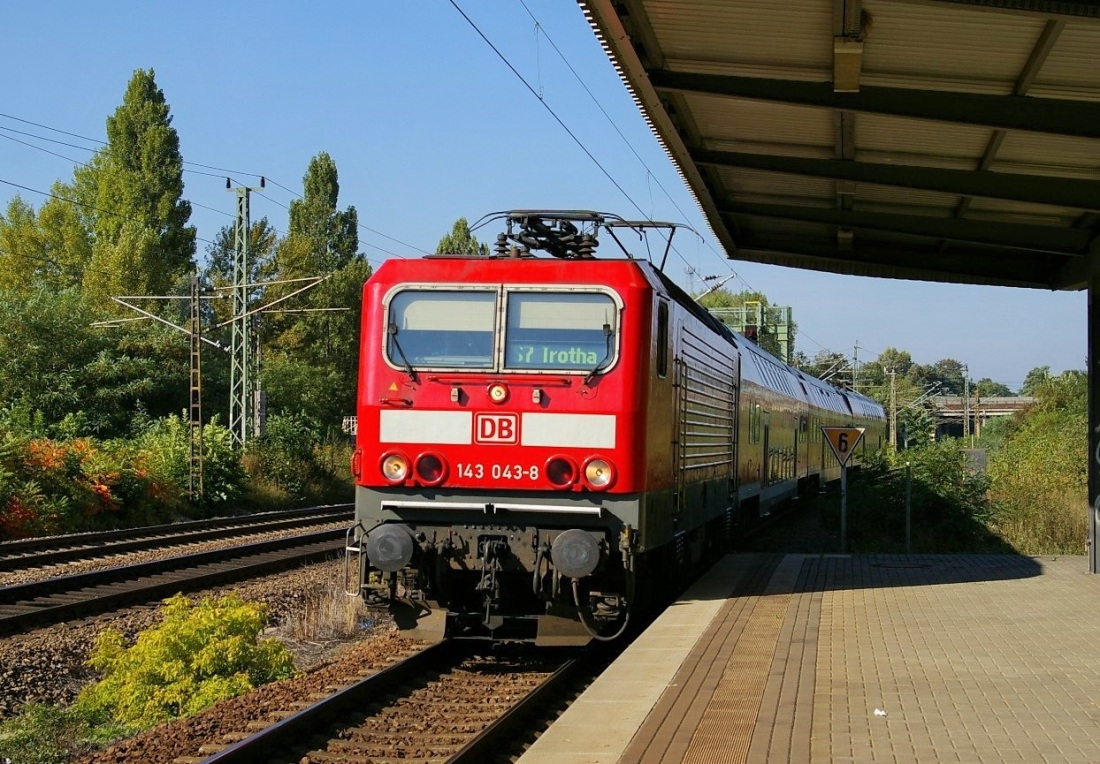
143 043 arrives at Halle Silberhöhe, 30/09/13 (JW)
A small, but nonetheless very interesting exception exists in the vicinity of Halle (Saale), approximately 20 miles west of the city of Leipzig. Halle (Saale) is a city with a history visibly stretching back centuries, and there is plenty for the tourist to see there.
The area around Halle is known as big centre for the chemical industry, with both the famous Leuna and Buna plants a short distance away. These two gained particular importance in the post-war period when they were expropriated, expanded as part of the 1958 “Chemieprogramm” and used to supply the Soviet Union, jointly employing up to 50,000 people between them (equating to 1 in 350 of all the citizens of East Germany).
The mushrooming of industry here, the need for people to work there and the poor quality of housing elsewhere (much of it badly damaged by war) led to a fascinating East German project – the conception of a completely new and thoroughly modern city, known initially as the “Chemiearbeiterstadt West” (“Chemical Workers’ City – West”). Later refined to “Halle-Neustadt”, this was to be a short distance to the west of the existing city. Construction began on 15th July 1964 under the watchful eye of the architect Richard Paulick who oversaw the project.
“The laying of the foundation stone of Neustadt in 1964 was also that of the Halle S-Bahn network” Ralf Jacob, Halle city archivist
In stark contrast to the 700-year-old buildings of Halle, Neustadt was a futuristic (for the time) settlement consisting largely of grey concrete tower blocks known as “Plattenbauten”, synonymous with East Germany, designed to home over 90,000 people in total in nine Wohnkomplexe (“living complexes”). Perhaps bizarrely, none of Halle-Neustadt’s streets apart from the main drag (the “Magistrale”) had any names – each block was identified by a number only – although this is one thing that has since changed. Each Wohnkomplexe was intended to be pretty self-sufficient, featuring shops, restaurants etc, but the city’s primary function of a dormitory for the chemical workers was very close to the surface.
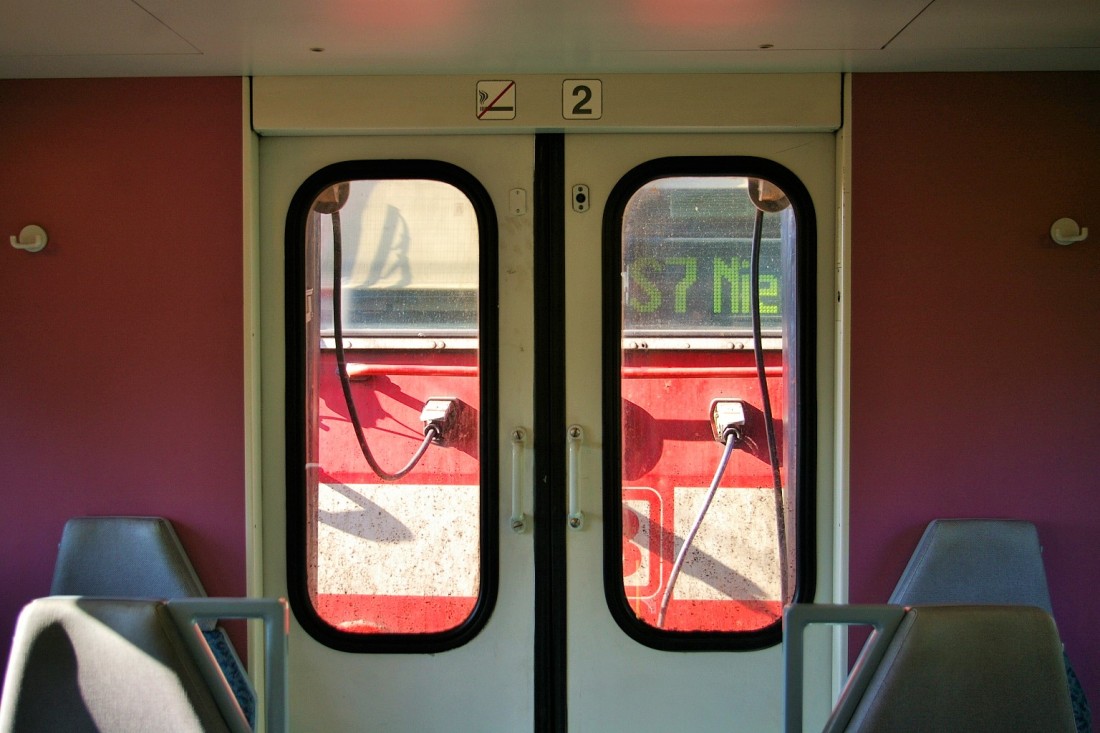
Basher’s eye view of 143 871 on the S7, 30/09/13 (JW)
Key to this was the creation of a public transport infrastructure to link the residential districts with each other, the chemical plants and also the original city of Halle. The centrepiece of this was the S-Bahn, the first part of which opened in 1967.
Halle S-Bahn
It may perhaps be a little odd to the 2017 observer to consider that this S-Bahn – a term we now largely associate with rapid transit operated by electric multiple units – was initially operated with Deutsche Reichsbahn V180-type diesel-hydraulic locos (later class 118, and DB class 228 after reunification) with up to 12 double-decker carriages in push-pull formation. These ran from the station now known as Halle Zscherbener Straße to Merseburg, Luna and Beuna and were supplemented by VT2.09 “pig taxis” to Halle (Saale) Hbf.
Electrification was soon to follow, along with new stations in the south of Halle-Neustadt as the city sprawled ever outwards and an extension through the Halle-Neustadt station (situated underground beneath the centre of the new city) through to Halle-Nietleben and Halle-Dölau. This allowed an electric S-Bahn service to be operated in an inverted “S” shape through the adjacent cities, beginning at Halle-Trotha and ending at Halle-Dölau – a distance of 22.8 km by rail, but less than 7 km as the crow flies. Traction for this was initially classes E11 and E42 (later DB class 109 and 142) electrics – as seen here in a rather impressive photo from after the fall of the Wall – and later the once-ubiquitous class 143 electric locos.
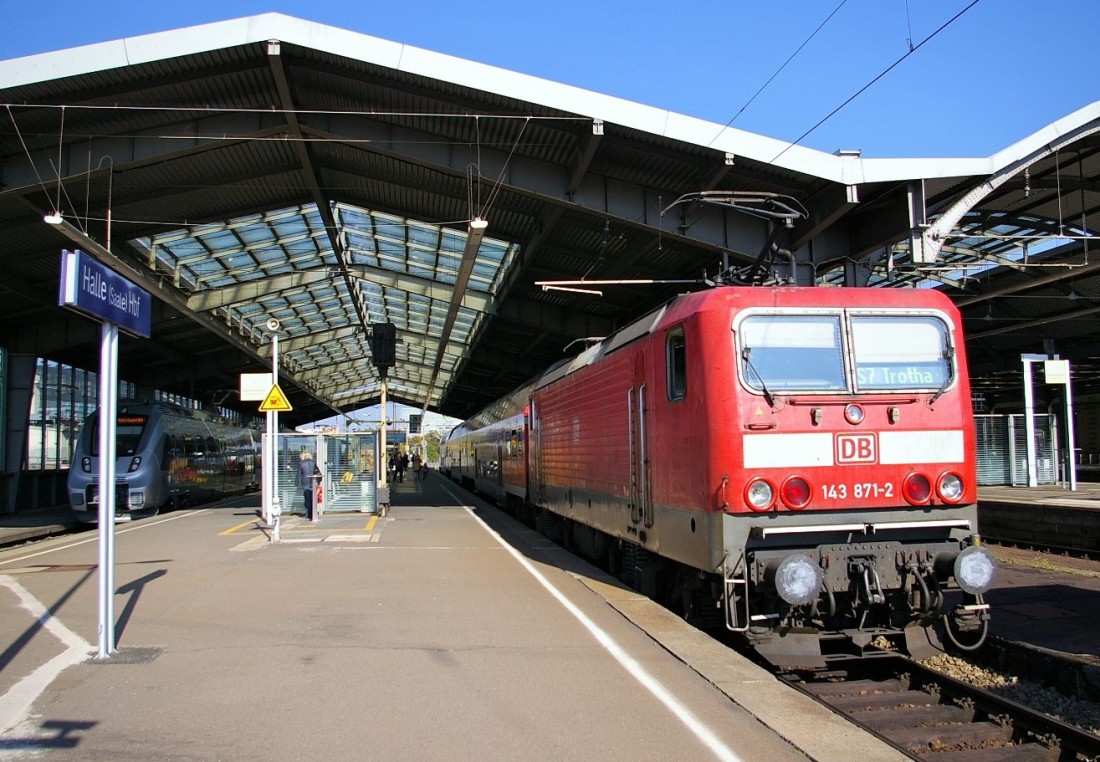
143 871 at Halle (Saale) Hbf, 30/09/13 (JW)
Halle-Neustadt Today
Halle-Neustadt’s initial strength has also proved to be its downfall. Conceived to home chemical workers, the plants are now shadows of their former selves, and this has had the predictable knock-on effect.
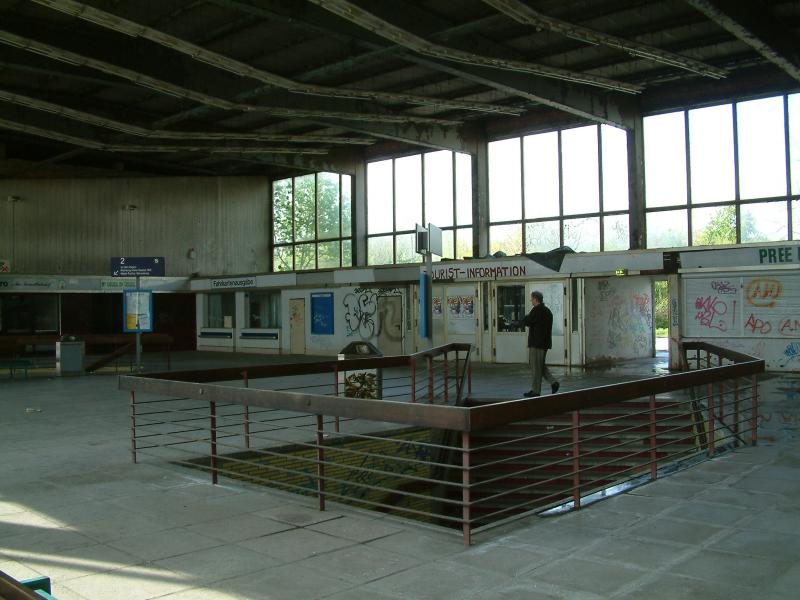
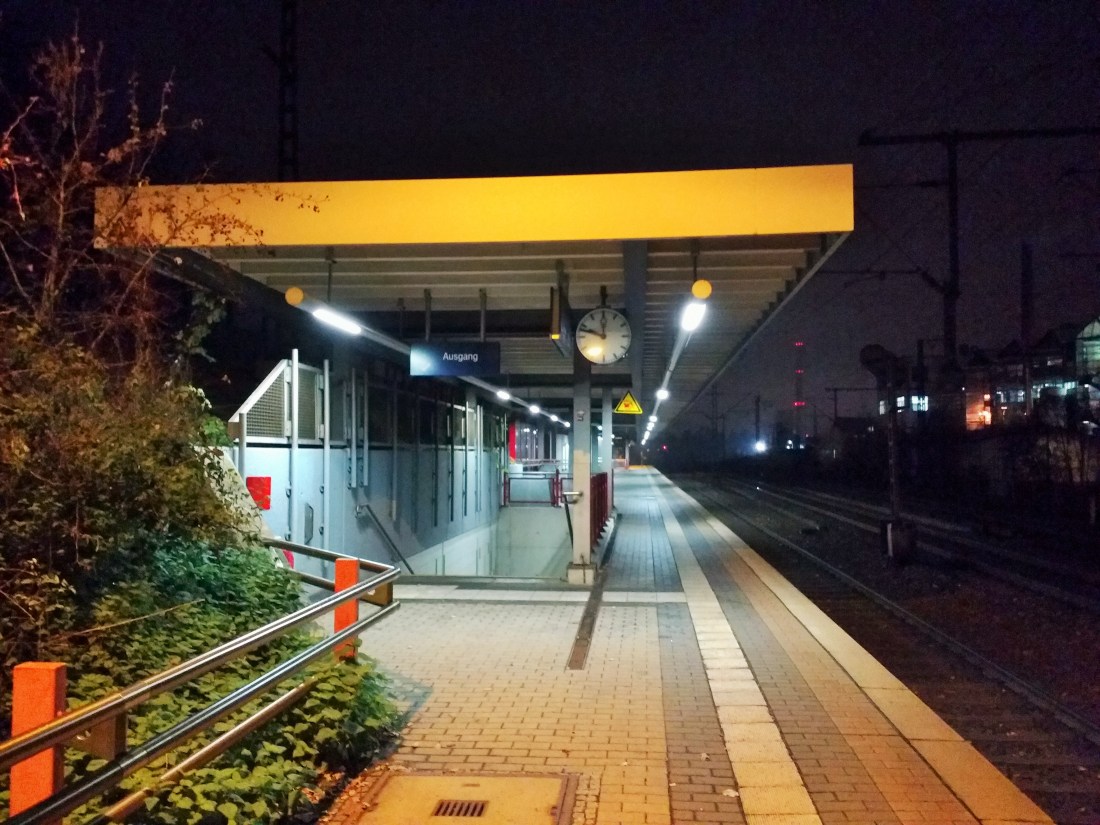
Home to 93,000 people at its peak, the turn of the century had seen Halle-Neustadt’s population reduce to 60,000, and now barely 40,000 live there. A startlingly high ratio of those people are the old people who were the young target market of the project 50 years ago. Many of the Plattenbauten lie empty, including those originally built for the families of the Soviet soldiers who built them. Consequently, some have even been demolished. Doubtless more will follow as the population gets older. Some modernisation has occurred – including to Halle-Neustadt’s S-Bahn station which retained this dilapidated throwback as late as 2009 – but generally, its East German character can still be very clearly seen.
Neither the direct link from Halle-Neustadt to Merseburg (2007), nor the section of line beyond Halle-Nietleben to Halle-Dölau (2002) retain a train service – although part of the latter saw its first train in 15 years in April 2017 when the Freunde der Halle-Hattstedter Eisenbahn ran a track machine along it (see news article here). For the meantime, though, the S7 route through Halle-Neustadt remains a little picture of a lost country.
The above is a link to a 9-minute YouTube video uploaded by user Berger Max neatly showing life on the S7 route in 2017. The deplorable state of Neustadt station can clearly be seen.
Halle S7 today – loco-hauled
The S7 is the remainder of the Trotha to Dölau route, now cut back to serve only Halle (Saale) Hbf to Halle-Nietleben. The section from the Hbf to Trotha has now been subsumed into an EMU-worked S-Bahn route from Leipzig.
Using East German traction (class 143) and East German-built double deck rolling stock, and running through as East German an environment as you are likely to find in 2018, this is probably as authentic as “Ostalgic” experience as any you could have.
Halle retains an allocation of five class 143s (143 034, 143 276, 143 810, 143 871 and 143 903) and the S7 represents 100% of their remaining booked work. This is now an oasis in a desert of suburban loco haulage – modern class 442 “Talent” EMUs having recently replaced locos on all but this route – although January 2018 has seen a couple of impromptu vice-unit appearances by 143s on route S9.
Two sets are employed on the route, operating at 30-minute intervals (xx:20 and xx:50 from both ends). If you simply wish to travel on both in the shortest time possible, then the “shack of choice” is Halle-Silberhöhe – you can depart from Hbf at xx:20, be at Silberhöhe from xx:28-33. This +5 is guaranteed to “make”, as Silberhöhe is a single-platform station. (It does, however, have the appearance of a former island platform – with a second platform face and ballast, but no track – this was never in fact laid, and was part of an uncompleted project to allow a 10-minute frequency along this route in the 1980s, such was the amount of usage that the line was getting).
This will get you back at the Hbf with both machines in your book by xx:41. (To note, these trains now use the new platform 13a at the Hbf, which is a few minutes’ – signposted – walk from the main station). However, if you have the time, I really would recommend a little wander into Halle-Neustadt.
Update 31/03/18 – From 18/04/18, the RE9 “Rhein-Sieg-Express” in the Köln area will have two class 442 “Hamster” EMUs replaced by two loco-hauled “Dosto” sets. It is expected that these will be the two sets from Halle currently used on the S7. This will mean that the 442s will move to Halle to work the S7, giving a common fleet in that area. I would not expect the 143s to move with the stock, so if you want to ride behind them, best to move quickly…
46 years ago this week saw a notable railway accident in western Hungary. Fortunately, there were no fatalities – although the loco, one of a small fleet of only six – was written off.
In a previous article (this one), I touched on how MÁV – Magyar Államvasutak, the Hungarian state railway – standardised on Russian M62-type “Szergej” diesel-electric locos in their bid to modernise in the 1960s and 1970s.
MÁV were supplied with 288 such locos between 1965 and 1978 – 273 of standard gauge, plus a further 15 broad (1524mm) gauge machines for use on the broad gauge tracks around the border with the Soviet Union (now Ukraine).
The Győr-Sopron-Ebenfurti Vasút (GySEV), a curiously independent Austrian-Hungarian joint venture operating largely in the border areas on the opposite side of the map, also ordered six M62s of their own. Numbered M62 901 to M62 906, they all entered traffic in May 1972, largely on express passenger work, and largely fairly anonymously.
At 06:07 on Thursday 15th November 1973, that was to change.
Above is a link to a photo of M62 906 after the accident at Fertőboz – from the Hungarian Locomotives Facebook page.
That day, M62 906 was powering train 107, the “Ciklámen Expressz”, the early morning Sopron to Budapest train, which it was booked to work as far as Győr where it would hand over to electric traction.
Running a short while ahead of it was a freight train – train 191 – hauled by a class 424, a 4-8-0 steam loco. Due to a brake defect on one of its wagons, it came to a stand near Fertőboz. Shortly afterwards, the signalman at the previous station of Balffürdő set the road for the “Ciklámen Expressz” to pass through, which it duly did.
A collision was now inevitable. Upon seeing the stationary train ahead of him, the driver of the express made a brake application however, at 06:07, the M62 struck the rear of the freight train at 57km/h (35mph) and derailed.
Fortunately, and most importantly, there were no fatalities – however 23 were injured, three of them seriously so. This included the driver of the M62 – who was trapped in his cab – as well as the railwayman manning the boiler in the steam van marshalled behind the loco (again, in this article we briefly looked at why MÁV were forced to heat their trains in a fairly unconventional manner). The driver of the 424 also suffered slight injuries.
Over 10 million forints of damage were caused. M62 906 was added to the pantheon of locomotives written off very early into their working lives – just 18 months, in this case. It was scrapped in March 1975. To correct the shortfall in its motive power fleet, GySEV in fact received two M62s – M62 143 and M62 093 – from MÁV in July 1976, which became its M62 907 and M62 908 respectively. GySEV’s last M62 was withdrawn from traffic in 1996.
But back to Fertőboz on that fateful day. Heavy rain in the immediate aftermath of the accident hampered both the recovery and the investigation – or investigations, as both GySEV and MÁV conducted inquiries independent of one another. Perhaps predictably, this led to confusion. GySEV attributed the accident not only to the signalman but also to the driver and secondman of the M62; their deliberate re-enactment on Wednesday 19th December 1973 with another M62 concluded that even taking into account the dark and foggy conditions on the day, the stationary freight train would have been visible from a distance of approximately 558 metres, which would have left sufficient time for the train to be brought to a stand. The brake only went in, however, at a distance of 165 metres. Meanwhile MÁV, on the other hand, placed the blame squarely on the signalman.
Those on the footplate of the M62 were acquitted though lack of evidence. The hearing at the District Court of Győr found that the signalman at Balffürdő – identified only as “Ferenc N.” – had misunderstood a phone call as pertaining to the freight train having reached Fertőboz – when in fact it had been from Sopron advising that the express was en route. He recalled that it had been a “senseless noise” and that he had only actually understood the word “received”. In fact, he claimed that he did then doubt himself, and attempted to contact Fertőboz, but could not get through. He then considered stopping the express via hand signal as it passed him, but feared disciplinary action for causing an unnecessary delay should his hunch be proved unfounded. He was sentenced to three years’ imprisonment for his mistake.
This story has no happy ending, as it is understood that “Ferenc N.” committed suicide by drowning.
If you enjoyed this article, you may be interested in a similar one – also about accidents writing two European locomotives off very early in their career – German electrics 103106 and 101092. Do contact me if there any other European Traction stories you would be interested in reading about.
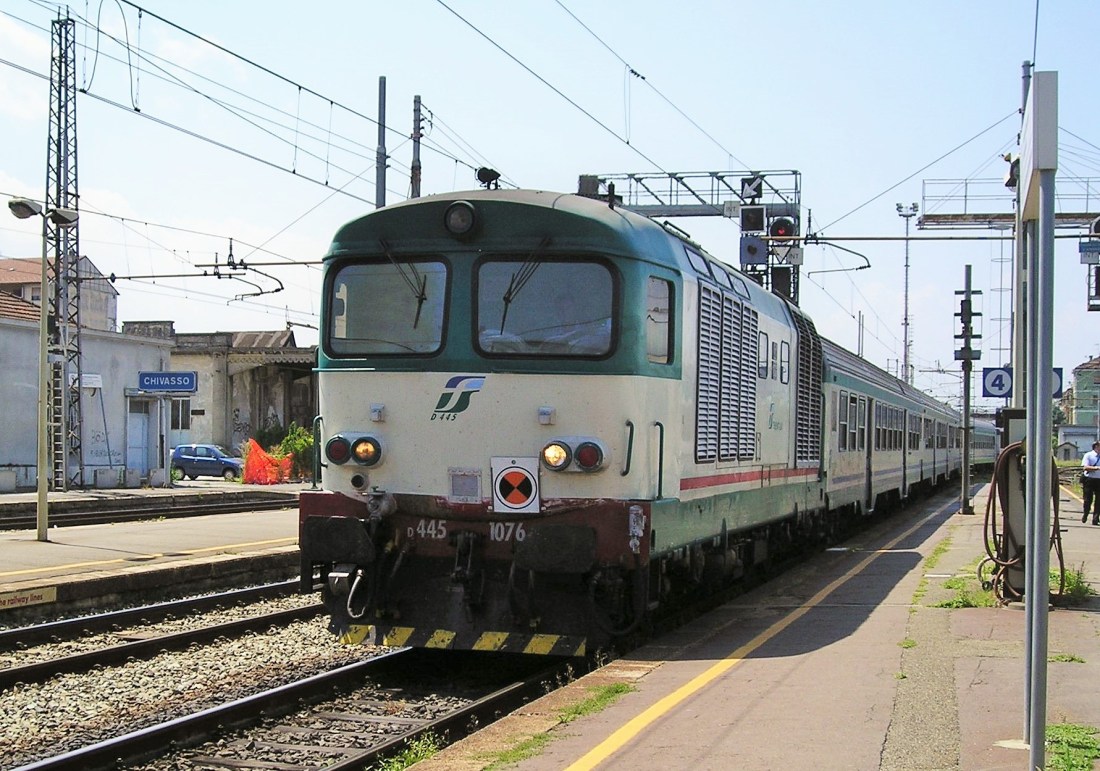
D445-1076 arrives at Chivasso on an Aosta to Torino service, 02/08/06. This part of Italy no longer sees diesel loco haulage on passenger trains, and indeed the loco has since been shipped over to Sardegna. (JW)
One European country that does not get much press in terms of the passenger diesel haulage that it has to offer is Italy. Perhaps this is with good reason, as the sole remaining mainline diesel class with passenger diagrams – the Fiat class D445 – is, if we’re honest, not the most exciting. Nevertheless, sitting in “proper” coaching stock behind a diesel loco is still a wholly sociable way to see this most scenic of countries.
150 of these little 2,090hp four-axle diesel-electrics were built between 1974 and 1988 in three batches; D445-1001 to D445-1035 by Savigliano in 1974-75, D445-1036 to D445-1055 by Reggiane in 1981-83, and D445-1056 to D445-1150 by O.ME.CA between 1985 and 1988. All are fitted with 12-cylinder Fiat power units (the first 35 have a slightly different variant to the latter 115).
Not all 150 remain in passenger use. D445-1008 was the first withdrawal through accident damage sustained after the tragic, fatal head-on collision with a DMU near Crotone on 16th November 1989, followed by D445-1146 which derailed after hitting a car at Brancaleone on 22nd September 1997 (the car itself had been involved in an RTA on the adjacent road and had ended up on the permanent way). Others have fallen by the wayside since – two in particular have succumbed to severe fire damage; D445-1072 in Firenze in 2005 and D445-1097 just recently at Asti on 13th October 2017.
As of 2017, 19 have passed to the freight sector with Mercitalia Rail (formerly Trenitalia Cargo) and work predominantly over unelectrified lines in the north of the country. Their sphere of passenger work is certainly contracting.
The above is a link to a YouTube video uploaded by user 251Aloha showing D445-1075 departing Mede in fairly typical D445 style…
The main aim of this article is to give a little overview of where D445 haulage can still be enjoyed, so I will deal with each relevant area of Italy in turn.
Toscana (Tuscany)
The area of Italy with the most D445 passenger activity is coincidentally also the one most visited by tourists – Toscana – which means that combining a “normal” family holiday with some diesel haulage would not be that difficult. They work on two routes, both radiating from Firenze (Florence) – that to Siena via Empoli, and that to Borgo San Lorenzo via Pontassieve.
According to the excellent E656.net website, D445-hauled trains to/from Firenze booked to be are as follows:-
Firenze, the capital of Toscana, hosts approximately 16 million tourists each year, so it must be worth a visit! Equally, Siena, as a medieval city (and, to a lesser extent, Empoli en route there), is on the tourist trail and so if you are staying in Firenze on a family holiday, this may be somewhere to recommend for a day trip in order to get your diesel haulage fix “by stealth”!
The above is a link to a YouTube video uploaded by user Luca Eseicinquantasei showing D445-1089 departing from Firenze Santa Maria Novella.
Veneto
Further north is the region of Veneto which sees more D445 action centred on the city of Padova – a tourist destination in itself, but less than half an hour by train from Venezia (Venice). As an aside, one of my travel tips to those visiting Venezia on a “normal” holiday would be to do as my fiancee and I did recently, and stay on the “mainland” – even taking into account the train travel across the causeway to the famous city of islands and canals, this is far cheaper than trying to book a hotel in Venezia itself. We stayed in Mestre, but Padova would be equally suitable (and would put you in position for some diesels, should you wish!).
The routes from Padova to Treviso Centrale, to Bassano del Grappa, and to Montebelluna all see D445 power. In basic terms, they operate early in the morning and then through the afternoon and evening. Booked trains according to E656.net are as follows:-
Padova to Bassano del Grappa: 06:12 / 14:16 / 17:16 / 18:16 / 19:16
Bassano del Grappa to Padova: 06:36 / 07:36 / 08:40 / 15:40 / 18:40 / 19:40
Bassano del Grappa is home to the Ponte Vecchio, a famous covered wooden bridge, which is only about a 10-minute walk from the station. It is increasingly getting a reputation as a “hidden gem” of a tourist destination, which usually means that it won’t remain “hidden” for long. Either way, the fact that diesels work trains there might hopefully mean that they are easier to weave into a family holiday – even if the timings are not exactly helpful…
There is also a diagram on the Treviso to Belluno route (which passes through Montebelluna along the way) – 07:34 from Belluno and 18:35 return from Treviso. Both of these trains connect in and out of D445-powered trains to and from Padova at Montebelluna.
The above is a link to one of garedeshimbashi‘s YouTube videos of D445-1142 departing from Padova in 2010.
Calabria
Right at the other end of Italy, two long-distance trains in Calabria retain D445 haulage for the time being.
IC558 08:13 Taranto to Reggio di Calabria Centrale, and the balancing working IC562 11:55 Reggio di Calabria Centrale to Taranto, each take approximately 6.5 hours and hug the coast for the entire way, around the Gulf of Taranto. However, it has been known for one or other of these trains to be substituted by a DMU, so beware!
Puglia (Apulia)
The branch shuttle from Foggia to the coastal town of Manfredonia, on the east coast at the top of Italy’s “heel”, is reported (again on E656.net) as still booked to feature D445 traction on summer Saturdays, the rest of the time being DMU-worked or even bustituted. The most recent confirmed report of a D445 working on the branch that I am aware of (thanks to Ed Beale) was of D445-1060 performing on 26th August 2016.
For the record, the services shown as D445-powered are those departing from Foggia at 07:05 / 09:05 / 11:05 / 13:05 / 16:05 / 18:05 and returning from Manfredonia 40 minutes later. If you do happen to see these trains on your travels, I would be very interested in learning what was working them (as I’m sure the relevant gen groups would be, too!).
Sardegna (Sardinia)
The last area in this list is arguably the most interesting. A small fleet (believed to now consist of six operational machines – D445-1038/1053/1055/1076/1119/1129) of D445s works on Sardegna, the second largest island in the Mediterranean Sea.
Their use is exclusively at the southern end of the island, centred on its capital, Cagliari. The bulk of their work is between Cagliari and San Gavino, but also on the branches to Carbonia and Iglesias, along with one (peak hour) diagram to Oristano, further up the main line that connects the north of the island with the capital.
Once again, E656.net lists the booked workings to/from Cagliari as follows – mainly in the morning peak, in the middle of the day, and again in the evening peak:-
To finish, a link to a YouTube video from tergv200 showing D445-1119 with an excursion at Golfo Aranci – part of the Sardinian rail network that no longer sees loco haulage under normal circumstances.




 European Traction