Latest Posts

5th & 6th May 2018 – Maldegem Steam Festival

Plans are now finalised for the key event of the year at the Stoomcentrum Maldegem, in Belgium.

This is one of my favourite European preserved railways – and one that can be visited as a day trip from the UK too.

DSC03078.JPG

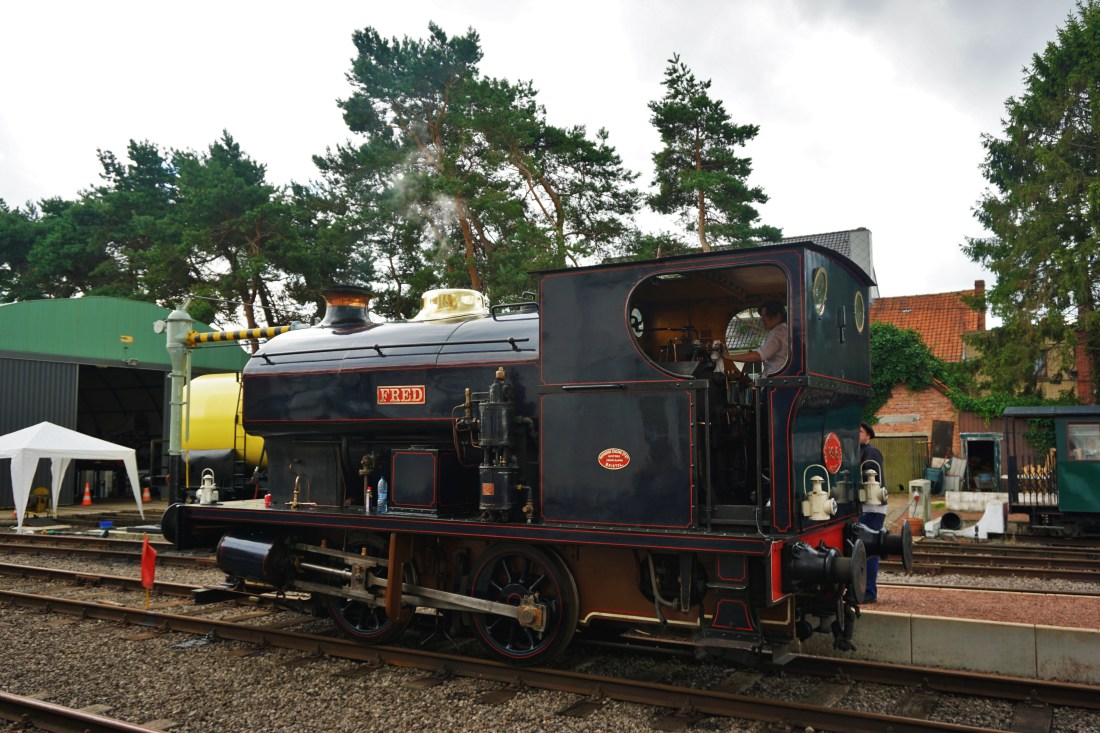
“Fred” at Maldegem, 13/08/17 (JW)

The event will be held on Saturday 5th and Sunday 6th May 2018, on the theme of “100 years since the end of the First World War”.  There should be seven steam locos in steam on both the narrow and standard gauge, as well as one diesel loco and a diesel railcar in use too.

In addition, several First World War-themed attractions are planned including re-enactors, musicians and a small memorial festival involving a steam loco and a large work of art featuring a poppy each day.  As usual, there will be an international selection of trade stands present.

The seven steam locos consist of three on the (600mm) narrow gauge and four on the standard gauge, and include foreign visitors:-

Narrow gauge

Kerr Stuart 0-6-0T “Joffre” (no.3014/1916) from the Apedale Valley Light Railway (used in the trenches)

Barclay 0-4-0T “Jack” (no.1871/1925) ex Granton Gasworks

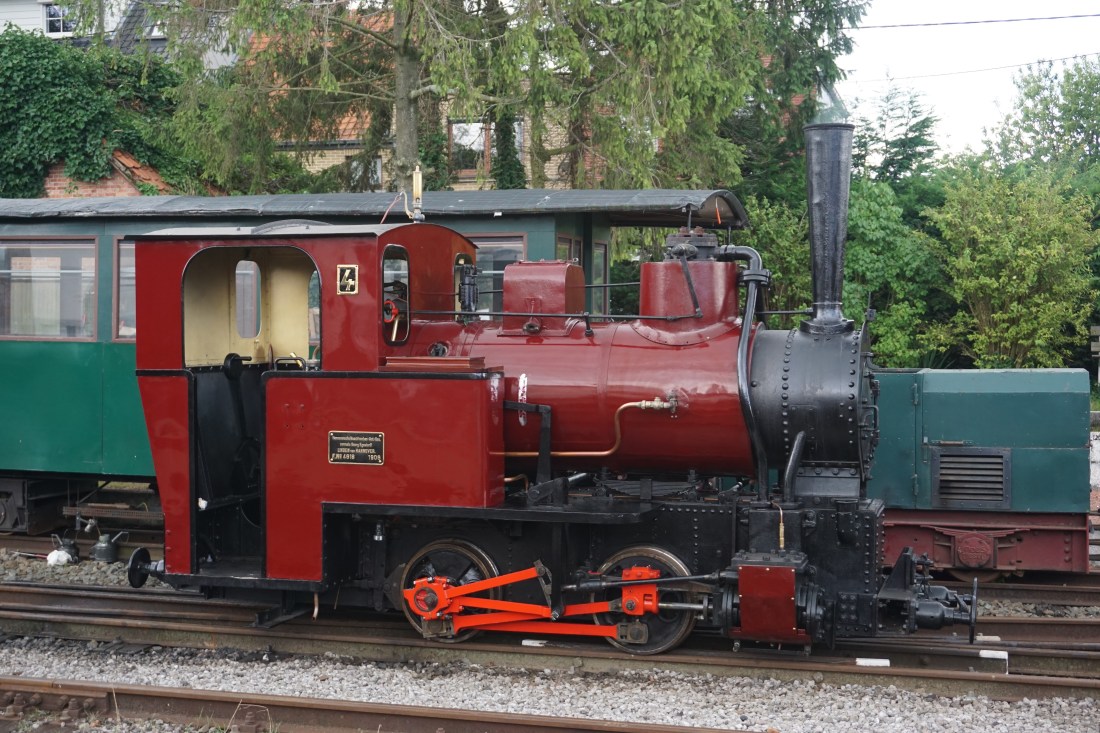
…as well as Hanomag 0-4-0WT no.4618/1906 (this loco is believed to have been taken “POW” by the British during the First World War).

DSC03079.JPG

Hanomag no.4618/1906 at Maldegem, 13/08/17 (JW)

Standard gauge

SLM 0-6-0WT “Tigerli” (no.2079/1910) from the MBS at Haaksbergen in the Netherlands – formerly of the Aluisuisse factory at Chippis, Switzerland

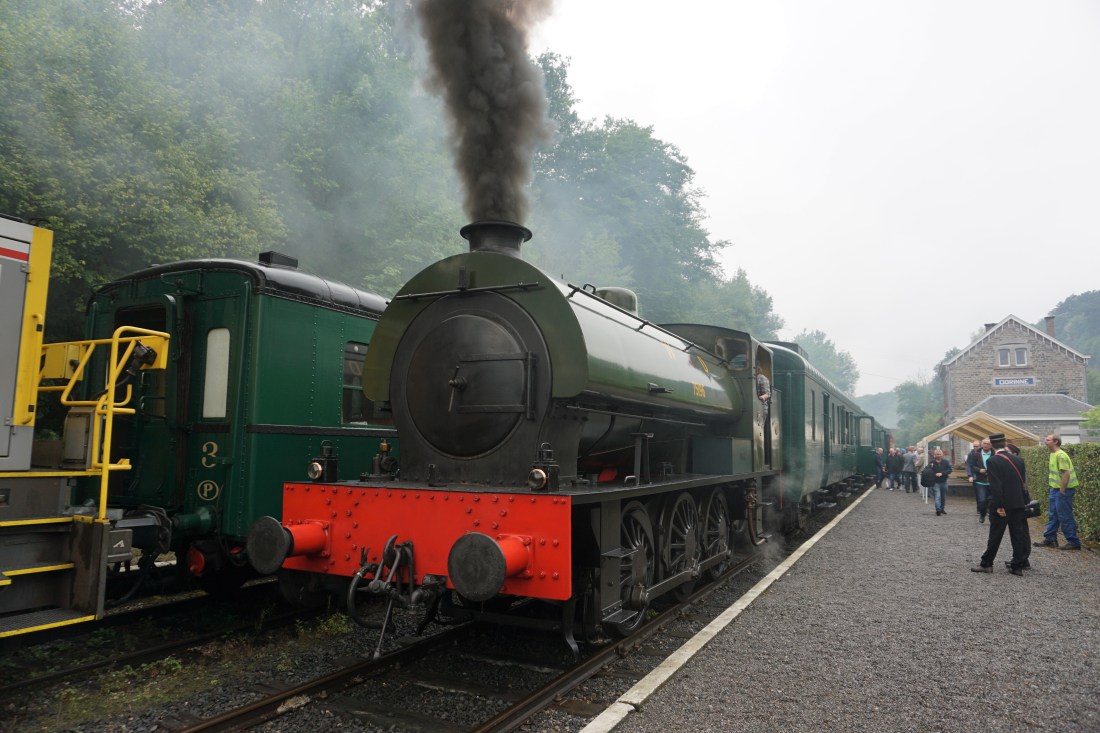
War Department Hunslet Austerity 0-6-0ST WD196 (no.3796/1953)

Avonside 0-4-0ST “Fred” (no.1908/1925) ex Buxton Quarry

St Leonard 0-4-0T “Yvonne” (no.947/1893) ex Soumagne Colliery

DSC03011.JPG

Many readers of this website enjoyed Austerity WD196 during its appearance at the Bocq railway “Festival” in August 2017.  It may be more familiar to others in the UK as the former “Errol Lonsdale”, a name it gained whilst employed at Longmoor – where it also featured in a St Trinian’s film.  Here it is seen at Dorinne, 12/08/17 (JW).

The railway

As the above implies, the railway has both standard gauge and 600mm lines, both running from its operational centre of Maldegem which is situated 14km from the Belgian-Dutch border.  The standard gauge line runs from Maldegem east to Eeklo, and the narrow gauge from Maldegem west along the route of the former line to Brugge as far as Donk.

Getting there

The railway can be reached by train via the branch line from Gent to Eeklo.  The SCM station at Eeklo is located just across the road from its mainline counterpart.

Alternatively, should you wish to head for Maldegem first, it is linked to Brugge railway station by the no.58 bus operated by De Lijn, with a journey time of roughly 25 minutes.  Via either of these methods, a day trip is eminently feasible, either by Eurostar or by plane to Brussel.

The railway advise that for groups wishing to attend from the UK, transport from the Zeebrugge P&O Ferries terminal (served by a nightly sailing from Hull) or Brugge railway station can be arranged by preserved bus.


With many thanks to Kevin Hoggett for his help with this article.

DSB ME 1503 – air pollution experiment

The Danish ME class General Motors diesels are nearing the end of an almost 40-year career.

The introduction from 2002 of a fleet of air-conditioned double-deck carriages – which have now replaced all of the single-deck, opening-window stock – gave rise to a problem.  Ultra-fine particles from the locos’ exhausts enter the carriages’ ventilation system and then circulate within the saloon.  This is caused wholly by the greater height of these vehicles than the ones they replaced.

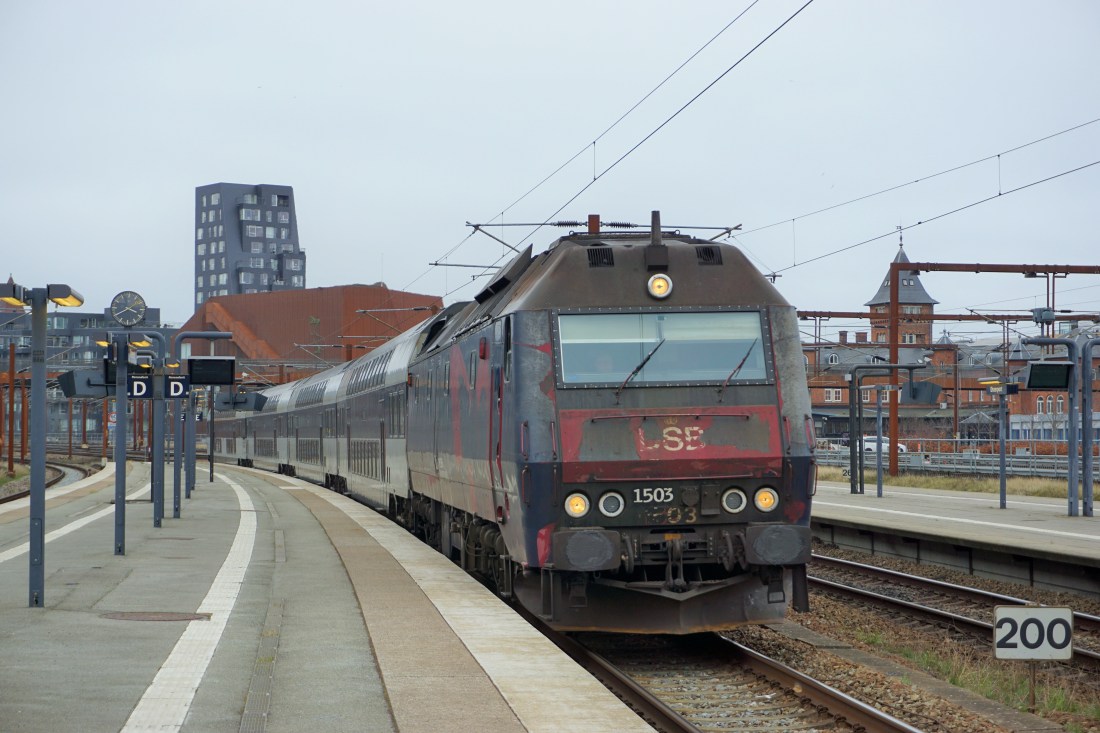
ME1503 at Østerport, 20/03/17 (JW)

ME 1503 at Østerport, 20/03/17 (JW)

This issue had been identified early in the days of the double-deck carriages and numerous attempts have been made to find a solution.  All 33 locos remaining in traffic in 2010 were fitted with an “emissions kit” which aims to give cleaner internal combustion; this has been successful with an estimated 30% reduction of such air emissions reached.  The locos are also driven according to a in-cab “green screen” computer system which instructs drivers on how to drive, matching the train’s progress to its schedule whilst also considering both emissions and fuel consumption.  Intake filters were also fitted to the carriages.  It is claimed that these two approaches taken together more than halved the amount of harmful pollutants detected within the carriages.

Two variants of catalyst were also tested on the MEs, however neither were successful (one was found to actually increase nitrogen dioxide emissions), so were not rolled out across the fleet.

2015 study

The Institute of Public Health at Københavns Universitet (København University) conducted a study in 2015 that concluded that staff working within ME-powered carriages were exposed to a higher level of air pollution than if they were on traffic-clogged city streets, and were therefore at increased risk of lung cancer, bladder cancer and cardiovascular disease.

“The impact on DSB employees working in the train carriages is considerably higher than if they were exposed to a highly-travelled traffic jam. So, of course, that’s not good. However, it is not acutely hazardous and does not give immediate effects. But there is a good reason to accelerate the electrification of the network”.

Professor Steffen Loft, Head of the Institute of Public Health, Københavns Universitet, 2015 (quoted in a news article in July 2017).

ME 1503

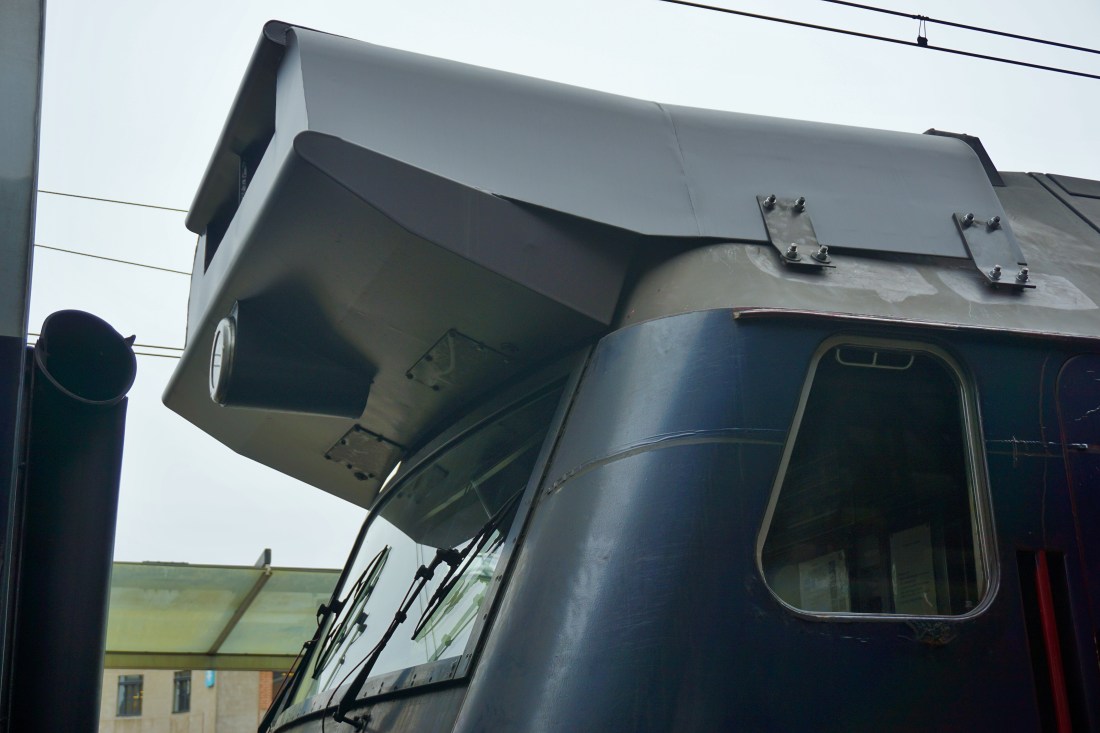
Consequently, as of June 2016, a spoiler was experimentally fitted to locomotive ME 1503, effectively deflecting the exhaust up and over the carriages by forming a “roof” between loco and stock.

This makes it identifiable from the other class members as it is a unique fixture.  It is only fitted as one end as the MEs now exclusively work on the western end of their trains.

DSC01713.JPG

ME 1503, spoiler detail (JW)

Findings

ME 1503‘s spoiler has been found to be effective, but not as effective as had been intended (link).

Ultimately, any solution will be just a case of “damage limitation” as the MEs will be replaced from 2020 by a fleet of new Siemens Vectron electric locos.  The Vectrons had initially been intended to work on the Nivå – København – Køge – Næstved route, but the replacement and withdrawal of the MEs is seen as such a priority that they will instead be put to work on the Nordvestbanen (to Kalundborg) in order for that aim to be realised.

The section of this line from Roskilde is yet to be electrified, but the project to do so has been signed off as part of a 1.2 billion DKK scheme, and some work has commenced.

The Wetteren derailment, 4th May 2013

On Saturday 4th May 2013, a Kijfhoek to Gent Zeehaven tank train hauled by DB Cargo Dutch class 6400 diesels 6506 and 6519 derailed at Schellebelle, Wetteren, near to its destination.

DSC03000

6506 at Dorinne/Durnal on the Chemin de Fer du Bocq, 12/08/17 (JW)

Single line working had been in place, and the train took the crossover back to the correct line at too high a speed; the locos remained on the rails and did not suffer damage, but the loaded wagons derailed. Three of the wagons caught fire, a fire which burned for quite some time.

Although there were no direct victims of the accident, the toxic gases released as a result of it ran off into sewer systems and caused significant health problems for local residents – including tragically killing a man and his dog who actually lived hundreds of metres away from the accident site – and over 100 were hospitalised.  More than 2,000 people were evacuated from their homes for up to three weeks.

The above is a link to a news video uploaded to YouTube by VTM in which the inferno resulting from the derailment can be appreciated – and the pair of 6400s can briefly be seen.

The locos returned to service in the Autumn, and remain in use with DB Cargo today.

Future 6400 haulage

Opportunities to ride behind 6400s are rare, but negotiations are underway to provide at least one member of the class to haul trains at the “Festival” at the Chemin de Fer du Bocq on 11th and 12th August 2018.

Vectron power from Nürnberg

Something gaining a fair amount of interest from haulage enthusiasts at the moment is the use of class 193 “Vectron” electrics on a brand new main line in south-east Germany.

10th December 2017 saw the latest section of brand new high-speed line under the Verkehrsproject Deutsche Einheit 8 (VDE 8) programme – the 107 km between Ebensfeld and Erfurt – open.  The project in its entirety is planned to create a high-speed line linking Berlin and München, and the idea dates back to the very earliest days after German reunification – although it is only really starting to bear tangible fruit now, nearly 30 years later.

It is not only ICE high-speed EMUs that can be seen on the new high-speed route (which crosses the former inner-German border) – there is also a loco-hauled presence.

DSC03461.JPG

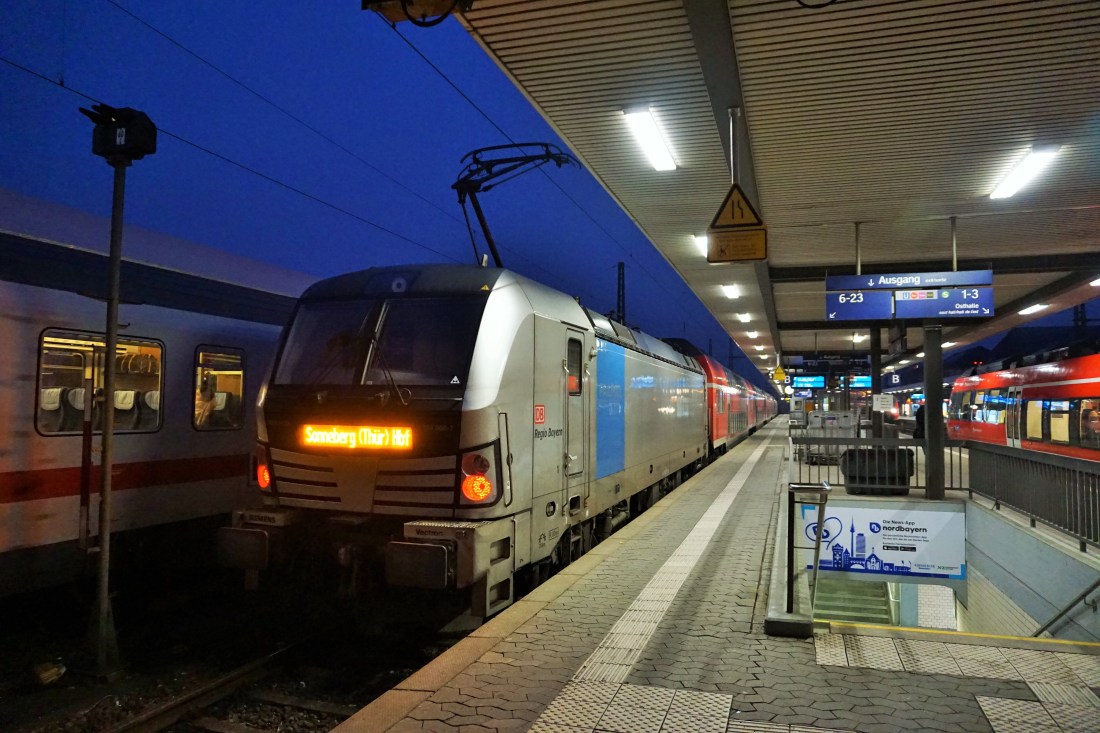
193 806 awaits departure from Nürnberg, 10/02/18 (JW)

Nürnberg to Sonneberg RegionalExpress

With the new line was inaugurated a two-hourly service between Nürnberg, in the former West Germany and Sonneberg, previously in the East, as part of the “Franken-Thüringen-Express” network.

Currently, this is operated by two rakes of four double-deck carriages, each sandwiched between two class 193 “Vectron” electric locomotives (used as they are fitted with ETCS which is required to work on the new route).  Both locos in a top-and-tail formation power at all times.  It is reported that late March/early April 2018 is expected to see one of the 193s on each set replaced by a double-deck driving trailer, released by the introduction of Twindexx EMUs on formerly loco-hauled routes elsewhere in December and themselves fitted with ETCS in the months since.  However – as we’ve seen with the class 102 saga – deadlines for traction introduction in the Nürnberg area have form for slipping!

The 193s run from Nürnberg to Bamberg, and then via the high speed line on the section between Unterleiterbach and Creidlitz, then through Coburg to Sonneberg.  Aside from Nürnberg itself, Bamberg is the stand-out town on the route – being a UNESCO World Heritage site and its flourishing beer tradition.  Unfortunately from a bashing perspective, you only have a +11 there from one set onto the other if travelling from the Nürnberg end!

The Locos

These are drawn from the pool of 193 801193 802193 804193 805 and 193 806, all leased from Railpool to DB Regio – consequently four of the five can be travelled behind in a day, whilst the fifth is a maintenance spare.  What happens to the pool once the extra driving trailers are available is still the subject of conjecture, but if your interest is travelling behind as many of these locos as possible, my advice would be go to sooner rather than later.

193 801 and 193 804 each worked on the München to Kufstein “Meridian vice turn” which operated between May 2016 and December 2017, although it must be said that – in the great scheme of things – prior to the commencement of these workings, these were previously very rare locomotives for haulage.

The Diagrams

These can be found in the members’ files section of European Rail Gen.  However, please take note of my usual friendly reminder that if you benefit from this information, please post your sightings to the group!

What you can combine it with

From a railway point of view, Nürnberg is home to the DB Museum (note: not open on Mondays) to which entry is a very reasonable €6.  Crossing the city, of course – and via Steinbühl station providing an interesting way to reach said museum – is the S2 S-Bahn route upon which most trains are powered by the only locomotives still in passenger traffic that were built for East Germany: the class 143.

Away from the railway, the city of Nürnberg is one of my favourites in Germany, and probably comes closest to stereotypical quaint Germany with timber-framed buildings and a castle looming over it.

DB Class 101 “Werbeloks”

The majority of loco-hauled Intercity trains in Germany are handled by class 101 electrics, but not all of them are in the red corporate livery. 

In the past, there have been large numbers “Werbeloks” in the 101 fleet – “advertising locos” carrying full body wraps advertising everything from early Agfa digital cameras to Mini Coopers to Zetti chocolates – indeed, only around a dozen of the 145-strong fleet have never been so-adorned.

Nowadays, however, the eye-catching liveries are generally more limited to historical commemorations or long-term formal tie-ups between DB and commercial partners, as opposed to using them simply as 200km/h billboards.

From a bashing perspective, colour obviously makes little difference (except for possibly saving you a long walk up a platform to read a number!), however as most German railway enthusiasts are predominantly interested in photography, their movements get reported – for example, on DSO Live Sightings – far more frequently than the red examples.

Here is a look at the 101 “Werbeloks” to be found across the German (and Austrian) rail networks in 2018:-

101 004 and 101 023 – BahnBKK

Above is a link to a video uploaded to YouTube by user regiosprinter-tv showing 101 004 in BahnBKK livery departing Karlsruhe Hbf in November 2017.

In August and September 2016, two previously red 101s gained a black livery advertising the railway health insurer BahnBKK, bearing the strap line “wir gehören zur Familie” (“we belong to the family”.

101 042 – CO2 / Ecophant

The above is a link to a video uploaded to YouTube by user ICE 91 Prinz Eugen showing 101 042 arriving at München shortly after it gained the livery.

Since October 2011, 101 042 has been carrying the “Ecophant” livery, trumpeting CO2 emission savings that can be made by employing DB Schenker for logistics.  An “Ecophant” – or, more accurately, an “ECO2phant” – is a unit of measurement invented by DB Schenker’s marketing partners that equates to 5 tonnes of carbon dioxide, on the reasoning that 5 tonnes is roughly what an adult elephant weighs.

101 071 – #ZeitFuerGold

The above is a link to a video uploaded to YouTube by Deutsche Bahn Konzern about 101 071’s unveiling in a gold Olympic livery.

DB AG is an official partner of “Team Deutschland” and the German Paralympic Team for Pyeongchang 2018 (the Winter Olympics) and Tokyo 2020 (the Summer Olympics).  To mark this, 101 071 emerged on 29th January 2018 – a few days before the start of the former event – in a gold livery with the hashtag #ZeitFuerGold (“time for gold”).

Indeed, Germany finished joint second in terms of gold medals (14) in the Pyeongchang Olympics (at the time of writing, the Paralympics are yet to start), so the message conveyed by 101 071 was obviously influential…possibly.

You have plenty of time to catch up with this loco, as it is intended to remain in this livery until after Tokyo 2020.

101 076 – Cewe Fotobuch

Above is a link to a video uploaded to YouTube by user BahnFan99 showing 101 076 departing Frankfurt Hbf in February 2016.

The most “red” of the true advertising liveries (as opposed to corporate-liveried 101s that simply carry a branding) is that carried by 101 076 since May 2014.  Quite simply, it advertises CEWE’s photo books.

101 112 – Rheingold

The “Rheingold” was a famous premium express train that ran from the Netherlands, into Germany and along the course of the Rhein river into Switzerland.  Discontinued in 1987, it had first run almost 90 years ago, on 15th May 1928.

Unveiled in Dessau Works on 27th April 2017 was an interesting new livery for a 101 – a variation on the beige and cobalt blue colours worn by the “Rheingold”‘s dedicated class 110s when delivered in the early 1960s.  The machine in question was 101 112.  This was a sponsored livery by the model railway dealer association w13plus and, indeed, H0 and N-gauge versions from Märklin, Piko, Tillig and Minitrix followed swiftly!

Amusingly, this was not the first locomotive to emerge in the Rheingold colours in April 2017, as w13plus had also engineered an April Fool by repainting prototype class 103 no.E03 001 in the colours on the first of the month!

The Rheingold colours are expected to be worn by 101 112 for a three-year period.

101 144 – Hertha BSC

Hertha BSC, the football club from Berlin, have been in partnership with DB since 2006 as its official carrier and shirt sponsor.  Since April 2009, 101 144 has carried a series of advertising liveries in their blue and white colours.

The newest of these was unveiled at Dessau Works by Paul Keuter of the Hertha executive board on 24th November 2017 and proclaims “die Zukunft ist am Zug!” (“the future is on the train”).

Recently Reliveried

There are a few other 101s that have lost their unique liveries only within the last few months.  Here are a couple:-

101 055 – Schauinsland Reisen

DSC01769 (2).JPG

101 055 at Hamburg Hbf, 07/04/17 (JW)

From September 2015 to December 2017, 101 055 advertised Schauinsland Reisen, a German tour operator predominantly engaged in package holidays from Germany to “sunny” destinations.

Presumably, the December 2017 timetable change marked the end of the contract, as this loco has now reverted to the corporate red livery.

101 119 – 500 Jahre Reformation

The above is a link to a video uploaded to YouTube by Deutsche Bahn Konzern regarding the wrapping of 101 119 in the “500 Jahre Reformation” design.

For the occasion of the 500th anniversary of the Reformation, DB held a competition for young people to design a commemorative livery to be carried by a 101 (the loco in question was 101 119).  The winner was 18-year-old Ileana Berning, from Nordhorn in Niedersachsen.  The loco was wrapped in the fetching design at Berlin Rummelsberg and then presented to the public at Berlin Hbf on 5th April 2017.

Ileana’s design featured Martin Luther, Johann (Jan) Hus and Johannes (John) Calvin, three of the leading Protestant Reformers in Europe in the 16th century; German, Czech and French respectively.  The 101 was not the only recipient of a Reformation-related embellishment; an ICE4 was also named “Martin Luther”.

101 119 carried the livery for eight months – until 5th December 2017 – and is also now once again an anonymous red member of the fleet.  However, 185 589 of RheinCargo still carries a “500 Jahre Reformation” livery.

Sunday 1st April 2018: Mainline “Warship” on a budget

If you’ve wanted to experience sole mainline Maybach-engined Deutsche Bundesbahn V200 (“Warship”) V200 033 on a charter, but are limited in the amount of time or money that you can throw at it, then you may be interested in its booked workings for Easter Sunday.

On Sunday 1st April 2018, this famous machine will haul a series of four trains on the mainline in the south-east of the Ruhr area as follows:-

201 10:09 Witten Hbf to Wuppertal Hbf 11:44
202 12:11 Wuppertal Hbf to Witten Hbf 13:25
203 14:09 Witten Hbf to Wuppertal Hbf 16:10
204 17:21 Wuppertal Hbf to Witten Hbf 18:47

Each run is approximately 25 miles in length.  All trains are routed via Hagen, but using the freight-only line (2144) via Wengern Ost between there and Witten in both directions.  They are operated by the Ruhrtalbahn (details here) and the fare for one round trip is €20 (€11 one way).  Online tickets are bookable here and must be booked more than 10 days prior to the running of the train(s).

To clarify, I am not saying that “pounds per mile” this is the best-value haulage opportunity currently in the calendar for V200 033.  However, it does give you the chance for a valid, interesting main line move with Maybach power for as little as €11 should you wish to avail of it.

The above is a link to a video uploaded to YouTube by user Dennis te D. of V200 033 departing Lingen on a railtour last year.

The loco

V200 033 is currently (and for the foreseeable future) the only Maybach-powered V200 that you can travel behind.  These locos were the precursors of British Railways’s Swindon-built D800 “Warship” class locos which obviously have a strong following in the UK.

Getting there

Probably what makes this most attractive is the fact that it is eminently doable in a day from the UK.  This again brings down the cost for a British-based enthusiast to experience a V200 this way as it removes the need for hotel accommodation; although naturally Easter Sunday is quite an expensive day to fly.

I am loath to quote exact air fares, as these are an ever-changing thing, but potential moves are as follows which are currently available in their entirety (plane/service train/V200) for less than £150.  That may sound a lot, however it is probably not appreciably less than what it takes to travel on a domestic railtour these days, and is certainly less than you would usually pay to get the V200 in the book.  Service train and bus travel on the below can be done on the SchönerTagTicket NRW, €30.50 each for a day or €45 for a group of up to five.

07:25 Stansted – Weeze (NRN) arrive 09:35 (Ryanair)
10:25 no.73 bus Weeze airport to Kevelaer arrive 10:43
10:51 DMU Kevelaer to Neuss Hbf arrive 11:51
12:24 loco-hauled Neuss Hbf to Witten Hbf arrive 13:40
14:09 V200 Witten Hbf to Wuppertal Hbf arrive 16:10
17:21 V200 Wuppertal Hbf to Witten Hbf arrive 18:47
19:19 loco-hauled Witten Hbf to Hagen Hbf arrive 19:30

19:39 EMU Hagen Hbf to Köln Messe/Deutz arrive 20:34
20:43 EMU Köln Messe/Deutz to Köln/Bonn Flughafen arrive 20:55
21:50 Köln (CGN) – Stansted arrive 22:10 (Ryanair)

08:05 Heathrow – Düsseldorf (DUS) arrive 10:30 (Eurowings)
11:25 EMU Düsseldorf Flughafen to Düsseldorf Hbf arrive 11:42
12:00 EMU Düsseldorf Hbf to Wuppertal Hbf arrive 12:01
12:11 V200 Wuppertal Hbf to Witten Hbf arrive 13:25
14:09 V200 Witten Hbf to Wuppertal Hbf arrive 16:10
16:25 EMU Wuppertal Hbf to Düsseldorf Hbf arrive 16:46
16:54 loco-hauled Düsseldorf Hbf to Düsseldorf Flughafen arrive 17:01
18:15 Düsseldorf (DUS) – Heathrow arrive 18:50 (Eurowings)

These are just ideas; there are many ways that you could cover the trains.

Easter Monday

It has also recently been confirmed that V200 033 will work a train the following day, Monday 2nd April 2018 – a 14:00 round trip from Hamm (Westf) Süd to Lippborg-Heintrop (for an Easter egg hunt) and return, getting back into Hamm Süd at 17:00 (details here).  Fares for this are again very reasonable at €14 second class or €18 first.

However, if choosing one day or the other, you may wish to bear in mind that the line from Hamm Süd to Lippborg-Heintrop is a 10-mile wayside branch that takes an hour to cover in each direction.  It should also be considered that Hamm Süd is not on the national network – it is here and is a good 15-20 minute walk to and from the Hbf.

From the Archive: Irish rover, 20th-25th February 2000

Although the primary aim of this site is to give you information on current and future workings and to demonstrate that there is still plenty out there of interest, I will occasionally dip into the past too and lament the fascinating railway scenes that are now gone forever.

5344641712_6403c35df3_o

My favourite Irish loco, 077, at Dublin Connolly.  Incidentally, Gary Thornton of Six Bells Junction accompanied us for the particular bash this photo was snapped on, and his top review of that day can be found here.  29/12/00 (JW)

18 years ago this week (at the time of writing!) it was the school half-term holiday and I was 11 years old.  Thanks to my Dad, I had a superb childhood on and around railways, and our most regular haunt in the mid and late 1990s was Ireland – floating across the Irish Sea and through a wave of insomnia one night when I was about 13 we worked out that I’d already made 64 trips to the Emerald Isle for a total of over 200 days, which was far more than I did on the trains at home.

The reasons for this were legion – but for a start, why would you hang around the UK railway (that was even then severely sanitised and unit-ised), when just 50 miles away there was a land where loco haulage, steam heating, vacuum braking, semaphore signalling, jointed track etc etc still ruled supreme?  On top of that, it was a land unburdened by much of the “red tape” found in the UK, and unofficial cab rides and depot tours and other such privileges unimaginable today were in fact easier to come by as a child than as a grown-up!  I certainly credit many of those early experiences of kindness shown to me by Irish railwaymen as part of the reason I was driven to pursue my own career on the railway in later life.

Additionally – and this is a tip that still has relevance today – if you are cranking on the Continent with your young children then returning home in an emergency (or simply if said children decide to “play up”!) can sometimes be difficult; but from even the furthest reaches of Ireland’s railway network, we could have been home in Kidderminster by hook, crook, air or sea within just a matter of hours.

Sadly, I don’t feel there’s much to tempt you to travel to Ireland for a train-related holiday these days, but there are at least a number of railtours each year that allow us to briefly relive the good old days – and these are listed in the Haulage Calendar on this site.

Sunday 20/02/00

I recall this day well, having watched Villa beat Everton in a televised FA Cup quarter-final, we set off on our overnight journey to Ireland.  Added interest in such journeys through the 1990s and until December 2000 was provided by class 37 haulage directly to the ferry, and tonight was no exception, with 37415 taking us through the night (topped by “Mary” as far as Crewe).

37401 + 37415 Birmingham New Street Crewe 23:30 NEC – Holyhead (1D99)
37415 Crewe Holyhead 23:30 NEC – Holyhead (1D99)

Monday 21/02/00

In 2000, if you wanted to travel overnight from Holyhead across the Irish Sea, you had two options: either Stena Line’s “HSS” (High Speed Service) fast catamaran, Stena Explorer, to Dun Laoghaire, or Irish Ferries’ Sulzer-powered Isle of Inishmore to Dublin.  Our usual move was the former on its 04:10 sailing, as the HSS was timed to make the crossing in just 99 minutes (more on that later…) and got you to Ireland and on the move sooner.  However, this sailing was seasonal, and didn’t run on this day, so the green ferry it was!  Irish Ferries also offered a fast-cat sailing, but that only ran during the daytime.

It is fair to say that such rancid overnights were made far more bearable by the fact that you could get to Holyhead loco-hauled, and I would certainly point you in the direction of air travel if heading for Ireland today – particularly with the budget airline possibilities that you have today.  However, should you indeed wish to travel by ferry, you still have the choice between Stena Line and Irish Ferries – the Stena Superfast X (now to Dublin), or the Ulysses or Jonathan Swift of Irish Ferries.

075

This rover saw me get two new locos for haulage, one of which was 192.  I had previously had an opportunity to ride behind that one – when it worked the Ballina branch shuttle on 29/03/99 – but as we were behind 075 on its first working in several years at the time, we gambled and stayed behind it to Westport (where this was taken) and back.  It took me 11 months to finally catch up with 192!  (JW)

Anyway, on with the 2000 rover.  Those who know me will know that my favourite Irish loco was, and is, 071 Class machine 077.  This dates back to very early in my childhood and will doubtless form the basis of a future article on this site.  It was certainly not unknown on a week’s Irish rover for us to find 077 and simply stick with it for the rest of the holiday.  However, at the time of this trip, we knew that 077 was still undergoing an overhaul in Inchicore Works, as it had been since mid-1999, so we knew that we were unlikely to cross paths with “the machine” (again, more of that later…).  As such, rather than focusing on the 071s, this rover was ideal for heading up country and enjoying some Bo-Bos around the two operational centres of Limerick and Cork.

“Irish Explorer” five-day all-line rover ticket purchased from Dublin Connolly booking office (a slightly cheaper alternative to a EuroDomino, and still offered today – and still slightly cheaper than the equivalent Interrail), we first enjoyed the 100-odd mile round trip to Mullingar on the two 071s out on the Sligo line that day, which were 072 and one of my favourites, 083.  We then took a Mark 3 push-pull set hauled by 218 out to Howth Junction to come back in on the “Arklow”, the 10:32 Dundalk to Dublin Pearse, a rake of Cravens booked to be hauled by an 071 but in practice often produced Bo-Bos either in singles or in pairs.  On this day, it was 081.  We took it through to Pearse before returning round the corner to Tara Street on another 201-hauled outer suburban working.  From here, it was the number 90 “Stationlink” bus – the precursor to the Luas tram in linking “Connolly side” with “Heuston side”.  This of course is now done by a number of service trains via Phoenix Park Tunnel too, but back in 2000, there was no rail-based option open to passengers transiting between the two separate railways in the capital.

Despite the fact that you would usually see only a small number of enthusiasts during a week’s roaming of the Irish rails – and even then, they were generally Brits on holiday! – Ireland was not entirely “genless”, although the nature of the gen varied and it was a case of who, rather than what, you knew.  On this day we had established that there were no 071s booked out of Dublin Heuston, so it was “first available apparatus” (the ubiquitous 201 Class) to the Limerick area to find some little engines.

OLYMPUS DIGITAL CAMERA

085 heads round the back of Limerick Junction to the “Waterford bay” on an ITG tour, 09/10/04.  This was the last time I ever did that move, the track is now long lifted.  Back in 2000, it was done daily by 141 or 181 Class-hauled 15:45 Limerick to Rosslare.  (JW)

A curious feature of most Irish rovers I ever did was that there were one or two locos that would “follow you around” for the duration.  For this week, the machines in question were 167 and 219 – with a total of 12 runs racked up behind these two alone.  Of course, we didn’t know this when we elected to “enjoy” 219 out to Portarlington on the 13:05 Westport in order to drop back onto our intended taxi, 215 on the Cork.

From Limerick Junction, three journeys between there and the station in the city of that name, 22 miles distant (abbreviated to “City” in my notes for brevity, although it was officially Limerick Colbert – along with Dublin Connolly, Heuston and Pearse, Cork Kent, Sligo MacDiarmada, Waterford Plunkett etc, named after executed leaders of the 1916 Easter Uprising) were enjoyed with three separate Bo-Bos (two 141s – 149 and 157 – and one 121 – 128 – on the push-pull diagram that shuttled up and down that line seemingly continuously!).

The train around which most Limerick area evenings was planned at this time was the 17:25 Dublin Heuston to Ennis.  This was booked for haulage by a 201 Class loco to Limerick, from where a pair of Bo-Bos (usually both 141s) backed on to take it the 25 miles up to Ennis.  These were kick-outs off the shed, so sometimes this provided the only opportunity to travel behind the machines in question that week.  The train then returned ECS from Limerick to Ennis – a friendly word to the guard before departure from Limerick, and an offer to go round with a binbag or equivalent usually ensured a place on this, but there was a dodgy Bus Éireann fallback move via Shannon Airport that got you back if this was denied!

We headed up to Thurles on a 201 to board this train on its inbound working – passage on the ECS agreed, we settled in towards the back of the train to enjoy 147 and 151 into County Clare and back.

One other aspect of bashing in Ireland that was a throwback to an earlier age was that you never really knew for sure where you would end up.  Although the fact that every loco class had booked passenger work and there was no formal sectorisation meant that theoretically everything was available for haulage, some machines were rarer than others, some classes deputised for others, and the element of surprise therefore still existed.  Consequently, we’d rarely book accommodation before we travelled, but had a list of “approved B&Bs” at which we were regulars that we tended to ring up during the day.  Our usual in Limerick was Boylans at 22 Davis Street, a stone’s throw from the station, and this night was no different – indeed, it transpired, we spent the full rover based there!

5362240188_e3f3695ff7_o.jpg

147 turned out to be one of the last locos to carry the 1987-vintage “four rails” logo and – along with fellow survivor 169 – it worked an ITG tour in 2002, which is photographed here at Waterford.  12/10/02 (JW)

Isle of Inishmore Holyhead Dublin Port 03:45 Holyhead – Dublin
98-D-20423 Dublin Port Dublin Connolly bus
072 Dublin Connolly Mullingar 08:28 Connolly – Sligo
083 Mullingar Dublin Connolly 07:40 Sligo – Connolly
218 Dublin Connolly Howth Junction 11:07 Pearse – Drogheda
081 Howth Junction Dublin Pearse 10:32 Dundalk – Pearse
228 Dublin Pearse Tara Street 12:14 Pearse – Drogheda
99-D-520 Tara Street Dublin Heuston bus
219 Dublin Heuston Portarlington 13:05 Heuston – Westport
215 Portarlington Limerick Junction 13:20 Heuston – Cork
157 Limerick Junction Limerick 15:10 Limerick Junction – City
149 Limerick Limerick Junction P4 15:45 Limerick – Rosslare
128 Limerick Junction Limerick 16:25 Limerick Junction – City
216 Limerick Thurles 17:45 Limerick – Heuston
205 Thurles Limerick 17:25 Heuston – Ennis
147 + 151 Limerick Ennis 17:25 Heuston – Ennis
151 + 147 Ennis Limerick 21:54 Ennis – Limerick (ECS)

Tuesday 22/02/00

The Monday had seen us bump into two top men of the Class 31 bashing fraternity (Andy & Dave) and, indeed, we were to enjoy their company for much of the rover as the best moves wrote themselves!  Each morning, one of the four of us would go over to the station to see if the first two Limerick to Dublins “had handrails” (i.e. were class 071/121/141/181 instead of the booked 201!) – if it did, we’d come back over the road, wake the others up at whatever hotel they were in, and go for a run to the capital.  Spoiler alert: it was a 201 all week!  A leisurely breakfast it was, then, before making the acquaintance for the millennium of our other “stalker” for this rover; 167, on the 08:35 to the Junction.

A phone call to Cork had established that one of the few Irish locos I still required at the time – 192 – was due to work a round trip on the Cork to Cobh branch that lunchtime whilst the booked “Arrow” DMU was being fuelled, and this dropped you very nicely onto the 13:30 Cork to Tralee – that week curtailed to Mallow as the Kerry Road was closed for engineering works – which was an 071, 085.  As I said, the best moves wrote themselves!

Consequently, we had time to enjoy 167 back to Limerick and to the Junction again before our 710-engined taxi to Cork.  You guessed it, it was 219…  Interestingly, although this was the usual rake of plug-door Mark 3s, it included BREL “International” coach no.6208 (ex-99529, I think), in which we ensured we sat – something a bit different.

The move worked beautifully, and with a gap in the service from Mallow, we had time to head back into Cork with 230 before 219 (again) returned us to Limerick Junction.  For reasons I don’t fully remember, the four of us took 154 on the Rosslare.  The obvious move on this was to do it all the way to Rosslare for a different loco of the same class all the way back, arriving very late.  However, wanting to cover the Ennis, we instead tapped up a bemused taxi driver before departure from the Junction to drive to the next station along the line, 3 miles distant, at Tipperary.  He thought we were mad, and insisted on telling us so, but was indeed waiting for us when 154 bumbled in with its tiny rake of Cravens, collected us and took us straight back to where we’d just come from!

This is where the wheel dropped off the day.  The plan was to take 128 on the 18:34 to Limerick, but we walked back from the pub to find that this “overgrown shunter” (I jest, I miss them very much now they’re gone) had failed, the railway had collapsed and a minibus was en route to convey us to Limerick.  This actually occurred with a minimum of fuss, but the Ennis was long gone when we arrived there.  Day over.

167 Limerick Limerick Junction 08:35 Limerick City – Junction
167 Limerick Junction Limerick 09:13 Limerick Junction – City
167 Limerick Limerick Junction 10:10 Limerick City – Junction
219 Limerick Junction Cork 09:05 Heuston – Cork
192 Cork Cobh 12:25 Cork – Cobh
192 Cobh Cork 12:55 Cobh – Cork
085 Cork Mallow 13:30 Cork – Mallow
230 Mallow Cork 11:25 Heuston – Cork
219 Cork P3 Limerick Junction 15:00 Cork – Heuston
154 Limerick Junction Tipperary 15:45 Limerick – Rosslare
taxi Tipperary Limerick Junction
99-D-30645 Limerick Junction Limerick bus replacing 128

Wednesday 23/02/00

The aims of this day were much the same – view the Dublins (both junk), enjoy some little engines and make sure we were in position for the Ennis.  Another of my five or so required Irish locos – 142 – had been spied on a freight in the area so we hoped that this might be in with a chance of dropping out for it.
5339462671_0c1a145748_o.jpg

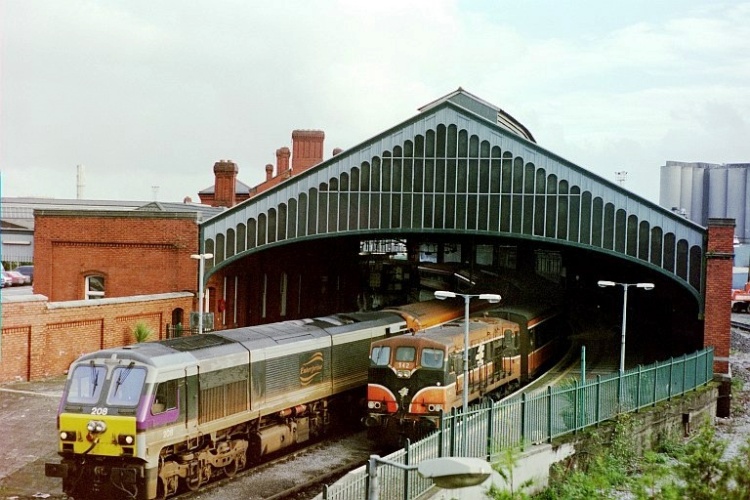
23/02/00 saw me score 142 for haulage, albeit in the dark!  The next time I enjoyed a run with it was in the October 2001 school holiday, out of Cork.  I wasn’t tall enough to see over the bridge (hence this dodgy “point and hope” shot!) but I’m happy I took it.  Enterprise-liveried 208 is seen adjacent, which didn’t see Belfast all week!  (JW)

For a change of scenery, we took 167 on the Ballybrophy round via Nenagh.  Although I considered this “brain death” at the time, I look back on that country branch line with fondness, and that run on a freezing cold February morning with the sun just rising, steam everywhere (except where it should’ve been, leaving the vestibules a sauna) and a little engine stridently chugging away at the sharp end particularly so.

128 was back in action so that was taken for another run, by which time 167 had returned to Limerick and to the Junction, so we had 167 back to Colbert.  Here, we took a little break from the bashing.  In complete contrast to what you would find today (police sirens, probably) the depot staff were entirely welcoming to an 11-year-old paying a visit, and when said child asked as politely as he could if there was any chance 142 might make an appearance on the Ennis that evening, the man said “wait and see”…

He also kindly phoned through to his colleague at Cork and established that the previous day’s scratch, 192, was in line for the 17:10 departure.  With the opportunity to increase the mileage a little bit, with a hellfire departure through the steep tunnel out of the “rebel city” guaranteed, it was a no-brainer to head back up to the station, get behind 167 again and head south.
5646992607_d1ab872708_b.jpg

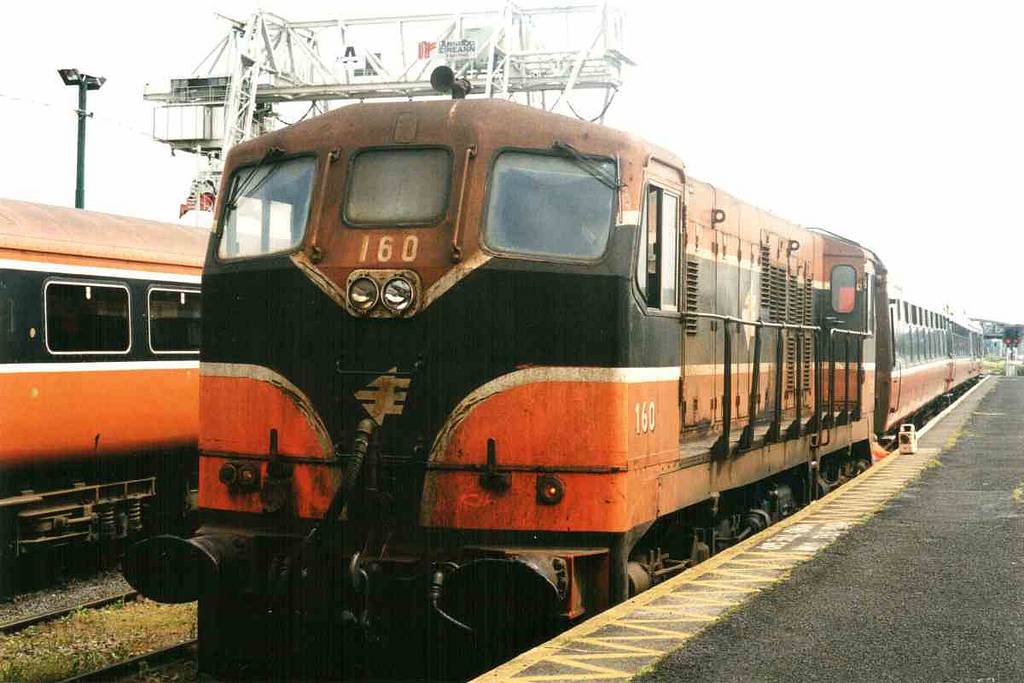
One “part of the furniture” in my childhood that I took completely for granted was the sight, sound and smell of 141 Class locos hauling steam-heated trains around Limerick.  (This brings it back instantly!)  Here is 160 on 30/05/98.  (JW)

Heading back into Limerick on 128, peering through the grimy windows of the push-pull set into the dark as we passed the depot, I was delighted to see 141 and 142 paired up, lit up and looking promising for the Ennis.  I was even happier to see them back onto the stock!  Interestingly, this pair are both preserved by the RPSI and have worked as a pair on railtour duty in recent years.

167 Limerick Ballybrophy 07:15 Limerick – Ballybrophy
201 Ballybrophy Portlaoise 08:00 Limerick – Heuston
215 Portlaoise Limerick Junction 09:05 Heuston – Cork
154 Limerick Junction Limerick 11:00 Limerick Junction – City
128 Limerick Limerick Junction 11:40 Limerick City – Junction
203 Limerick Junction Thurles 11:05 Cork – Heuston
223 Thurles Limerick Junction 11:25 Heuston – Cork
167 Limerick Junction Limerick 13:01 Limerick Junction – City
167 Limerick Limerick Junction 14:20 Limerick City – Junction
222 Limerick Junction Cork 13:20 Heuston – Cork
192 Cork Mallow 17:10 Cork – Mallow
222 Mallow Limerick Junction 17:30 Cork – Heuston
128 Limerick Junction Limerick 18:34 Limerick Junction – City
142 + 141 Limerick Ennis 17:25 Heuston – Ennis
141 + 142 Ennis Limerick 20:58 Ennis – Limerick (ECS)

Thursday 24/02/00

After the previous day’s use of the red pen it stood to reason that this day would be more sedate on that front, and so it proved.  I seem to recall that the 07:15 was 167 again, so we had a more leisurely breakfast and started our day’s bashing on 147, which was the 08:35 to the Junction, and then headed south.
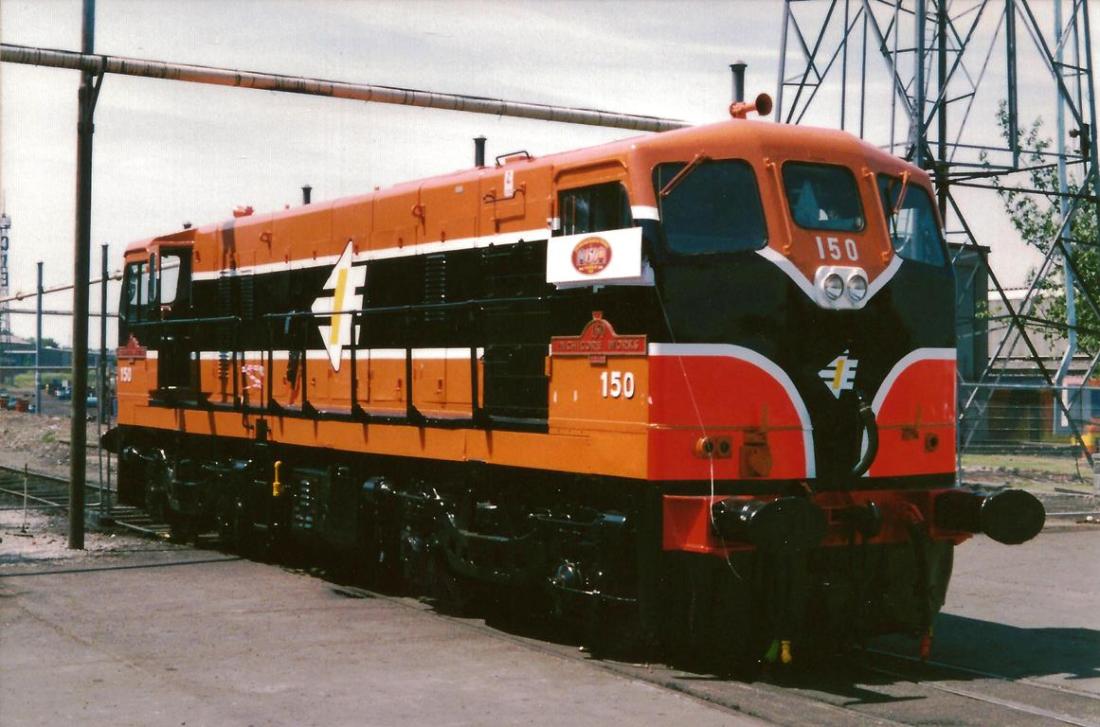
150 Inchicore

150 was the only 141 which was named, at Inchicore Open Day in 1996.  Four years later it had lost its plates (they had in fact been stolen much, much earlier than that – they didn’t last long!), but I did at least enjoy it to Ennis!  16/06/96 (JW)

The Cobh lunchtime turn was 162 on this day, and it did two round trips, so we visited the former Queenstown (final port of call of the RMS Titanic) twice.  With not much more in the way of proper GM on offer, and presumably a plethora of 167 followed by 167 passing 167 (or so it felt!), we headed back to Limerick for yet another 22 miles with 128 and then the Ennis.  On this night, it was 141 again, but this time mated with 150 – a loco I was quite pleased to have as I had not enjoyed a run with it since mid-1996.
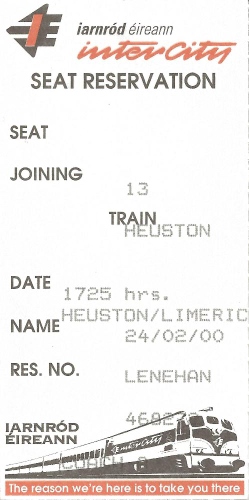
077

I worked my passage with 141+150 on the empties back from Ennis.  I was happy to see them using a proper loco on the reservation slips…

147 Limerick Limerick Junction 08:35 Limerick City – Junction
219 Limerick Junction Cork 07:30 Heuston – Cork
162 Cork Cobh 11:25 Cork – Cobh
162 Cobh Cork 11:55 Cobh – Cork
162 Cork Cobh 12:25 Cork – Cobh
162 Cobh Cork 12:55 Cobh – Cork
225 Cork P3 Limerick Junction 15:00 Cork – Heuston
128 Limerick Junction Limerick Junction 16:34 Limerick Junction – City
210 Limerick Thurles 17:45 Limerick – Heuston
220 Thurles Limerick 17:25 Heuston – Ennis
141 + 150 Limerick Ennis 17:25 Heuston – Ennis
150 + 141 Ennis Limerick 20:47 Ennis – Limerick (ECS)

Friday 25/02/00

And so to the last day of the rover.  Fridays were always good fun as there were plenty of Fridays Only services across Ireland, and these were a good bet for 071 Class haulage.  We already knew that 080 – my second favourite of the class, after 077 – was in Cork and a phone call established that it was allocated to the 10:35 FO service to Dublin – which was normally a train from Tralee, amended to run from Cork on this day due to the closure of the route west of Mallow.  The move was a no-brainer then.

We had a 141 on the 08:35 to the Junction and then a 201 on the taxi to Cork.  Can you guess which ones they were?!

080 was sat there ticking over at the head of the rake of Cravens, but actually against the blocks as it was in Platform 1, a south-facing bay.  The train propelled out of the platform towards Cobh and then took the avoiding line behind the station, before crossing over and, once clear and well into the tunnel, giving us the thrash of the trip on what I recall as a beautiful sunny day.  What a fine machine 080 was.

What I have not yet mentioned is that we were returning home on the Friday afternoon, as the Saturday was seeing Deltic 55019 “Royal Highland Fusilier” work a railtour from Newcastle to London and back.  This loco has always been very close to my family’s heart and I hope to clear it for 10,000 miles this year – hopefully before I’m 30 in December!  Back in 2000, though, that railtour was unmissable for me and therefore the plan was to cross the water on the 16:05 “HSS” sailing, which connected into the class 37-hauled 1G79 18:22 Holyhead to Birmingham.  Quick trip home for a few hours’ kip then a fast car to Newcastle for the Deltic.  What could go wrong.

The first spoke in the day’s wheel occurred passing Inchicore Works.  We knew that the stock was meant to do a round trip to Limerick (the 13:45?) but, as we were heading home, we had not troubled the usual contact to find out if that was booked for an 071.  On rolling past the depot, there was what can only be described as a blindingly shiny 071 sat waiting to head towards Heuston.  Getting closer… it was only 077!!!  My Lords!  The machine was quite clearly coming out to work the Limerick – which it duly did – and we believe this to have been its first passenger run of the millennium.  After much soul-searching, however, we decided to stick with the plan and headed back for the UK.  Nonetheless, it had been an absolutely fantastic rover, and as school holidays go… I’m sure the like will never be seen again.

5378587751_fece6e242c_b.jpg

I’ve included this photo, taken in low light in absolutely deplorable (but, in my experience, normal for County Longford!) weather, as it includes the two locos that starred in 25/02/00 for me – 077 and 080 – and I also like the fact that the single-line token can be seen in mid-air!  Edgeworthstown, 22/10/01.  (JW)

Just as an aside, the Dart down to Dun Laoghaire for the ferry was the first and only unit travelled on in Ireland that trip – how times change.

If you fancy a bit of schadenfreude, have a look at our journey home.  I mentioned that the HSS was advertised to make its crossing in 99 minutes, which would give a +30 or so onto 1G79.  That was when the ferry was on four jets.  It was often on three, including today.  Long story short, as we were getting off the ferry we heard the Type 3 erupt and take its doubtlessly empty train towards Birmingham.  Along with several hundred other people, we endured a selection of units home.  I would rather have been out to my ankles behind 077 howling down the Cork main line!  “Welcome home”.

167 Limerick Limerick Junction 08:35 Limerick City – Junction
219 Limerick Junction Cork 07:30 Heuston – Cork
080 Cork P1 Dublin Heuston 10:35 Cork – Heuston
99-D-519 Dublin Heuston Dublin Connolly bus
8313 Dublin Connolly Dun Laoghaire 14:45 Howth – Bray
Stena Explorer Dun Laoghaire Holyhead 16:05 Dun Laoghaire – Holyhead
153316 Holyhead Llandudno Junction 18:45 Holyhead – Llandudno Jn
158752 Llandudno Junction Chester 19:46 Llandudno – Piccadilly
153358 Chester Crewe 21:00 Chester – Crewe
323241 Crewe Wolverhampton 20:49 Lime Street – New Street

Saturday 26/02/00

Just to bookend the rover with Vulcan Foundry products, here’s the Saturday moves.  No fuss, no drama, no book-filling up rusty sidings.  My kind of day.

55019 Newcastle King’s Cross 09:50 Newcastle – KX (1Z49)
55019 King’s Cross Newcastle 18:10 KX – Newcastle (1Z48)


I hope you have enjoyed reading this article as much as I have enjoyed the walk down memory lane writing it.  I am truly grateful to my Dad for making sure that I got to know a railway that, to British eyes, was a window on the past, and is now only something that old fools happily reminisce about over a Guinness or several.  We didn’t just travel to Ireland, by the way (many of you will know me better as a devotee of German diesel-hydraulics) but it is those formative years travelling so regularly to Ireland that have ensured that I feel more at home on overseas railways than those on my doorstep!

This was by no means unusual in terms of an Irish rover in 2000.  I enjoyed many better ones, and many more that weren’t so good!  But 18 years ago this week, this is what you could have chosen to have done, and although these days are irretrievably gone, you can still travel behind some of the old Irish locos on occasional railtours or at the Downpatrick & County Down Railway.  If you haven’t yet done so, I would highly recommend it.

Sunday 9th September 2018: SNCF Baldwin A1AA1A 62029 private charter train

I am very pleased to announce a modest charter train featuring interesting locomotive haulage on the Chemin de Fer Touristique du Rhin (CFTR) in north-east France.

Sunday 9th September 2018 – 62029 – 10:15 Volgelsheim to Sans-Soucis and return on the Chemin de Fer Touristique du Rhin, France

The locomotive

The locomotive hauling our charter will be ex-SNCF A1AA1A 62000 class locomotive no.62029.

This diesel-electric machine was built in 1946 by the Baldwin Locomotive Works in Eddystone, Pennsylvania, and has a six-cylinder, 660hp Baldwin 606NA power unit.

106 locomotives of model DRS-6-4-660 (Diesel Road Switcher, 6 axles, 4 powered, 660hp) were built by Baldwin between 1946 and 1948, all for the French Supply Council under Marshall Aid.  100 went to SNCF and the other six to Morocco, as class DB-400.  Only seven of the French machines remain extant – in various states of repair – but 62029 according to my research at the beginning of this year, although two others have worked recently, is the only one that is currently operational.  I am not sure whether any of the Moroccan machines survive, but check out a selection of Phil Wormald’s excellent photos here to see some shots of DB-405 in a deplorable state, long withdrawn at Taza.

Under normal circumstances, the steam-oriented CFTR use 62029 only to move empty stock between the depot and the operating base at Volgelsheim, and its passenger-carrying appearances are usually ad-hoc and restricted to the occasional short-distance shunt release.  For now at least, this would appear to be your only opportunity to ride behind a locomotive of this type under any real load and for a worthwhile distance.


The above is a link to an excellent 9-minute video uploaded to YouTube by user PATOU5844 showing 62029 in action light engine on its home line, with some excellent thrash to be heard.

The charter

The railway is 11km long and runs from Volgelsheim north to Sans-Soucis, adjacent to the bank of the River Rhein, across which is Germany.  This track is jointly-owned by the local port authority and is used by commercial freight traffic during the week.  We will make a round trip along it with 62029.

We are constrained both by the railway’s existing traffic requirements (including freights) and also the fact that there is only one man who can drive it for us, and therefore we can only be accommodated on a Sunday morning circa 10:15, and only one round trip can be fitted in.

It is expected that there will be at least one photo stop during the round trip, and also hopefully a visit to the depot on the outskirts of Volgelsheim.  62029 will power the train in both directions; the shunt release at Sans Soucis being performed by ex-SNCF Decauville-built diesel “locotracteur” Y2402, recently re-engined with a Deutz power unit and fitted with train brakes.  This is the only other nominally operational ex-SNCF diesel on site (all other diesels owned by the CFTR being of industrial parentage).

Getting there

The railway’s operating base at Volgelsheim is situated 10 miles east of Colmar in France (on the main Basel/Mulhouse to Strasbourg main line) and 2 miles west of Breisach in Germany (the terminus of a branch from Freiburg), but cannot be reached by public train services.

I have a dilemma here, in that the necessary departure time of our train is earlier than the arrival in Volgelsheim of the first public bus on a Sunday (no.1076, at 11:08, and even then only from the Breisach direction – although the stop is a 15-minute walk from the CFTR station), so it cannot be reached by public transport.  (NB: I am aware that there is a timetable online dated 2014 that shows an earlier departure, I have confirmed with the operator that this no longer runs, and this is corroborated by “Hafas”).  I will therefore be hiring a coach which will meet service trains at Colmar both before and after our event.

There are benefits to hiring a coach in any case, as it does not run the risk of members of our party being unable to travel on a public bus due to passenger volume or the risk of the bus not even turning up at all.  It also negates the 900 metre walk from the nearest public bus stop to the station.

I am aware that travelling on a coach is not everybody’s cup of tea, however I stress that the timing of the run with the Baldwin is fixed and we need to work around this somehow.  You are of course more than free to make your own travel arrangements to get to Volgelsheim.

Connections in

The bus will pick up from Colmar station at 09:30, making connections out of the 09:07 arrival (the 08:21 loco-hauled train from Basel, which again provides day train connections from Zürich, Interlaken and Luzern, as well as the overnights from Hamburg and Berlin), the 09:23 arrival (08:51 loco-hauled ex Strasbourg, which connects out of a TGV from Paris).

It will then pick up at Breisach station at 10:00, connecting out of the 08:24 from Freiburg Hbf – in theory the 09:24 makes it too but I would not recommend catching that as we will not be able to wait if it is delayed.

Connections out

The coach also sets down at Breisach in time to catch the 13:39 back to Freiburg.

It is also easy to get back to the UK by rail from this event the same day.

The coach will drop you at Colmar in good time to catch the 14:07 loco-hauled service to Strasbourg, which gives you a +29 onto the 15:08 TGV to Lille Europe, for a fairly tight or remarkably relaxed connection onto the 18:35 or 19:30 Eurostars respectively back to St Pancras, the latter of which getting into London at 20:03.  Connections from this include to Liverpool, Manchester, Wolverhampton, Newcastle, Leeds, Sheffield, Norwich, Exeter, Bristol, Swansea, Worcester and all across the Southern Region – as well, of course, as the overnights from both Euston and Paddington.

If you are heading south from Colmar, using multiple units you can be back in Basel before 15:30 which gives you opportunities to head into or through Switzerland or beyond.

What you can combine it with

The vast array of long-distance connections both into and out of the event as outlined above mean that your weekend can take many forms – conceivably you could spend a worthwhile Saturday in at least eight or nine countries that I can think of, and still comfortably get here.  As such, I have not organised any additional haulage opportunities this time, as I feel that that would be counterproductive when there are already events going on that are very deserving of your attendance.

In terms of special events on the Saturday, the standout has to be the “Mega Bernina Festival” at the Chemin de fer-musée Blonay-Chamby in Switzerland, featuring a number of interesting electric locomotives, and including the return to service after a long restoration of RhB 181.  Our visit to Volgelsheim would form an easy and interesting stop-off on an overland trip back to the UK from that event.

(Update 22/06/18) I expect many people to spend the Saturday night in Basel prior to travelling up to Colmar.  Some may wish to look at the open day of the Basel tram network, which is expected to include special trips with heritage vehicles.

By heading south from Breisach or Colmar directly after our event, you can reach Belp or Bern respectively in ample time to enjoy a short main line run with 1939-built BLS class Ae6/8 electric loco no.205 on an additional service train, which will depart from Bern at 17:08, stop at Zollkofen at 17:15 and terminate at Burgdorf at 17:26 (see Erlebniszug Lötschberg website).

Do of course keep an eye on the Haulage Calendar on the main site for updates on other unusual haulage-based events going on around this.

Fares and how to book

This does not come as cheaply as I might have liked to offer, but this is linked entirely to the amounts that I am being charged to put the event on for you.  I would very much like to think that it still represents excellent value for what is a very rare opportunity.

Train only – £25

Train and connecting coach – €40  £35

In the first instance, please email me on jw218344@gmail.com to confirm your place on this tour, listing the names of all participants, and if you will be joining us on the coach as well as the train.

Caveats

I do need to emphasise that 62029 is over 70 years old and is the only currently operational example of its class, and a failure before or during the event is always a possibility.  I will provide you directly with more detailed booking information at the time that payment is being arranged.

Saturday 26th & Sunday 27th May 2018: BLS Re425 farewell railtour

5527195493_6231930d82_o (1)

173 “Lötschental”, at Spiez with a Zweisimmen to Interlaken train on 24/08/07 (JW).

The weekend of Saturday and Sunday 26th and 27th May 2018 will see a farewell railtour to the BLS class Re425 “Brown Bomber” electrics.  The train will run from Interlaken Ost and will feature up to five locos over the two days.  Further details will become available in due course.

In the meantime, please use email smithstuart@btinternet.com as a point of reference or for registering interest.  This promises to be an unmissable railtour!


Update 21/03/18 – postponed, may be redated to later in the year.

Sunday 17th June 2018: CC40110 on tour in France

Sunday 17th June 2018 sees an attractive little railtour featuring the first main line passenger run of an iconic class of locomotive in over a decade.

SNCF CC40100 class loco CC40110 will be making its first passenger train appearance in years on Sunday 17th June 2018, when it hauls a railtour on an 160-mile round trip from Paris Gare du Nord to Amiens and return.

The railtour is being operated by Matériel Ferroviaire, Patrimoine National (MFPN – in English, “Rolling Stock, National Heritage”, a name which I think sums up the ideals of railway preservation nicely) who also own the loco.

I must say that I have found the organisers to be immensely polite and helpful, and although my dealings with them to date have been in French, they assure me that they have members who speak English should you require dialogue.  I also have a PDF booking form for the tour, so if you would like a copy of this to fire off to them, please just contact me and I will email it across (this is not yet on their website).

The Loco

CC40110 is one of three surviving members of this once ten-strong class (technically there were eleven, as the original CC40106 was written off very early in its life in 1969 and was replaced by a new loco with the same number) – and the only one that is operational.

These were instantly-recognisable, visually striking (built to Paul Arzens’ “Nez Cassé” design), powerful four-voltage machines built to haul the “Trans-Europe Express” (TEE) across borders.  However, in practice, they only worked to Belgium (both Brussel and Liège).  They were withdrawn in the mid-1990s with the onset of the “Thalys” concept, which can be considered a modern-day successor to the “PBA” (Paris-Brussel-Amsterdam) axis of the TEE.

https://www.youtube.com/watch?v=QJywWIgNh2Q

The above is a link to a YouTube video uploaded by user FTZvideo showing a short documentary on the CC40100s from 1967, by André Périé.

Logistics – Times and Prices

According to indicative timings, the train will depart from Paris Gare du Nord at 07:25, arriving in Amiens at approximately 09:30.  Participants then have over seven hours to explore the city, before returning at 16:35 and arriving back at the blocks at roughly 18:35.

Obviously for an 07:25 departure from Paris, you will need to have stayed in or around the French capital on the Saturday night, as there are no overnight trains that arrive early enough to reliably get you there from elsewhere.  Perhaps my Paris in a day article from May 2017 might give you some ideas about seeking out loco haulage in the local area – although, sadly, there will no longer be any diesel diagrams around the capital by the time this train runs.

Nevertheless, the indicative timings for the return leg would drop you comfortably enough onto the 20:04 (at a push), 20:34 and 21:13 Eurostars back to London on the Sunday evening (which conveniently enough also depart from Nord, of course), off which you can get back as far north as Wolverhampton, Leeds and Derby, or onto the Down “Night Riviera”, etc…

The return fare for this excursion is only €49 standard class (€74 first class).

Amiens – Enthusiasts

The most obvious activity for enthusiasts in the seven-hour layover at Amiens is to have a look at the BB67400 diesels on the route from there to Boulogne (see brief trip report from 2014 that included covering these turns here).  It is possible to make a round trip to Boulogne on one of these (IC2011 10:51 Amiens – Boulogne Ville 12:26 / IC2026 14:45 Boulogne Ville – Amiens 16:09 – but watch out for that estimated +26 onto the tour) but not a lot of other tunes that you can play on that, to be honest.

Amiens – Normals(!)

As you would expect, this tour would also be an ideal one on which to take the family.  The whole point of its running is to visit Amiens (tourist website here) on this particular day – the third Sunday of June each year sees “le marché sur l’eau” (“the market on the water”) where market gardeners in traditional dress go along the River Somme in cone-shaped boats, before setting up at the waterside and selling their fruit, vegetables and flowers.

If this does not particularly appeal to you, Amiens itself is a historic city in its own right – and its history is not restricted to that indelibly linked to 20th century wars, although both have left their mark still visible today – and there are guided historical tours offered as an optional extra when you book your railtour ticket.  The city’s imposing Gothic cathedral is a UNESCO World Heritage Site.