
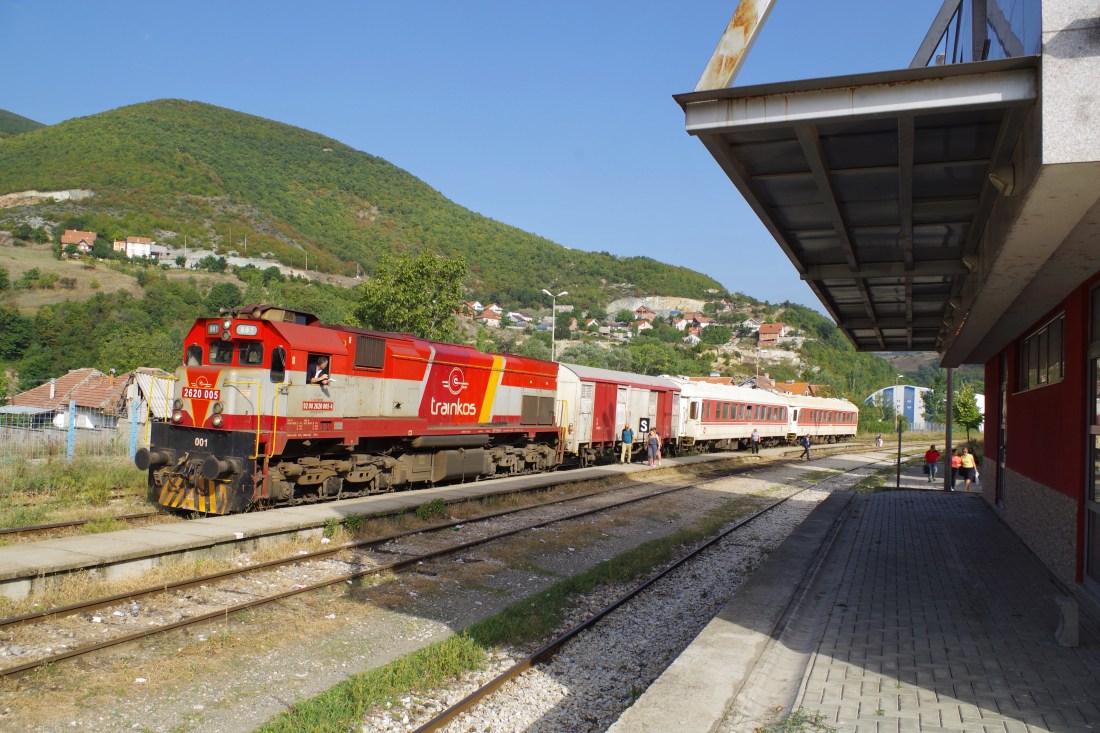
2620 005 (ex-HŽ 2044 031) at Hani i Elizit, 20/09/15 (JW)
Standing at the erstwhile crossroads of the Yugoslavian railway network, Kosovo Polje – or Fushë Kosovë, to use its Albanian name – is a town approximately five miles west of Pristina, the capital of the disputed state of Kosovo. It has had a turbulent past riddled with conflict – not least in the last 20 years – but, on a breezy afternoon in September 2015, it cut a peaceful figure.
Fushë Kosovë remains a railway crossroads, but its services are much curtailed from the Yugoslavian heyday – ethnic and political tensions have severed hitherto-vital links and reduced former main lines to branch line status. One thing that Fushë Kosovë does retain, however, is a railway depot of significant size. It is where the entire fleet of the Kosovan railway is based and maintained.
As well as maintaining the operational rolling stock, the depot at Fushë Kosovë contains a padlocked compound at its southern end, in which 20 locomotives are parked – rusty, faded, battered and derelict. These actually hold the key to telling us a fair amount about the history of Kosovo since the war of 1998/99, so rather than a straightforward “spotters’ fleet list”, I’ll try and cover a bit more general history.

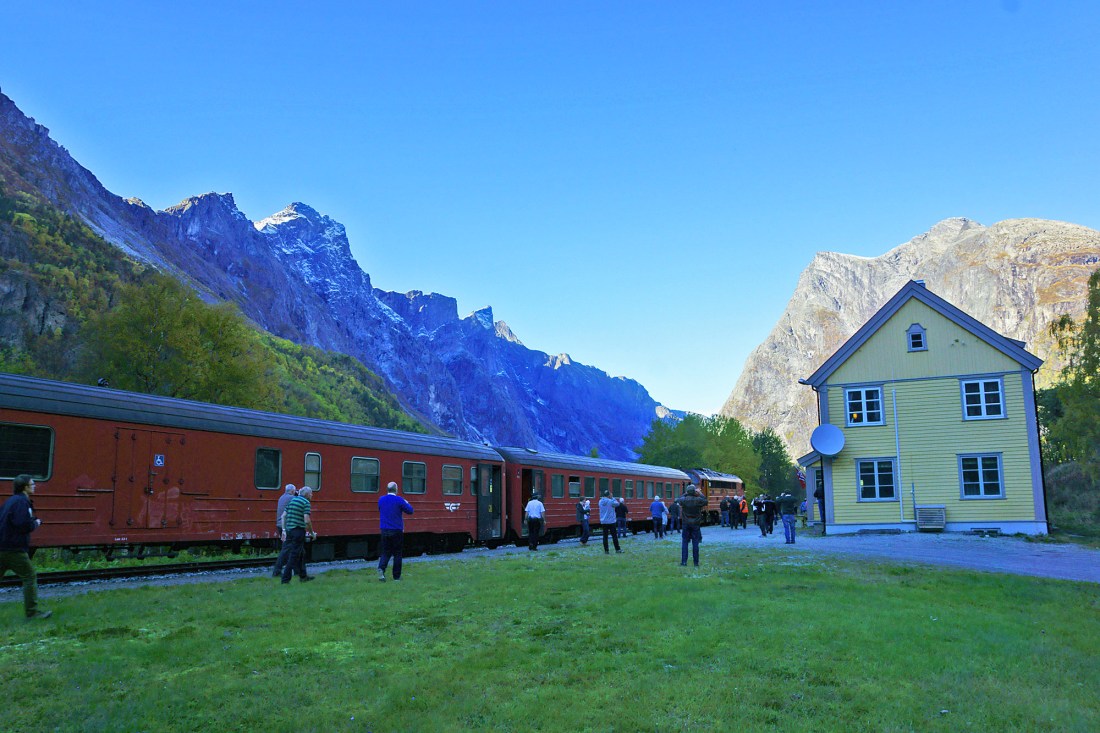
2640 007 (ex-661 228) trundles into Ferizaj, a small microcosm of the multicultural state that Kosovo is – with a mosque dominating the skyline but a church steeple peeking over the trees too. 1605 Fushë Kosovë – Hani i Elizit, 17/09/15 (JW)
Kosovo, as a former territory of the Socialist Federal Republic of Yugoslavia, benefited from being a small cog in the big wheel of a relatively homogeneous Balkan railway network; Jugoslovenske Železnice (Yugoslavian Railways). Rolling stock procurement was done on a national (i.e. Yugoslavian) scale and therefore you would not necessarily have expected to find different types of train in each republic/province. However, the break-up of the former Yugoslavia has certainly changed this. It’s just one more way that each republic has, consciously or otherwise, cemented its independence.
However, one thing that has all but disappeared from the public eye in most other parts of the former Yugoslavia is any trace of the JŽ logo, or indeed many reminders at all that the constituent parts used to be part of the federation with each other. The Fushë Kosovë compound is one exception. Here, the locomotives sit rotting, Kosovan purely by dint of being unserviceable there when the federation collapsed. Nobody especially wants them, and in a cash-strapped environment, nobody really sees a need to spend any money on them, or more importantly, as their problem to do so. Some of these locomotives will have not seen use since Yugoslavian days, many have certainly not seen heavy maintenance since then, as the faded painted dates on their bodysides attest. The vast majority – if not all – will never pull a train again.

Traces of Yugoslavia in the scrap line (JW)
Kosovo will be most well-known – certainly to people of my generation – as being the scene of deep-set tension between ethnic Albanians and ethnic Serbs, and most notably, the attempt of Slobodan Milosevic’s government to brutally suppress the Kosovo Liberation Army’s campaign for independence which erupted into civil war in 1998/99. Between March and June 1999, our TV screens were full of images of the 78-day NATO bombing campaign – “Operation Allied Force” – carried out with the intention of removing Milosevic’s forces from Kosovo. Milosevic accepted the terms of an international peace plan, and the UN deployed a security presence in Kosovo, the “United Nations Interim Administration Mission in Kosovo” (UNMIK); NATO also deployed peacekeepers – the Kosovo Force (KFOR). KFOR supported UNMIK’s work, but, as befitted their parentage, there was no chain of command between the two.

KFOR and UN logos on the side of ex-SNCF BB63018 (JW)
KFOR were up against a difficult task and it became clear that, dilapidated as they may be, the Kosovan railways would be integral to their operations. Initially, the British Army (79 Railway Squadron of the Royal Logistic Corps) was in charge of railway operations for KFOR.
79 Railway Squadron had been present in West Germany during the Cold War which, had it turned “hot” and escalated into conflict between East and West, would have seen the squadron operate a support network of railway services using Class 216 diesel-hydraulic locomotives (on which the crews had been fully trained). Sadly, the British Army no longer maintains a railway operating capability – if required in the future, these duties will need to be carried out by civilians instead.
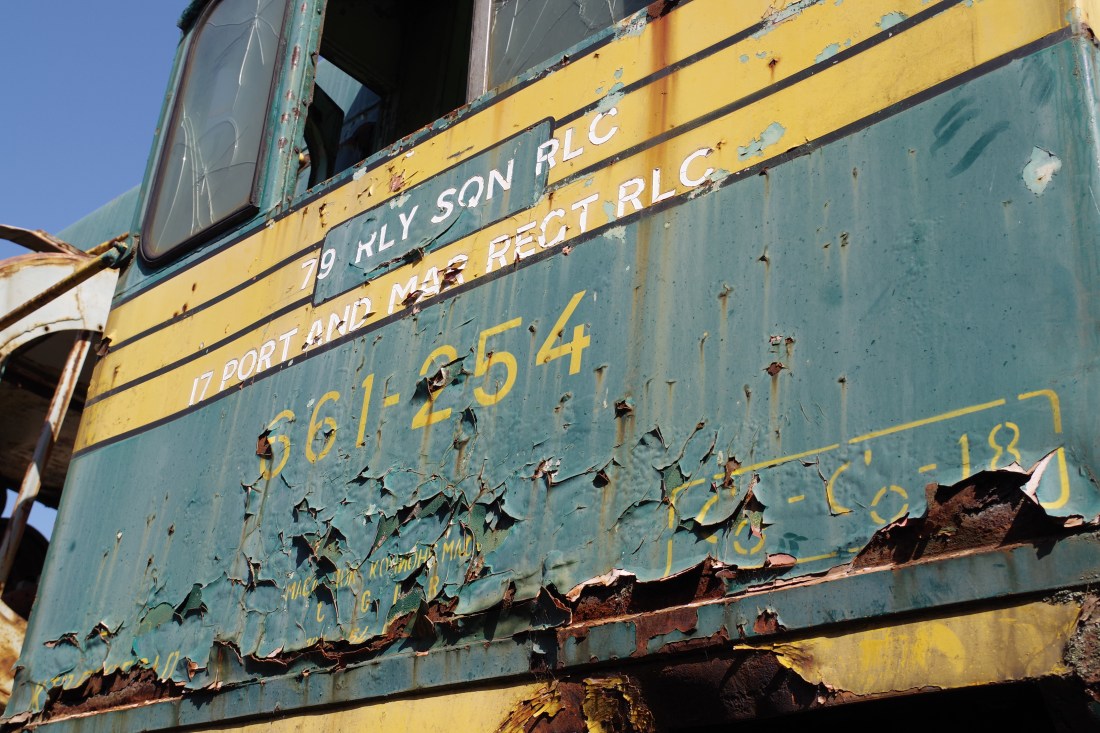
79 Railway Squadron lettering as worn by accident-damaged 661 254 (JW)
The Italian Railway Regiment took over in the September, providing 120 specially-trained railwaymen and women, who were veterans of the Bosnian railway rebuilding earlier in the decade and therefore more than able to carry out what was required of them. They brought their own train, the Rapid Reaction Train, in order to assist, which arrived in the October.
As an aside, this wasn’t the first train of the era to run all the way through to Kosovo. A remarkable train had operated in September 1999 in connection with the KFOR operations, all the more special as it was a charity endeavour. What was called the “Train for Life” took three ex-British Rail Class 20 diesel locomotives and their train from London all the way through to Kosovo, arriving in Fushë Kosovë – not without some resistance en route! – on 27 September. It was conveying 15 carriages of donated clothes, food and medical supplies, as well as educational material and other items to assist with the rebuilding of Kosovo. Key to this was the train itself. The three British locomotives then remained in Kosovo for a while, operating trains for KFOR, eventually returning to Britain where they re-entered service on less prestigious duties.

Back in the UK after its Balkan adventure, 20901 is seen at Bury Bolton Street during a diesel gala at the East Lancashire Railway, 12/09/05 (JW)
The reconstruction and recommissioning of the railway network in Kosovo continued. At this point, it’s important to point out that not all the work was done by soldiers – at all points they were assisted by railwaymen who had previously worked for the JŽ and gave their labour for free. In the same way that railwaymen have in divided communities the world over, from Belfast to Berlin, ethnic Albanian railwaymen worked alongside ethnic Serb railwaymen – the common bond of the railway proving strong.
Piece by piece, the damaged and severed railway lines were brought back into use, predominantly for the transportation of supplies (both of a construction and a humanitarian nature). As well as assisting in the general rebuilding of Kosovo, this proved great for morale. A NATO article in 1999 quoted Pejë stationmaster, Muharrem Ukaj, as saying on the event of the first train back to his station after the reopening of the line: “This is a big day. I am full of feeling, almost about to cry”. The recommencement of trains was one very forceful sign that life might be returning to normal (whatever “normal” was).
In December 1999, the railways were opened up for the use of civilian passengers – for free; 20,000 people travelled in the first three months.
UNMIK’s mandate was, and is, “to help ensure conditions for a peaceful and normal life for all inhabitants of Kosovo and advance regional stability in the Western Balkans”. This included the eventual transition of the management of the railways (along with other services) back to civilians. The operation of the trains remained under the control of KFOR, until it was handed over to UNMIK in March 2001, and then on to local civilian management.
Kosovan Traction Policy
One notable thing about Fushë Kosovë, and the Kosovan railways in general, is the remarkable variety of rolling stock that can now be found there. This can largely be attributed to KFOR. Only three ex-JŽ locomotives were fit to be used for KFOR’s post-war railway operations. All of the others – which remain in the compound – were simply no prospect for renovation, having stood neglected for too long, or suffered severe mechanical failure or damage in the past (or both!).
It was therefore up to KFOR (and, it transpired, its successors) to source alternative rolling stock to use. Some of the nations working as part of KFOR came up trumps here. Locomotives and railcars were donated or borrowed from service in the UK, France, Italy and Germany; although it followed that as these were the ones most easily spared from their “day jobs”, they were generally near to the end of their service lives or already surplus to requirements. The British and German rolling stock was repatriated for further use, whereas the French and Italian rolling stock is still at Fushë Kosovë – depressingly, it was used until it broke down and then was unceremoniously dumped amidst the weeds, its purpose served.
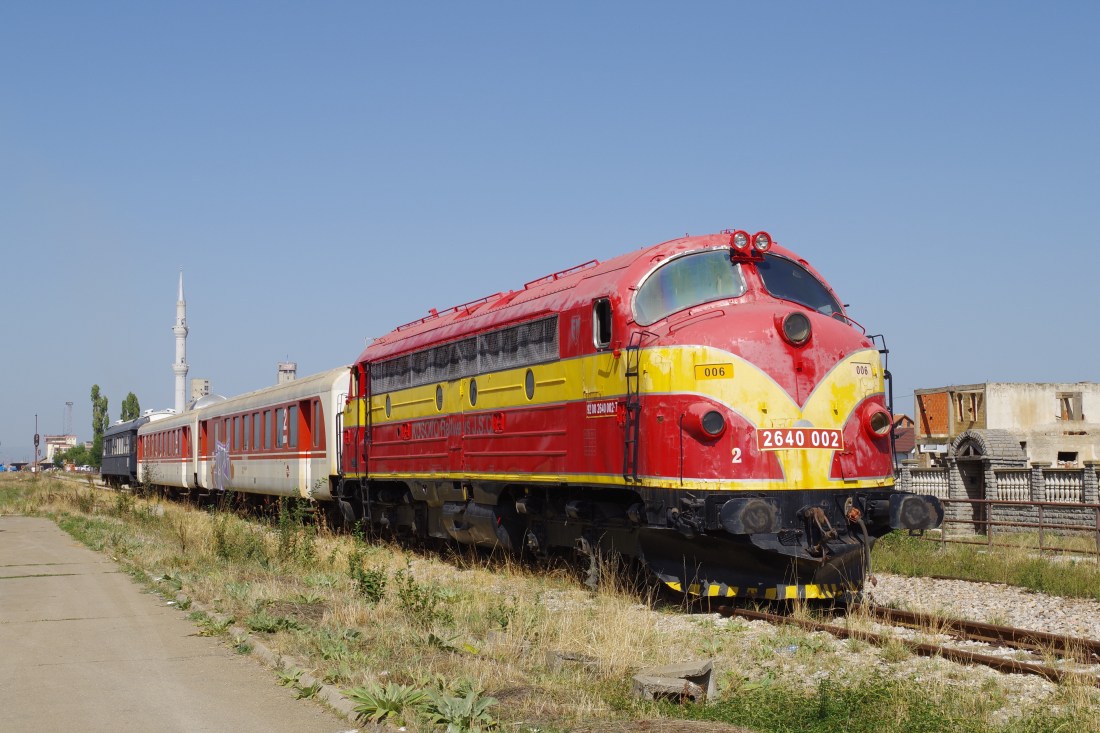
Ex-Norwegian NoHAB Di3.633 (now 2640 002) at Fushë Kosovë (JW)
Four Norwegian Di3 NoHAB diesel locomotives were donated to Kosovo as “start-up aid” in 2001. These, too, are thought to all now out of service (although the former Di3.641 has been reported in limited use recently). In addition, a fairly extensive amount of Swedish rolling stock was acquired towards the middle of the decade (mainly railcars and carriages, and a shunter). The network appears to go through cycles of acquiring another country’s cast-offs, using it until it breaks, then repeat ad nauseam. This may seem wasteful on the face of it, but it makes commercial sense for such a small, cash-strapped organisation to operate in this manner – especially if it can negotiate to acquire the replacement stock as an economic donation.
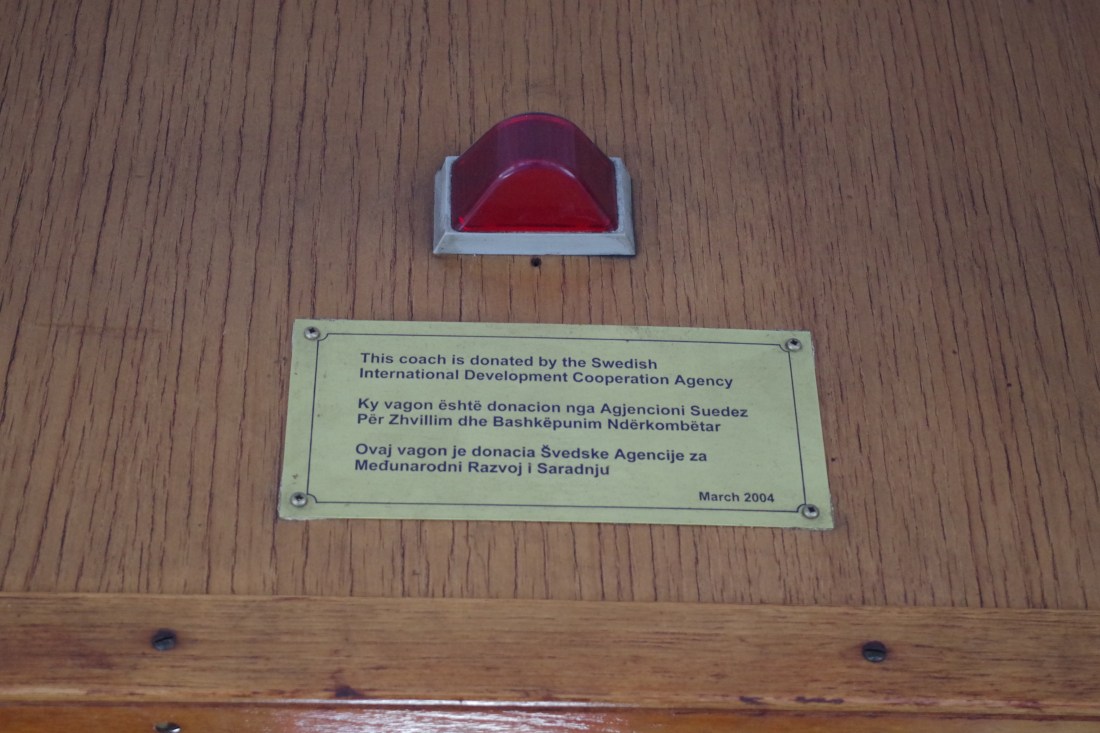
A plaque inside ex-Swedish carriage no.5163 denoting its heritage (JW)
Kosovo declared their independence from Serbia in February 2008, and although this has not been universally recognised, it certainly did mark a watershed in the evolution of the former Yugoslavia. “The youngest country in Europe” certainly feels as if it is developing, and although parts of it seem crushingly down-at-heel, its people are on the whole positive, the younger generations multi-lingual and technology-literate with a clear yearning to better both themselves and their environment.
It would be misleading to intimate that Kosovo has been a calm place since the end of the civil war, over 17 years ago. Violent clashes are frequently seen in response to what might be seen by outsiders as relatively innocuous stimuli. Some claim that Kosovo is a hotbed of Islamic extremism and recruitment for Isis; although it is considered as one of the most pro-American societies in the world, its citizens still grateful for NATO’s efforts to remove the Serbian oppressors in 1999. One thing is for certain, Kosovo has changed much for the better since Pristina was a daily fixture on the TV news, but it will continue to develop, and the manner in which it does so remains to be seen.
The majority of these locomotives have remained largely untouched in their compound through numerous conflicts and changes of ideology. Ultimately, I suspect that they will stay there until such a time as the price of scrap metal picks up. However, until that time, a small snapshot of both the former Yugoslavia, and the collective effort to help rebuild Kosovo after the civil war, will continue to decay in a padlocked compound in Fushë Kosovë.

2640 003 (ex-NSB Di3.641) on a Mercia Charters railtour, 18/09/15 (JW)
Locomotives in Kosovo
For a photographic summary of the locomotives currently to be found in Kosovo, please click here (Part 1 – ex-JŽ GM diesels); here (Part 2 – other ex-JŽ locos); and here (Part 3 – imported and new traction).
Additionally, the following locomotives were provided for use in Kosovo, but have now returned to their home countries.
BR Class 20 – 20901, 20902, 20903
DB Class 202 – 202 318, 202 432, 202 516, 202 613, 202 615, 202 637, 202 658, 202 786

 European Traction