MAV electric classes 431, 432, 433, 470, 480 and diesel class 418. GySev classes 430 and 471, all available for short leaps as are ÖBB 1116 and Railjet 1216s. CD class 380, ZSR class 350 and Romanian class 477 also visit but longer leaps are needed for these.
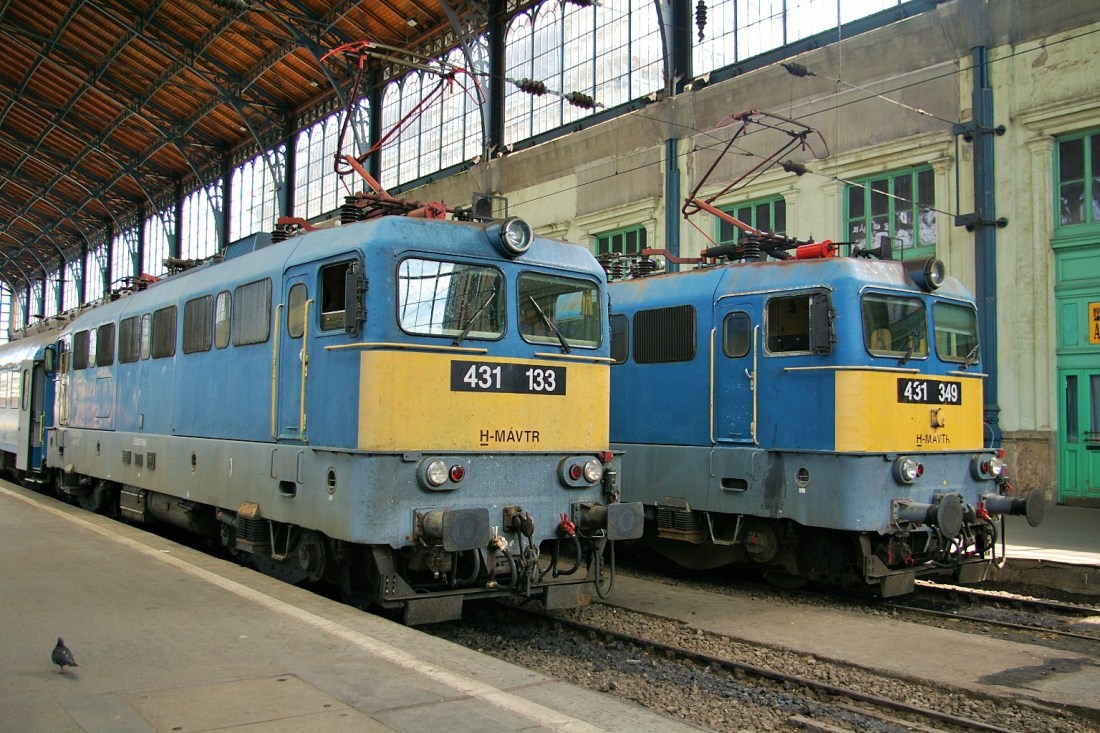
431133 and 431349 sit side-by-side on the blocks at Budapest Nyugati, 03/08/14 (JW)
In the hills is the children’s railway using class Mk45 diesels on most services although they do have a unit and in summer use a kettle.
Budapest Deli has frequent loco hauled departures all stopping after 4km in Budapest Kelenföld, the stop at Kelenföld is seen by some conductors as a pick up/Set down only station so you have to be a bit smart at times. Kelenföld also has hauled departures to Budapest Keleti. Deli is a bit of a mess of a station with hauled services using the lower numbered platforms, a fair bit of shunting goes on but is unpredictable. Lots of food and drink shacks here and the station also has metro line 2 to Keleti.
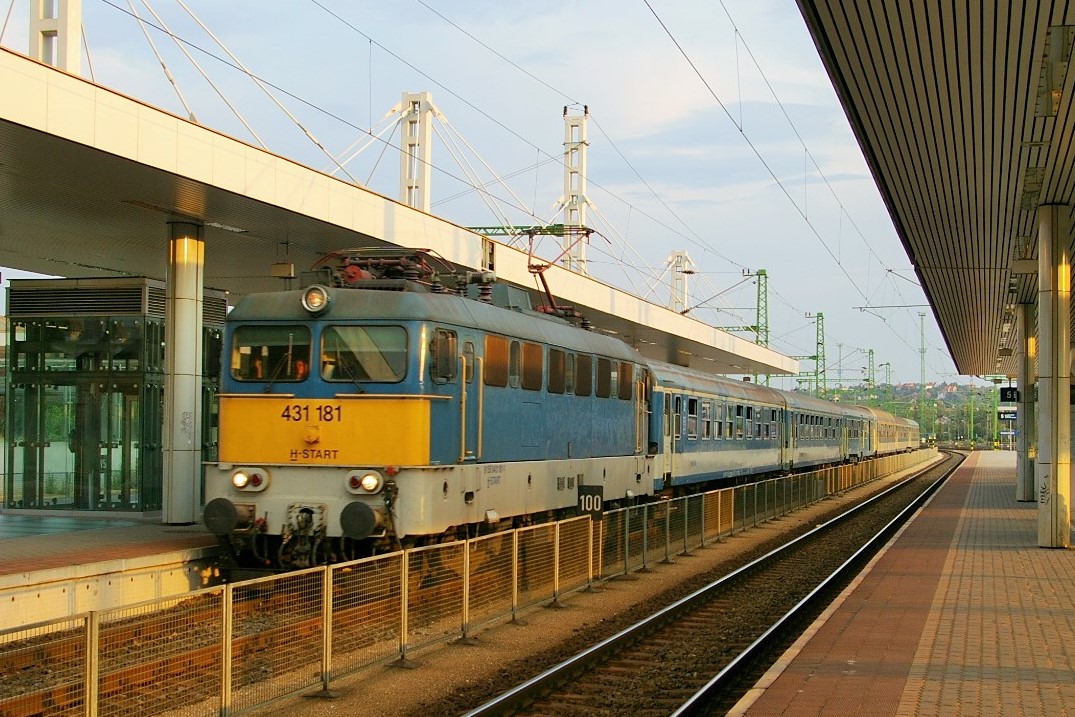
431181 rushes into Kelenföld with a local train, 02/08/14 (JW)
Kelenföld is a rebuilt station with the Deli services using the lower numbered platforms and Keleti services use platforms 14+15. A couple of food outlets but fairly rubbish shop wise. Kelenföld is 13 minutes away from Keleti by metro line 4. Keleti itself has plenty to offer food and drink wise including a supermarket across the road on the lower numbered side.
Keleti mainly sees the longer IC trains and thus the only leaps from here are out to Kobanya Felso (15 minute walk to Kobanya Also on the Nyugati line) using class 432 and occasionally class 431. OBB 1116, 1216, GySev 430, 471 and MAV class 433 can be leapt on out to Kelenföld but again the problem with the pick-up/set down scenario exists.
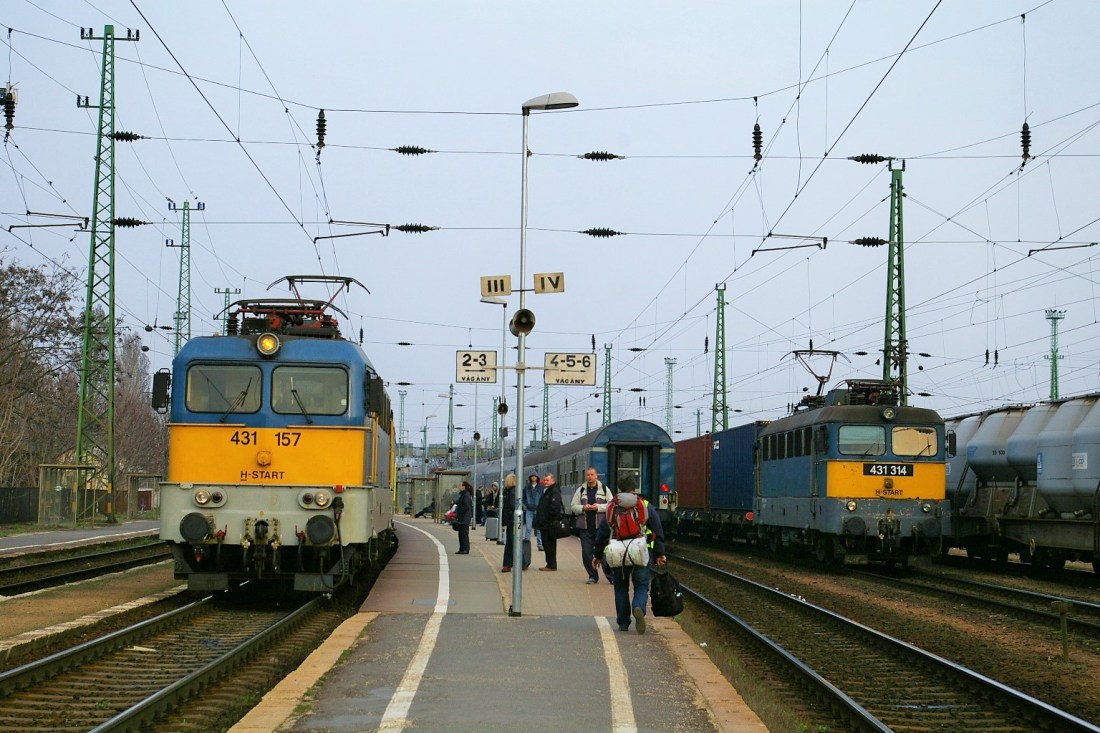
A busy moment at Ferencvaros with 431-hauled local passenger trains heading each way and 431 314 standing alongside on a freight, 22/03/15 (JW)
A few times per day some hauled trains stop at Ferencvaros station. This station is alongside the yard and sees very frequent freight and shunting. Not really any facilities here though. The local service between Kelenföld and Kobanya Kispest stops at Ferencvaros.
Budapest Nyugati is the main bashing station in Budapest, leaving Nyugati the first station is Zuglo some 5km out, all trains stop here although the IC services from here into Nyugati are set down only so use your head. Next station is Kobanya Also where only the locals stop. Next along is Kobanya Kispest where all trains stop. All electric services go straight on here, the locals calling at Pestszentlorinc and Szemereetelep and then all trains calling at the airport station of Ferihegy. This station was new built about 10 years ago and was excellent for the passenger terminal just across the road, however nowadays the passenger terminal is on the opposite side of the airport requiring a bus. The 200E bus runs frequently from Kobanya Kispest station to the airport and stops alongside the train station at Ferihegy.
The above is a link to a YouTube video from TKori225 of Ganz-built diesel-hydraulic 418110 getting into its stride away from a station stop on a Budapest to Lajosmizse service.
From Kobanya Kispest the diesels turn right heading down to Lajosmizse the first stop being Kispest. At the Budapest end of Kispest is a supermarket but more interestingly a flat crossing with a busy tram line. Budapest Nyugati has also a hauled service on the Szob line using mostly class 432 but also class 431. The stopping patterns are a bit up in the air but the first shack is called Rakosrendozo.
Nyugati and Keleti station are of a similar build with the main platforms being in the train shed whilst bay platforms are further up on the left and right, Nyugati has a subway between both sets whereas Keleti doesn’t. Zuglo has a kiosk on the island platform and a couple of drinking shacks down below. Zuglo and Budapest Keleti are just a few minutes apart by a very frequent bus service. Metro line 1 is the oldest metro in mainland Europe.
A 24 hour ticket costs 1650 forint and covers a good distance including the airport and all the stations mentioned above.
Useful Links
A very smart thing with Hungary is that most locos are fitted with GPS and this is accessible to the public at iemig.mav-trakcio.hu
My sincere thanks to Tony for putting this together and allowing me to publish it on the site – I am very grateful to be able to benefit from his expertise! If you have any content that you would like to see here, please contact me.
This is a bit of an in depth view of bashing around Bucharest (București) and the facilities at station and tickets etc.
With regard to the so called Henri Coanda express train trip via P.O Aeroporto and then a shuttle bus, it really is easier to catch the 780 bus which goes directly to the main station.
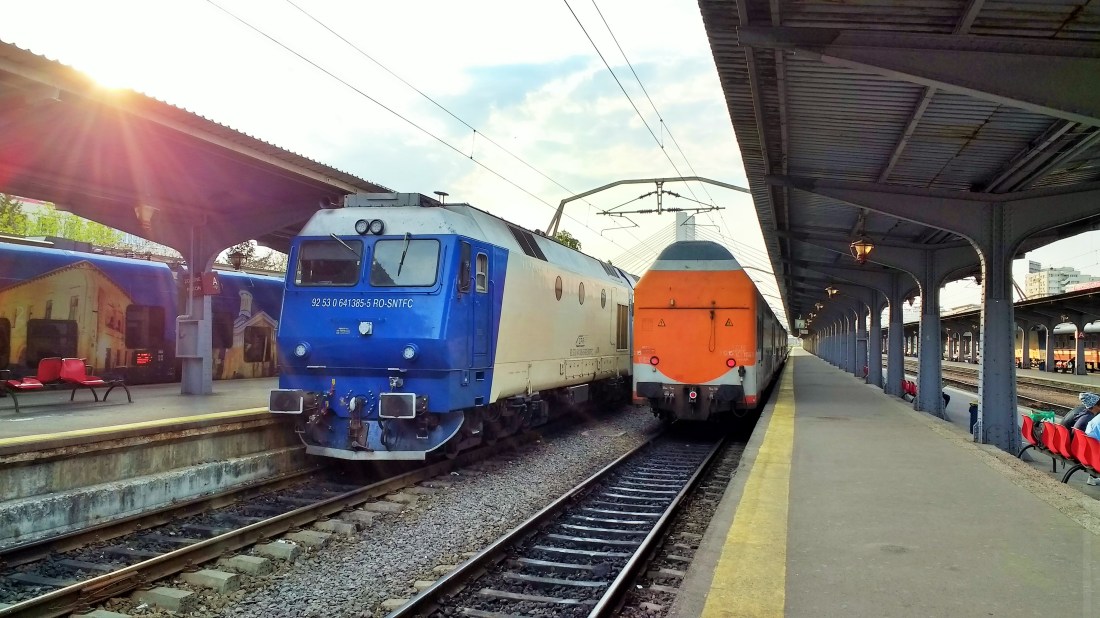
64.1385 at Bucharest Gara de Nord A, 16/04/17 (JW)
I bought a weekly season ticket between Gara du Nord and Buftea which cost 24 Lei (£4.47). This ticket covers almost all the local turns out of Bucharest both Diesel and electric. The wording is “Abonament de calatorie saptamanal, pentru tren regio, pe ruta Buftea – București”. This ticket was invaluable as most trains had teams of ticket collectors on board (as they did in October last year) and people who didn’t have tickets were ejected at the next station, this happened on most of the trains I travelled on.
Most local trains are old double decker ones, generally blue for the local services and orange for the IRs although single deck ones do appear too. One annoying feature about Romanian trains is that a lot of them have pairs up front which are always both manned but you never know if they work or not, I decided that in fairness they probably didn’t power so were not countable but luckily all the ones I had in pairs I also had singularly too.
The morning turn out of B station which should have a 60 DIT, didn’t, the evening turn into B did, so I guess there is another way of getting it to Rosiori Nord for the Alexandria branch.
Only 1 class 60 working was noted that being 60.1038 on the 1640 ex Nord to Slobozia Veche, this train returns the following morning at 0605 to Bucharest Nord. No other class 60s were seen on passenger in the 4 days I was there.
All the local diesel turns were 63, 64, 65 or 82, all the local electric turns 40, 41 or 45. The 1407 which is shown as a pair was single every day.
The Regiotrans trains were all working in push pull mode with the class 425 loco at the Bucharest end, these push as far as Ploiesti Vest and then run around and lead to Brasov, the steep descent into Brasov being given as the reason for this.
The 1937 departure from Nord (not every day) is 43.0069 or 44.0124 of the Astra Transcarpatic Company and cost 16 lei for a single to Ploiesti.
Shack of the trip has to be P.R 1 Buciumeni between Chitila and Buftea with no platforms, no raised ground or anything, nothing, a few trains per day stop there on this double tracked mainline and getting off and getting on is not for the faint hearted but had to be done.
Station by station out of Bucharest
From Nord A blocks to viewing a loco at Nord B is exactly 1km, a good 10 min walk. The “stations” out of Bucharest are dire to say the least, Bucharest Gara du Nord A is the main one and has plenty of shops and McDonalds, KFC, Subway etc. A menu in McDonalds is about £3, there are also a couple of supermarkets selling booze etc. Cans of beer cost about 50p. Gara Du Nord B has a few food and drinks shacks but nothing to write home about.
The above is a link to a YouTube video of user ALEX CFR‘s showing 9 minutes of comings and goings at Basarab.
The first station out is Basarab…. Which quite basically is a length of raised ground covered in rubbish, bit of a leap getting on and off but if the local 80 year old Adas can do it so can I!! No facilities whatsoever although the derelict coaches along the station were burnt out on the Tuesday night which gave something to look at, fairly decent spot to watch the trains into and out of Nord but I really wouldn’t want to hang around pointing an expensive camera at trains. There is a big foot bridge which leads over the tracks and to Grivita metro station where you can catch a metro back to Gara Nord A which also stops at Gara Nord B.
Next along is the junction station of Carpati which is even worse and not a very friendly looking area, hardly any platforms and a bridge you wouldn’t use even if being offered money to do so. No facilities whatsoever but if you walk south for a few minutes you can catch a trolleybus back to Gara Nord B. Everybody and I mean EVERYBODY just crosses the track in Romania, kids, oldies, blokes with donkeys, shopping carts etc, anything goes even in front of the police, it just seems acceptable.
The next station is an oddity in that it has two names, an island platform with one side being called Pajura and the other Triaj – but in reality is the same station. Trains can turn up on any platform in any direction or even the lines without a platform going in either direction so keep your wits about you. Needless to say there are no departure boards or anything. There is a little shack here which sells beer, drinks snacks etc and seems quite popular. From here you can take a walk south through the old yard to Noi station within about 15 minutes, Noi has 1 platform but the trains tend to stop at the line without one. Pajura/Triaj has shelter from the rain whereas the others do not.
Next again is Depoul which is basically a stop for workers (but fine for us) at the depot and has two raised platforms and a bridge!!!!
The above is a link to a YouTube video uploaded by user ANDU2100HP showing Sulzer 60.0864 getting into its stride at Chitila.
The star of the show is the next one at Chitila, raised platforms, a tunnel, ticket office and a bar just outside, a yard is alongside and there is always something there. North of the station runs a bus which you can take to Depoul or Carpati, all stations being a 5 minute walk away.
P.R 1 Buciumeni is the next station which I described earlier, I guess it’s for the signal box but has several trains stopping there in the peak and even the local dogs got bored with me after a few minutes.
There are thousands of dogs in Bucharest, all a bit tatty and sad looking but generally harmless, a couple of years ago they had a purge where over 50,000 were captured – 50% were killed and the rest adopted into families. There are incidents of course, in 2012 over 16000 people were bitten by dogs, mostly older or younger people resulting in 3 deaths which kind of set the dog euthanasia law in to place, resulting in far, far fewer incidents.
Buftea station, raised platforms, a tunnel and a bar, nice and peaceful place where I spent some time yesterday watching a 3 legged dog struggling to eat a loaf of bread. A dog was killed at Basarab station on Tuesday afternoon as I arrived, being chopped completely in half by a light loco, mercifully for it, it was very quick although its carcass remained in full view until at least this morning.
The track layout at Gara Nord A is a mare, a very tight bottleneck opening out into 14 platforms (Gara Nord B has 4) there is a very severe restriction over this bottleneck of about 5-10kph depending on the driver, an amusing thing for me was on Thursday arriving into B at 1857 on 40.0811 (60.0652 DIT) and walking to A to see what was leaving on the 1900 Urziceni service, as I got to the station 63.1143, which I needed, was trundling along platform 7, I noticed the front carriage doors open (totally normal thing in Romania) and estimated that if I crossed the tracks to number 7 that I would reach the train as it passed me at the open door, this worked a treat, I didn’t speed up or anything and the meeting was perfect and on I bailed. There is service from Gara Nord A at 1440 which goes to Bucharest Obor (running around at Pantemilion and then again at Obor to form the 1620 to Fetesti) – an hour’s journey that ends up just 4 miles away.
Don’t be put off by the mayhem of Bucharest, it’s chaotic and downright dirty, full of character and wrecked old trains, just like BR in the 70s… Oh and there is a smallish railway museum on platform 14 at Gara Nord A.
My sincere thanks to Tony for putting this together and allowing me to publish it on the site – I am very grateful to be able to benefit from his expertise! If you have any content that you would like to see here, please contact me.
Two separate events have recently been advertised, both intending to feature multiple Swedish-built “roundnose” NoHAB diesel-electrics in and around Hungary.
The history and background of the fleet of General Motors-engined diesel-electrics supplied by the Swedish firm of Nydqvist & Holm AB (“NoHAB”) to Hungary has previously been explored in an article on this site – and it’s an interesting tale, lurking in the iciest depths of the Cold War. May 2018 marks the 55th anniversary of the arrival of the first machine – M61.001 – and therefore it’s appropriate that they get some time in the limelight.
30th December 2017, Budapest to Tapolca
The first event is on Saturday 30th December 2017 and is a variation on something that has become a bit of an annual institution – similar events having occurred on 30th December 2016 and 22nd December 2015 – taking 8 NoHABs (all 6 surviving M61s and 2 former Danish MYs, one of which has just celebrated its 60th birthday!) from Budapest to Tapolca and return.
The above is a link to a video uploaded to YouTube by user Gábor Szőcsényi of 2016’s 8-NoHAB event.
The 2017 event, however, will have something of a twist. Whereas in the past, all 8 locos have been the head of the same train simultaneously (although not all powering at the same time, causing some headaches for the haulage enthusiasts…), this year will see two separate trains each with 4 machines on the sharp end.
One, named the “Vulkán”, will be powered by M61.019, 459 021 (ex-DSB MY1125), 459 022 (ex-DSB MY1156) and M61.017. The other, named the “Panorama”, will be powered by M61.001, M61.006, M61.010 and M61.020.
Both depart from Kelenföld station in the Budapest suburbs at 08:55 and run to Székesfehérvár, from where there will be a parallel departure of the two trains at 09:55. From there, the “Vulkán” takes the route along the north shore of Lake Balaton, whereas the “Panorama” heads around the south side – the two trains converging on the M61s’ spiritual home of their later years of Tapolca. Each train will return to Kelenföld via the opposite route.
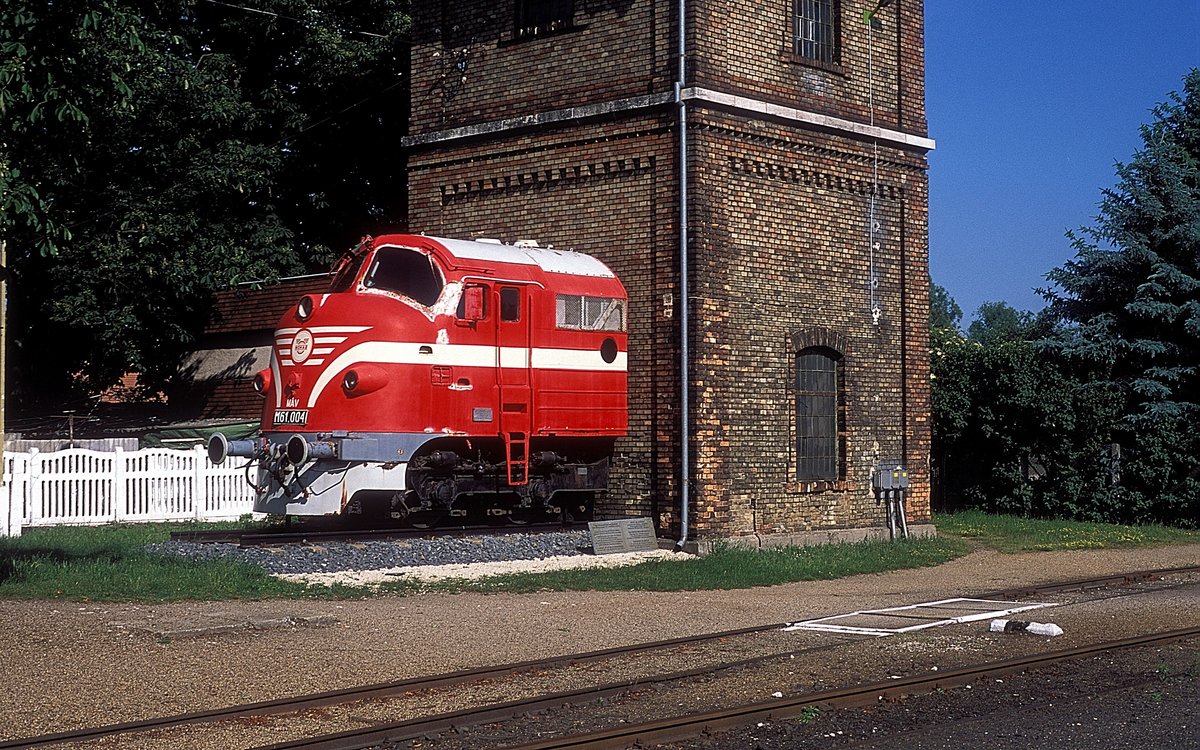
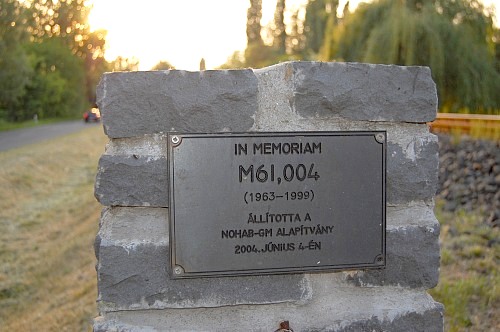
Additionally, the cab of M61.004 will be able to be seen at Tapolca. It has been on display in the vicinity of the station since the 2015 event. This loco was a devastating loss; having already been earmarked for preservation, it struck a fallen tree, derailed and was written off at Badacsonylábdihegy on the north shores of Lake Balaton on 4th June 1999. A memorial stone to the loco has stood at the trackside at the accident site since the 5th anniversary, in 2004 – and, of course, both charters will also pass this spot during the day.
Fares for each train are 5,990 HUF (£17.10 at current prices). It does appear that if you wish to travel behind all 8 during the day, you will need to purchase a separate ticket for each train, but I’m sure you will agree that even then that would still represent superb value for money. More details here.
10th-13th May 2018, Hersbruck to Budapest
A separate event for those with a significantly larger budget has been advertised by the German firm of IGE Erlebnisreisen; a multi-day affair stretching from Thursday 10th May 2018 to Sunday 13th May 2018, featuring 5 of the 6 surviving M61s (the only absentee from the plan as currently advertised is M61.017) along with Altmark Rail’s ex-DSB loco MY1149.
Above is a link to one of Kaspertog‘s videos of MY1149 at work for Altmark Rail in Germany in 2014. This loco will work the trunk sections of the IGE tour in May 2018, it being a long way from its Danish homeland when it rolls into Budapest…
Kicking off from Hersbruck (near Nürnberg) with MY1149, it runs via the main line through Regensburg, Passau, Linz and skirting Wien as far as the Hungarian border at Hegyeshalom, where it is joined by M61.001 for a mainline blast to Budapest.
On the Friday, MY1149 is joined by M61.010 and M61.019 for a circular trip around the lake with a break in Tapolca – out via the north shore and back via the south.
The Saturday sees M61.006 take the train from Budapest Nyugati to Balassagyarmat, on the Slovakian border, and then back to the railway museum in Budapest whereupon there will be a photographic gathering of “as many NoHABs as possible”.
The return on the Sunday is as per Thursday’s outward, but the pilot loco to Hegyeshalom is M61.020.
The total fare for train travel only (not including accommodation) for the four days is €949 (£843.10 at current prices). The organiser has stated that a minimum number of 130 participants signed up by 28th February 2018 is necessary in order for the tour to run.
Additionally, Continental Railway Solution – the Hungarian company that used ex-British Rail class 47, 47375 on a ground-breaking railtour in May 2017 – have recently posted on their Facebook page (link below) that they are hoping to run a charter from Hungary to Kosovo and back using GM power all the way in 2019, the implication being that NoHABs will feature for at least parts of the itinerary.
This idea is reminiscent of a railtour that ran in August 2009 from Augsburg (in south-west Germany) to Kosovo and return that was intended to feature NoHAB power throughout – although sadly MY1125 had to be piloted by Serbian locos (electrics and also a GM class 661 “Kennedy” diesel) when in that country. Additionally, the main train only reached Zvecan, as the contentious political situation in Kosovo prevented it going any further – passengers were conveyed south into Kosovo by road transport in order to travel behind the former Norwegian class Di3 NoHABs eking out their life there.
News from Austria this afternoon, 30th October 2017 is of a remarkable event involving an ÖBB class 1144 “Howling Gale” electric loco, 1144 259.
At approximately 11:50, the 50-year-old driver of the loco, which fortunately was hauling ECS at the time, stepped off the footplate at Neumarkt-Kallham station for a break. However, it appears that the brakes were either not applied or leaked off, as the train then rolled away – unmanned – towards Wels.
As there was no method of automatically bringing the train to a stop, arrangements appear to have been quickly made to bring the 1144 to a halt by bringing it into contact with a Siemens Desiro EMU forming a local service from Linz, which had been evacuated. This occurred at Haiding station, 22 km (13.6 miles) distant.
Further information does not appear to be available just yet, such as the speed of the 1144 at impact, but this is sure to come out as more is known.
Both trains suffered damage, but appear not to have derailed. Fortunately, there were no injuries, but the route has still not fully reopened to traffic.
Although many of us travel to the Continent to broaden our railway horizons, it is understandable that some of the most popular overseas locos amongst British enthusiasts are those which previously plied their trade on these shores. Probably the best-known of these are the Dutch electric locomotives once employed on the much-missed “Woodhead” route between Manchester and Sheffield.
This is a story that goes back quite some way – in fact, September 2017 saw the 70th anniversary of the arrival in the Netherlands of LNER 1,500 V d.c. electric loco no.6000.
1505 (ex-BR E27001 “Ariadne”) at the Manchester Museum of Science and Industry, 05/09/17 (JW)
This story effectively begins in the early years of the last century, when the Great Central Railway looked to electrify its route over the Pennines between Manchester and Sheffield, through the Woodhead Tunnels. This did not proceed, for economic reasons as well as the onset of war, but was revisited after the Grouping by the nascent London & North Eastern Railway (LNER). After a false start or two, the Woodhead electrification plans really got going after the Depression (and based on a the findings of a report by the Railway Electrification Committee led by Sir John Pringle in 1927, a voltage of 1,500 V d.c. was decided upon for main line routes) and some of the infrastructure was constructed, but again the onset of war led to the project being placed on ice. However, work did not stop completely during the years of conflict, and one of the new electric locomotives was manufactured.
One of the last locos to be overseen by Sir Nigel Gresley prior to his death from a heart attack aged 64 in April of that year, locomotive no.6701 was built at the LNER’s Doncaster Works in 1941, but without the electrification of Woodhead, was effectively a locomotive without a railway. It was able to be tested on the LMS (former MSJ&AR) suburban route from Manchester to Altrincham (now part of the Manchester Metrolink) which, again in line with Pringle’s report, had been electrified at 1,500 V d.c. in 1931. However, the character of this 8-mile line did not allow the loco to really show what it was capable of.
The end of the war brought about a set of circumstances that were to prove mutually beneficial. The LNER wanted to put its loco – renumbered to no.6000 in June 1946 – through its paces, but had no appropriate route electrified at 1,500 V d.c. on which to run it. The Netherlands had suffered large-scale destruction during the Second World War – the strategically-located port city of Rotterdam, for example, suffered heavy aerial bombardment both at the hands of the Luftwaffe (prior to German occupation in May 1940) and the RAF (afterwards) that left it in ruins. Its state railway – the Nederlandse Spoorwegen (NS) – had in the 1930s electrified a number of its main line routes (mainly in the south and west of the country) at 1,500 V d.c., but had a chronic post-war traction shortage.
Tommy
As a result, on a lend-lease principle that benefited both parties, no.6000 was dispatched to the Netherlands. Sailing on board the LNER’s train ferry TSS Essex Ferry, it left British soil at Harwich on 3rd September 1947, docking at Hoek van Holland the next day. It entered service on the 15th of that month.
No.6000 saw a number of modifications for use in the Netherlands, but as it was only a temporary visitor, these were not major. Given the fact that it was an anachronistic system even then, its vacuum braking equipment was isolated (but not removed). It gained air brakes, a train heating boiler and was apparently also adapted for push-pull working.
The loco served initially between Utrecht and Eindhoven on both passenger and freight trains. From the end of 1948 it was used on express passenger duties between Amsterdam and Eindhoven, from mid-1949 running through to Maastricht. For the last couple of years of its life in the Netherlands it was mainly used on freight trains, and was regularly seen between Amsterdam and Amersfoort, Amsterdam and Arnhem and on coal trains from the Limburg coalfield.
No.6000 was closely scrutinised in the Netherlands by British engineers, experience with it fed back into the design of the production fleet of EM1s, and 26001 rolled off the production line at Gorton Works in July 1950.
After over four years’ service in the Netherlands, and after having worked over 500,000 km, no.6000 returned home on 23rd March 1952. The NS had by now procured its first fleet of electric locos (the Swiss-derived class 1000), had trialled SNCF class BB300 electrics, which eventually led to the order of class 1100 locos, and the first Baldwin-designed class 1200 electrics had emerged from the Werkspoor factory in Utrecht. Importantly, February 1952 had also seen the first electric trains on the Woodhead route (specifically, between Wath and Penistone) and therefore the machine would no longer be homeless in the UK.
By now, the LNER had ceased to exist with nationalisation, and no.6000 became British Railways no.26000. In a ceremony at London Liverpool Street station (also electrified at 1,500 V d.c., but later re-electrified to 6.25 kV a.c. in 1960 and then again to 25 kV a.c. in the late 1970s), the nickname that it had been given by the Dutch railwaymen who worked it on it – “Tommy”, after the generic name for British soldiers – was officially bestowed upon it, along with an additional plate explaining “So named by drivers of the Netherlands State Railway to whom this locomotive was loaned 1947-1952“.
“Tommy” next went to Gorton Works – which was engaged in the construction of the production EM1s at the time – where he lost his air brakes but retained his steam heating capability, and thence worked over Woodhead for almost two decades, as part of the boilered EM1 fleet that handled much of the passenger traffic. “Tommy” was out of service by 2nd March 1968 and briefly stored at Bury. However, he returned to service over Woodhead for a final six-month hurrah at the end of 1969, whilst the route saw a temporary increase in passenger traffic as a consequence of major work on Totley Tunnel on the Hope Valley route – ironically given what was on the horizon.
Under controversial circumstances, the railway over Woodhead lost its passenger service on 5th January 1970 and, with it, went the need for boilered EM1s. “Tommy” returned to storage at Bury six days later and, tragically given his significance both to the UK and the Netherlands, was scrapped at Crewe in early November 1972. Both his nameplates survive – one in private ownership, and one returned to the Netherlands, presented to the Dutch national railway museum in Utrecht.
This, however, was not the end of Woodhead’s association with the Nederlandse Spoorwegen. In fact, at the time of “Tommy’s” withdrawal, a new chapter was only just beginning.
The EM2s
The “Manchester-Sheffield-Wath” electrification project – including the opening of a new Woodhead Tunnel – had progressed through the early 1950s, and September 1954 saw the completion of electrification throughout from Manchester London Road (now Piccadilly) to Sheffield Victoria. Express passenger trains between the two cities now had a journey time of 56 minutes, which is not appreciably slower than you can travel between the two cities now, over 60 years later.
The post-war expectation had been for electrification not just of Woodhead but of other (ex-)LNER main lines, including up the Great Central main line through Nottingham, Leicester and Rugby to London Marylebone. As a result, 1948 saw the ordering of 27 more powerful, six-axle electric locos of class EM2. However, a wind change in policy (to standardise instead on 25 kV a.c. electrification) saw the order curtailed to just 7 machines.
The first, no.27000, emerged from Gorton Works in December 1953, with the other six (27001-006) following. The decision not to pursue further electrification left the EM2s “landlocked” between Manchester and Sheffield, on one route on which they were never really able to show their true abilities (although railway folklore says that three-figure speeds were reached on occasion); it must be wondered whether the locos would ever have made it off the drawing board if it had been known that they would have such a restricted sphere of operation. The locos received names (six in 1959, and the seventh, 27003 not until 1961) on the theme of ancient goddesses – three Greek and four Roman.
The above is a link to a fascinating 8-minute-long video of a footplate ride over Woodhead in 1965 in the cab of E27004 “Juno” (later NS 1503), uploaded by user Alan Snowdon.
The wind-down of Woodhead passenger services in the mid-to-late 1960s saw the EM2s sidelined by 2nd March 1968. Initially, they were earmarked for movement to the redundant steam shed at Stafford, but their movement from Reddish in April 1968 for storage was actually north to Bury steam shed, along with “Tommy” (and a.c. electrics of TOPS classes 83 and 84), having barely broken a sweat during a criminally short life over Woodhead.
However, the very fact that none of them had reached a million miles meant that they were not by any stretch life-expired. For an operator with 1,500 V d.c. electrification and a need for traction, they would have been an ideal solution…
…re-enter Nederlandse Spoorwegen! In common with many railways in Western Europe in the 1960s (see also the Deutsche Bundesbahn), NS was losing the competition with the private car, and set about exploring drastic measures to attract passengers back to the iron road. Initially, NS looked at procuring a small new class of high-speed electric loco, but it could not afford to pursue this project. Under the banner of “Spoorslag 70”, it looked to implement a high-frequency timetable in the spring of 1970, and still needed more electric passenger locos to deliver this.
The memory of “Tommy” was still well alive on the other side of the North Sea. NS approached BR, and their representatives inspected the EM2s at Bury. On 20th August 1969, a reactivated E27002 “Aurora” was provided for a special train across Woodhead for NS dignitaries and engineers, and the machine put in a storming run, satisfying the Dutchmen who saw the EM2s as the ideal solution to its traction shortfall. Consequently, NS purchased all seven – six for use, and the seventh as a source of spares. It is thought that they were offered fellow Bury resident “Tommy” too, but they saw no use for an eighth machine, certainly not a non-standard one. It’s unfortunate to the 2017 observer that seemingly nobody at the time recognised its significance enough to preserve it, the enthusiasts of the time doubtless preoccupied with the end of BR steam.
The nameplate of E27004 “Juno” (NS 1503), as well as of BR diesels D870, 55020 and others is on display in the Kidderminster Railway Museum. 08/10/11. (JW)
NS 1500s
The EM2s were taken across to the Netherlands the very next month, and fully refurbished at Tilburg works. Unlike with “Tommy”, heavy work was carried out, and the locos gained air brakes, driving positions on the right-hand side of the cabs, new pantographs, along with the requisite Dutch safety systems – plus, of course, the NS yellow and grey livery and new numbers.
The six locos earmarked for use became class 1500 and were numbered 1501-1506 in the order that they left Tilburg between May 1970 and June 1971 (which did not correspond to their BR numbers), with E27005 “Minerva” being the unlucky machine that was cannibalised and then scrapped in November 1969. The machines mainly operated on the axis between Den Haag and Venlo and Maastricht, as well as to Roosendaal.
Masters of their own downfall in some ways, “Spoorslag 70” had been such a success that 1978 saw an order for the 58 modern electric locos from Alsthom (class 1600). This theoretically allowed NS to pursue standardisation further, and withdraw class 1000 and 1500 completely. However, an upturn in traffic delayed the withdrawal of the 1500s until 1986.
As an aside, there are suggestions that NS considered purchasing a fleet of EM1s (by now BR class 76) to work heavy freights out of Europoort in pairs after BR had closed Woodhead in July 1981, but that BR did not want to risk discrediting its claim that they were life-expired by selling them for further use. It has also been said that BR’s decision not to sell them meant that NS was unable to deliver on its intention to electrify the “Havenspoorlijn Rotterdam”; that objective was not achieved until the 21st century.
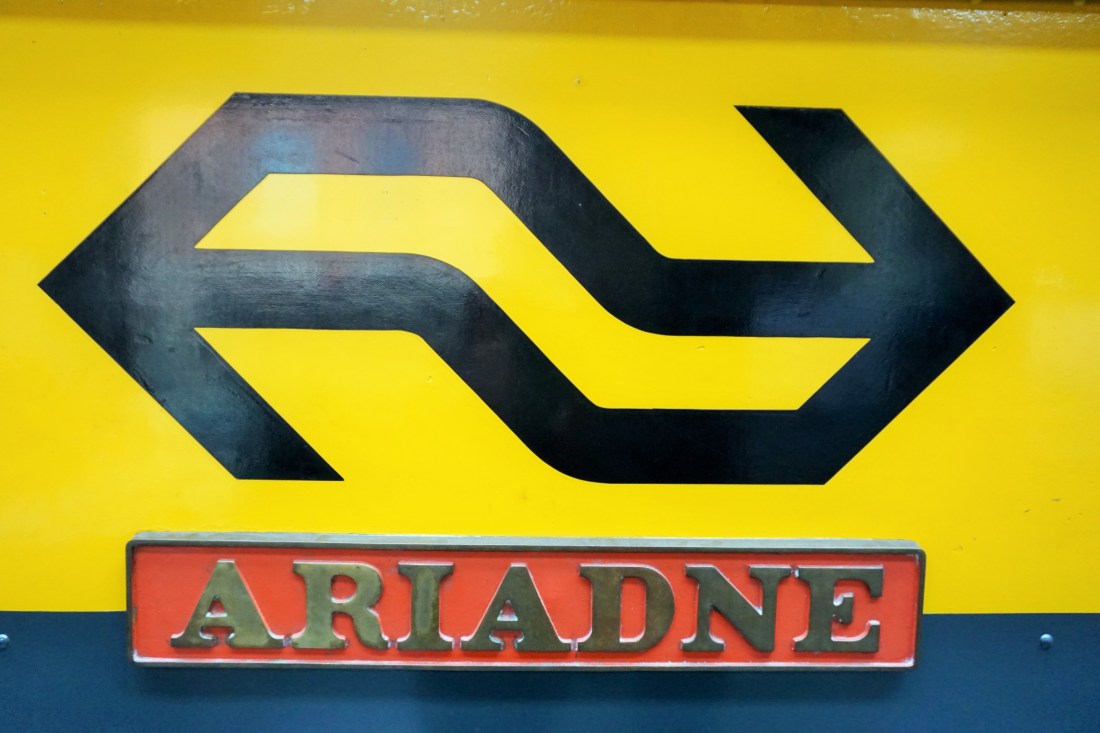
The NS logo and nameplate (regained at the twilight of its Dutch career) on 1505 – ex-E27001 “Ariadne”. 05/09/17 (JW)
Survivors
Three of the six 1500s survive – 1501 (ex-E27003) remaining in the Netherlands, with 1502 (ex-E27000) and 1505 (ex-E27001) returning “home” to the UK.
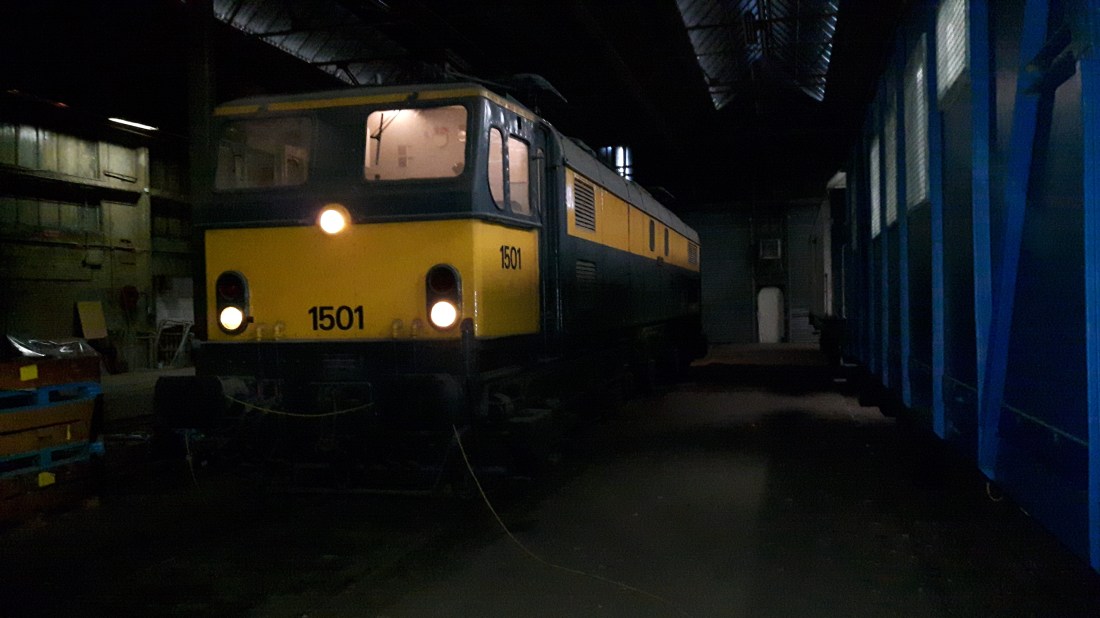
1501 is preserved by Werkgroep Loc 1501/Stichting Klassieke Locomotieven and has worked extensively on the Dutch main line under their ownership. It last ran on 23rd November 2007 (picture link here) – just shy of a decade ago, at the time of writing – and is now stored in their facility at Blerick, near Venlo awaiting restoration. This work has been hampered and delayed by issues with asbestos in the building in which it is housed, but fortunately as of October 2017 this has just been resolved and restorative work can now commence.
Two photos of 1501 at Blerick taken in early 2017, courtesy of Michiel de Wijs of Werkgroep 1501. The “new” (47-year-old!) right-sided driving position can clearly be seen.
The desire to return 1501 to the main line is certainly there, but there are a number of issues currently precluding this, which will be familiar to any British preservation group attempting the same. The biggest is that there seems to be a far greater paperwork barrier to preserved mainline running than existed when 1501 previously ran over NS metals. Problems that require overcoming are a lack of maintenance papers and maintenance history of the locomotive to satisfy the “powers that be”. There is also the perennial problem of a lack of sufficient suitable volunteers for the extensive and serious technical work that must be carried out.
*If you have experience of working on the EM2s in their BR days, or have contact with anyone who does, the group will certainly be keen to hear from you – please contact me and I will put you in touch. Additionally, if you have access to any technical maintenance documentation regarding the EM2s, particularly (but not limited to) their bogies, this may be crucial to helping return 1501 to the main line, and your help would be very much appreciated!*
Of course, limited financial resources form their own barrier, for example to outsource various essential tasks. If you would like to make a donation to the group to help them in their important work, I would invite you to take a look at this link on their website which gives you details of how to make such a bank transfer to them. It is in Dutch, but can be easily translated online (e.g. by copying and pasting the text into Google Translate).
The above is a link to a video on YouTube by Vinkendrecht showing 1501 departing Dordrecht on 24th September 1993.
From the first example to work in the Netherlands to the first to work in England – 1502. The purchase of the former E27000 “Electra” from NS by the EM2 Locomotive Society was negotiated in 1984 and finalised after the loco’s withdrawal in 1986.
In a lovely poetic turn, the transfer of 1502 (and 1505, bound for Manchester – see below) away from Tilburg on the first leg of their journey “home” on 10th July 1986 was done by none other than 1503 (ex-E27004 “Juno”), reactivated from the scrap line especially for this task. This was not the only display of the massive Dutch respect for these machines, for anecdotally hundreds of NS staff who had worked with them over the previous 16 years turned out to wave them off. While 1502 and 1505 moved on to a third life, destiny was not so kind to 1503, which did not evade the cutter’s torch.
For 1502, however, the next chapter of the story was already laid out. She had been invited back to the Netherlands for the 150th anniversary celebrations in 1989, and therefore although repainted into BR green, was not drastically modified, retaining the various accoutrements required for operation on NS metals.
“Electra” was in the Netherlands between May and September 1989, during which she covered more than 3,000 miles on a programme of special operations. However, she has not hauled a train since she returned to the UK, 28 years ago last month – although she theoretically remains operational, and as the EM2LS website states – “a further return to Holland only needs the invitation”!
27000 “Electra” (NS 1502) at the National Railway Museum, York on 05/06/04 (JW)
The locomotive has been returned to BR black livery, as delivered, and is on display at the Midland Railway Butterley.
Membership of the EM2 Locomotive Society is available via this link. The Society are currently engaged in fundraising to restore their Drewry-built overhead line inspection vehicle (OLIVe!) DB998901, which was mindlessly damaged by arsonists in February 2016.
The final survivor is 1505. This machine was donated by NS to the Manchester Museum of Science and Industry, on the express condition that it remained in Dutch livery and condition. It is on display as such in their Power Hall. Initially, NS had earmarked 1506 (ex-E27002 “Aurora”) for this role – however, sadly, that machine suffered fire damage in August 1984 and was later scrapped. 1505 (ex-E27001 “Ariadne”) stepped in.
As mentioned above, it left the Netherlands in the company of 1502, having been taken away from its home of Tilburg by its sister, 1503. It parted company with “Electra” for the final time at Harwich (photo here) and was dragged first to Willesden, then to Warrington Arpley (behind 85015 in the consist of 6X86, a Speedlink service), and finally directly into the museum (by a BR blue class 31). There it remains.
The future
We are lucky to still have half of the 1500s in existence, even if one of them (at least) is unlikely to draw power ever again. It seems hopeful that we will see 1501 hauling trains on the Dutch main line in the future, if they can overcome the current obstacles – and, who knows, perhaps even 1502 one day as well.
There are currently no plans for any event to celebrate the 50th anniversary of the introduction to traffic of the first 1500 (1501 itself) in the Netherlands, which will be on 5th May 2020, but this is clearly a space to be watched.
What does seem very much the case is that even though these locos were built for England, it is the Dutch chapter of their history in which they showed their true capabilities and ensured their place in European traction lore.
Many thanks to Michiel de Wijs and Ian Dobson for their help in the preparation of this article.
Possibly the least-visited area of diesel loco haulage in Germany at the moment – admittedly possibly in part due to the “blandness” of the locos concerned – is the route between Leipzig and Chemnitz, operated by Siemens Eurorunner class 223s.
The area of the former German Democratic Republic (GDR; East Germany) is now a desert in terms of diesel locomotive haulage on passenger trains. The cessation of through running to Szczecin by EC178/EC179 “Alois Negrelli” in Summer 2012 left Summer weekend-only 218-hauled Intercity portions on the island of Usedom as the only booked mainline diesel-hauled trains in the entire (former) country.
223 055 at Chemnitz Hbf (Photo: Darren Fawcett)
The December 2015 timetable change, however, brought something of an oasis to this desert, when the private Mitteldeutsche Regiobahn (MRB) took over the operation of one particular route from the incumbent DB Regio.
The unelectrified 38-mile cross-country route between Leipzig and Chemnitz links what were two of the four largest cities in the GDR – although, of course, Chemnitz was known as Karl-Marx-Stadt in those days. Chemnitz cannot be described as particularly inspiring, being notable for having lots of Communist-era architecture, being the “fallback” target for Allied bombers in February 1945 if Dresden had been covered by cloud, and being widely believed to have the lowest birth rate of any city in the entire world. The route will never win any scenery awards, although there is some interest in the area – for example, it passes within 10 miles of Colditz Castle, the site of the wartime POW camp that was the subject of a famous 1955 movie.
Anyway, back to the trains!
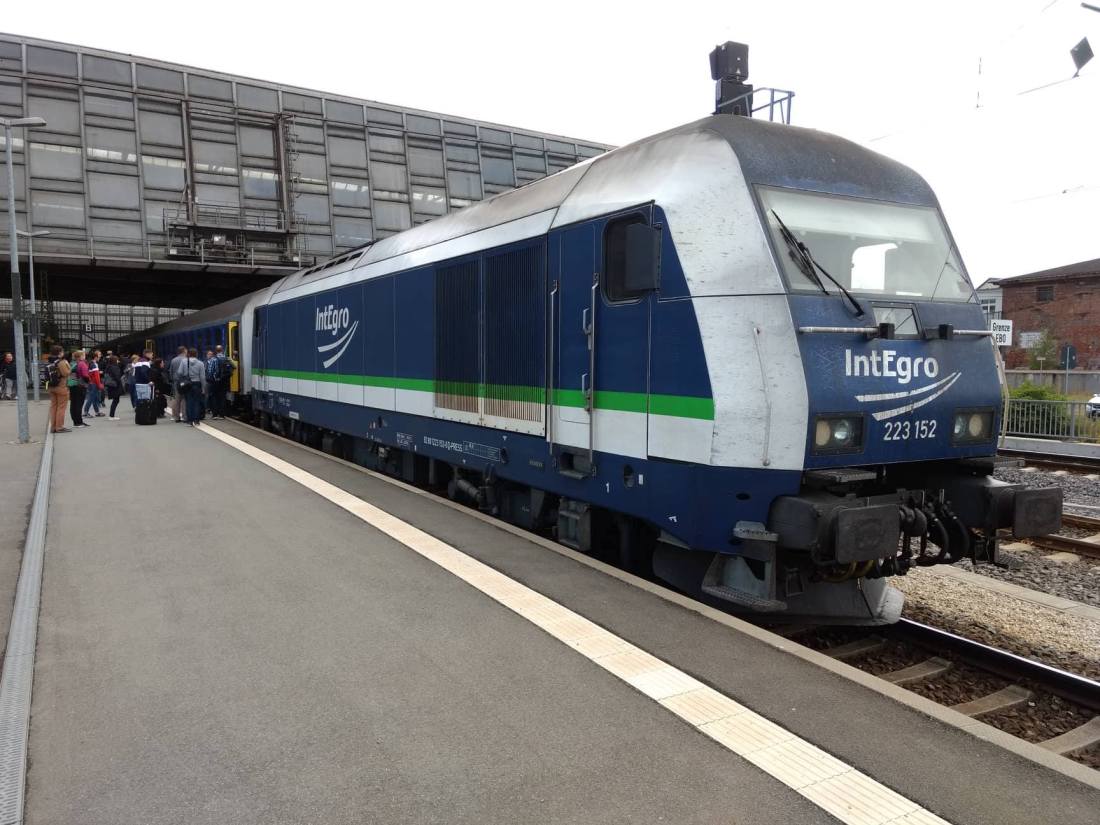
223 152 at Chemnitz Hbf (Photo: Darren Fawcett)
Motive Power
The trains are formed of Siemens “Eurorunner” class 223 diesels – noted for being almost silent! – and four- or five-strong rakes of GDR-era Halberstädter carriages, operated in push-pull mode.
The pool consists of the three machines that were in the fleet of NOB on the “Marschbahn” route prior to their replacement by the troubled 245.2 fleet – 223 053, 223 054 and 223 055 – plus two locos that were new to passenger work; 223 144 and 223 152.
However, at the time of writing, 223 152 had been hired to ALEX for use on diesel-hauled passenger services in the Bayern region. In September/October 2017, it had previously been engaged on the island of Rügen with one carriage, replacing the usual class 650 single-car DMU on the shuttle from Bergen auf Rügen to Lauterbach Mole while it received works attention.
Moves
Three sets of stock (and, consequently, three locos) are in use 7 days a week between Leipzig and Chemnitz each day, and moves are very easy to put together.
Departures are hourly from each end (xx:20 from Leipzig and xx:31 from Chemnitz) with an end-to-end journey time of 59 minutes.
Heading towards Chemnitz, the “leaping shack” is Geithain (+5), and heading towards Leipzig, Narsdorf (+9) and Bad Lausick (+39). Therefore all three turns can be covered in, for example, a “Leipzig > Geithain > Bad Lausick > somewhere” move in just over an hour.
The above is a link to a YouTube video uploaded by user SvenRailworld showing 223 054 making a sprightly departure from Leipzig Hbf in February 2016.
Controversy
Although pleasing from an enthusiast’s perspective to see a revival of loco-hauled operation an environment where it is otherwise in its death throes, it has not been universally welcomed by the locals.
The increased noise levels (not in terms of engine noise, but of wheel-on-rail and of the cast iron brakes of the stock) have gained much criticism in a country that culturally values silence – and that is not to mention that lack of air conditioning, slam doors etc that have generally been perceived as a backwards step by those that use them every day.
There have also been reports of trains with no serviceable toilets, as well as (unrelated to the rolling stock) driver sickness causing cancellations on the route.
223 053 at Leipzig Hbf (Photo: Darren Fawcett)
The Future
The MRB have the franchise for the route until 2023 – at least – and it seems as if the class 223 locos and Halberstädter stock will continue in use until then, although it must be wondered whether the sheer weight of public discontent will force another solution sooner.
Update 31/03/18: The above words must have been prescient as it was announced in the last week of March 2018 that replacement coaching stock will be obtained ASAP. Also, a further loco will be available after Easter 2018 to provide greater operational resilience, although its number is not yet known.
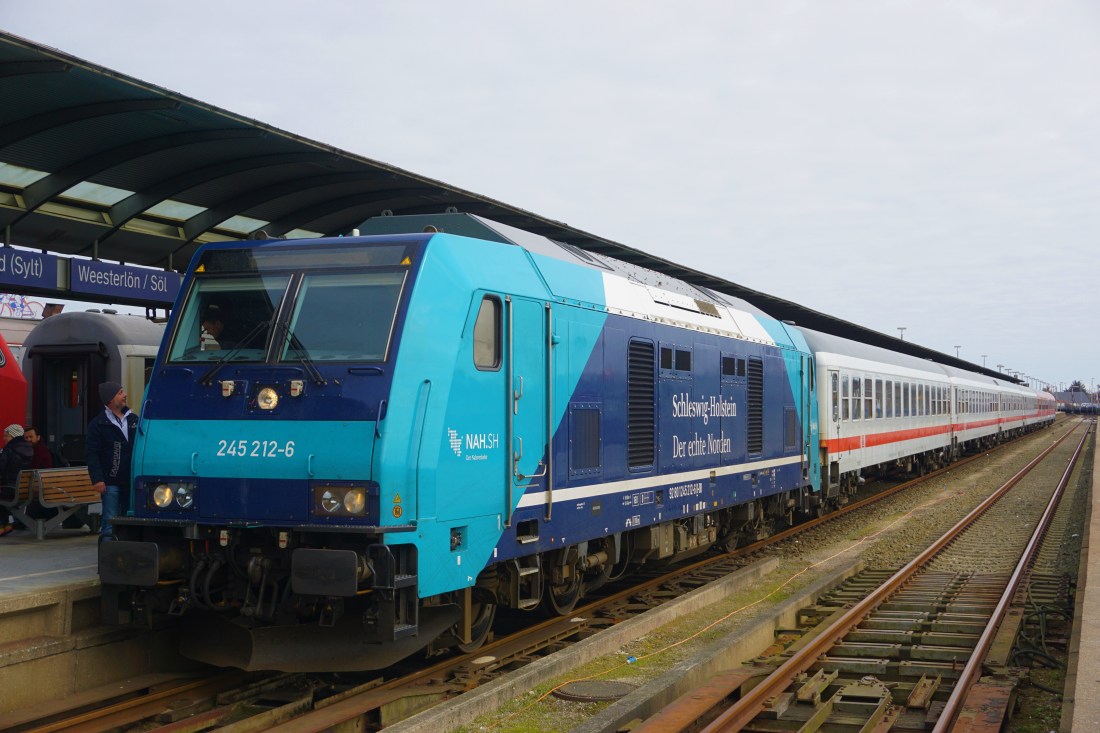
245 212 at Westerland on a rake of drafted-in DB Intercity stock, 08/04/17 (JW)
Regional traffic on the Hamburg to Westerland “Marschbahn” route has been suffering from disruption for some time, and this does not look to end any time soon. From a haulage and photography perspective, this may result in some interesting opportunities to remain present until Spring 2018.
This passenger rail traffic on the Marschbahn is some of the most important in Germany, given that the railway represents the only fixed transport link between the mainland and the North Sea island of Sylt, via the Hindenburgdamm causeway. Sylt is a popular tourist destination, and it relies on the train service over the causeway to function effectively – all road traffic has to be conveyed on trains to and from Niebüll, and this itself has been a particular political hot potato over recent years.
The operation of the Hamburg to Westerland regional passenger trains passed from DB Regio to the private operator Nord-Ostsee-Bahn (NOB) at the December 2005 timetable change. NOB retained the franchise for 11 years, operating the service with little fuss with a mixture of Siemens class 223 and MaK class 251 diesel locomotives.
Motive Power
2014 marked the root of the current problems. The organisation that co-ordinates public transport in Schleswig-Holstein – now known as “NAH.SH” – decreed that a fleet of 15 brand-new Bombardier Traxx class 245.2 locomotives (245 201-215) would be procured by the investment company Paribus for use specifically on the Marschbahn regional trains, regardless of operator. These entered traffic from late 2015. At about the same time, it was announced that the franchise would be returning to DB Regio as of the December 2016 timetable change, using the 245.2s and the existing Bombardier “Married Pair” carriages.
However, problems with the 245.2s have been legion since day one. Initially, they suffered from frequent overheating issues and required fire brigade attendance worryingly often. Software problems have been frequent and oil and coolant issues have been frequently reported as the cause of failures too. This is over and above an acceptable level of “teething troubles” and is clearly unsustainable. In October 2017 it was announced that they must again go through a rolling programme of works visits for software updates and that the fleet is not expected to be back at the planned-for level of availability until Spring 2018.
Part of the problem, it is commonly believed by railwaymen and observers alike, is that the 245s are very technology-heavy locomotives, a fleet of which has been ordered without any real prototype having been tested. Throughout the entire history of (West) German diesel and electric motive power, all new technology has been thoroughly tested on the duties expected to be carried out before an order is placed – here, we are seeing issues being discovered for the first time on the front line. The Marschbahn is far from flat and the locos get very warm on these demanding duties.
With a full fleet of 245.2s unable to be fielded, DB Fernverkehr Niebüll depot’s allocation of 245.0s (245 021-027) have been pushed into service on these diagrams, with at least one such loco being in use on these workings each day. Originally procured to replace pairs of 218s on Intercity and car train workings, their own poor account of themselves has seen them generally relegated to half-length Niebüll to Westerland car trains only – although it is technically possible to get haulage from these (thanks to the “Sylt Shuttle Plus” DMU workings that attach to the rear of the car trains – article on this in production), they are otherwise very rare on passenger trains.
Additionally, a number of class 223s and 251s have been called back to the Marschbahn to help prop the service up. It is unclear whether these machines will be easily ridden behind once the 245.2s are back in action.
Only one class 218 “rabbit” diesel-hydraulic working has been recorded on the regional traffic since the troubles began – when 218 381 piloted an early morning southbound service to save on a light engine path. Further 218 use is not expected on these services as they are booked to be worked entirely by drivers who no longer sign them.
October 2017 has also seen problems with class 245s hit the headlines in the Frankfurt area – perhaps surprisingly given they have five locos (245 016-020) for four very leisurely peak hour-only diagrams. Commuters were reported as being “left in the lurch” specifically by 245s, which suffered three fires in just eight days.
Of note, the Intercity traffic on the Marschbahn – almost entirely in the hands of pairs of 40-year-old class 218s – is not affected. These locomotives continue to provide sterling and reliable service, and some are even being put through Bremen works even now, ostensibly to continue to work on Intercity duties on this route until 2025.
Carriages
The “Married Pair” carriages are also providing trouble. On 11th November 2016, a coupling defect was identified with one of the vehicles that led to the entire fleet of 90 being immediately withdrawn from traffic. Even now, nearly a year later, only 68 are back in service. This has led to all manner of scratch sets being formed from withdrawn Intercity and “fresh air” regional stock obtained from across Germany.
Indeed, DB Regio, which inherited the fleet at a time when none of the vehicles was operational, are apparently considering pursuing NOB for some form of compensation.
8 Belgian class 21 electric locos have been moved across the continent to Poland this week, although there is currently not a lot of information regarding what is planned for them.
One of the 21s now currently in Poland – 2125 seen at Gent Sint Pieters on 04/04/14 (JW)
8 withdrawn examples of the Belgian class 21 have now arrived at Bydgoszcz depot, after a two-week journey across Europe, although there is currently a lot of conjecture but no confirmation as to why this is. The fact that some plans were afoot was reported on this site’s sister Facebook page as long ago as 11th July, when the documentation was prepared for four of the machines to travel east, but at that point it was thought that they were heading to the Czech Republic. The story then went quiet until they set off at the start of this month.
It appears that the general consensus is that they are either for reactivation by CZ Loko – the Czech firm that has recently refurbished similar ex-Belgian loco no.1203 as the prototype “Effiliner 3000” loco – now sold to, and in use by, IDS Cargo – or DEPOL, a firm local to Bydgoszcz notable for having some former East German “Ludmillas” in its fleet. According to Rynek Kolejowy, both companies have neither confirmed nor denied the suggestion.
Poland shares the Belgian 3,000V dc electrification system so there is no technical barrier to the 21s operating there (other than fitment of safety equipment etc, and it is believed that they require an element of asbestos removal). This voltage is also used in the Netherlands, Italy, Slovakia, some of the Czech Republic and Slovenia.
This 60-strong class of electric locos were built by BN in the mid-1980s, and the first withdrawals began in 2014 as the class 18 and 19 Siemens Vectrons and new EMUs bedded in, although many remain in traffic in Belgium.
The machines in question are: 2103, 2104, 2109, 2119, 2120, 2125, 2128 and 2129. Of note is that 2119 was involved in the Buizingen train crash on 15th February 2010 – the most deadly railway accident in Belgium in recent times – although it was undamaged as it was at the rear of its train.
Among the most popular French locomotive types are the class CC6500 express electrics. Retired from main line use for over a decade, there are currently two in working order, and Saturday 9th December 2017 sees both in use on the same day.
This class of 200km/h 1.5kV dc electrics were the crack express locos of their day in pre-TGV France, and are one of several types built to Paul Arzens’s classic “broken nose” styling. 74 were built – with a further 4 converted in the 1990s from CC21000 class locos (one of which, CC21003, had been tested between Washington DC and New York by Amtrak in 1977) – but only 2 remain in occasional service on the main line; CC6558 and CC6570.
CC6558 is painted in green livery, and is notable as one of the 21 machines that were actually built as dual voltage, to also operate on the 1.5kV dc third rail system on the Maurienne route from Chambéry to Modane, which was converted to overheads in 1976. It is perhaps a little odd to see photos of these machines hauling trains with no catenary in sight!
CC6570, meanwhile, is painted in the attractive burgundy and orange “coup de soleil” (sunburn) livery.
CC6558
CC6558 is working a short-but-sweet railtour from Chambéry (where it is based) to Lyon and return, in connection with the Festival of Lights and the Christmas market there. Lyon is France’s second-biggest city and is a UNESCO World Heritage site so is surely worth a visit!
The tour departs Chambéry at 13:59 and returns from Lyon Perrache at 23:40, with a journey time in each direction of appoximately two hours. The fare for the round trip is a bargain €23.
The tour is operated by the APMFS (l’Association pour la Préservation du Matériel Ferroviaire Savoyard) and more details can be found on their site here.
The above is a link to a YouTube video by user Paul Mollard showing CC6558 on the same working five years ago.
CC6570
CC6570’s duty is from Avignon-Centre to Arles and return and is essentially a Santa Special, with treats and entertainments for children on board. The route is circular, travelling out via Cavaillon, Salon and Miramas, and back via Tarascon, and the train performs this loop twice – at 15:00 and 17:00 from Avignon. The second of these can even be easily reached from the 07:52 Eurostar from London to Paris that morning.
The fare for a round trip is a supremely reasonable €12, and there is an option to travel outwards on the first, have a break of two hours in Arles, then return on the second.
This tour is operated by APCC6570, and more details can be found on their site here. Update 25/11/17: this tour is now fully booked.
The above is a link to a YouTube video by appropriately-named user Nez Cassés showing CC6570 on the main line in 2016.
Cranks’ Itinerary
Whilst the clash is perhaps unfortunate in some respects, you may be interested to know that you can comfortably travel behind both during the day – and given the very cheap prices involved, missing part of a tour is not necessarily the end of the world.
Following the arrival of the second round trip from Avignon to Arles with CC6570 (departs approx 17:00 and returns approx 19:00), you can travel on the 20:27 local train to Avignon TGV, a TGV to Lyon Part-Dieu, and then another local train into Lyon Perrache, arriving at 22:43 and giving you a nice +57 onto CC6558’s return working (of course, what you then do at 01:42 at Chambéry is up to you!).
An advance through ticket from Avignon-Centre to Lyon Perrache on these service trains is currently available on the SNCF website (at the time of writing) at €14.50, meaning that the entire itinerary including both CC6500s and transport between them is theoretically available for less than €50.
One type of diesel loco extinct in the Netherlands is the NS class 2000 – 65-ton 600hp Whitcombs built for, and used by, the US Army Transportation Corps during World War 2 for their operations in Europe, of which NS acquired 20 after the end of the war. All were out of service and subsequently scrapped by the early 1960s.
However, the Stoomtrein Goes-Borsele have now finally succeeded in acquiring an example of the same type from industrial use in the States – works no.7989 of 1943, which has been in use up until fairly recently on the internal system of Lehigh Cement in Mason City, Iowa. It is to be loaded onto a ship tomorrow, 19th October 2017, and should arrive in Antwerpen in mid-November. Link to photos here and below.
Congratulations to the SGB on achieving their goal, and I’m sure many of us are very keen to see it back in action!







 European Traction