4th and 5th June 2017: Rare “Rabbit” haulage near Frankfurt

5492259865_57962a2e5a_o

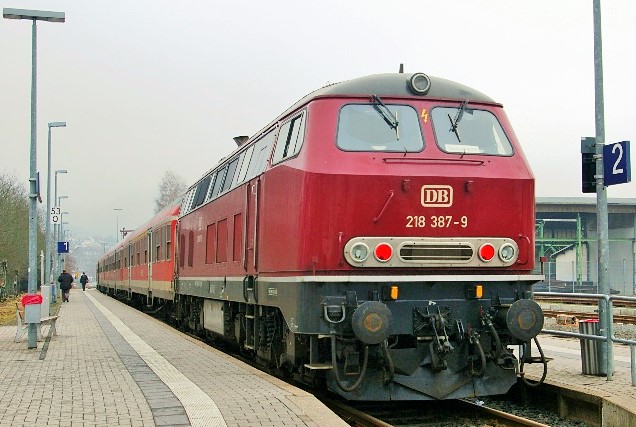
218387 at Marburg (Lahn), 16/02/11 (JW)

Edit: On Saturday 3rd June 2017 it was announced that these duties would now be covered by 203152 – ex-DB 202818.  218387 is currently based at Hamburg along with 218460 “Conny” ostensibly in order to haul IRE18447 06:55 Hamburg Hbf to Berlin Ostbahnhof on Monday mornings until 31/07/17 due to a diversion via the non-electrified slow line east of Stendal.  This article will be left up for historical interest.

Ex-DB class 218 no.218387 will be working special trains in connection with a special event near Frankfurt over two days at Whitsun.

In connection with a special event at Königstein for Pfingsten (Whitsun), two shuttle trains will operate along the 9-mile branch line between there and Frankfurt-Höchst on Sunday 4th and Monday 5th June 2017 – one with steam haulage and one with diesel.

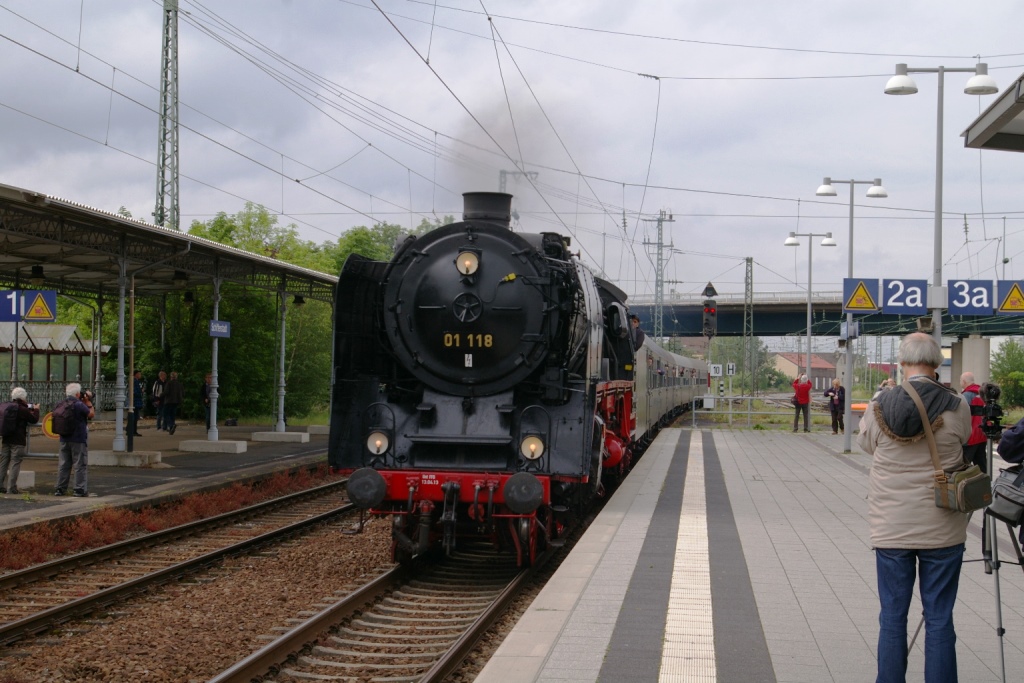
The traction for the steam shuttle will be 2-10-0 “Kriegslok” 52.4867, and/or Pacific 01.118.  The diesel shuttle is arguably of more interest to the haulage fan, as it is planned to be powered by class 218 “rabbit” diesel loco no.218387.

Built by Henschel in 1975, 218387 was allocated to Kaiserslautern and Regensburg depots for the majority of its life, before it passed to the Kurhessenbahn (a DB Regio subsidiary) in 2008.  This being an entirely DMU-worked operation, its appearances on passenger trains in the last decade have been restricted to special events and sporadic hires to other depots.

These have included a stint in early 2011 where 218387 (by now painted in the “heritage” livery of DB altrot) and a rake of stock substituted for DMUs on certain services between Marburg (Lahn), Bad Laasphe and Erndtebrück; a short spell at Niebüll later that year where it was used on Marschbahn Intercity workings and at least one to Fehmarn Burg; and a couple of months in 2013 when it joined Kempten’s 218 fleet, working regional services in Bayern.

5492891524_dd02f36bc4_o

218387 trying to brighten up a very gloomy Bad Laasphe, whilst on “vice DMU” workings from Marburg, 16/02/11 (JW)

Its last known passenger workings were in September 2015 at the “Kurhessenbahnfest” event – since then, ownership has passed to the Brohltalbahn, but it is being hired back by its former operators.  Obviously time will tell what the future holds for it.

218387 is planned to work the following shuttles on both days:-

11:27 Frankfurt-Höchst to Königstein
12:25 Königstein to Frankfurt-Höchst
13:27 Frankfurt-Höchst to Königstein
14:25 Königstein to Frankfurt-Höchst
15:27 Frankfurt-Höchst to Königstein

16:25 Königstein to Frankfurt-Höchst

The timings for the steam shuttle are as follows:-

09:42 Königstein to Frankfurt-Höchst
10:27 Frankfurt-Höchst to Königstein
11:25 Königstein to Frankfurt-Höchst
12:27 Frankfurt-Höchst to Königstein
13:25 Königstein to Frankfurt-Höchst
14:27 Frankfurt-Höchst to Königstein
15:25 Königstein to Frankfurt-Höchst
16:27 Frankfurt-Höchst to Königstein
17:25 Königstein to Frankfurt-Höchst
18:08 Frankfurt-Höchst to Königstein (Sunday Only)


IMGP0643

01.118 steams into Schifferstadt during a “Plandampf” event, 30/05/14 (JW)

Practicality

Special tickets are required for travel on the service and are available to buy on the train; €15 for a round trip, and a number of single-ticket options are also available.

It will be possible to change trains at the quite brief connections at the “crossing point” of Kelkheim, should you so desire.  The “timetabled” unit-worked local trains will also continue to run up and down the branch; these being extras inserted into the timetable.

In addition, Königstein will see an exhibition from 10:00 to 17:00 each day, including a number of items of rolling stock on static display, and the all-important beer garden!  Cab rides will also be provided on an (as yet unspecified) diesel loco.

More details (in German) here.

What can I combine it with?

Monday 5th June also sees another low-price, short-distance heritage traction working in the general area.  Ex-ÖBB class 1020 electric, 1020.010 (as DRG E94.088), a “Krokodil” dating from 1943, is advertised to work three short circular tours from Ludwigsburg top and tail with a steam loco, departing at 10:20, 12:20 and 14:20 and taking roughly 90 minutes.  It would be easy to combine the first of these with the event at Königstein.

MONTH 010 - OCTOBER

218387 at Buchloe after working a commuter train from München, 10/10/13 (JW)

Various dates in 2017 – heritage diesel and steam in north-east Germany

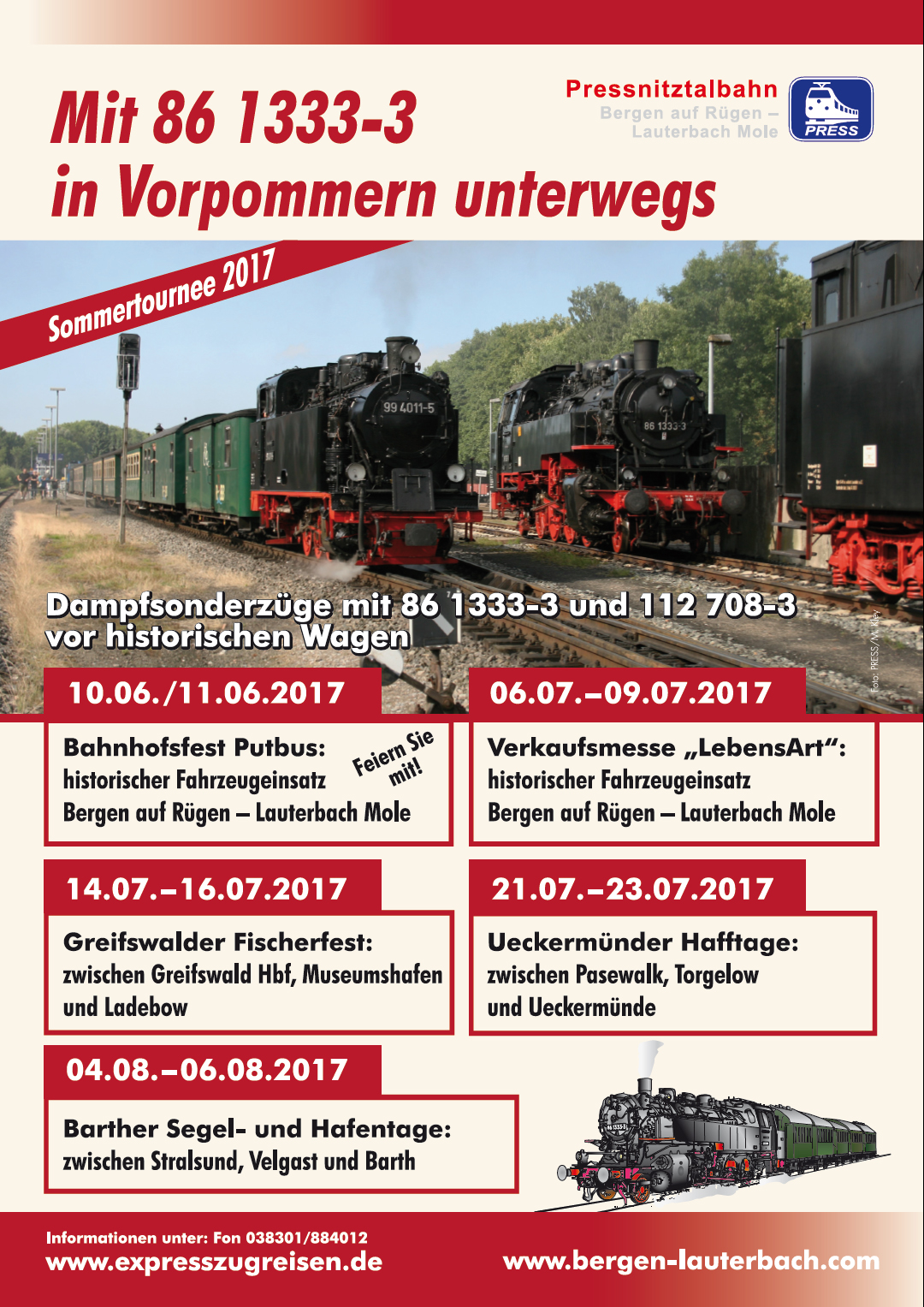
The Pressnitztalbahn’s 2-8-2 steam loco 86.1333, dating from 1939, normally resident in Glauchau, will spend Summer 2017 in the far north-east of the former East Germany, and is advertised to work a number of special trips top-and-tail with V100 class diesels.

The first advertised workings are specials on the island of Usedom, featuring the 86 working top-and-tail with 110 001, a centre-cab diesel-hydraulic of the former Deutsche Reichsbahn – which later became 201 001 of DB after reunification.  More details here.  (To note that the Intercity services that previously brought a class 218 “rabbit” onto the island of Usedom on summer weekends does not run this year).

Friday 12/05/17

Four round trips from Seebad Heringsdorf to Zinnowitz.

Saturday 13/05/17

Four round trips from Seebad Heringsdorf to Zinnowitz.

Sunday 14/05/17

Four round trips from Seebad Heringsdorf to Zinnowitz.

The rest of 86.1333’s summer workings are advertised as being top-and-tail with a different V100 – 112 708 (DB 202 708).  They cover a number of different branch lines in their area of Vorpommern, none of which usually see loco haulage these days, and one of which is freight-only.  Details for all of these can be found here.

Saturday 10/06/17

Shuttles between Bergen auf Rügen and Lauterbach Mole.

Sunday 11/06/17

Shuttles between Bergen auf Rügen and Lauterbach Mole.

Friday 07/07/17

Shuttles between Bergen auf Rügen and Lauterbach Mole.

Saturday 08/07/17

Shuttles between Bergen auf Rügen and Lauterbach Mole.

Saturday 09/07/17

Shuttles between Bergen auf Rügen and Lauterbach Mole.

Friday 14/07/17

Shuttles over the freight line between Greifswald and the docks at Ladebow.

Saturday 15/07/17

Shuttles over the freight line between Greifswald and the docks at Ladebow.

Sunday 16/07/17

Shuttles over the freight line between Greifswald and the docks at Ladebow.

Friday 21/07/17

Shuttles between Pasewalk and Ueckermünde

Saturday 22/07/17

Shuttles between Pasewalk and Ueckermünde

Sunday 23/07/17

Shuttles between Pasewalk and Ueckermünde

Friday 04/08/17

Shuttles between Stralsund Hbf and Barth

Saturday 05/08/17

Shuttles between Stralsund Hbf and Barth

Sunday 06/08/17

Shuttles between Stralsund Hbf and Barth

DB “Ludmillas” – current status

232583

232 583 at Szczecin Glowny, 17/05/12 (JW)

One of the most popular European diesel locomotive types is the “Ludmilla” family; powerful machines built in the Soviet Union for the Deutsche Reichsbahn of East Germany.  Of a total fleet of 873 locos, only 242 are thought to remain extant – roughly a sixth of which have now left Germany.

OLYMPUS DIGITAL CAMERA

One of the machines now in Romania is 232653, seen here at Berlin Schönefeld Flughafen on a very long freight train, 21/04/06 (JW)

This article is not intended as a history of these locos, although I am in the process of writing one.  Rather, this is a roll-call of those that have survived to the current date (01/05/17), with details of where they can now be found, plus dates of recent photographs and sightings, with links to them.

This list is correct and up-to-date to the best of my knowledge, but trying to keep tabs on several hundred locomotives spread across the continent can be like herding cats – so if you’re aware of any corrections required, please let me know!

DR Class 130 / DB Class 230

130 002 Interessengemeinschaft Bw Dresden-Altstadt, Dresden, Germany Static Display 17/04/2016
130 012 PHU Lokomotiv Bronisław Plata, Podegrodzie, Poland Spare Parts
130 077 Bahnlogistik 24 GmbH, Dresden, Germany – as 230 077 Operational 24/02/2016
130 101 BSW-Gruppe Traditionsgemeinschaft Bw Halle, Halle (Saale), Germany Operational 05/07/2015

DR Class 131 / DB Class 231

131 001 BSW-Gruppe Traditionsgemeinschaft Bw Halle, Halle (Saale), Germany Static Display 03/07/2010
131 011 ArcelorMittal Eisenhüttenstadt Transport GmbH, Eisenhüttenstadt, Germany – as 232 107 Operational
131 012 Wedler Franz Logistik GmbH, Germany – as 231 012 Operational 22/04/2017
131 015 STRABAG, Berlin, Germany – as 232 105 Operational 06/12/2016
131 034 Ecco Rail, Będzin, Poland – as BR231-063 Operational 17/11/2016
131 050 stored at Neustrelitz Works, Germany – as 231 050 Stored
131 056 Orion Kolej, Z.P., Nowy Sącz, Poland – as BR232-035 Operational 27/01/2017
131 060 Sächsisches Eisenbahnmuseum, Chemnitz-Hilbersdorf, Germany Static Display 29/08/2015
131 070 Privately owned, Falkenberg, Germany – as 231 070 Static Display 13/09/2009
131 072 Bahnbetriebswerk Arnstadt, Germany Static Display 19/09/2015
131 075 Ecco Rail, Będzin, Poland – as BR231-014 Operational 26/07/2015

DR Class 232 / DB Class 232, 233, 234 and 241

232 004 Leipziger Eisenbahnverkehrsgesellschaft, Leipzig, Germany – as 132 004 Operational 06/04/2017
232 005 DB Cargo, Germany Operational 30/03/2017
232 008 Starkenberger Baustoffwerke GmbH, Starkenberg, Germany – as 241 008 Operational 27/04/2017
232 010 Thüringer Eisenbahnverein, Weimar, Germany – as 132 010 Static Display 30/05/2015
232 022 DB Cargo Romania, Romania – stored at Constanta Spare Parts
232 040 DB Cargo, Germany – as 233 040 Operational 27/08/2016
232 043 DB Cargo, stored at Chemnitz, Germany – as 233 043 Stored
232 045 DB Cargo, Germany Operational 20/02/2017
232 049 Pol-Miedź Trans, Poland – as BR232-049 – badly damaged at Bolesławieci, 30/07/2015? Scrapped? 12/04/2013
232 050 Przedsiębiorstwo Obrotu Surowcami Wtórnymi „DEPOL”, Bydgoszcz, Poland – as BR232-781 Operational 13/04/2017
232 055 DB Cargo, stored at Chemnitz, Germany Stored
232 057 ArcelorMittal Eisenhüttenstadt Transport GmbH, Eisenhüttenstadt, Germany – as 232 850 Operational 24/01/2017
232 068 Leipziger Eisenbahnverkehrsgesellschaft, Leipzig, Germany – currently as MEG 313 Operational 04/03/2017
232 072 Wedler Franz Logistik GmbH, Germany – as 232 901 Operational 21/12/2016
232 073 Przedsiębiorstwo Obrotu Surowcami Wtórnymi „DEPOL”, Bydgoszcz, Poland – as BR232-789 Operational 21/07/2016
232 076 DB Cargo, stored at Chemnitz, Germany – as 233 076 Stored
232 079 DB Cargo, Germany Operational 22/02/2017
232 083 DB Cargo, stored at Chemnitz, Germany Stored
232 088 EfW, Frechen, Germany Operational 24/01/2017
232 090 Rail Time Polska, Warszawa, Poland – as BR232-090 Operational 13/10/2016
232 092 DB Cargo, Germany Operational 29/03/2017
232 093 DB Cargo, Germany Operational 25/04/2017
232 096 Unknown, last reported at Eisenach ??
232 103 Leipziger Eisenbahnverkehrsgesellschaft, Leipzig, Germany – stored at Delitzsch Stored 02/04/2017
232 104 PUK Kolprem, Dąbrowa Górnicza, Poland – as BR232-037 Operational 11/06/2016
232 105 DB Cargo, Germany Operational 28/03/2017
232 109 Leipziger Eisenbahnverkehrsgesellschaft, Leipzig, Germany – as 132 109 Operational 20/04/2017
232 112 DB Cargo, Germany – as 233 112 Operational 28/07/2016
232 117 DB Cargo, Germany Operational 29/04/2017
232 118 DB Cargo, stored at Hamm, Germany – as 233 118 Stored
232 122 DB Cargo Romania, Romania – as 651 010 Operational 18/01/2014
232 127 DB Cargo, Germany – as 233 127 Operational 01/07/2016
232 128 DB Cargo, Germany Operational 10/09/2016
232 131 unknown ?? 01/12/2016
232 135 DB Cargo Romania, Romania – as 651 013 Operational 25/03/2017
232 141 Wedler Franz Logistik GmbH, Germany Operational 19/04/2017
232 151 DB Cargo, stored at Hamm, Germany – as 233 151 Stored
232 154 Przedsiębiorstwo Obrotu Surowcami Wtórnymi „DEPOL”, Bydgoszcz, Poland – as BR232-561 Operational 27/12/2016
232 155 Starkenberger Güterlogistik GmbH, Starkenberg, Germany – as V300 005 Operational 07/04/2017
232 158 Leipziger Eisenbahnverkehrsgesellschaft, Leipzig, Germany – as 132 158 Operational 23/12/2016
232 161 DB Cargo, stored at Hamm, Germany – as 232 902 Stored
232 170 DB Cargo, stored at Hamm, Germany – as 232 903 Stored
232 173 DB Cargo, stored at Chemnitz, Germany Stored
232 176 DB Cargo, Germany – as 233 176 Operational 22/10/2016
232 179 DB Cargo, stored at Halle (Saale), Germany – as 233 179 Stored 29/04/2017
232 182 Leipziger Eisenbahnverkehrsgesellschaft, Leipzig, Germany – stored at Delitzsch Stored
232 184 Exported to Poland, future user TBC Stored 19/03/2017
232 189 DB Cargo, Germany Operational 14/02/2017
232 201 DB Cargo, Germany Operational 18/03/2017
232 206 DB Cargo, stored at Chemnitz, Germany – as 233 206 Stored
232 209 DB Cargo, Germany Operational 13/11/2016
232 217 DB Cargo, Germany – as 233 217 Operational 15/02/2017
232 219 DB Cargo, Germany – as 233 219 Operational 01/03/2017 + rep. wkg. on DSO 21/04/17
232 223 DB Gleisbau, Germany Operational 02/12/2016
232 227 Ecco Rail Sp. z o.o. g, Będzin, Germany – as BR232-446 Operational 11/05/2016
232 229 Leipziger Eisenbahnverkehrsgesellschaft, Leipzig, Germany – stored at Delitzsch Stored 29/07/2016
232 230 DB Cargo, Germany Operational 26/04/2017
232 232 DB Cargo, stored at Halle (Saale), Germany – as 233 232 Stored 16/02/2017
232 233 DB Cargo, Germany – as 233 233 Operational 27/03/2017
232 238 Leipziger Eisenbahnverkehrsgesellschaft, Leipzig, Germany Operational 28/03/2017
232 239 Erfurter Bahnservice, Erfurt, Germany Operational 11/04/2017
232 240 DB Cargo, stored at Halle (Saale), Germany Stored 07/12/2013
232 241 DB Cargo, Germany Operational
232 242 DB Cargo, stored at Mukran, Germany – as 234 242 Stored 19/11/2014
232 249 DB Cargo, stored at Chemnitz, Germany – as 233 249 Stored
232 252 DB Cargo, stored at Nürnberg Rbf, Germany Stored
232 253 DB Cargo, stored at Chemnitz, Germany Stored
232 254 DB Cargo, Germany Operational 20/04/2017
232 255 DB Cargo, Germany Operational 11/04/2017
232 259 DB Cargo, Germany Operational 04/02/2017
232 262 DB Cargo, Germany Operational 03/02/2017
232 264 DB Cargo, stored at Hamm, Germany – as 233 264 Stored
232 265 DB Cargo Bulgaria, Bulgaria (stored at Pirdop?) Stored? 22/09/2014
232 278 DB Cargo, stored at Mukran, Germany – as 234 278 Stored
232 280 DB Cargo, stored at Halle (Saale), Germany Stored 16/02/2017
232 281 DB Cargo, stored at Mukran, Germany – as 233 281 Stored 19/09/2015
232 283 Wedler Franz Logistik GmbH, Germany Operational 09/03/2017
232 285 DB Cargo, Germany – as 233 285 Operational 12/04/2017
232 288 DB Cargo, Germany – as 233 288 Operational 10/04/2017
232 289 DB Cargo, stored at Chemnitz, Germany – as 233 289 Stored
232 293 Erfurter Bahnservice, Erfurt, Germany Operational 11/02/2017
232 294 DB Cargo, Germany Operational 24/04/2017
232 295 DB Cargo, stored at Hamm, Germany – as 233 295 Stored
232 303 DB Cargo, Germany Operational 31/03/2017
232 304 Interessengemeinschaft Dampflok Nossen e.V., Nossen, Germany (permanent loan by DB Museum) – as 234 304 Static Display 11/10/2015
232 305 Dampflok-Museum Hermeskeil, Germany Static Display
232 306 DB Cargo, Germany – as 233 306 Operational 02/02/2017
232 309 DB Cargo, Germany Operational 20/04/2017
232 314 DB Cargo, Germany – as 233 314 Operational 17/02/2017
232 320 DB Cargo, stored at Cottbus, Germany – as 232 904 Stored 24/01/2017
232 321 DB Cargo, Germany – as 233 321 Operational 16/06/2016
232 322 DB Cargo, Germany – as 233 322 Operational 03/11/2016
232 326 DB Cargo, stored at Chemnitz, Germany – as 233 326 Stored
232 330 DB Cargo, Germany Operational 22/10/2016
232 333 Wedler Franz Logistik GmbH, Germany Operational 26/04/2017
232 334 Erfurter Bahnservice, Erfurt, Germany – as 132 334 Operational 13/04/2017
232 338 Starkenberger Baustoffwerke GmbH, Starkenberg, Germany – as 241 338 Operational 20/04/2017
232 347 DB Cargo, Germany Operational 24/01/2017
232 353 Erfurter Bahnservice, Erfurt, Germany – as 241 353 – stored at Delitzsch Stored 02/04/2017
232 356 Wedler Franz Logistik GmbH, Germany Operational 06/12/2016
232 358 DB Cargo, stored at Rostock Seehafen, Germany Stored
232 359 DB Cargo, stored at Chemnitz, Germany Stored
232 367 DB Cargo, Germany – as 233 367 Operational 31/03/2017
232 372 Mecklenburgische Eisenbahnfreunde Schwerin, Germany – as 132 372 Static Display 06/05/2013
232 373 DB Cargo, Germany – as 233 373 Operational 19/08/2016
232 375 Privately owned, Falkenberg, Germany Static Display 09/10/2016
232 384 DB Cargo, stored at Cottbus, Germany Stored 24/01/2017
232 387 Schienen Güter Logistik GmbH, Germany – as V300.18 / 232 446 Operational 25/03/2017
232 388 DB Cargo, stored at Hamm, Germany Stored 17/03/2016
232 401 DB Cargo, Germany Operational 22/10/2016
232 404 Starkenberger Güterlogistik GmbH, Starkenberg, Germany – as V300 001 Operational 26/10/2016
232 405 Starkenberger Güterlogistik GmbH, Starkenberg, Germany – as V300 002 Operational 04/10/2016
232 408 Orion Kolej, Z.P., Nowy Sącz, Poland – as BR232-408 Operational 29/10/2016
232 409 DB Cargo, Germany Operational
232 411 DB Cargo Bulgaria, Bulgaria Operational 12/03/2017
232 413 DB Cargo, stored at Chemnitz, Germany Stored
232 416 Leipziger Eisenbahnverkehrsgesellschaft, Leipzig, Germany Operational 21/04/2017
232 423 unknown – as 232 905 ?? 01/12/2016
232 426 DB Cargo, stored at Hamm, Germany Stored
232 428 DB Cargo, Germany Operational 27/04/2017
232 429 Starkenberger Güterlogistik GmbH, Starkenberg, Germany – as V300 004 Operational 03/11/2016
232 434 Unknown, last reported at Nymburk ???
232 441 DB Cargo, stored at Chemnitz, Germany – as 233 441 Stored
232 443 Ecco Rail, Będzin, Poland – as BR232-443 Operational 13/10/2014
232 448 Exported to Poland, future user TBC Stored 19/03/2017
232 449 Starkenberger Baustoffwerke GmbH, stored at Halle (Saale) (or Cottbus?), Germany – as 241 449 Stored 24/01/2017
232 450 DB Cargo, stored at Hamm, Germany – as 233 450 Stored
232 451 DB Cargo, stored at Chemnitz, Germany – as 233 451 Stored
232 452 DB Cargo, Germany – as 233 452 Operational 29/03/2017
232 453 DB Cargo, stored at Chemnitz, Germany Stored
232 457 DB Cargo, stored at Chemnitz, Germany Stored
232 458 DB Cargo, stored at Hamm, Germany – as 233 458 Stored
232 461 DB Cargo, stored at Mukran, Germany Stored 19/09/2015
232 469 DB Cargo, Germany Operational 28/04/2017
232 472 DB Cargo, Germany Operational 16/02/2017
232 478 DB Cargo, Germany – as 233 478 Operational 22/04/2017
232 484 DB Cargo, Germany (possibly now stored at Cottbus?) Operational? 29/03/2017
232 486 DB Cargo, stored at Hamm, Germany – as 233 486 Stored
232 489 Mitteldeutsche Eisenbahn GmbH, Schkopau, Germany – as 315 Operational 16/04/2017
232 493 DB Gleisbau, Germany – as 233 493 Operational 09/03/2017
232 498 DB Cargo, Germany Operational 21/03/2017
232 500 Dampflokfreunde Salzwedel, Wittenberge, Germany Static Display 25/03/2017
232 502 DB Cargo, stored at Cottbus, Germany Stored 24/01/2017
232 504 DB Cargo, stored at Cottbus, Germany – as 232 906 Stored 06/09/2014
232 505 DB Cargo, stored at Chemnitz, Germany Stored
232 510 DB Cargo, Germany – as 233 510 Operational 30/08/2016
232 511 DB Cargo, Germany – as 233 511 Operational 20/04/2017
232 512 DB Cargo, Germany Operational 13/04/2017
232 515 DB Cargo, stored at Mukran, Germany – as 233 515 Stored 19/09/2015
232 519 DB Cargo, stored at Chemnitz, Germany Stored
232 521 DB Cargo, Germany – as 233 521 Operational 24/08/2016
232 524 DB Cargo, stored at Hamm, Germany Stored Scrapped 08/2018
232 525 DB Cargo, Germany – as 233 525 Operational 02/07/2015
232 527 DB Cargo, stored at Chemnitz, Germany Stored
232 528 DB Cargo, Germany Operational 31/08/2016
232 529 DB Cargo, stored at Chemnitz, Germany Stored
232 531 DB Cargo, Germany Operational 13/04/2017
232 534 DB Cargo, stored at Mukran, Germany Stored
232 535 DB Cargo, stored at Chemnitz, Germany Stored 19/09/2015
232 536 DB Cargo, stored at Mukran, Germany – as 233 536 Stored
232 537 Orion Kolej, Z.P., Nowy Sącz, Poland Operational 08/09/2016
232 541 DB Cargo Romania, Romania – as 651 001 Operational 04/08/2013
232 543 GySEV, Hungary – as 651 002 Operational 08/08/2016
232 547 DB Cargo, stored at Mukran, Germany – as 233 547 Stored 19/09/2015
232 550 DB Gleisbau, Germany Operational 22/04/2017
232 559 DB Cargo Romania, Romania – as 651 003 Operational 08/08/2015
232 561 Leipziger Eisenbahnverkehrsgesellschaft, Leipzig, Germany – stored at Delitzsch Stored 29/07/2016
232 562 DB Cargo, stored at Mukran, Germany – as 233 562 Stored 19/09/2015
232 567 DB Cargo, Germany Operational 25/04/2017
232 568 DB Cargo, stored at Mukran, Germany Stored 19/09/2015
232 569 DB Cargo, Germany Operational 26/04/2017
232 571 DB Cargo, Germany Operational 25/08/2016
232 572 DB Cargo, Germany – as 233 572 Operational 20/04/2017
232 579 DB Cargo Romania, Romania – as 651 014 Operational 18/08/2016
232 583 DB Cargo, Germany Operational 04/03/2017
232 586 DB Cargo, stored at Hamm, Germany – as 233 586 Stored
232 587 DB Cargo, Germany Operational 05/04/2017
232 588 DB Cargo, stored at Hamm, Germany – as 233 588 Stored
232 589 DB Cargo, Germany Operational 07/11/2016
232 592 DB Cargo, stored at Cottbus, Germany Stored 24/01/2017
232 596 DB Cargo, stored at Chemnitz, Germany – as 233 596 Stored
232 598 DB Cargo Romania, Romania – as 651 004 Operational 20/09/2015
232 600 DB Cargo Bulgaria, Bulgaria Operational 21/04/2017
232 601 Wedler Franz Logistik GmbH, Germany Operational?
232 609 DB Cargo, Germany Operational 26/08/2016
232 613 DB Cargo Bulgaria, Bulgaria Operational 19/06/2016
232 614 DB Cargo Romania, Romania – as 651 005 Operational 09/06/2015
232 616 DB Cargo, stored at Hamm, Germany – as 233 616 Stored
232 617 DB Cargo Romania, Romania – as 651 006 Operational
232 618 DB Cargo, Germany Operational 19/11/2016
232 622 DB Cargo, stored at Mukran, Germany – as 233 622 Stored 19/09/2015
232 625 DB Cargo, stored at Mukran, Germany – as 233 625 Stored 19/09/2015
232 635 DB Cargo, Germany Operational 27/08/2016
232 636 DB Cargo, Germany – as 233 636 Operational 11/08/2016
232 643 DB Cargo, stored at Chemnitz, Germany – as 233 643 Stored
232 652 DB Cargo, stored at Chemnitz, Germany – as 233 652 Stored
232 653 DB Cargo Romania, Romania – as 651 015 Operational 23/05/2015
232 654 DB Cargo, Germany Operational 16/02/2017
232 657 DB Cargo, Germany – as 232 909 Operational 19/08/2016
232 658 DB Cargo, Germany Operational 11/04/2017
232 660 Protor SA, Zabrze, Poland – as BR232-660 Operational 06/11/2016
232 662 DB Cargo, Germany – as 233 662 Operational 24/08/2016
232 663 DB Cargo Bulgaria, Bulgaria Operational 29/01/2017
232 665 DB Cargo, stored at Cottbus, Germany Stored
232 668 DB Cargo, Germany Operational 16/02/2017
232 669 DB Cargo, Germany Operational 29/04/2017
232 673 Leipziger Eisenbahnverkehrsgesellschaft, Leipzig, Germany Operational 20/04/2017
232 678 DB Cargo Bulgaria, Bulgaria Operational 04/07/2016
232 682 GySEV, Hungary – as 651 008 Operational 28/01/2017
232 683 DB Cargo, stored at Chemnitz, Germany – as 233 683 Stored
232 684 Starkenberger Güterlogistik GmbH, Starkenberg, Germany – as V300 003 Operational 11/03/2017
232 685 DB Cargo Romania, Romania – as 651 009 Operational 26/08/2014
232 689 DB Cargo, stored at Mukran, Germany – as 233 689 Stored 19/09/2015
232 690 Mitteldeutsche Eisenbahn GmbH, Schkopau, Germany – as 318 Operational 20/03/2016
232 693 DB Cargo, stored at Mukran, Germany Stored 19/09/2015
232 696 DB Cargo, stored at Cottbus, Germany – as 233 696 Stored 24/01/2017
232 697 Starkenberger Baustoffwerke GmbH, Starkenberg, Germany – as 241 697 Operational 19/04/2017
232 698 DB Cargo, Germany – as 233 698 Operational 05/01/2017
232 699 DB Cargo, Germany – as 232 908 Operational 19/04/2017 + rep. wkg. on DSO 30/04/17
232 701 Leipziger Eisenbahnverkehrsgesellschaft, Leipzig, Germany – stored at Delitzsch Stored 29/07/2016
232 703 DB Cargo, Germany Operational 24/04/2017
232 704 DB Cargo, stored at Chemnitz, Germany Stored 05/01/2013
232 705 DB Cargo, stored at Mukran, Germany – as 233 705 Stored 19/09/2015
232 709 DB Cargo, Germany – as 233 709 Operational 20/04/2017

DR Class 242/ DB Class 142

142 001 EKO-Trans (Arcelor Mittal), Eisenhüttenstadt, Germany – as 242 001 Operational 16/03/2017
142 002 Hafen Halle GmbH, Halle-Trotha, Germany – as 232 002 Operational 28/06/2015
142 003 Captrain, Wroclaw, Poland – as BR232-01 Operational 12/11/2016
142 004 Captrain, Wroclaw, Poland – as BR232-04 Operational 12/10/2016
142 005 Pozbruk, Rokietnica, Poland – as BR232-003 Operational 07/03/2017


232 387

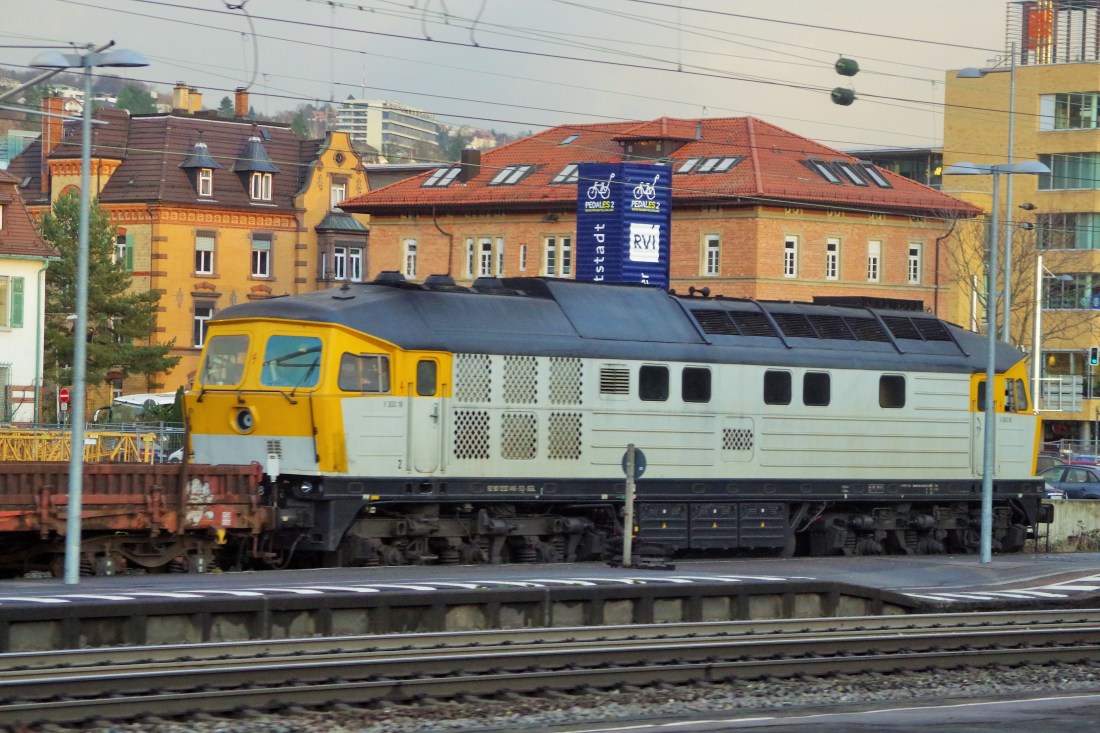
Today, there are two 232s that carry variations of the number “232446”, but neither of them are the original!  SGL (Schienen Güter Logistik GmbH)’s V300.18, the UIC number of which is 92 80 1232 446-5 D-SGL, is the body of 232387 with the innards donated by the real ‘446.  More confusingly, the former 232227, now working for Ecco Rail in Poland, carries “BR232-446”. The SGL machine is seen here on an engineers train at Esslingen, near Stuttgart, 28/11/15 (JW)

15th May 2016 – Maybach MD870 power on the main line

IMGP4886

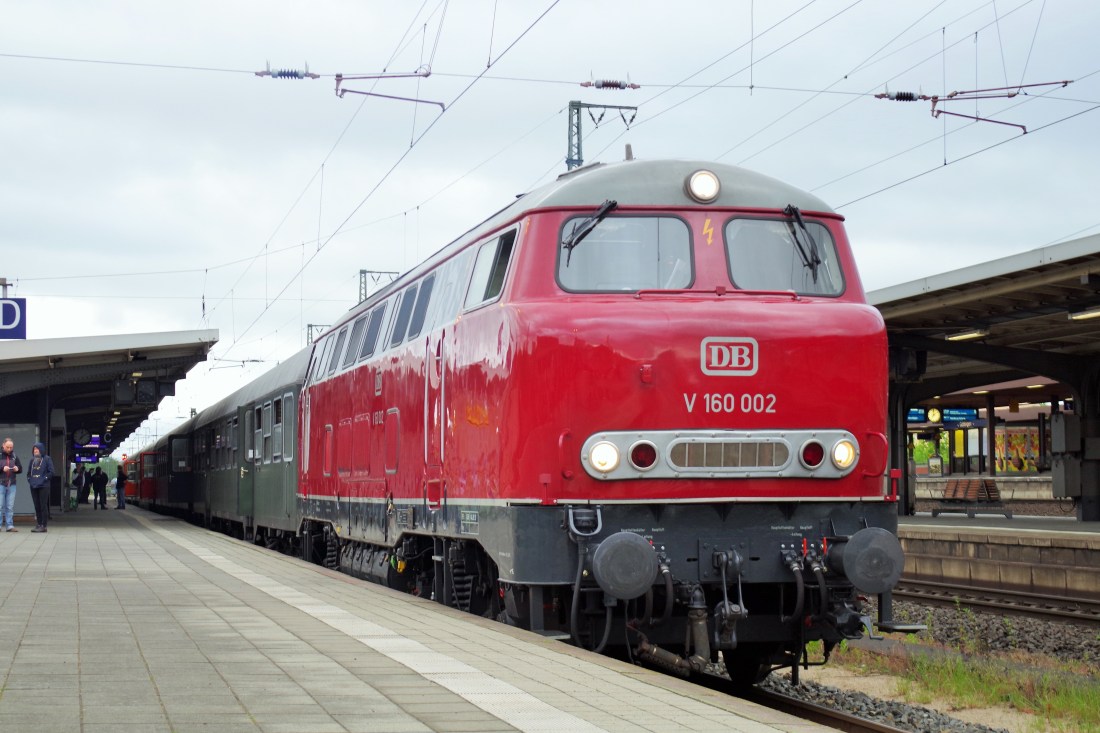
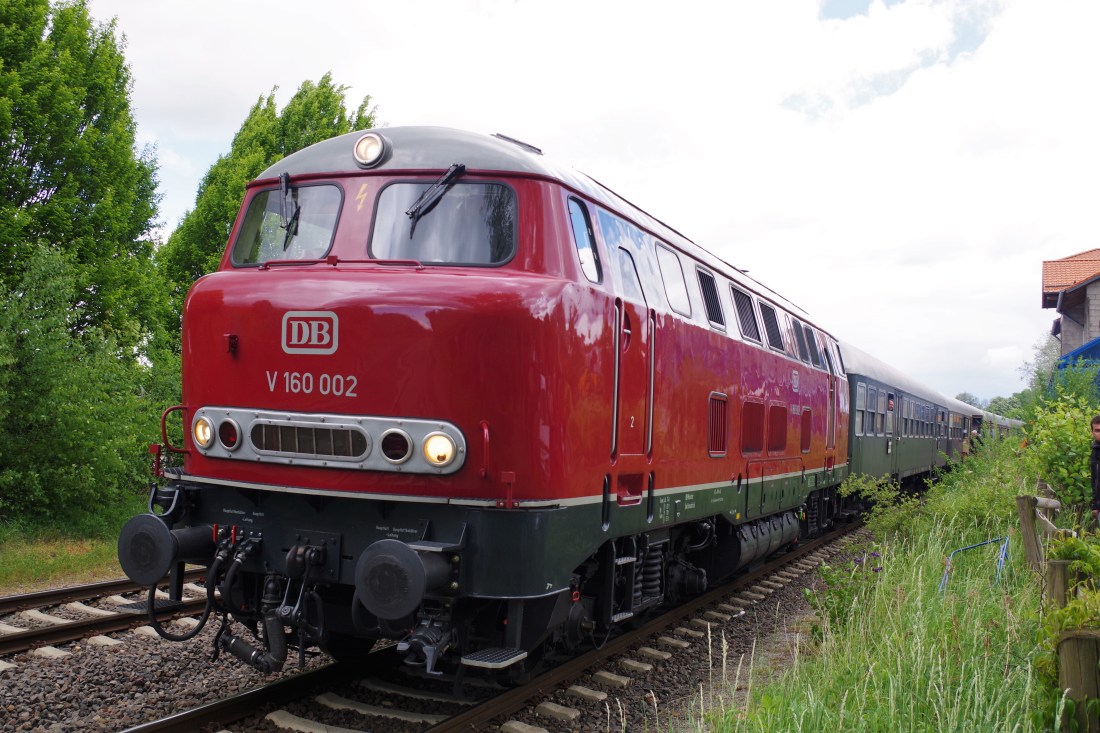
15th May 2016 saw “Lollo” V160 002 (DB 216 002) work a mainline railtour from Treysa to Klein Mahner and back, to the delight of a large contingent of British enthusiasts on board.

British modern traction enthusiasts have been travelling to foreign shores in significant numbers to feed their interest for over 40 years.  Although – as I hope this website will show you – the decision to make this first trip can be the gateway to an almost infinite number of different railway experiences, the first time that many ventured overseas was in search of things that reminded them of home; exported ex-BR “EM2” electrics in the Netherlands, for example, or Vulcan Foundry-built 8 and 16-cylinder English Electrics in Portugal.  But one of the oldest and most enduring subjects of our attention have been the Maybach-powered diesel-hydraulic locomotives of the former West Germany.

The “Western” class diesel-hydraulics of British Rail were the first modern traction type to gain a significant following, and after D1013 and D1023 drew to a halt at London’s Paddington station at 23:41 on Saturday 26th February 1977, it was assumed that the glorious sound of Maybachs would never again be heard on the front of a train on the main line in the UK (that assumption, by the way, was wrong!).  That was an experience now to be found only overseas, predominantly in West Germany with the Deutsche Bundesbahn V200.0 class of locomotives, which were built with twin MD650 power units and Voith transmissions and were the forerunners of our own “Warship” locos.  These lasted in main line passenger service until 1984; you can still rely on a sizeable British booking on most railtours hauled by preserved machine V200 033 even now.

The V200.0s may have been almost identical to BR’s Swindon-built D800s, not least visually, but they were certainly not the only Maybachs that Deutsche Bundesbahn had had.

IMGP4907

V160 002 at Salzgitter Bad, 15/05/16 (JW)

It’s a commonly-repeated misconception that the Vorserienloks (prototype batch) of Class 216 – the first ten machines of the “V160 family” that eventually totalled 800 locos, some of which are still in use on front-line passenger work today – were the same as BR’s D7000 “Hymeks”.  This is not strictly true – the German machines were indeed built with Maybach MD870 power units, as were as the “Hymeks”, but they had Voith as opposed to Mekydro transmissions, and this does make an appreciable audible difference.

The last of this small batch of 10 machines, nicknamed “Lollos”, worked its last train for DB in 1981.  This was not the end of the story, though, as five examples escaped the cutter’s torch – one for preservation (V160 003, although this has now sadly lost its MD870), and four for private non-passenger use – three of these ended up in Italy, and one, V160 002, in Spain.

This article is not a history of Maybach traction in Germany, however (that will come at a later date).  This is a review of a railtour hauled by a truly hellfire locomotive.

IMGP4895

V160 002 worksplate detail (JW)

A bit of historical scene-setting first, though: V160 002, later numbered 216 002, was repatriated from Spain by a private individual in 2010 and restored in the works at Neustrelitz.  It emerged in 2015 in almost-original condition, and as well as some work on main line freights for RailSystems RP, worked passenger trains at a special event on the Kurhessenbahn in the September 2015, a trip paired with V200 033 in April 2016, and some heritage-themed shuttles between Coesfeld and Dorsten in May 2016. Its first proper solo railtour, however, was scheduled for 15th May 2016, and this was immensely popular with British enthusiasts.  A fair few, like me, had never even had the chance to ride behind a “Hymek” on the main line, so it was a totally new experience.

This was a trip starting at Treysa and running via Kassel, Göttingen, Hildesheim, Oker and Vienenburg to Braunschweig.  The run between Hildesheim and Oker was with the express intention of commemorating the reign of the DB class 218 “rabbit” locos, which had been withdrawn from service on the much-loved Hannover to Bad Harzburg route which used this section of line, at the end of 2014.

The “Lollo” ran round at Braunschweig and headed south the short distance to Salzgitter Bad where, after another reversal, it gained the route to the tour’s nominal destination of Klein Mahner, home and operating base of the Dampflok-Gemeinschaft 41 096 e.V.

Klein Mahner was a familiar destination to those of us who had travelled on the “Stahlstadtexpress” railtour in May 2014, which itself had been operated as a farewell to Braunschweig’s 218 447.

IMGP4919

323479 at a brief photo stop at Werlaburgdorf, 15/05/16 (JW)

However, on that occasion, the 218 had not been permitted to traverse the full line, and it had been the only motive power of the day.  This visit was to prove different.  One of the railtour coaches was uncoupled, and taken forward to the end of the line at the junction of Börßum and back by diminutive class 323 (Köf) diesel shunter, 323 479.  It was perhaps hard to believe that this loco was 82 years old at the time, its entry to traffic having been on 12th October 1933!

Back at Klein Mahner, we regained the V160 and set forth on a brief tour of the freight-only lines threading through the sprawling steelworks complex that sits between Salzgitter and Peine.  Some of us, again, were no strangers to this route – it also having featured on the 218 447 railtour in 2014 – but it was an interesting way to spend an hour or so, nonetheless.  The noise levels were ramped up a notch or several when we regained the main line, however, which was well-received by all!  Although there were to be two further reversals, that was the branch lines dispensed with for the day, and thrash and speed were sustained all the way back to Treysa.

I think it is no exaggeration to say that everybody who travelled on this railtour was very impressed with the loco.  The atmosphere on the train was brilliant, and apart from those with D1015 at the helm, it eclipsed every railtour I’ve travelled on in the UK in recent memory in just about every aspect.

I made a video of the day and uploaded it to YouTube, and it can be seen below.  It’s 24 minutes long, but it gives a good overview of the day, with plenty of MD870 thrash for you to enjoy!

V160 002 has recently re-entered traffic after a period out of service, and is advertised for a sensibly-priced and timed railtour from Piesberg (near Osnabrück) to the Christmas market at Goslar on Saturday 9th December 2017, followed by another on Saturday 3rd February 2018 from Münster Hbf to Willingen and return (link).

If you like your diesel-hydraulics, you will certainly not regret ensuring you are there!

“Flüchtlingszüge”, October 1989

Railways have been key to facilitating many of the major historical events of the last two centuries, but it is rare that the trains have been the subject of the world’s attention.  This is the tale of two nights in 1989 when, for a series of trains, that was indeed the case.

The Background

The German Democratic Republic (GDR), or East Germany, was a Communist state formed in 1949.  Mainly due to the comparative lack of its own naturally-occurring industrial resources, it never managed to match the “economic miracle” that occurred in West Germany after the Second World War, and indeed the flow of people from East to West in search of a better life was stemmed only by the construction of the Berlin Wall in 1961.  Ten years later, the man who masterminded the project – Erich Honecker – became the country’s leader, and ruled with an iron fist.  Many citizens dreamed of leaving the country, but the very existence of the Wall – as part of the Iron Curtain that bisected the continent – steadfastly prevented them from doing so.  Their international travel was limited to a small number of fellow Warsaw Pact nations.

As the 1980s progressed, disquiet diffused throughout the Eastern Bloc.  Under Mikhail Gorbachev’s leadership, Moscow no longer got involved in the Warsaw Pact states’ internal affairs, and amid this atmosphere, the first crack in the Iron Curtain showed on 11th September 1989 when Hungary dismantled its border with Austria.  Thousands of East Germans began travelling through Czechoslovakia to Hungary for “holidays”, then simply crossing to Austria and beginning a new life in the West.  Unsurprisingly, this situation was not allowed to develop.  As a bid to cut off the flow of people, Czechoslovakia closed its border with Hungary to GDR citizens.

This left thousands of East Germans stranded in Czechoslovakia.  Rather than return home, many headed straight to Prague and congregated at the West German Embassy, 3,000 people cramming themselves in the baroque palace and its gardens, seeking asylum in the West.  West Germany did not have grounds to protest – according to its own Basic Law, they were all German citizens.  Eventually, almost double that number presented themselves.

This had the potential to cause extreme embarrassment to the GDR regime, who were gearing up for lavish celebrations in the first week of October to mark the 40th anniversary of their country’s formation.  At a time when they were preparing to demonstrate that everything was rosy in the East, they really did not need a high-profile diplomatic incident in which significant numbers of their citizens would rather live in borderline unsanitary conditions in corridors and cupboards than make a life in their country.

The decision to let them leave for the West was therefore an obvious one that suited all parties.  However, Honecker wanted the last word.  He could have let them all simply leave on service trains directly to the West German border.  However, in revenge for potentially tainting his highly-anticipated anniversary celebration, he wished to humiliate them.  He also wanted to portray them to the world as traitors, as undesirables that were being expelled by the glorious GDR rather than fleeing it.

Honecker’s self-serving solution was to insist that all 5,490 refugees travel in sealed refugee trains – or Flüchtlingszüge – from Prague, transiting through the territory of the GDR, whereupon Stasi officials would confiscate their ID papers and effectively render them stateless, before depositing them just across the border at Hof.

The Evacuation

The decision had been made late on Friday 29th September.  Things got moving the following evening.  Prioritising those with small children, the first tranche of passengers were marshalled onto buses outside the Embassy and driven to Praha-Libeň railway station.  To say that the atmosphere was tense would be an understatement.  There was suspicion that the East German authorities would not let the train proceed beyond their territory.  Nobody knew how this would play out.

At 20:50, hauled by a class T478.3 “Goggle” diesel loco, the first train pulled out of Praha-Libeň.  In total, another five trains followed at two-hour intervals.  Ironically, the reason that the requisite coaching stock – six rakes of at least 10 vehicles apiece – had been able to be cobbled together with such a short lead time, was that scratch sets had already been assembled at various locations across the GDR in readiness for working reliefs in connection with the 40th anniversary celebrations later that week; it was these rakes that were sent to Prague.  True to Honecker’s promise to himself that he would humiliate the passengers, however, they were unheated and in various states of disrepair.

The trains proceeded via Dĕčín to Bad Schandau, where they lost their Czechoslovakian motive power and gained both Deutsche Reichsbahn (DR) locos and Stasi border officials, who confiscated the paperwork of the passengers.  The trains then continued via Dresden and the “Sachsen Magistrale” route through Karl-Marx-Stadt (now Chemnitz) and Zwickau, then finally across the border to Hof, the first one arriving at 06:14.

The journey was not a smooth one.  Most of the trains were booked a crew change at Dresden Hbf – the main station of the third-largest city in the GDR.  Obviously, the GDR was not publicising the fact that the trains were running, but the West Germans were, and although it was illegal to do so, East Germans in some areas could pick up Western TV.   Ironically, the area around Dresden was known as the “Valley of the Clueless”, the geography of the region blocking out TV signals from over the border.  During the brief crew change on the second train however, at least three young people were able to jump aboard.  Many arrests were made further along the route as others tried.  A dramatisation was made for the 25th anniversary featuring 231 012 of WFL, some of which is on YouTube here.

The locos used to power these illustrious trains through the night in the GDR were as follows:-

Headcode DR Loco(s)  
23360 250 192 Bad Schandau – Reichenbach
132 478 Reichenbach – Hof
23362 132 285 Bad Schandau – Hof
23366 132 059 Bad Schandau – Hof
23364 132 696 Bad Schandau – Hof
23368 132 695 Bad Schandau – Hof
23370 132 701 Bad Schandau – Hof

The Consequences

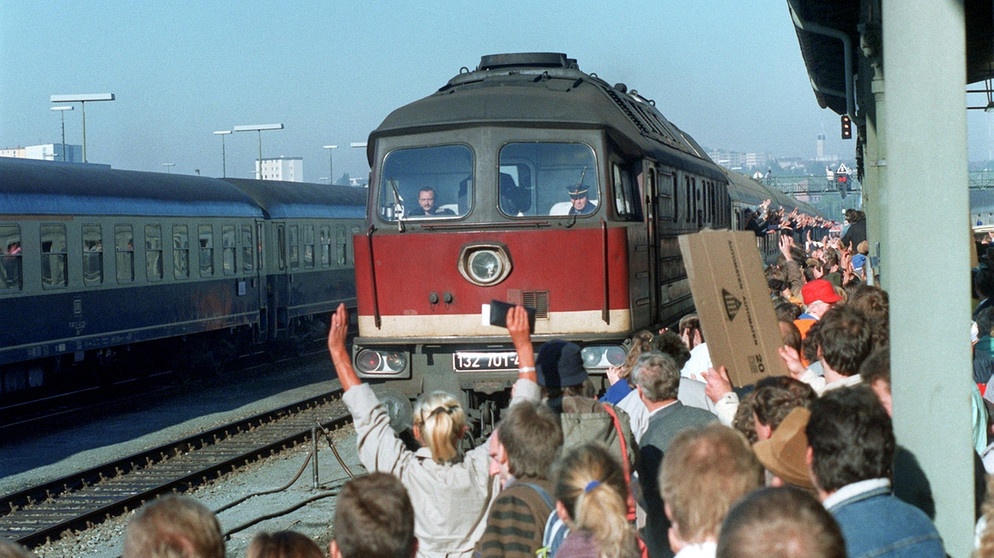
The scenes of the trains’ arrival at Hof were shown on TV screens across the world.  Millions saw the big Russian class 132 “Ludmilla” diesels (later DB class 232, after reunification) lumbering along the crowded platforms at Hof, illuminated by blinking flashguns as they came to a halt and their excited and relieved passengers alighted.

Of course, amongst those millions were large numbers of East Germans – who, their resolve strengthened by the feat of successful escape by their fellow countrymen, then immediately made their way to the West German Embassy in Prague in an attempt to emulate them!  Almost as soon as it was emptied, the old building became full of East German refugees again.

Eventually, 7,607 people shoehorned themselves into the Embassy.  There could only be one solution.  However, Honecker persisted with his insistence that they be removed on trains that pass through the GDR.

The Second Operation

This time, eight trains were required to convey them.  The first departed from Praha-Libeň at 18:34 on the night of Wednesday 4th October, the last seven hours later.

This time, the locals in Dresden were prepared.  5,000 people crammed themselves in the Hbf, with 10,000 outside, all with the hope of getting aboard one of the refugee trains that was due to pass through. What ensued was nothing short of an all-out riot; described afterwards as the greatest example of civil disobedience in the GDR since the 1953 uprising.  Many were injured, including one man who lost both of his legs when he fell underneath one of the trains whilst trying to climb aboard.  Severe damage was caused to the station.  Police used water cannons in an attempt to quell the disturbance but thankfully, in contrast to 1953, no shots were fired.

After the first three trains had passed Dresden, and amidst escalating chaos, the remaining five trains were diverted away from the city.  This was no mean feat, with them having to travel further through Czechoslovakia, entering the GDR by way of Bad Brambach.  The use of this route necessitated a reversal at Plauen.  During a run round here, a further seven people succeeded in sneaking aboard one of the trains, but ultimately, these diversions were a success.

The DR locomotives involved on the second night were as follows:-

Headcode DR Loco(s)  
23358 132 478 Bad Schandau – Hof
23362 132 655 Bad Schandau – Hof
23360 132 596 Bad Schandau – Hof
23366 132 701 Bad Brambach – Hof
23356 132 285 Bad Brambach – Hof
23364 132 059 Bad Brambach – Hof
23368 132 696 Bad Brambach – Hof
23370 132 643 Bad Brambach – Hof

Here is some footage on YouTube from Hof as these trains arrived.  Again, after seeing the scenes from Hof, thousands more East Germans descended on the Embassy in Prague.  This time, however, they were loaded onto a much lower-key special train on 3rd November and simply taken via Cheb directly into West Germany.  The GDR regime had learnt from their mistake, but – as with many things in their short history – it was too late.

The Locos Today

The route to Hof is now electrified.  The border has gone.  There are no longer two Germanies or a border between them.

However, most of the locomotives that found themselves thrust into the world spotlight over those two nights in 1989 still exist.  The fates of the nine class 132s that performed on the refugee trains over the two nights are as follows:-

Loco No. Final No. Current Operator Current Status
132 059 232 059 scrapped
132 285 233 285 DB Cargo operational
132 478 233 478 DB Cargo operational
132 596 233 596 DB Cargo stored at Chemnitz
132 643 233 643 DB Cargo stored at Chemnitz
132 655 232 655 scrapped
132 695 232 695 scrapped
132 696 233 696 DB Cargo stored at Cottbus
132 701 232 701 Leipziger Eisenbahngesellschaft GmbH stored at Delitzsch

Even the class 250 that worked the very first train out of Bad Schandau – 250 192 – still survives, as DB Cargo loco 155 192, stored at Sassnitz-Mukran on the island of Rügen.

The part that these locomotives played has not been forgotten.  PIKO produced a G-scale model of 132 478, the loco that brought the first train over the border, and Lok Magazin have made a couple of calls for the loco, now DB Cargo’s 233 478 and still in traffic, to be preserved as a memorial to the events.

Another of the locos, 132 701 – now 232 701, recently purchased by the private freight operator Leipziger Eisenbahngesellschaft GmBH (LEG) – has attracted attention.  The Leipziger Volkszeitung newspaper dubbed it “die Lok der Freiheit” (“the freedom loco”) and expressed the editorial opinion that given its status as “ein Stück Weltgeschichte” (“a piece of world history”) it should be brought back into action – it currently remains stored at Delitzsch.  ‘701 did not haul the ground-breaking first train, however the interest in it might well be explained that its arrival at Hof was later in the morning, after daybreak, and therefore it appears in far more photographs from the day.  (Edit 08/2018 – the loco has been put through works in Latvia and has now returned to Germany, hopefully to re-enter service with LEG shortly).

The Historical Impact

There is a credible interpretation of history that says that these fourteen trains over two nights in autumn 1989 irreversibly changed the world.

Routing the trains via the GDR was a gamble that did not pay off.  Intended to act as a show of State strength, it only served to strengthen the resolve amongst many of those that remained in the GDR to emulate the passengers in their journey west.  Public unrest spread like wildfire, and the numbers taking part in the peaceful demonstrations springing up across the GDR swelled.  According to politician Günter Schabowski, Honecker’s decisions regarding these trains were the major catalyst that swayed the Politbüro to force his resignation on 17th October.  It was amid this background of spiralling social and political chaos that the Berlin Wall was opened on 9th November.

From there, the domino effect was unstoppable.  The general anti-Communist sentiment that had taken hold across the Eastern Bloc throughout 1989 gained renewed strength.  Bulgaria’s leader Zhivkov was ousted the very next day; the government in Czechoslovakia had been overthrown in the “Velvet Revolution” by the end of the month; Christmas Day saw the violent deposal, fleeting trial and summary execution of the Romanian dictator Nicolae Ceauşescu.  These events effectively rendered the Warsaw Pact null and void, and it was dissolved in 1991; in this act, the Cold War was arguably ended on the spot.

Perhaps, then, if anyone would have been lucky enough to have been stood at the lineside on the “Sachsen Magistrale” on those two nights almost three decades ago, they would have not only witnessed a procession of powerful Russian diesels howling over the steep gradients with their heavy trains, but they would have been witnessing true history in the making.

DB Class 110 – survivors and where to find them

The E10 family of electric locomotives were once one of the most numerous on the Deutsche Bundesbahn.  However, of the 415 examples built (plus a further one converted from a class E40), only a paltry 42 remain extant.


110 002 E10 002 DB Museum, Nürnberg
110 005 DB Museum, Koblenz-Lützel
110 114 115 114 In service with DB Fernvekehr
110 121 E10 121 DB Museum, Koblenz-Lützel
110 152 Preserved by Baureihe E10 e.V., Köln
110 169 In service with Euro Express Sonderzüge GmbH
110 177 139 177 In service with Lokomotion Gesellschaft fur Schienentraktion
110 198 115 198 In service with DB Fernvekehr
110 205 115 205 Awaiting scrapping at Bender’s, Opladen  cut 2017
110 213 139 213 In service with Lokomotion Gesellschaft fur Schienentraktion
110 222 139 222 DB Cargo, stored at Mukran
110 223 DB Museum, Koblenz-Lützel
110 226 E10 226 DB Museum, Koblenz-Lützel
110 228 E10 228 DB Museum, Koblenz-Lützel (currently in Crailsheim)
110 239 E10 1239 DB Museum, Koblenz-Lützel
110 260 139 260 In service with Lokomotion Gesellschaft fur Schienentraktion
110 261 115 261 In service with DB Fernverkehr
110 262 (139 262) In service with Bayern Bahn Betriebsgesellschaft
110 267 113 267 Preserved, location currently unknown
110 268 113 268 In service with TRI Train Rental GmbH
110 278 In service with Centralbahn AG
110 281 SVG Eisenbahn-Erlebniswelt, Horb
110 283 139 283 In service with Lokomotion Gesellschaft fur Schienentraktion
110 285 139 285 In service with Eisenbahn Gesellschaft Potsdam (EGP)
110 287 139 287 In service with Bayern Bahn Betriebsgesellschaft
110 292 DB Museum, Nürnberg – in Crailsheim
110 293 115 293 In service with DB Fernvekehr
110 300 Preserved by Baureihe E10 e.V., Köln
110 309 E10 1309 In service with TRI Train Rental GmbH
110 311 113 311 DB Museum, Koblenz-Lützel
110 346 115 346 DB Cargo, stored in Hamm strategic reserve and for sale
110 348 E10 348 DB Museum, Koblenz-Lützel
110 350 115 350 In service with DB Fernvekehr
110 383 In service with Centralbahn AG
110 428 In service with TRI Train Rental GmbH
110 448 115 448 In service with DB Fernvekehr
110 459 115 459 In service with DB Fernvekehr
110 468 Preserved by Verein Die Bügelfalte 110 488
110 469 In service with TRI Train Rental GmbH
110 488 114 488 Preserved by Verein Die Bügelfalte 110 488
110 491 In service with BahnTouristikExpress GmbH
110 509 115 509 In service with DB Fernvekehr
110 511* “110 043” In service with Pressnitztalbahn

* – ex-139 134

29-30th April 2017 – Special event at the Eisenbahnmuseum Bochum

IMGP0497

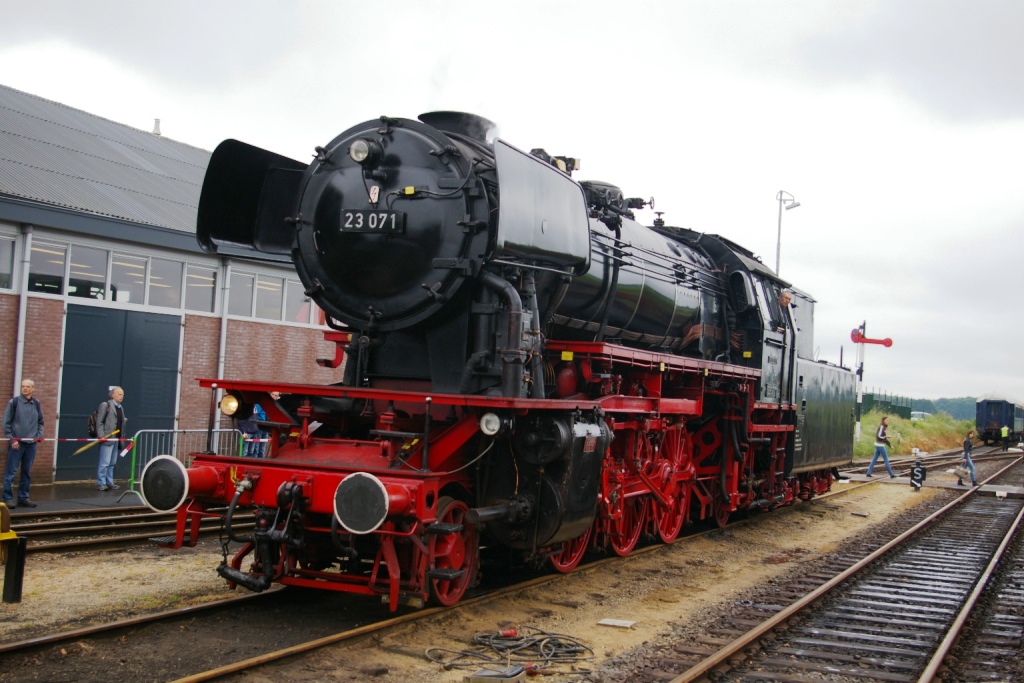
23.071 at Beekbergen, 30/05/14 (JW)

Two anniversaries are being celebrated at the Eisenbahnmuseum Bochum in western Germany on Saturday 29th and Sunday 30th April 2017.

The museum itself is celebrating its 40th anniversary, and the Deutsche Gesellschaft für Eisenbahngeschichte (German Railway History Society) its 50th.  To celebrate, a large display of rolling stock will be amassed at the museum on the theme of “Ost trifft West”; “East meets West”.

In the second half of the 20th century, the railways of the two Germanies (the Deutsche Bundesbahn in West Germany and the Deutsche Reichsbahn in the East) developed along their own lines, and this exhibition takes the opportunity to place equivalent types from either side of the “Iron Curtain” next to each other for comparison.

As well as their large collection of resident machines, a considerable number of notable locos will visit from elsewhere to help tell this story, and can be seen at the link here.  It will certainly be rewarding to take a good number of hours to have an explore!

Shuttles to and from Essen Hbf

In order to help provide easy access from the main line railway network for visitors, a shuttle will run from Essen Hbf station directly into the museum, at the following times both days:-

09:59 / 10:59 / 11:59 / 13:59 / 14:59 / 15:59 / 16:59 / 17:59 ex-Essen Hbf

09:25 / 10:30 / 11:30 / 13:30 / 14:30 / 15:30 / 16:30 / 17:30 ex-Museum

On one end of each train, which will be formed of DB “Umbauwagen”, will be DB Class 212, 212007, dating from 1962 (external link to photo here).  On the other will be a rotating cast of up to seven of the steam exhibits.

The journey time for the 9.5-mile journey will be in the region of 20 minutes each way.  Fares are €5.50 each way and entry to the museum is €16.

Shuttles from Bochum-Dahlhausen

A separate shuttle train service will operate from the local S-Bahn station, at Bochum-Dahlhausen, a distance of less than a mile.  Times as follows:-

10:00 / 10:35 / 11:00 / 11:44 / 12:00 / 12:35 / 12:55 / 13:12 / 13:35 / 14:00 / 14:35 / 15:01 / 15:35 / 16:01 / 16:35 / 17:00 / 17:35 ex-Bochum-Dahlhausen

10:20 / 10:45 / 11:29 / 11:51 / 12:20 / 12:45 / 13:05 / 13:20 / 13:45 / 14:20 / 14:55 / 15:20 / 15:51 / 16:20 / 16:50 / 17:20 / 17:55 ex-Museum

The journey time is only 5 minutes and tickets cost €2.50 each way.  This train is to be formed of a rake of older “Donnerbüchsen” carriages and will equally be hauled by a rolling cast of locomotives; however, due to the short distance involved, this can also include their Köf III shunting loco (possibly 332306), and also 2-6-2 tender engine 23.071, visiting from the VSM in the Netherlands and not fitted with PZB (German in-cab signalling) so cannot venture onto the mainline itself, neither of which will work on the Essen trains.

More info here.


Additionally, an extra day of the exhibition specifically for photographers has been arranged for Monday 1st May.

Many thanks to the Eisenbahnmuseum Bochum for their help in preparing this brief article.

Various dates in 2017: OSEF railtours and expected traction.

IMGP1611

231012 on railtour duty at Helmstedt, 12/05/12 (JW)

The Ostsächsische Eisenbahnfreunde e.V. have kindly provided me with information regarding the motive power expected to haul their railtours over the next few months.

Saturday 22nd April 2017

“Mit Ludmilla zum Deutschen Dampflokomotiv-Museum”, 06:10 Löbau to Neuenmarkt-Wirsberg and return, €75.  Link.  Traction is planned to be 231012 from Wedler & Franz – one of only 11 extant class 231s (ex-Deutsche Reichsbahn class 131) and still a working freight loco.  This tour covers some true Ludmilla territory in the form of the Sachsen Magistrale and you can be sure that it will sound great!

231012 gives “a little helping hand” to 03.1010 at Berlin Spandau, 13/05/12 (JW)

Monday 5th June 2017

Please note that this trip is currently fully booked.  “Mit dem Sonderzug zu Škoda Mladá Boleslav”, Löbau to Mladá Boleslav and return, €75.  Link.  Traction is planned to be 112331 (DB 202331) in Germany and “Goggle” 750308 in the Czech Republic.

Saturday 10th June 2017

“Mit OSEF zum R.SA-Festival 2017 in Schwarzenberg”, 11:30 Löbau to Schwarzenberg and overnight return, €60.  Link.  Traction is planned to be 112331 (DB 202331) and probably another loco of the same class.

Please note that this is only the current plan and everything is subject to change.  Please check with the organiser before committing to travel and booking.

30th April 2017 – Unusual DB class 212 and 218 haulage (and class 261 cab rides!)

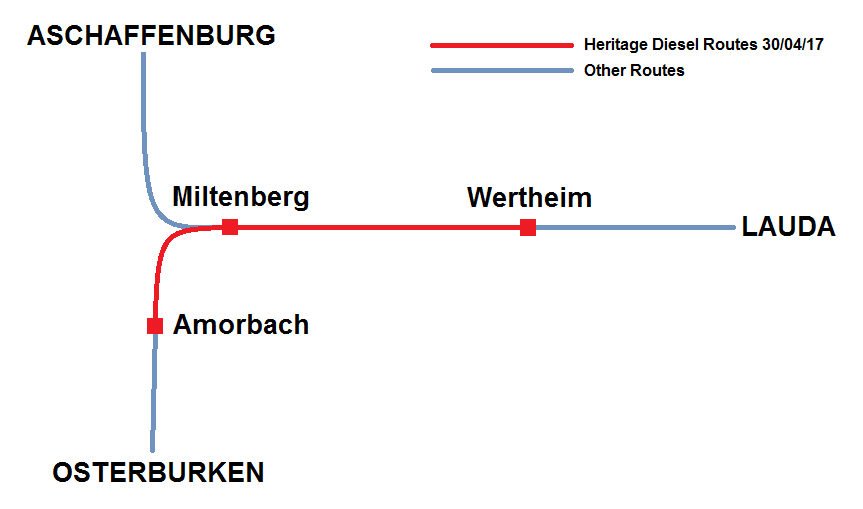
Sunday 30th April 2017 sees two interesting events south-east of Frankfurt am Main, the “Tag der offenen Tür” (open day) at Miltenberg and the “Tag des offenen Eisenbahnmuseums” (railway museum open day) at Amorbach.  The Westfrankenbahn are advertising additional passenger trains, with class 212 (V100) and class 218 (V160) diesel-hydraulic locomotives as the motive power, to link the two and also run along the scenic route hugging the Main river as far east as Wertheim.

Normal tickets (for example the Bayern-Ticket) will be valid for travel on these trains, alternatively single trip tickets will be available for €3.30 (regardless of length of travel on each train).  Great value for an interesting day out.

WFB 300417

The 218 in question will be MTU4000-engined 218460, recently repainted into “ozeanblau-beige” livery and named “Conny”, of the Westfrankenbahn (external link to photo here).  The loco has been well-travelled recently – spending a week (between 30th January and 7th February) hauling peak-time commuter trains out of Frankfurt am Main to cover for a lack of class 642 DMUs; and then six weeks (1st March to 18th April) off Mühldorf, working everything from local passenger trains to Eurocity expresses, this time covering for a temporary shortage of 218s there.

The 212 will be 212372, belonging to the DB Museum (external link to photo here).

The two locos will sandwich three carriages – a Bm, an Abn and another Bm.

4892584414_916771c230_o

218460 has now been repainted into a heritage livery, but here it is in service days at Illertissen, 25/08/08.  (JW)

In common with previous events at Miltenberg, cab rides in a Voith Gravita class 261 centre-cab 1,600hp diesel loco will be available from Gleis 9 at Miltenberg.  Previous locos to have performed such duties have included 261039 in 2014 and 261031 in 2016.

The exhibition at Miltenberg will see three electric locos on display, all normally to be found at the DB Museum at Koblenz.  These are of class 103 (103113 – retired from main line service only last month), class 110 (110152) and class 141 (E41001).

Of further interest is that the railway museum at Amorbach contains four carriages and the “Lindenberg-Lok”, 218212, on static display.  Link to photo of 218212 in situ.

A link to the timetable in PDF form on the Westfrankenbahn website can be found here.  The diagram for the diesel-hauled train covers 242 miles (389 km) through the day and is as follows:-

RE23471 09:15 Miltenberg – Wertheim 09:53
RE23470 10:02 Wertheim – Amorbach 10:51
RE23473 11:01 Amorbach – Wertheim 11:53
RE23472 12:02 Wertheim – Amorbach 12:51
RE23475 13:01 Amorbach – Wertheim 13:53
RE23474 14:02 Wertheim – Amorbach 14:51
RE23477 15:01 Amorbach – Wertheim 15:53
RE23476 16:02 Wertheim – Amorbach 16:51
RE23479 17:01 Amorbach – Wertheim 17:53
RE23478 18:02 Wertheim – Miltenberg 18:36

These are always great events, so I’d really recommend you pop along if you are in Germany that weekend!

Many thanks to the DB Regio AG for their assistance with info for this article.

DB Class 103 – survivors and where to find them

Only 17 of the 149 class 103s remain extant.

Of these, just two remain active on the main line: 103 222, a former test train loco now used predominantly for stock moves by Railadventure, and 103 245, based at München and occasionally used to haul main line service trains (although it is currently out of traffic).  103 113, which was retired from front line service on 30th March 2017, is now a museum loco based at the DB Museum at Koblenz and will perform on occasional main line railtours – the first occurred on 17th and 18th June 2017.

The other 15 can be found static across Germany, predominantly in museums.  Those on display are at locations easily accessed by train, with the sole exception of one of the prototypes, 103 002, which is on display at the “Spatzenpark”, a family attraction at Herrnried, approximately 25 miles north-west of Regensburg.  It occasionally comes up for sale on eBay, although nobody has stumped up the €200,000 asking price yet!

103 001 DB Museum, Koblenz-Lützel
103 002 Spatzenpark, Herrnried
103 004 Bahnbetriebswerk Lichtenfels
103 101 DB Museum, at Eisenbahnmuseum Darmstadt-Kranichstein
103 113 DB Museum, Koblenz-Lützel
103 132 DB Museum, stored at Dessau Works
103 136 Bayerisches Eisenbahnmuseum, Nördlingen
103 167 DB Museum, at Lokwelt Freilassing
103 184 DB Museum, at Bahnbetriebswerk Lichtenfels
103 197 Privately owned, stored at Altenbeken
103 220 Südwestfälisches Eisenbahnmuseum, Siegen for repaint, to return to DB Museum, Koblenz-Lützel imminently
103 222 In service with Railadventure
103 224 DB Museum, Nürnberg
103 226 Südwestfälisches Eisenbahnmuseum, Siegen
103 233 DB Museum, Koblenz-Lützel
103 235 DB Museum, Koblenz-Lützel
103 245 In service with DB Fernverkehr, München (out of traffic since March 2018 with wheelset issues)