Albanian Passenger Haulage

The small Balkan country of Albania has no passenger rail connection to any other country and is one of the least visited by railway enthusiasts.  It would be fair to say that its rail system is struggling, but it is still worth a visit.

Timetable

Albania has a skeleton of a rail network and a sparse service.  Travel is generally quicker by road.  As if that was not enough, its capital – Tiranë – lost its rail service in 2013, the trains now running only as far as Kashar.  The station in Tiranë is allegedly being rebuilt on another site and the service will return there, but this does not look likely to be any time soon.

The timetable as currently understood (July 2018) is as follows:-

Shkodër 05:45
Kashar 07:15 08:30 15:30
Durrës 06:30 07:59 08:15 09:13 09:35 14:45 16:13
Rrogozhinë 07:40 ??:?? ??:??
Elbasan 10:58 17:30
Elbasan 06:10 13:53
Rrogozhinë ??:?? ??:?? 16:00
Durrës 07:00 08:57 13:00 14:30 16:36 17:00 17:10
Kashar 07:42 15:13 17:43
Shkodër 16:50

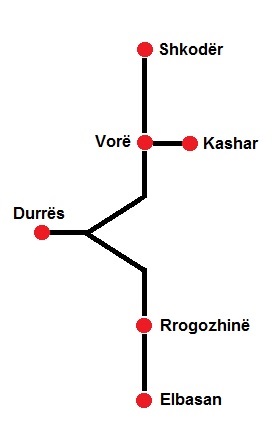
Below is a map of the current passenger routes currently thought to see a service.  Not to scale.albania

Traction

All trains are hauled by Czechoslovakian-built class T669 diesel-electrics, formed nowadays generally of ex-East German carriages in deplorable condition.

Tickets

There are no rover tickets valid for travel in Albania.

Eurotunnel Car Trains

Although not strictly within the remit of this website, I thought I would also cover the Eurotunnel car trains under the Channel, as they do provide an element of loco haulage to and from the Continent.

From its opening in 1994, the Channel Tunnel gave two new ways for passengers to travel between the UK and the Continent – by Eurostar between London and Paris and Brussels, and on the car-carrying “Le Shuttle” between Cheriton (Folkestone) and Coquelles (Calais).  This article looks briefly at the latter.

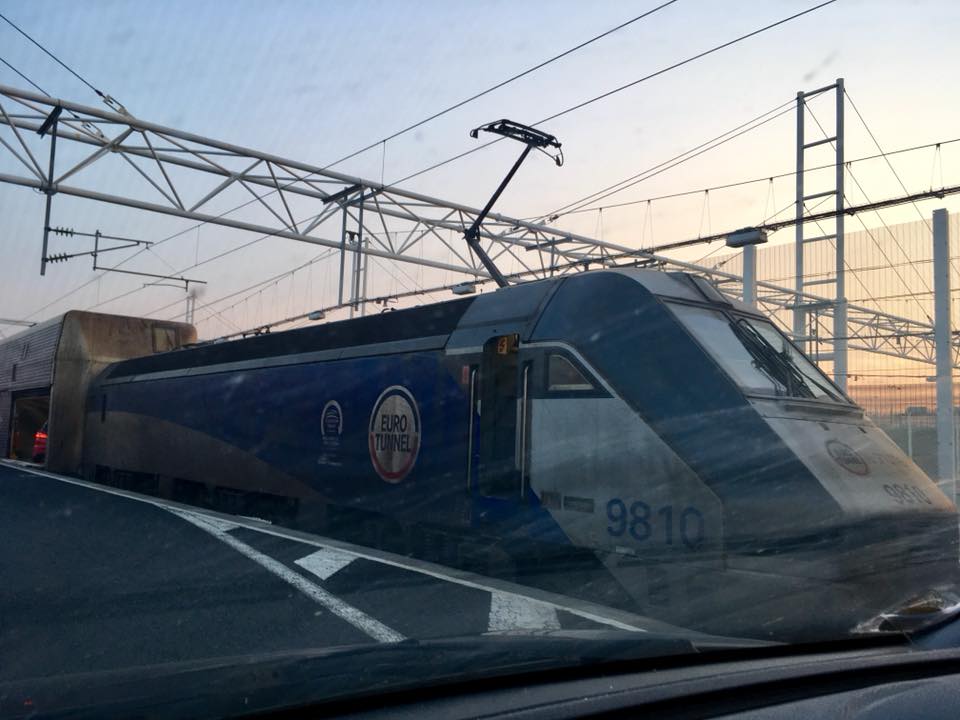
37958597_10156733425999379_9153045937407393792_n

The view from a car boarding a train at Coquelles of 9810 on the rear of a car train to Cheriton.  Taken by my lovely fiancee Nic as I was driving at the time!

The car shuttle service

The car-carrying shuttle is operated by Eurotunnel and operates to a fixed timetable 24 hours a day, 7 days a week, 365 days a year, with up to four departures an hour in each direction.  There is no provision for foot passengers – all passengers need to be in cars or coaches.  Certain commercial coach services do use the shuttle (whereas others use the Dover to Calais ferry).  The journeys take approximately 35 minutes.

Access to both terminals is directly from each country’s motorway network – the M20 in England and the A16 in France.  As such, it’s probably best considered not so much as a train service at all but as a tolled section of motorway on which vehicles happen to be conveyed on board trains and pre-booking of a slot gives a cheaper fare.

The traction

The trains are worked in top-and-tail fashion by Bo’Bo’Bo single-cabbed electric locos assembled by Brush Traction in Loughborough from the early 1990s.  The initial batch dating from 1992 were numbered 9001 to 9038.  One of these – 9030 – was destroyed in a catastrophic fire in the Channel Tunnel on 18th November 1996, and was replaced by a new-build loco, 9040.  Since 2004, these locos have been going through a comprehensive upgrade programme, from which the locos so treated are emerging as 7 MW (9,400hp) machines and renumbered in the 98xx series (with the last two digits remaining the same).

There are also 20 similar locos dedicated to the freight shuttles (9101 to 9113, and 9701 to 9707), but these are outside the scope of this article.

“Bashability”

Such a service is inherently “unbashable” in that you cannot wait for a “winner”, in fact not only do you not see the identity of one of the locomotives at all until you are driving down the ramp towards the train, but you never actually see the other locomotive at all.

However, the on-board staff are invariably very helpful in advising you of what its number is.  They walk through after departure and as long as you are sensible and polite about how and when you ask them if they could find out for you and above all explain why you want to know, they tend to ask the question and come back with the answer and a smile.

Do also note that (in my experience) if you travel out and back from the UK on the same day in your car – even if the outward was by ferry – you are likely to get pulled by UK Customs back at Coquelles for a thorough interrogation and search of your vehicle.

Off the beaten track: 2060 009 at Stammersdorf

Austria is another country to see withdrawn locomotives plinthed at unlikely locations well away from the nearest operational railway line.

1955-built ÖBB class 2060 diesel shunter 2060 009 is, however, on former railway property – the site of Stammersdorf station, on the northern outskirts of Wien (Vienna), which closed in 1988 (see photo here).  Almost all trace of the railway has been obliterated from Stammersdorf, with the exception of the station building (now dilapidated and with little by way of betraying its former purpose) and two track panels on the site of the former platform area, upon one of which the 2060 now sits (upon the other are a pair of steam loco wheels).

How to get there

The 2060 is easily viewed and is permanently on accessible public display.  It is precisely adjacent to the platforms of the terminus of the no.30/31 tram line operated by Wiener Linien.  These both serve Wien-Floridsdorf railway station – a 13-minute ride away.  A little trip to see the 2060, therefore, might provide you with a useful diversion in amongst sampling the loco haulage to be found in the city, for example on the Wiener Stammstrecke.

To see the Google Maps map and street view of 2060 009‘s location, click here.

Amtrak X995 and X996 – European locos in 1970s America

The remit of this site allows me to write about many of my great interests, but I might not have expected American railroads to be among them!

The flow of locomotives across the North Atlantic has always been much more from America to Europe than vice versa.  However the 1970s did see two particular European locomotives make a brief sojourn to the USA (and I’m not talking about “Flying Scotsman”!).

The 100mph streamlined Art Deco 2-Co-Co-2 “GG1” electric locos built for the Pennsylvania Railroad in the 1930s were, by all accounts, highly impressive machines, but by the time of the creation of Amtrak on 1st May 1971, they were showing their age.  Consequently, the nascent organisation quickly sought to replace them with new traction.  At the time, there was nothing appropriate “off the shelf” in the States, but procurement of a suitable fleet from Europe would have taken years.  Amtrak therefore looked to General Electric to rapidly develop an express (120mph) passenger version of its brutal-looking “E60” locos – 6,000hp machines under construction at that time for heavy freight work on the Black Mesa and Lake Powell Railroad.  The initial E60 order was placed by Amtrak in early 1973.

The E60s were not a success.  Their fate was largely sealed on Monday 24th February 1975 when loco no.950 derailed at 102mph in Elkton, Maryland whilst on test, and the cause was traced to fundamental wheelset issues.  The fleet were restricted to 85mph.  Behind the scenes, steps were made almost immediately to pursue the European route after all…

The 1976/1977 Trials

Amtrak therefore selected two modern electric locomotive designs from Europe to test on its famed Northeast Corridor: one from Sweden (which they numbered X995) and one from France (X996).  These plans were formalised in October 1975 with both locos to arrive roughly a year later.

The “Swedish Meatball” – X995

The first to arrive, in August 1976, was brand-new SJ Rc4 electric loco, Rc4 1166, built by Allmänna Svenska Elektriska Aktiebolaget (ASEA).  This was painted in Amtrak livery and numbered X995.  Until April 1977, it was tested on the Northeast Corridor between New York and Washington DC at up to 200km/h.

Upon return to Sweden, it was painted into SJ’s red livery and entered service.  As a reminder of its early travels, it obtained a cabside plaque (photo here), although this is understood to have been stolen.  Rc4 1166 remains in service to this day with Green Cargo (see photo here).

The “French Fry” – X996

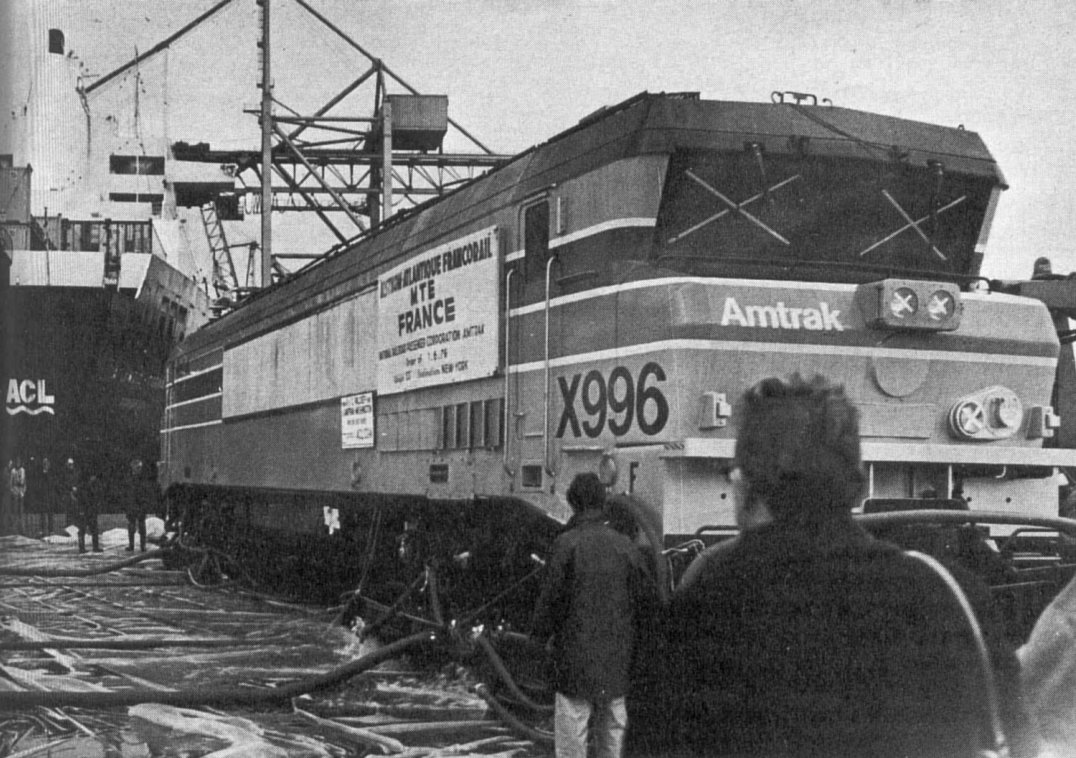
By comparison, although the nominated French machine was relatively new, it was not fresh off the production line.  CC21003 was one of a fleet of four dual-voltage machines built to the classic Paul Arzens “nez cassé” (“broken nose”) design; it had entered service with SNCF in June 1974.  During 1976, the loco was lent back from SNCF to its builders – Alsthom, in Belfort – from where it was turned into an American demonstrator (no mean feat considering the significant modifications involved – not least a new transformer for the different voltage of 11kV a.c. used over there).  CC21003 – by now X996 – was ready by the end of the year and was shipped to the States from Le Havre in January 1977 (see photo here).

X996 was put to work being tested under the same conditions as the Swedish machine.  However, these tests were not as successful.  Following the debacle with the E60s, Amtrak were understandably tetchy about locomotive suspension, ride quality and wheelsets, and X996 did not shape up in this respect.  The Americans concluded that the loco’s design did not pass muster for their needs; the French maintained that the loco was fine but the condition of the track was the issue.  The loco was only used in anger over there for a month, between March and April 1977; the testing was then terminated and the loco was returned to Belfort in the June.

It was promptly converted back to the dual-voltage loco it had been when SNCF had returned it there in 1976.  CC21003 returned to French metals.  In the mid-1990s, along with its three sisters, it lost its a.c. capability and was reclassified accordingly as a CC6500; it became CC6577.  It was withdrawn in 2005 and then quietly scrapped.

The Verdict

Predictably, given the issues identified with X996, the lightweight Swedish machine won out with the Americans – and indeed an order for a fleet was forthcoming.  These were manufactured under licence by General Motors’s Electro-Motive Division (EMD) in La Grange, Illinois, with bodyshells from Budd and bogies and electricals from Sweden.  This fleet, which was delivered to Amtrak from 1980, was designated AEM-7 (ASEA Electro-Motive – 7,000 hp) and eventually numbered 54 machines.  Commuter rail operators MARC and SEPTA also purchased small fleets.

Amtrak’s AEM-7s gave sterling service up until the withdrawal of their last examples in Summer 2016.  MARC’s followed suit in 2017 and SEPTA’s examples are expected to be gone by the end of this year; ending over four decades of Rc4 technology on American metals.

Off the beaten track: Germany’s “EsS Bahn”

One enterprising business to have “repurposed” former railway rolling stock is “EsS Bahn”, which uses redundant former Berlin S-Bahn class 475 and class 477 vehicles – the name being a play on both S-Bahn and the German verb “essen”; to eat.  These are housed at airports and are used to sell sausages; in particular currywurst, sliced Bratwurst in a curry ketchup-based sauce.  Currywurst is said to have been invented in Berlin in the immediate post-war years, therefore both remaining Berlin airports have “EsS Bahn” booths.  The third that uses a former railway vehicle is at Stuttgart.

Here are some of my photos – of varying quality! – of the three vehicles concerned.  Just something for you to keep an eye out for next time you pass through any of these airports on your way in or out of Germany!

Berlin-Tegel Airport

Tegel Berlin.jpg

475 079 at Berlin Tegel Airport, 19/06/17 (JW)

Berlin-Schönefeld Airport

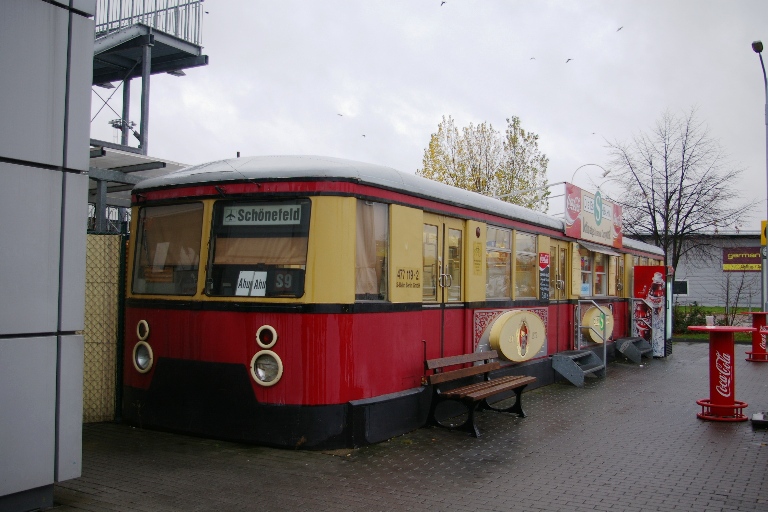
5773023241_b2d4ef57e7_o

477 119 at Berlin Schönefeld Airport, 06/11/10 (JW)

Stuttgart Airport

35297270_10155254565935356_4652284171023024128_n

475 608 at Stuttgart Airport, 08/06/18 (JW)

Others

There are also “EsS Bahns” airside at two more airports – Köln/Bonn and Shanghai(!).  However, these use mock-ups and not genuine former S-Bahn vehicles.