Latest Posts

DB Class 112 and 114: current status

As of 05/07/17, only 75 of the 90 class 112.1 remain in traffic.

Loco Operator Last Reported Passenger Working
112 101 DB Regio – Cottbus 13/05/17: RE4355
112 102 DB Regio – Rostock 02/06/17: Berlin REs
112 103 DB Regio – Rostock 17/05/17: RE13290
112 104 DB Regio – Cottbus 09/06/17: RE10
112 105 DB Regio – Stuttgart 09/06/17: RB39910
112 106 DB Regio – Stuttgart 24/06/17: Stuttgart RBs
112 107 stopped at Dessau Works 26/12/16: RE4358
112 108 DB Regio – Stuttgart 19/06/17: Stuttgart RBs
112 109 DB Regio – Cottbus 19/06/17: Berlin REs
112 110 DB Regio – Cottbus 01/06/17: Berlin REs
112 111 DB Regio – Cottbus 19/06/17: Berlin REs
112 112 DB Regio – Cottbus 03/05/17: RE5
112 113 DB Regio – Cottbus 05/06/17: RE18392
112 114 DB Regio – Cottbus 02/06/17: Berlin REs
112 115 DB Regio – Berlin-Lichtenberg 02/06/17: Berlin REs
112 116 DB Regio – Berlin-Lichtenberg 02/06/17: Berlin REs
112 117 DB Regio – Cottbus 28/05/17: Kirchentag additional to Lutherstadt Wittenberg
112 118 DB Regio – Berlin-Lichtenberg 19/06/17: Berlin REs
112 119 DB Regio – Berlin-Lichtenberg 02/06/17: Berlin REs
112 120 DB Regio – Cottbus 02/06/17: Berlin REs
112 121 DB Regio – Cottbus 23/05/17: RE78903
112 122 DB Regio – Cottbus 02/06/17: Berlin REs
112 123 DB Regio – Cottbus 09/05/17: RE3
112 124 DB Regio – Berlin-Lichtenberg 08/06/17: RE3306
112 125 DB Regio – Kiel 23/06/17: RE7
112 126 stored at Hamm (SSM)
112 127 stored at Hamm (SSM)
112 128 stored at Kiel 15/07/16: RE15
112 129 stored at Cottbus 30/09/16: RE1
112 130 stored at Hamm (SSM)
112 131 stored at Kiel 18/01/17: Hamburg REs
112 132 stored at Cottbus 13/09/16: Berlin REs
112 133 DB Regio – Berlin-Lichtenberg 17/06/17: RE18491
112 134 stored at Stuttgart 13/08/16: RB31
112 135 scrapped 03/09 after a fire at Borgeln on 04/06/08
112 136 stored at Hamm (SSM)
112 137 stored at Hamm (SSM)
112 138 DB Regio – Stuttgart 09/06/17: RB19122
112 139 DB Regio – Stuttgart 19/06/17: Stuttgart RBs
112 140 DB Regio – Kiel 26/04/17: RE21134
112 141 DB Regio – Kiel 30/05/17: Hamburg REs
112 142 DB Regio – Kiel 12/06/17: RE21026
112 143 DB Regio – Kiel 22/06/17: RE21008
112 144 DB Regio – Kiel 21/06/17: RE21083
112 145 DB Regio – Kiel 19/02/17: RE7
112 146 DB Regio – Cottbus 14/03/17: RE3191
112 147 DB Regio – Kiel 18/06/17: RE21418
112 148 DB Regio – Cottbus 27/02/17: RB49
112 149 DB Regio – Kiel 18/06/17: RE21064
112 150 DB Regio – Kiel 21/06/17: RB21306
112 151 DB Regio – Kiel 21/05/17: RE21014
112 152 DB Regio – Cottbus 10/06/17: RB31
112 153 DB Regio – Kiel 22/06/17: RE21010
112 154 DB Regio – Kiel 24/06/17: Schleswig-Holstein RE7
112 155 DB Regio – Cottbus 13/05/17: Warnemünde cruise train
112 156 DB Regio – Kiel 21/06/17: RE21006
112 157 DB Regio – Kiel 07/06/17: RE21865
112 158 stored at Kiel 26/04/17: RE21420
112 159 DB Regio – Kiel 22/06/17: RB21306
112 160 DB Regio – Kiel 22/06/17: RE21004
112 161 DB Regio – Stuttgart Overhaul date of 28/06/17 now back in traffic.
112 162 DB Regio – Kiel 21/06/17: RE21056
112 163 DB Regio – Kiel 18/06/17: RE21318.  Viewed on stock move at Seelze 07/07/17.
112 164 DB Regio – Magdeburg 11/06/16: RB86
112 165 DB Regio – Berlin-Lichtenberg 02/06/17: Berlin REs
112 166 DB Regio – Magdeburg 11/05/17: Magdeburg S1
112 167 DB Regio – Kiel 24/06/17: RE41420
112 168 DB Regio – Kiel 30/05/17: Hamburg REs
112 169 DB Regio – Stuttgart 09/06/17: RB39914
112 170 DB Regio – Stuttgart 08/06/17: RB39914
112 171 DB Regio – Kiel 30/05/17: Hamburg REs
112 172 DB Regio – Kiel 18/06/17: RE21420
112 173 DB Regio – Kiel 30/05/17: Hamburg REs
112 174 DB Regio – Stuttgart 24/06/17: Stuttgart RBs
112 175 stopped at Kiel 17/01/17: Hamburg REs
112 176 DB Regio – Kiel 26/04/17: RE21470
112 177 DB Regio – Kiel 21/06/17: RB21308
112 178 DB Regio – Kiel 21/06/17: RE21008
112 179 DB Regio – Kiel 22/06/17: RE21058
112 180 DB Regio – Kiel 18/06/17: RE21018
112 181 DB Regio – Kiel 26/04/17: RE21422
112 182 DB Regio – Berlin-Lichtenberg 04/09/16: RE5
112 183 DB Regio – Berlin-Lichtenberg 19/06/17: Berlin REs
112 184 DB Regio – Cottbus 03/02/17: RB49
112 185 DB Regio – Berlin-Lichtenberg 21/08/16: RE4364
112 186 DB Regio – Berlin-Lichtenberg 20/01/17: RE3309
112 187 DB Regio – Rostock 12/05/17: RE13290
112 188 DB Regio – Cottbus 03/05/17: RE13290
112 189 DB Regio – Berlin-Lichtenberg 19/06/17: Berlin RB14
112 190 DB Regio – Berlin-Lichtenberg 15/04/17: RE4362

Only 31 of the 39 class 114s remain in traffic:-

Loco Operator Last Reported Passenger Working
114 002 DB Regio – Stuttgart 31/03/17: Stuttgart RBs
114 003 stored at Cottbus
114 004 DB Regio – Stuttgart 19/06/17: Stuttgart RBs
114 005 DB Regio – Rostock 26/04/17: Warnemünde cruise train.  Re-entered traffic from Dessau Works circa 04/07/17
114 006 DB Regio – Stuttgart 24/06/17: Stuttgart RBs
114 007 DB Regio – Frankfurt (Main) 31/05/17: RE4542
114 008 DB Regio – Frankfurt (Main) 10/02/17: RB15618
114 009I scrapped 07/13 after a fire at Berlin Lichtenberg on 26/07/11
114 009II DB Regio – Frankfurt (Main) – former 143 873 01/06/17: Frankfurt RBs
114 010 DB Regio – Frankfurt (Main) 31/05/17: RE4540
114 011 DB Regio – Frankfurt (Main) 24/05/17: Frankfurt RBs
114 012 DB Regio – Frankfurt (Main) 31/05/17: RE4525
114 013 DB Regio – Frankfurt (Main) 31/05/17: RB15623
114 014 DB Regio – Frankfurt (Main) 26/02/17: RE50
114 015 DB Regio – Stuttgart 19/06/17: Stuttgart RBs
114 016 stopped at Frankfurt (Main) 08/02/17: Frankfurt RBs
114 017 DB Regio – Stuttgart 24/06/17: Stuttgart RBs
114 018 DB Regio – Frankfurt (Main) 19/07/16: RE30
114 019 scrapped 06/10 after a collision at Berlin-Karow on 16/04/09
114 020 DB Regio – Frankfurt (Main) 31/05/17: RB15662
114 021 stopped at Frankfurt (Main) 20/03/16: Frankfurt RBs
114 022 DB Regio – Frankfurt (Main) 31/05/17: RE4522
114 023 DB Regio – Frankfurt (Main) 31/05/17: RE4523
114 024 DB Regio – Stuttgart 08/06/17: RE19962
755 025 Departmental loco since mid-1992.  Now stored at München-Freimann – as 114 501
114 026 stored at Hamm (SSM)
114 027 DB Regio – Frankfurt (Main) 19/04/17: RB39906
114 028 DB Regio – Stuttgart 24/06/17: Stuttgart RBs
114 029 DB Regio – Frankfurt (Main) 31/05/17: RE4524
114 030 DB Regio – Frankfurt (Main) 31/05/17: RB15661
114 031 DB Regio – Frankfurt (Main) 28/05/17: RE28541 (Kirchentag vice in  Dresden area)
114 032 DB Regio – Stuttgart 05/06/17: RE22017
114 033 DB Regio – Frankfurt (Main) 15/02/17: RE4163
114 034 DB Regio – Frankfurt (Main) 31/05/17: RB15656
114 035 DB Regio – Stuttgart 19/06/17: Stuttgart RBs
114 036 DB Regio – Frankfurt (Main) 31/05/17: RE4520
114 037 DB Regio – Frankfurt (Main) 05/05/17: Frankfurt RBs
114 038 stopped at Frankfurt (Main) 15/09/16: RE4540
114 039 DB Regio – Stuttgart 05/06/17: RE4930
114 040 DB Regio – Rostock 28/05/17: Kirchentag additional to Lutherstadt Wittenberg
114 101 stored at Magdeburg – reverted to 143 171
114 301 DB Regio – Dresden – reverted to 143 120 Class 143


Norsk Jernbanemuseum receives new operating licence

Good news from the Norsk Jernbanemuseum – they have now received a new safety certificate and operating licence, which means that all being well we will be seeing some new Stålvogntoget charters with NoHAB diesel Di3.642 and electric loco El11.2107 in Norway in the not-too-distant future.  When any are announced, they will of course be posted on this site.

More information here.

24th & 25th June 2017: DB class 218 haulage into France

IMGP0092

218 484 at Hüffenhardt, 27/06/15 (JW)

A special event will be held over the weekend of 24th and 25th June 2017 to celebrate the “Grenzüberschreitendes Bahnjubiläum Winden – Wissembourg”; the 20th anniversary of the reopening of the cross-border route between Winden, in the German Land of Rheinland-Pfalz, and Wissembourg, in France.

This route, closed in 1975 and reopened in March 1997, has been “off the radar” for locomotive fans since occasional class 218 diesel-hydraulic haulage ceased on summer Saturday specials in 2013; this was also the last time that we saw booked class 218 operation into France.

A two-train shuttle will be operated between Winden and Wissembourg – one formed of a modern SNCF class X73500 DMU, and the other top and tailed by CFL 2-10-0 steam locomotive 5519 and a 218.  The 218 is presumed to be either 218 483 or 218 484 from DB Regio at Karlsruhe (which have not had any passenger diagrams for a good number of years, and only make sporadic short-notice forays onto passenger work these days).  5519 should lead into Wissembourg, with the 218 leading back out.

7761133098_4e3a4f366e_o.jpg

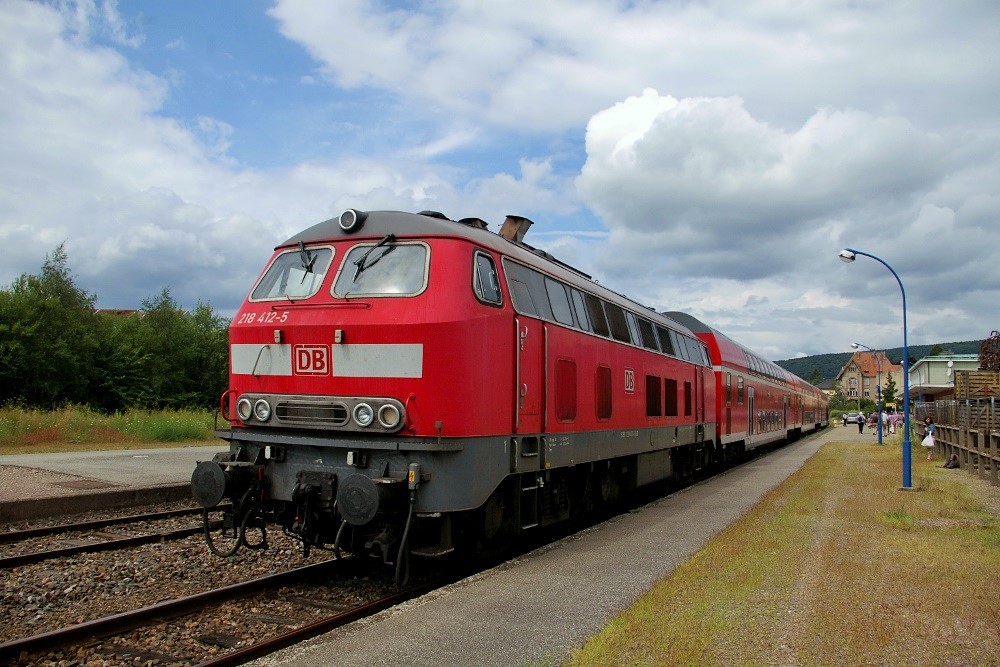
218 412 awaits departure from Wissembourg, 05/08/12 (JW)

The diagram for the “hauled” set each day is as follows:-

07:30 Neustadt Hbf – Wissembourg
10:25 Wissembourg – Winden
11:15 Winden – Wissembourg
13:25 Wissembourg – Winden
14:15 Winden – Wissembourg
16:25 Wissembourg – Winden
17:15 Winden – Wissembourg
19:25 Wissembourg – Neustadt Hbf

Service train tickets are valid for travel on all of these.

More information in a German-language online leaflet here and in French here.

Many thanks to Jonas Briest for his help with this article!

8th October 2017: A Russian repatriate in East Germany

Important Note: This tour was cancelled on 13/09/17 due to engineering works on the route.

Sunday 8th October 2017 sees an opportunity to travel behind E77.10, a well-travelled machine that was ceded to the Russians as war reparations.

Following the end of World War 2, or specifically the Potsdam Conference that set out how the “spoils” would be distributed amongst the Allied nations, the orders of the Sowjetische Militäradministration in Deutschland (SMAD) dictated that much of the infrastructure in the Russian zone of occupation of Germany (later East Germany, the DDR) was dismantled by Spring 1946 and taken to the Soviet Union as war reparations.  Included in this was the vast majority of electrified railway – including rolling stock.  Some of these routes have remained unelectrified ever since.

Quite what the intention of this move was – apart from opportunistic cynicism on the part of the Russians – is not entirely clear.  Certainly, huge swathes of mother Russia had been devastated during the conflict – not only its railways, but much of its industrial capacity, housing and even whole towns had simply ceased to exist, and needed to be recreated almost entirely from scratch.  However, a high proportion of this German railway equipment was simply never used.  A major factor in this is that the Russian track gauge is 1520mm (as opposed to the “standard gauge” of 1435mm used in Germany) necessitating complex regauging; these machines were 15kV a.c. as opposed to the then Russian standard of 3kV d.c.; but above that, the locos and catenary simply were not suited to the harsh environment – certainly not where they wished to use it.

It had apparently been intended to use a portion of this “recovered” German equipment to build a freight-only line at Vorkuta, deep into the Arctic Circle, over 1000 miles north-east of Moscow.  The Soviets also wanted to electrify a route from Tobul to Akmolinsk in Kazakhstan with the German system.  However, it soon became apparent that there was no obvious way to generate electricity for a system in this location and/or then get it into the overheads.

In 1953, the USSR largely gave up and gave the Deutsche Reichsbahn of East Germany the opportunity to purchase much of this material back.  This they did, although a lot of it was simply no longer usable; in truth, after its thuggish dismantling in 1946 and conveyance across the continent in questionable conditions, it never would have been.  The first newly-(re)electrified route to open in the DDR was that from Halle (Saale) to Köthen, on 1st September 1955.  However, progress with re-electrification was slow until after the 1972/73 oil crisis; again, this policy had been born of Moscow, who had a vested interest in selling cheap oil to the DDR through the Družba pipeline.

It’s fair to say that there is not much detail out there on this whole story, as throughout the “DDR times” it remained something of a taboo subject; not wishing to rock the boat with the Soviets or indeed point out any flaws in their reasoning.  As such, a lot of this history has simply been lost.

What is known is that locomotives of classes E04, E44, E77 and E94 were taken to Russia, along with some class 52 “Kriegslok” steam locos and some rolling stock from the Berlin S-Bahn system.

The above is a link to a YouTube video uploaded by user SuperJanH1 of E77.10 at work in 2011.

Although attempts are thought to have been made to operate the other classes in the Soviet Union, it is thought that the class E77s were simply housed in a facility at Babushkin in the Moscow area and were never used.  42 complete E77s, plus parts of 8 others, had survived the war and were taken away; 38 returned, although only 10 were returned to DR capital stock.  These were all scrapped by 1966, with the sole exception of E77.10, which survived in use as a train heating unit at Halle (Saale).  This machine – dating from 1924 – still makes occasional forays onto the mainline at the head of railtours.

The next of these is on Sunday 8th October 2017, when E77.10 hauls a short railtour from Leipzig-Plagwitz to Altenburg and return.  Operated by the Eisenbahnmuseum Leipzig, it departs from Leipzig-Plagwitz at 09:57 for an approximately 75-minute journey to Altenburg.  During the 3 hours there, participants are encouraged to visit the Altenburger Brauerei (brewery) where a beer tasting session and food are included in the tour ticket price of €62 second class/€78 first class.  The E77 departs back at 14:00, arriving back at Leipzig-Plagwitz at 15:15.

What can you combine it with?

There are not currently any other railtours of particular haulage interest in Germany advertised to run on that weekend, but do keep an eye on the Haulage Calendar section of this website for any new additions.  (Edit 25/06/17: a tour has now been advertised with 2,500hp diesel 118 770 (ex-DB 228 770) and 4-6-2 steam loco 01.0509 fairly nearby, the previous day).

Leipzig – or “Hypezig” as it is now known in some quarters – has recently rapidly gained a reputation as Germany’s creative capital.  Indeed, Plagwitz (the suburb from which this tour runs) has been transformed from run-down industrial wilderness to arty hotspot.  The city retains plenty of history, from 16th century Renaissance architecture to the sites widely recognised as the cradle of the 1989 revolution, and it definitely works as a destination for a “normals” holiday – as does the short, destination-focused nature of this tour.


If you’re enjoying the content of this website, please could I invite you to have a look at how you could support it?  Thanks!

MÁV class M41 diesel-hydraulics – fleet round-up

IMGP6780

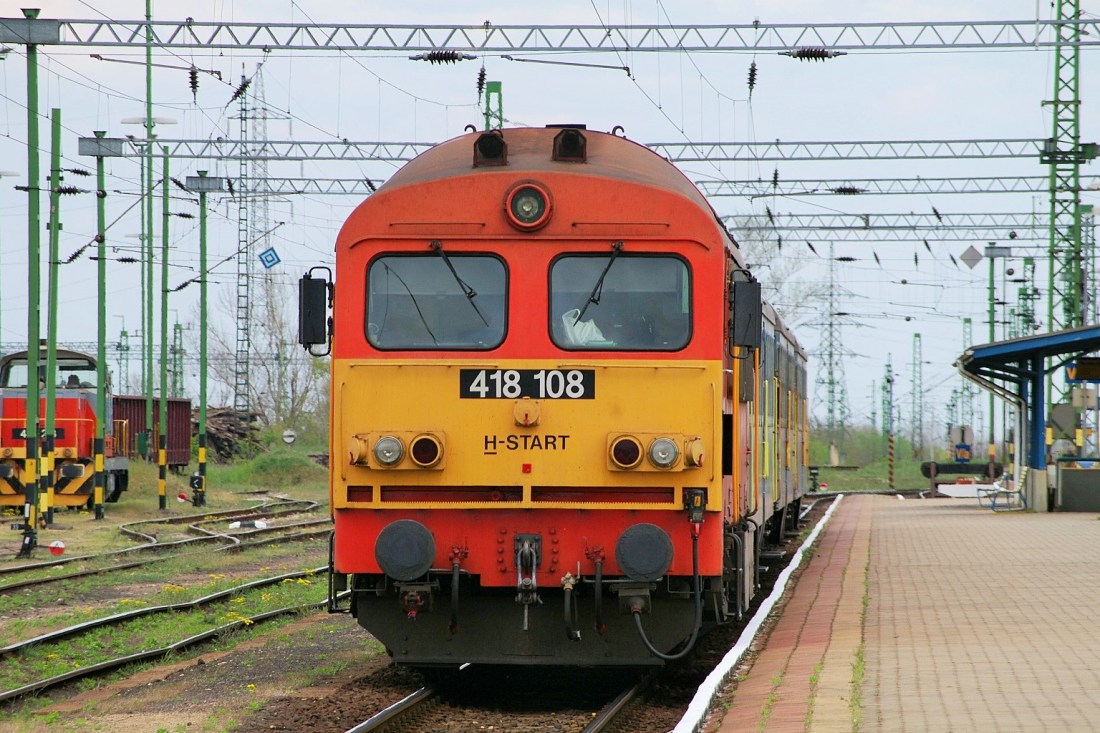
418 108 at Veszprem (JW)

One of my personal favourite European classes is the Hungarian M41 type (now class 418 since renumbering); gutsy 1,800hp diesel-hydraulics built by Ganz-MÁVAG in the 1970s and early 1980s.

114 of these machines were built for Hungary; 107 for the national operator MÁV, and 7 for the private railway GySEV.  (The GySEV machines passed to MÁV in 1987 after the electrification of the Győr to Sopron main line, as a small fleet of class V43 electrics moved the other way).

Of these 114, only 78 remain in service, but just 47 of these retain their 12-cylinder licence-built SEMT-Pielstick power units.  31 of the survivors have been re-engined with quieter Caterpillar 3512-series power units and renumbered firstly to M41 23xx and more recently to 418 3xx.

These locos do have nominal depot allocations, however it is fair to say that they can and do move around frequently.  To give a recent example, I spent a morning covering four of the diagrams booked for Hatvan-allocated M41s out of Budapest Nyugati in April 2017, and was presented with one machine from Szombathely, one from Debrecen, one from Székesfehérvár and one indeed from Hatvan; three of those moved on again within the next three weeks, so it is a very fluid situation.

As a result, rather than listing their depot allocations, I have decided to keep tabs on where the surviving M41s are actually working, with the assistance of the excellent MÁV “mapper”.  This shan’t be updated every day, and it certainly doesn’t purport to be a definitive list of “last workings” etc, but hopefully it will be a useful resource if you are searching for particular machines.  If a loco does not have anything shown against it, then I have not seen or heard of it working for some time; indeed, this might even mean that they are already withdrawn (but were shown as operational on the last list I had).

Updated to:- 04/08/17

Loco No. Former No. Working date Diagrams covered
418 103 (ex M41 2103) 30/06/2017 Békéscsaba
418 106 (ex M41 2106) 27/07/2017 Hatvan
418 108 (ex M41 2108) 07/07/2017 Celldömölk
418 110 (ex M41 2110) 04/08/2017 Hatvan
418 112 (ex M41 2112) 03/07/2017 Székesfehérvár
418 115 (ex M41 2115) 04/08/2017 Békéscsaba
418 118 (ex M41 2118) 04/08/2017 Szombathely
418 120 (ex M41 2120) 04/08/2017 Debrecen
418 122 (ex M41 2122)
418 126 (ex M41 2126)
418 128 (ex M41 2128) 04/08/2017 Miskolc
418 130 (ex M41 2130) 04/08/2017 Debrecen
418 131 (ex M41 2131) 30/06/2017 Debrecen
418 135 (ex M41 2135) 04/08/2017 Debrecen
418 140 (ex M41 2140) 03/07/2017 Székesfehérvár
418 142 (ex M41 2142)
418 143 M41 2143 27/07/2017 Hatvan
418 145 (ex M41 2145) 06/07/2017 Debrecen
418 146 (ex M41 2146) 04/08/2017 Hatvan
418 148 (ex M41 2148)
418 149 (ex M41 2149) 27/07/2017 Hatvan
418 150 (ex M41 2150) 10/07/2017 Szombathely
418 152 (ex M41 2152) 04/08/2017 Miskolc
418 153 (ex M41 2153) 04/08/2017 Debrecen
418 154 (ex M41 2154) 07/07/2017 Debrecen
418 156 (ex M41 2156) 27/07/2017 Hatvan
418 157 (ex M41 2157) 13/07/2017 Hatvan
418 163 (ex M41 2163) 07/07/2017 Miskolc
418 164 (ex M41 2121) 13/07/2017 Hatvan
418 165 (ex M41 2165) 04/08/2017 Miskolc
418 166 (ex M41 2166) 04/08/2017 Debrecen
418 167 (ex M41 2167) thought to have been OOS since March 2017
418 170 (ex M41 2170)
418 171 (ex M41 2171) 04/08/2017 Békéscsaba
418 172 (ex M41 2172) 04/08/2017 Debrecen
418 174 (ex M41 2174) 14/11/2016 Hatvan
418 175 (ex M41 2175) 04/08/2017 Hatvan
418 177 (ex M41 2177) 04/08/2017 Miskolc
418 178 (ex M41 2178) 04/08/2017 Miskolc
418 185 (ex M41 2185) 04/08/2017 Hatvan
418 187 (ex M41 2187) 06/07/2017 Debrecen
418 188 (ex M41 2188)
418 197 (ex M41 2197) 30/06/2017 Dombovar
418 198 (ex M41 2198) 04/08/2017 Debrecen
418 202 (ex M41 2202) 10/07/2017 Debrecen
418 204 (ex M41 2204) 14/07/2017 Székesfehérvár
418 211 (ex GySEV M41 004, M41 2211) 04/08/2017 Hatvan
418 303 (ex M41 2137)
418 304 (ex M41 2158) 04/08/2017 Székesfehérvár
418 305 (ex M41 2192) 04/08/2017 Székesfehérvár
418 306 (ex M41 2205) 04/08/2017 Székesfehérvár
418 307 (ex M41 2136) 14/07/2017 Székesfehérvár
418 308 (ex M41 2180) 04/08/2017 Szombathely
418 309 (ex M41 2127) 04/08/2017 Székesfehérvár
418 310 (ex M41 2161) 04/08/2017 Celldömölk
418 311 (ex M41 2134) 04/08/2017 Celldömölk
418 312 (ex M41 2196) 04/08/2017 Szombathely
418 313 (ex M41 2147)
418 314 (ex GySEV M41 002, M41 2209)
418 315 (ex M41 2107) Caught fire at Vep 04/08/17
418 316 (ex M41 2206) 10/07/2017 Szombathely
418 318 (ex M41 2201) 04/08/2017 Celldömölk
418 319 (ex M41 2179) 01/08/2017 Celldömölk
418 320 (ex M41 2125 / 2184) 07/07/2017 Szombathely
418 321 (ex M41 2199) 04/08/2017 Székesfehérvár
418 322 (ex M41 2173) 07/07/2017 Debrecen
418 323 (ex M41 2113)
418 324 (ex M41 2124)
418 325 (ex M41 2111) 06/07/2017 Debrecen
418 326 (ex M41 2119) 06/07/2017 light engine off Debrecen
418 327 (ex M41 2116) 06/07/2017 Székesfehérvár – caught fire 06/07/2017
418 328 (ex M41 2138) 04/08/2017 Székesfehérvár
418 330 (ex M41 2176) 04/08/2017 Celldömölk
418 331 (ex GySEV M41 007, M41 2214) 10/07/2017 Szombathely
418 332 (ex M41 2141) 10/07/2017 Székesfehérvár
418 333 (ex M41 2169) 03/07/2017 Szombathely
418 334 (ex M41 2182) 04/08/2017 Székesfehérvár
418 335 (ex M41 2186)

It is, of course, entirely possible that some of those listed with no recent passenger workings have been stored, or that some not listed might be reinstated at some point.


If you’re enjoying the content of this website, please could I invite you to have a look at how you could support it?  Thanks!

HŽ Class 2044 – GM power in Croatia

IMGP2479

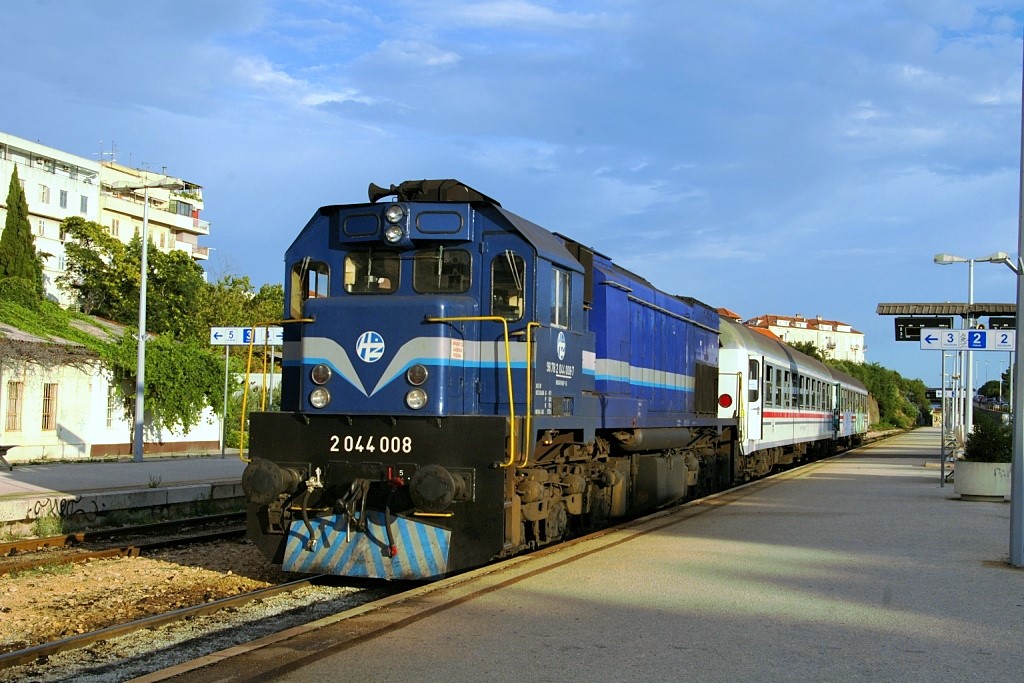
2044 008 at Split, 31/07/14 (JW)

Jugoslavenske Željeznice – the state railway of Yugoslavia – had a successful track record of sourcing diesel traction from General Motors.  One such class of loco was the JŽ class 645 which, following the break-up of Yugoslavia in the 1990s, became the Croatian class 2044s, many of which are still in traffic.

Between 1981 and 1984, JŽ procured 35 locomotives of class 645, which were 2,330hp A1A-A1A General Motors diesel-electrics built under licence by Đuro Đaković in Slavonski Brod, in modern-day Croatia.  4 of them (645 031, 032, 034 and 035) passed to Železnice Srbije in Serbia and retained their numbers, the other 31 of them to Hrvatske Željeznice, the Croatian railways, becoming class 2044.  This article is about the latter.

IMGP7457.JPG

2044 017 worksplate detail.  Note that the word “Jugoslavija” has been crudely removed from the plate.  (JW)

16 of these 31 remain in operational condition – two of these with the private freight operator PPD Transport, a further two in Kosovo, and 12 with HŽ.  The current disposition of operational class members is shown below:-

2044 003 PPD Transport (Skinest Rail)
2044 004 HŽ, Varaždin
2044 005 PPD Transport (Skinest Rail)
2044 006 HŽ, Varaždin – withdrawn in September 2017
2044 007 HŽ, Varaždin
2044 008 HŽ, Varaždin
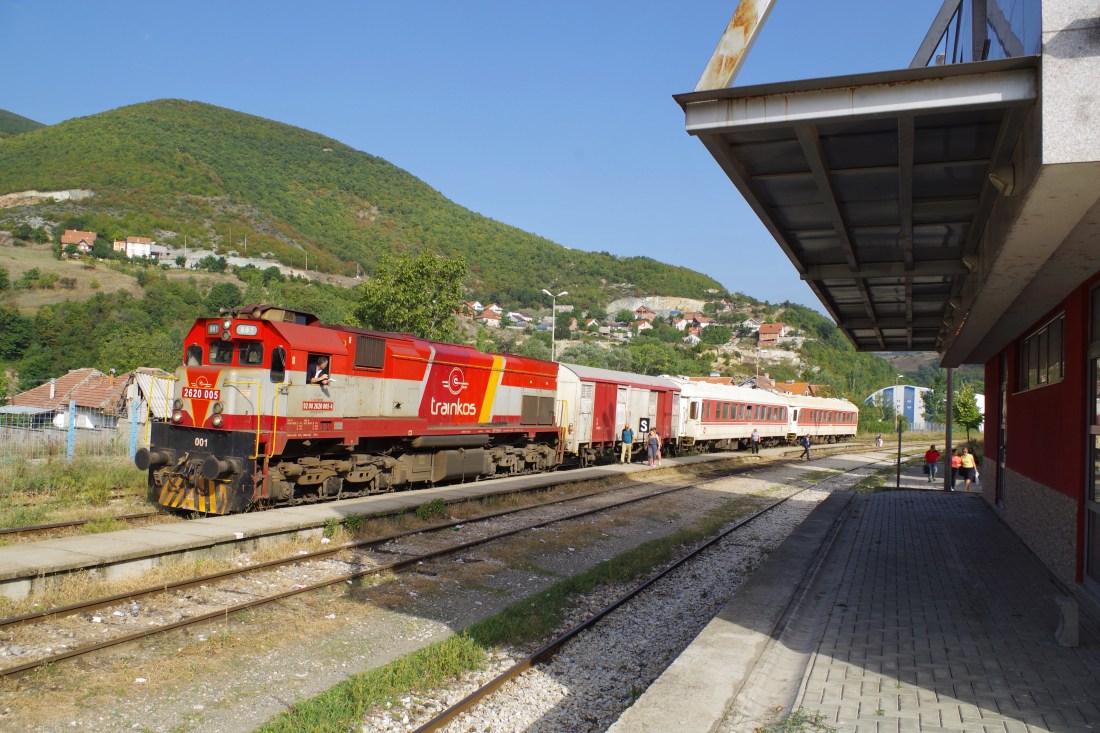
2044 010 Trainkos, Kosovo – as “2620 016”
2044 011 HŽ, Osijek
2044 013 HŽ, Osijek
2044 015 HŽ, Osijek
2044 016 HŽ, Varaždin – now withdrawn
2044 017 HŽ, Varaždin
2044 020 HŽ, Varaždin
2044 022 HŽ, Varaždin – withdrawn in July 2017
2044 026 HŽ, Osijek
2044 028 HŽ, Varaždin
2044 029 HŽ, Split
2044 030 HŽ, Split
2044 031 Trainkos, Kosovo – as “2620 005”

It is, however, entirely possible that some of the stopped machines may yet be reinstated.

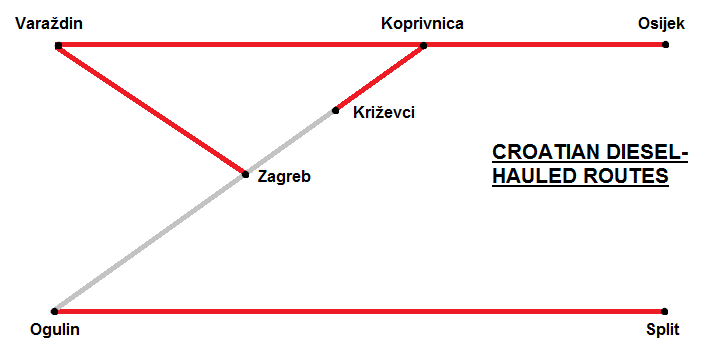
The HŽ locos are nominally allocated to three depots – Split, Osijek, and Varaždin – although can be, and frequently are, loaned between them.  Their use on passenger trains is now concentrated on three routes; Split – Ogulin (on overnight trains only), Osijek to Koprivnica and Varaždin – Zagreb.  These are now the last diesel-hauled passenger trains in Croatia.

2044 routes

Routes that currently see diesel haulage in Croatia (JW)

2044 011 departs Zaprešić on “Table 12”, 01/08/14 (JW)

“Unofficial” diagrams are available on the excellent European Rail Gen e-group, with generally about 9 machines in traffic each weekday, with significantly reduced numbers at weekends.

In short, the overnight trains between Split and Zagreb are 2044-hauled between Split and Ogulin and vice versa.  The solid climb out of the port town of Split into the mountains is a great stretch of railway.  It has to be said that being stood at an open window with a bottle of beer, a red sunset over the water and a wall of GM sound from the front of the train sometimes being brought down to walking pace by the combination of gradient and load is one of the truly great diesel hauled experiences of Europe.

The above is a link to an excellent video uploaded to YouTube by diesellokguru giving an impression of what the route of Split is like.

The second route mentioned is that from Osijek to Koprivnica.  I think it’s fair to say that this route does not have the geographical benefits of the route out of Split!  In the main, the 2044s handle the Zagreb to Osijek trains on the unelectrified section east of Koprivnica – a journey of just over 3 hours each way.  One of these locos also hauls a one-way local train from Križevci to Koprivnica in the early morning.

Koprivnica is also served by a Varaždin-based 2044 on the Varaždin to Zagreb “express” – R771 which departs Varaždin at 05:33, reaching Koprivnica 36 minutes later.  This loco then lays over until the return train, R770, comes back in the evening peak.

The more normal route, however, from Varaždin to Zagreb takes about 45 minutes longer and is that via “Table 12” via Zabok.  It is certainly not the fastest of routes – although it has some quite scenic parts – and the locos are rarely taxed.  Multiple units have now made their presence felt up here, and this former GM stronghold now sees only three weekday 2044 diagrams – two of which are peak hours only.

2044 006 departs Podsused Stajalište on an evening commuter train on “Table 12”, 26/08/10 (JW)

As a rule, however, these venerable locos’ star is falling, with less than half the fleet now active with HŽ – their bread and butter work either covered by multiple units or wiped from the timetable altogether.  With three more due for imminent withdrawal, and with Balkan locos rarely having a future after withdrawal from normal service, I would make plans soon if you wish to experience them.

Kosovo

Two locomotives – the former 2044 010 and 2044 031 – have been “exported” (I use the apostrophes, as they remain in the former Yugoslavia) and are now to be found in Kosovo, forming the backbone of the loco-hauled passenger service there.

IMGP2662

001 (ex-HŽ 2044 031) at Hani i Elizit, Kosovo, 20/09/15 (JW)

These machines have been fully overhauled at TŽV “Gredelj” in Zagreb and are in good condition.  The Kosovar railways have had a historical tendency to obtain second-hand traction from other countries, run it into the ground and then park it up (broken) before finding some more motive power from elsewhere and starting the cycle again.  Hopefully the condition of these machines will mean that they provide some stability and many years’ gainful service.

It’s fair to say that not many railway enthusiasts travel to Kosovo, and therefore operations there are rarely reported.  What is known is that the reliability of their Swedish railcar fleet leaves something to be desired, and most services are currently being loco-hauled.  Services run on two routes (Pristine to Pejë and Pristine to Hani i Elizit, the Macedonian border) and there seems to be one of the 2044s out each day.

Private Use

Last to be mentioned are 2044 003 and 2044 005 which have now passed to the private freight operator PPD Transport and are painted in a striking green and black livery (link to photo here).  It is early days, however they appear to be getting their feet under the table with some container train work between Zagreb and Rijeka – here is a link to a photo of the first working, on 12th April 2017.

2044 005 departs Zagreb Zapadni Kolodvor, 26/08/10 (JW)

Many thanks to Julian Mandeville and Colin Garner for their help with the preparation of this article.


If you’re enjoying the content of this website, please could I invite you to have a look at how you could support it?  Thanks!

Summer 2017 – DB “Rabbits” return to Berlin

DSC02429

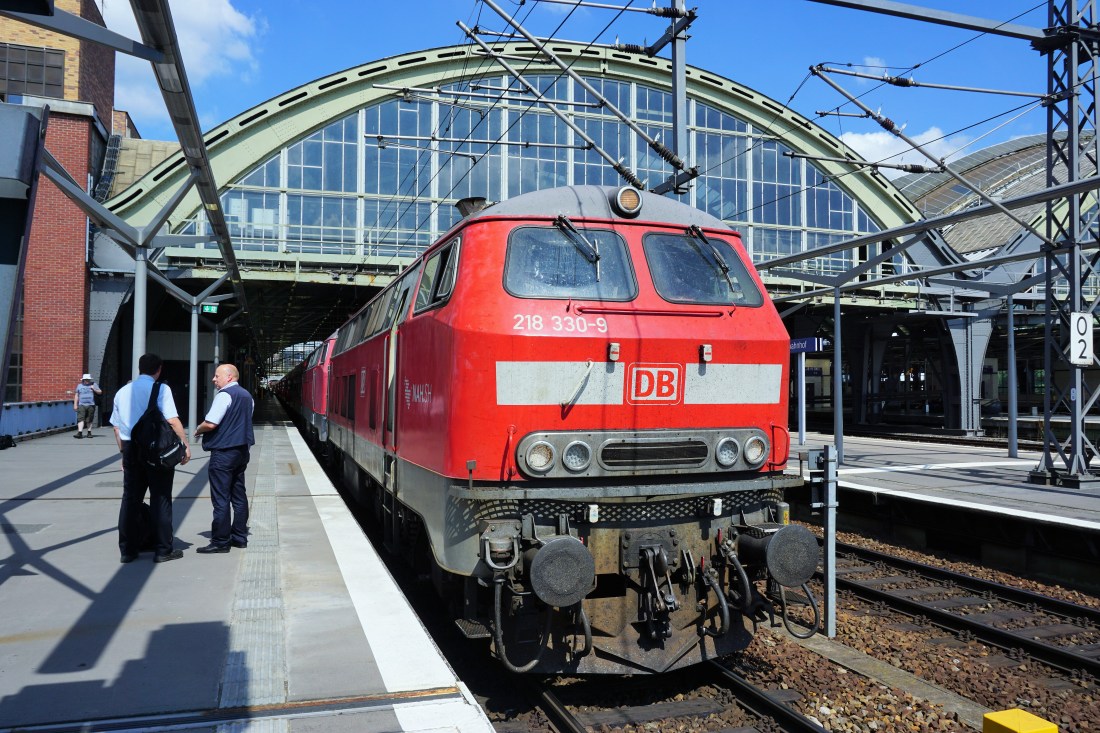
218 330 and 218 474 at Berlin Ostbahnhof, 19/06/17 (JW)

An intriguing service operated in northern Germany on selected days through Summer 2017, in some ways winding the clock back 20 years.

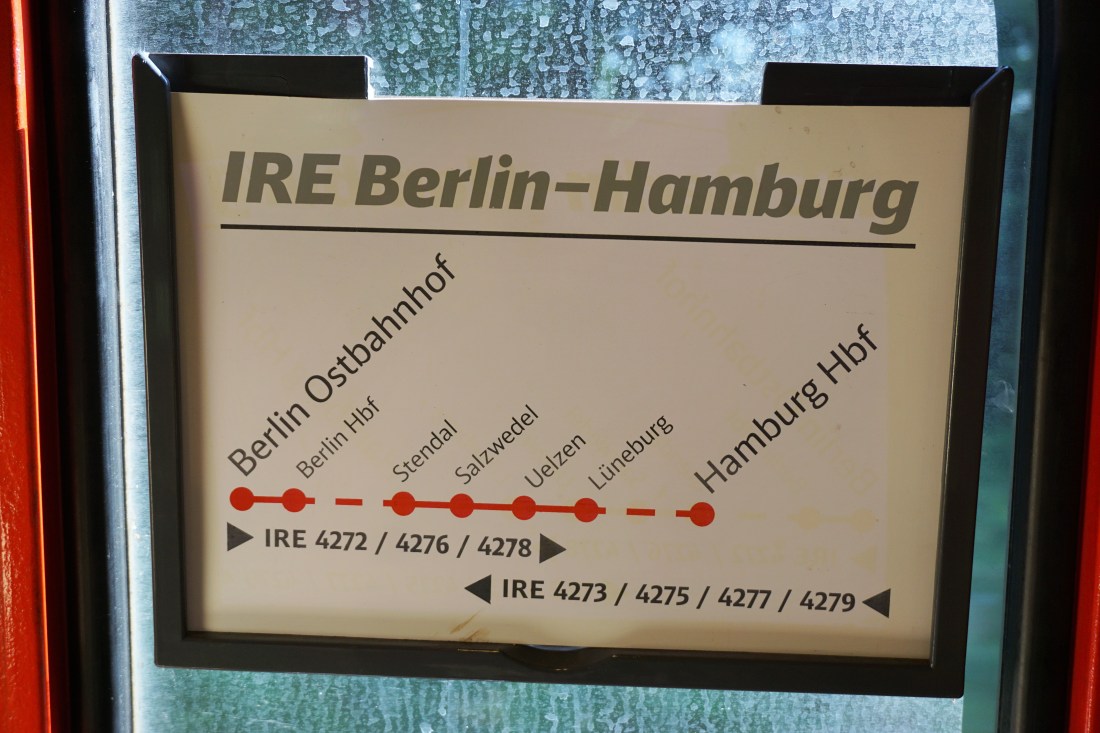
In mid-May, in a move that seemed out of the blue to many, IRE18447, the 06:55 Hamburg Hbf to Berlin Ostbahnhof, usually hauled by a class 182 electric, became a diesel diagram on Mondays only.  This is because for those days only, it was booked to run over the non-electrified classic “slow” lines between Stendal and Rathenow.  There was a recurring Sunday night possession on the Neubaustrecke which was not given up in one direction until mid-morning on Monday, meaning that single line working needed to be implemented; this train being diverted onto the non-electrified section to keep it out of the way of the ICEs.

This was a one-way diagram retaining the booked electric dead in the consist, the diesel(s) returning from Berlin to Hamburg light engine.

DSC02404.JPG

The traction

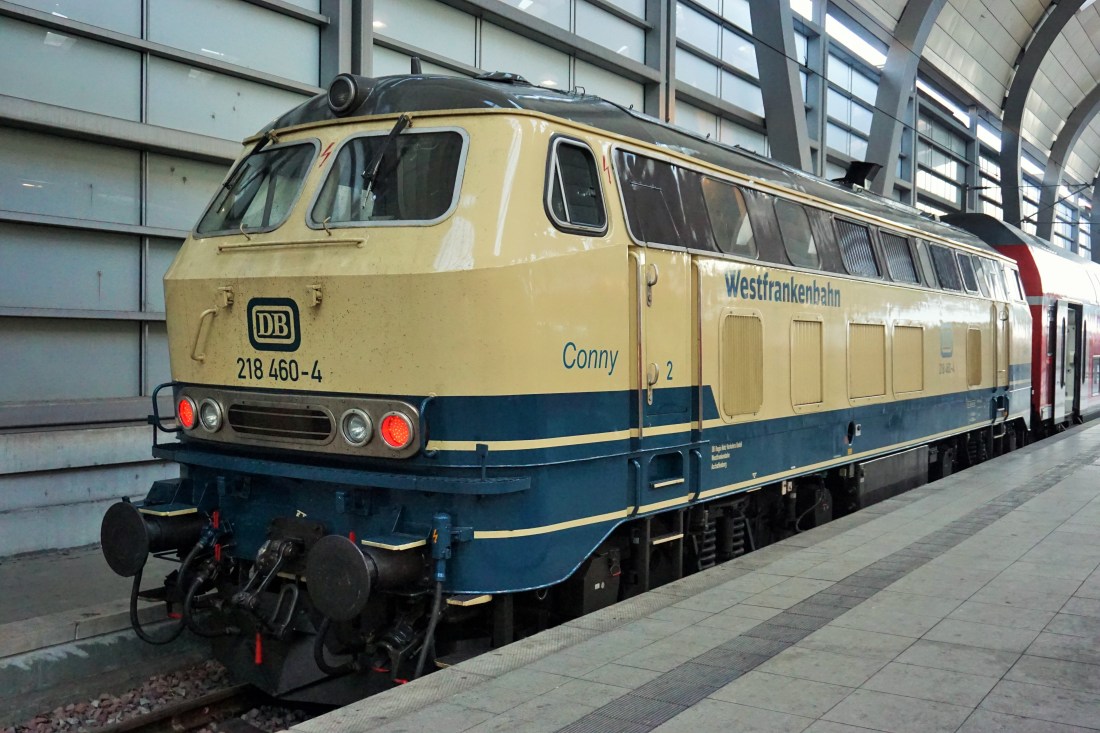
The two “celebrity” class 218 “rabbit” diesel-hydraulics – altrot liveried 218 387 of the Brohltalbahn (currently on hire to the Kurhessenbahn), and ozeanblau-beige liveried 218 460 “Conny” of the Westfrankenbahn – were moved north to Hamburg to act as motive power for these trains.

This provided a welcome return to the north for 218 460, which is “northerner” through and through, having been allocated to Lübeck depot from new in 1978 until 2007, before migrating south to Kempten.  Indeed, in 1996/97, it was numbered 210 460, denoting that it was one of the twelve Lübeck 218s renumbered into the 210.4 subclass.  The need for these came about as part of the development of the post-reunification cross-country network; DB wanted to create a Hamburg – Berlin – München InterCity axis, but the former cross-border section from Hamburg to Berlin via Ludwigslust had not yet been electrified.  Lübeck depot selected the 12 of its “rabbits” in the best condition and re-plated them from 140km/h (87mph) to 160km/h (99mph) to work this section in pairs at high speed.

Although 2017’s temporary diesel services were more sedate – and via the fairly-recently-reopened through route via Uelzen, Salzwedel and Stendal, rather than via Ludwigslust – it was still nice to be able to have ‘460 from Hamburg to Berlin once again.

DSC02398.JPG

Heritage-liveried 218 460 “Conny” at Kiel Hbf, 18/06/17 (JW)

However, ‘387 (especially) and ‘460 sadly proved somewhat less than reliable – certainly in the early days.  Ostensibly all 39 trains were meant to be worked by the pair of them, but it only made it to Berlin with the pair of celebrities (powering) four times, for various reasons.

In total, seven different 218s were used on the turn – 218 329 / 330 / 387 / 460 / 473 / 474 / 484.  Arguably the standout there was 218 474 from S-Bahn Hamburg, which – making its first passenger workings in nearly three years – was drafted in to work the train with ‘330 on 19th June 2017, and they put in an absolutely storming run, waiting time at every station along the way until being held at Rathenow to take additional passengers from a failed ICE.  218 474 took charge of the train solo the week after, arriving in Berlin less than 10 minutes late.

17th July 2017 was also lined up to see hit-listed 218 314 from Niebüll partner 218 460, however the failure (again) of the latter prior to departure time meant that by the time the defect had been diagnosed, ‘460 failed and the pair split, the train was sufficiently late to not require diesel haulage at all.  Indeed, 182 021 worked alone under its own power, and we reached Stendal after the possession had been lifted.

There were only two other occasions when the train did not enjoy the booked 218 power – 11th and 12th August 2017 – when the engineering work on the NBS was not being carried out, so there was no need to divert it.  On both dates, the train ran with just the booked 182 on the train, in the booked path and via the Neubaustrecke.

Times & Fares

This one-way 190-mile journey took just over 3 hours and definitely wound the clock back decades.  It required the locos to work at design speed for most of the way, and it was lovely to be able to sit in a compartment with an opening window behind a pair of more than 40-year-old diesels on a long distance service that late in the day.  At the time on this site, I recommended it as the place to experience 218s in 2017, and that is something I certainly stand by!

The train itself ran at an almost unsociably early hour, and short leaps were theoretically not too possible (the first stops being pick-up only and the last set-down only), but the train was best done throughout.  As one of the Berlin-Hamburg Express services, DB offered a €19.90 single fare (£17.54 at the time) – with a limited number of €14.90 fares if booked online very much in advance.  If returning later in the day (necessarily by electric), a return ticket could be purchased for €29.90 (£26.36).

If on a holiday in the Hamburg area, this was an ideal way to have a day trip to the capital, and allowed you over six and a half hours in what I believe to be the world’s most interesting city, before returning on the 16:52 with the class 182.

The route the train took is quite an interesting one.  Heading south from Hamburg, it left the main line at Uelzen and took the cross-country route through Salzwedel to Stendal.  This route – part of the former “Amerikalinie”, the erstwhile trunk route between Berlin and the great sea port of Bremerhaven and its opportunities for trans-continental import and export – was severed, literally, from 1946 as it crossed what was to become known as the Iron Curtain.  It was only reopened as a through route in 1999, and is now a fantastic bit of fast railway, although most of it is still only single track.  Even now, although the exact line of the former “inner-German border” is barely discernible, the atmosphere still feels a little different once you cross into the former DDR.

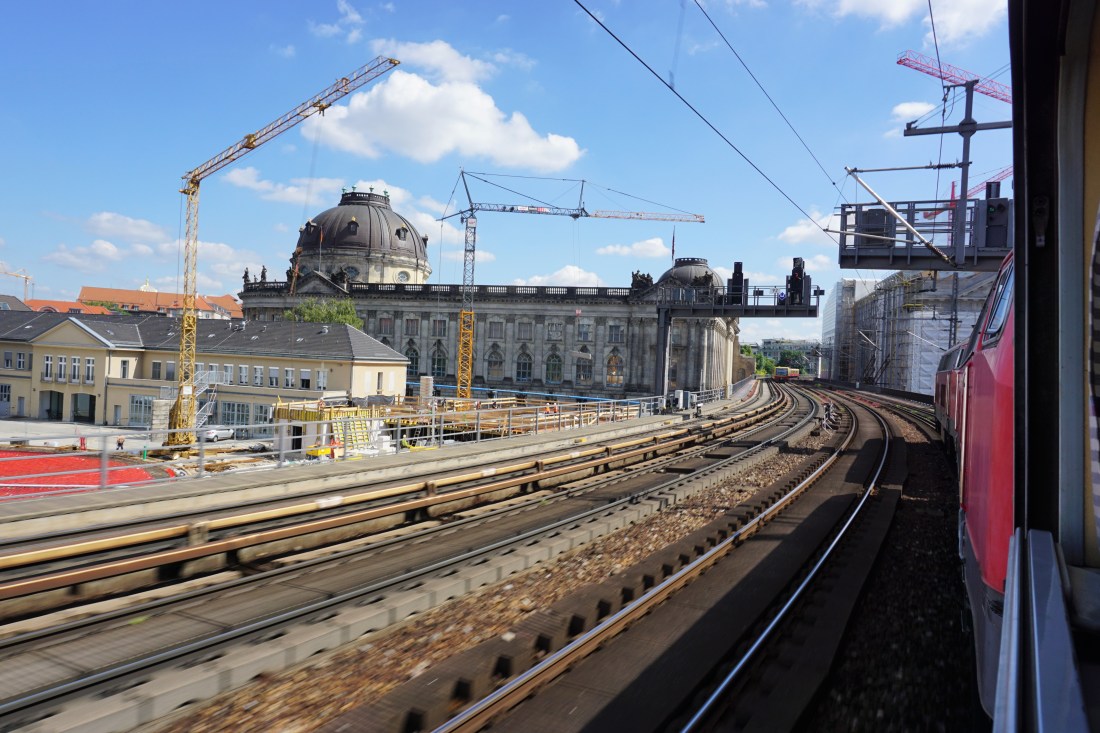
After a brief stop at Stendal, the train took line 6107, the classic route towards Berlin which is not electrified, running adjacent to the Neubaustrecke high-speed double-track railway.  It regained the electrified stretch after Rathenow, before making its grand entrance into Berlin, running right through the former West Berlin and out the other side before terminating at Berlin Ostbahnhof station, within sight of a remaining section of the Berlin Wall, at 10:11.

DSC02427.JPG

Sweeping right through the middle of reunited Berlin, along its elevated “Stadtbahn” (JW) 

Although this service was initially booked for 218 haulage on Mondays only, throughout the month of August this train was booked to be 218-hauled on Mondays to Saturdays.

Traction Log

Monday 15/05/17 218 460 218 387 failed with pre-heat defect
Monday 22/05/17 218 460 218 387 remained defective
Monday 29/05/17 218 460 + 218 387
Tuesday 06/06/17 218 387 218 460 used for Schleswig-Holstein RE services. Ran on 06/06 as 05/06 was a public holiday.
Monday 12/06/17 218 387 + 218 460 218 387 failed en route, shoved the rest of the way by 218 460
Monday 19/06/17 218 330 + 218 474 218 387 unserviceable, 218 460 on Kieler Woche services
Monday 26/06/17 218 474 218 387 still unserviceable, 218 460 on RE21602
Monday 03/07/17 218 473 + 218 460 218 387 still unserviceable
Monday 10/07/17 218 330 + 218 460 218 387 undergoing repairs at Niebüll
Monday 17/07/17 182 021 Planned for 218 314 + 218 460, but ‘460 failed before departure.  By the time they had been split for ‘314 to go alone, there was no need to diesel-haul it – ran sufficiently late to go main line from Stendal
Monday 24/07/17 218 330 + 218 460
Monday 31/07/17 218 330 218 460 failed before departure
Tuesday 01/08/17 218 330 218 460 still defective
Wednesday 02/08/17 218 330 + 218 460
Thursday 03/08/17 218 460 + 218 330
Friday 04/08/17 218 330 + 218 460
Saturday 05/08/17 218 460 + 218 329
Monday 07/08/17 218 329 + 218 460
Tuesday 08/08/17 218 460 + 218 329
Wednesday 09/08/17 218 329 + 218 387 218 460 had run north light to Niebüll
Thursday 10/08/17 218 387 + 218 329
Friday 11/08/17 182 001
Saturday 12/08/17 182 001
Monday 14/08/17 218 387 + 218 484
Tuesday 15/08/17 218 484 + 218 387
Wednesday 16/08/17 218 387 + 218 484
Thursday 17/08/17 218 460 + 218 387
Friday 18/08/17 218 387 + 218 460
Saturday 19/08/17 218 460 + 218 387
Monday 21/08/17 218 387 + 218 484 Via Magdeburg due to signal damage at Spandau
Tuesday 22/08/17 218 484 + 218 387 Via Magdeburg due to signal damage at Spandau
Wednesday 23/08/17 218 387 + 218 484
Thursday 24/08/17 218 484 + 218 387
Friday 25/08/17 218 387 + 218 484
Saturday 26/08/17 218 484 + 218 387
Monday 28/08/17 218 387 + 218 484
Tuesday 29/08/17 218 484 + 218 387
Wednesday 30/08/17 218 387 + 218 484
Thursday 31/08/17 218 484 + 218 387


If you’re enjoying the content of this website, please could I invite you to have a look at how you could support it?  Thanks!

Modern GM diesel power in Spain

There are relatively few places in Europe where diesel locos can still be found on several-hundred-mile-long cross-country routes.  Spain remains something of an exception.

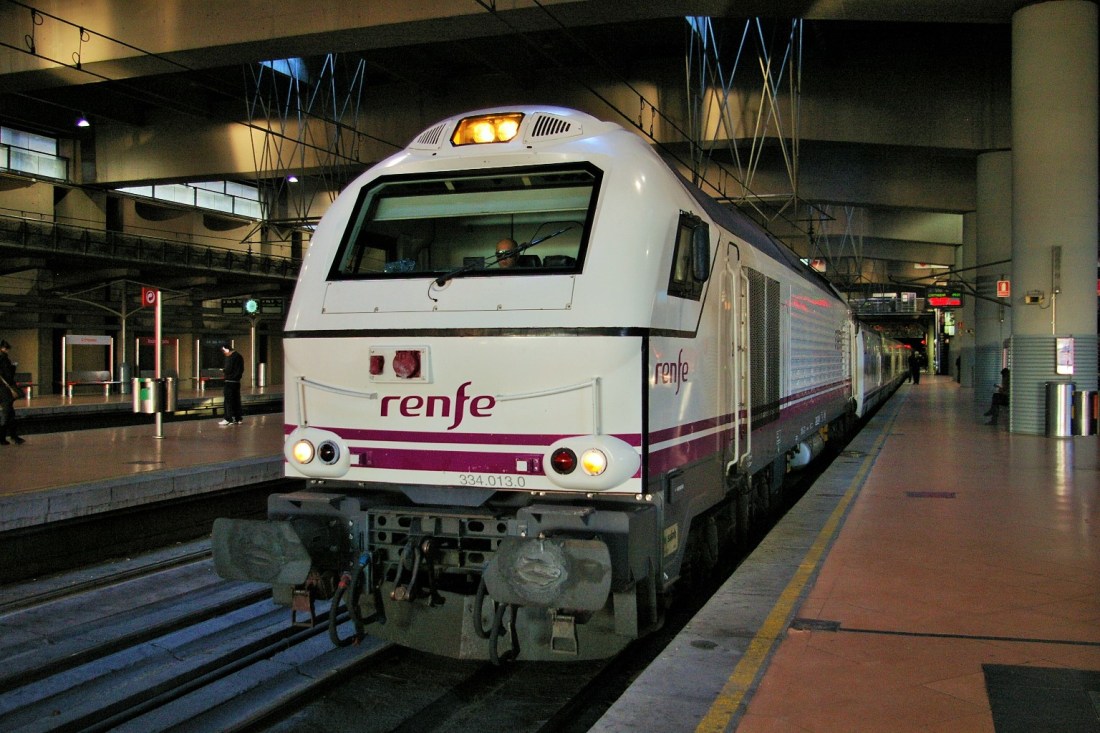
It’s fair to say that if you like the Class 67s in the UK, then the 28-strong RENFE Class 334 will be up your street.  Built between 2006 and 2008, these are 200km/h (125mph) Bo-Bos that feature 12-cylinder General Motors 710-series power units in an “Alstom” bodyshell too.  Indeed, they were built in the same factory in Valencia.  The main difference, of course, is that the Spanish machines are built to the wider Iberian gauge (1668mm, as opposed to 1435mm of our “standard gauge”).  They are also 3,300hp – slightly more than the 67s’ 3,200hp.  Link to the Vossloh information sheet on the class.

334013 departs Madrid Atocha Cercanias, 31/01/15 (JW)

In something of a Spanish tradition, they are not entirely-new locos, but did in fact re-use certain components from previous generations of RENFE GMs.

Their work is almost exclusively on long-distance passenger trains, which makes them an excellent choice if you just want to effortlessly sit back and relax behind diesel traction, passing through fantastic scenery for up to 700 miles a day with a lunchtime break at an interesting destination.  It’s much less straightforward, however, if your personal aim is to get as many different machines for haulage as possible!

Mainly, this is due to all of their work requiring a compulsory seat reservation (as is the norm in Spain), and trains sometimes travelling for upwards of 100 miles in between stops.  Even if you have an “all line rover”, you can’t simply get the deckchair out at a station and wait for your machine of choice to roll in; if anything, the system steers you towards committing yourself to a “move” before you leave home.

IMGP5409

334013 at Madrid Atocha Cercanias, 31/01/15 (JW)

However, if that hasn’t put you off, then I can highly recommend giving them a go.  Arguably the best place to base yourself is Spain’s capital city; Madrid.  Being the third largest city in the EU, there is plenty of accommodation to suit any budget, a generally excellent standard of English spoken, and plenty to do and see away from the railway if trains aren’t your sole focus (or if you have the family in tow!).

Spain diesel routes

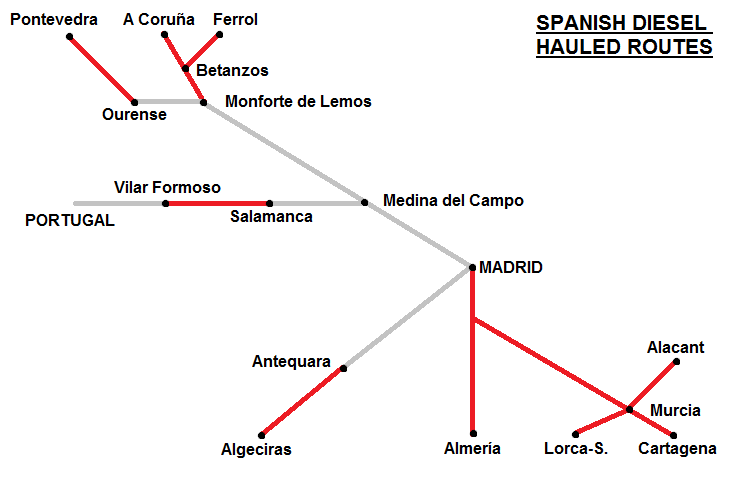
Spanish diesel-hauled routes (JW)

For a relaxing but rewarding “bash”, two of the main routes for 334 power radiate from the capital, and are the 350-mile journey to Almería, in Andalucia, and the 330 miles to Cartagena, in Murcia; both seaside towns on the Mediterranean.  I would actually go as far as saying that the departure from Almería at the edge of the stunning Sierra Nevada mountain range is one of the most scenic parts of the Continent that you can experience with a diesel at the sharp end.

There are morning departures from Madrid to both Almería and Cartagena that give you a lunch break at the seaside, and can get you back to the capital in time for “last orders”.  To Almería:-

Talgo 276, 08:00 Madrid Chamartin – Almería arrive 14:17

Talgo 279, 16:05 Almería – Madrid Chamartin arrive 22:33

You actually have two options for a round trip to Cartagena (or, indeed, can mix and match):-

Altaria 222, 09:00 Madrid Chamartin – Cartagena arrive 14:12

Altaria 225, 16:00 Cartagena – Madrid Chamartin arrive 21:00

Or:-

Altaria 228, 12:34 Madrid Chamartin – Cartagena arrive 17:28

Altaria 227, 18:20 Cartagena – Madrid Chamartin arrive 23:40

Both yield an interesting day.  Indeed, it’s possible to do the either route out and back to Alcazar de San Juan (92 miles distant from Madrid, and the junction of the two routes) and then have a break there in order to complete the journey on a different 334.  Be warned, though, I have not found punctuality to be great on these trains, and my 90 minute wait at Alcazar de San Juan one night turned into nearly 4 hours on my own, with little information as to when (or even if) my train would arrive!  Some consolation, however, was a good amount of freight traffic passing through to keep me entertained.

334012 runs round at Almería, 30/01/15 (JW)

All of the trains on these routes are 334-hauled, though, and you can easily piece together a “move” that can feature up to five of them in a day, should you so wish.  This would be my personal suggestion for a long day (but with built-in breaks):-

Altaria 220, 07:13 Madrid Chamartin – Hellín arrive 10:22

Altaria 223, 10:49 Hellín – Alcazar de San Juan, arrive 12:34

Talgo 694, 13:15 Alcazar de San Juan – Villarobledo, arrive 13:46 *

Altaria 228, 14:29 Villarobledo – Murcia del Carmen arrive 16:43 **

Altaria 225, 16:47 Murcia del Carmen – Alcazar de San Juan arrive 19:28

Talgo 279, 20:59 Alcazar de San Juan – Madrid Chamartin arrive 22:33

* This is a Class 252 electric – you can wait for the 334 behind if this isn’t your cup of tea.

** If sweating on a +4 doesn’t sound like your idea of fun, you can instead “leap” at Albacete, 15:00-18:34.  This certainly wouldn’t be something to be avoided; it’s not the stereotypical “bit of tarmac with a bench and a sign, miles from civilisation” but is in fact the largest city in its province and is certainly somewhere you could spend 3.5 hours.

334018 departs Madrid Atocha Cercanias, in the very early hours of 31/01/15 (JW)

It would, however, be completely wrong of me to suggest that these are the only places you can ride behind 334s.

There is further 334 haulage on offer in Murcia, on the Talgo services between Alacant and Murcia del Carmen (some continue to Lorca Sutullena or Cartagena, and vice versa).  Occasionally, the loco change occurs at Valencia rather than Alacant.

334s are also used on the Altaria services from Madrid to Algeciras – Spain’s most southerly station and only about 25 minutes on the bus from the border with Gibraltar.  These trains are worked from Madrid (Atocha) to Antequera by standard gauge class 252s, where the train goes through a gauge changer – after which a 334 picks it up on the other side and takes it forward to Algeciras on the standard gauge.  There are two trains a day in each direction from Madrid to Algeciras – 08:35 and 15:05 from Madrid and 08:43 and 15:03 from Algeciras.  These can all be covered by the same 334.

Diesel haulage – from both class 334 and the Co-Co class 333.4s – is also available in the north-west of the country on the unelectrified sections of the remnants of Spain’s decimated overnight train network – from Monforte de Lemos to Ferrol and A Coruña, from Medina del Campo (although this will imminently change to Salamanca) to Vilar Formoso (on trains to and from Portugal) and also under the wires from Ourense to Pontevedra.

There are also a number of heritage operations that feature diesel loco haulage – including the “Tren dels Llacs” (class 308) and the “Montserrat Classic Express” (ex-FEVE metre gauge Alsthom no.1003).


Many thanks to Philip Wormald, Charles Hinton and the posters to European Rail Gen for their assistance in keeping this article up to date!

Daily until 17th September 2017: Marshal Tito’s big GMs on passenger work in Serbia

One quite recent surprising development in the Balkans is the re-emergence of ŽS class 666 General Motors diesels on passenger work – locos with quite a bit of history behind them.

The socialist federation of Yugoslavia was born out of the Second World War under the direction of Marshal Josip Broz Tito, a key figure of the wartime resistance.  From 1947, he used the “Blue Train” to both travel around and entertain and impress guests; in much the same vein as the British Royal Family’s own private train.  The “Blue Train” was the epitome of luxury, being essentially a hotel on wheels – it included bathrooms, suites, and copious amounts of leather and wood panelling.  As a feather in the cap and a demonstration of Yugoslavia’s increasing prosperity, virtually every material that went into it was locally sourced.

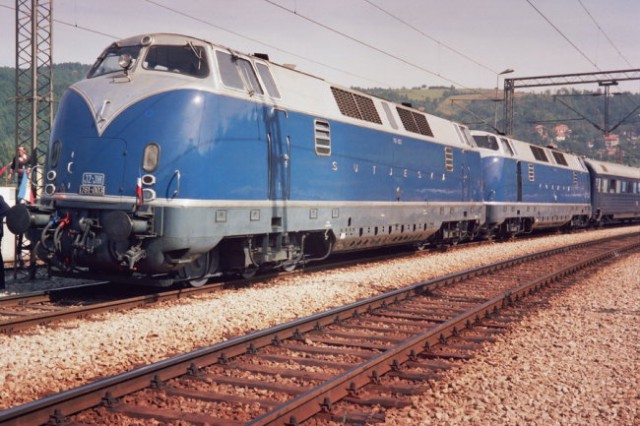
This special train was greeted rapturously by the locals wherever it passed through.  It was routinely hauled by three dedicated steam locomotives, one of which is now plinthed and on display at the side of Beograd’s main railway station.  As part of the ongoing modernisation of Yugoslavia, these were replaced in 1957 by three West German-built Class 761 diesel-hydraulics – a six-axle version of the famous V200 class of the Deutsche Bundesbahn – named “Dinara”, “Kozara” and “Sutjeska” in honour of important Second World War battles fought in the Balkans.  These were withdrawn in 1978, and now stand rusting away in sidings in Topcider, a southern suburb of Beograd (and here is a link to them on Google Maps!).

Yugoslav Railways (JŽ) had, through the 1960s and early 1970s, procured a great deal of its main line diesel traction from the Electro-Motive Division of General Motors, with great “out of the box” success.  Consequently, it was an obvious decision to source the 761s’ replacements from GM too.

The result was four brand-new General Motors Class 666 diesel-electric locomotives; the first three inheriting the previous battle-inspired names and the fourth having the title “Neretva” bestowed upon it, on the same theme.  These were built at roughly the same time and to a virtually identical design to the Irish 071 Class locos.

This is a link to a video uploaded to YouTube by Nemes Nikola, showing 666 003 at work on a freight train in 2016.

However, the GMs’ most notable duty was to be Tito’s final journey.  After a protracted illness, the dictator died on 4th May 1980 in a Ljubljana hospital.  The “Blue Train” – hauled by 666 003 “Sutjeska” and 666 004 “Neretva” – conveyed his remains, departing Ljubljana at 08:20 the next day and, after a break in Zagreb, arrived in Beograd approximately six hours later.  Tito was buried in the “House of Flowers” there three days later.

Although the “Blue Train” is seen generally in history as “Tito’s”, it continued to operate after his death, conveying the new order of Yugoslavian top brass.  An example of its use was to take Slobodan Milosevic to Kosovo Polje in order for him to give the infamous speech to over a million people at the Gazimestan memorial on 28th June 1989.  This was one of the train’s last uses; its carriages were retired that year.  The locos, however, remained in service, albeit with a much lower profile and, most recently, no passenger work and even withdrawal.

However, they have now obtained a daily passenger diagram on the two services that link the capitals of Bulgaria and Serbia (Sofia and Beograd), working the non-electrified section between Dimitrovgrad and Niš, as follows:-

1490 (09:40 Sofia -) 11:00 Dimitrovgrad – 13:38 Niš (- 18:14 Beograd)

1491 (09:25 Beograd -) 14:15 Niš – 16:58 Dimitrovgrad (- 20:10 Sofia)

These trains are booked to run daily until 17th September 2017.

CIÉ E421 Class – Little Maybachs in Ireland

IMGP4195

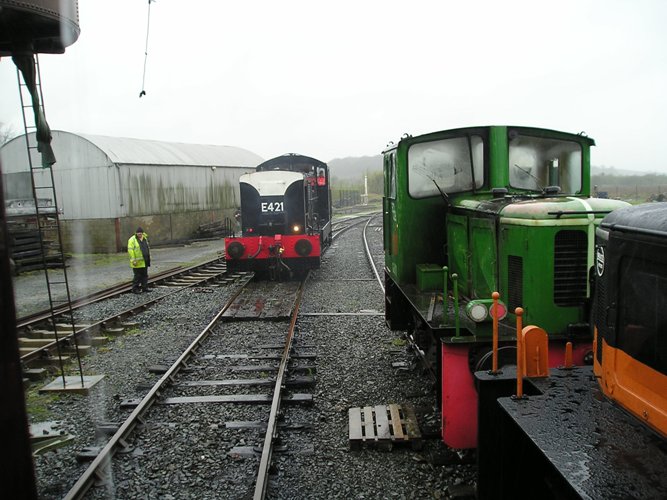
E421 at Downpatrick, 18/10/14 (JW)

The Maybach-engined diesel-hydraulic locos of British Rail have long had a large enthusiast following, but it’s lesser-known that there were Maybachs across the Irish Sea too – three of which have survived into preservation.

Largely unburdened by war damage in comparison to other European countries, the railways of Éire embraced diesel traction relatively early, although initially in something of a piecemeal and haphazard way.  Aside from five Mirrlees-engined shunters, two prototype 960hp Sulzers and a one-off 0-8-0 MaK diesel-hydraulic, CIÉ’s first serious attempts at dieselisation came from 1954-58 when it procured 94 Crossley-engined diesel-electrics from Metropolitan-Vickers in Dukinfield – 60 of 1200hp (the famous A Class) and 34 of 550hp (C Class).

Aside from these sizable orders, CIÉ continued to amass small fleets of entirely disparate traction, including from BRCW/Sulzer, Deutz, and the first order of 15 machines from General Motors (B121 Class), which allowed steam traction to largely be dispensed with by the end of 1962.  One of these small fleets was of 19 420hp diesel-hydraulic shunters constructed by CIÉ themselves at their Inchicore Works in 1956/57, with 420hp Maybach MD220 power units with Mekydro transmission, and were known as the E401 Class.

The E401 Class met CIÉ’s expectations and indeed led to a follow-on order of 14 further machines to a largely similar design, known as the E421 Class, which entered traffic in 1962/63.  These featured a different Mekydro transmission, multiple working capability and were slightly longer than their forebears.

OLYMPUS DIGITAL CAMERA

E421 alongside G611 and G613 during a diesel gala at Downpatrick, 17/04/05 (JW)

Strictly speaking, “shunter” might actually be an unnecessarily derisive term to use for these diminutive machines, as they were designed with greater things in mind than shunt releasing in termini and knocking wagons about in yards.  They may have only been of 420hp but they were built with a plated maximum speed of 100km/h (62mph).

The E421 Class, however, did not get off to an auspicious start.  On Friday 7th September 1962, whilst returning from Kildare to Inchicore on one of its pre-acceptance test runs with five coaches, E421 had just passed Droichead Nua/Newbridge station when it derailed.  Thankfully, none of the seven people on board the loco and train – six CIÉ staff and a German Maybach technician – were injured, however 200 yards of track were destroyed (effectively closing the main Cork to Dublin main line) and all of the vehicles including E421 sustained serious damage.  E421 came to rest jammed up against a bridge embankment (see photo on Wikipedia).

The loco’s wheel arrangement (C) was implicated in the accident and this, combined with a notorious reputation for rough riding, meant that both the E401s and the E421s were permanently restricted to 40km/h (25mph) not long after, which naturally affected the duties on which they were employed.  Generally, their existence was a relatively humdrum one, predominantly in and around Dublin, and all were withdrawn by 1983.

The above is a link to a video uploaded to YouTube by Ulsterimages with some good sound of E421 in action in 2010.  The loco is currently out of service.

All of the E401s were withdrawn by the late 1970s and cut up by the end of the following decade, however the E421s survived in an operational condition long enough to feature in the developing Irish preservation scene in the mid-1980s.  E421 and E432 went to the Downpatrick & County Down Railway over the border in Northern Ireland, where they remain, although both are currently out of traffic awaiting overhaul.

E428 and E430 went to the nascent “Westrail” based at Attymon Junction.  Westrail had hoped to take over the short branch line from there to Loughrea (closed 1975) as a preserved railway, but this did not come to pass; CIÉ downgraded Attymon Junction as a block post and sold the formation of the branch.  Westrail decamped to the goods shed at Tuam, on the Athenry to Claremorris route, in late 1985, but E430, which had been cannibalised for spares, had been cut up by then.

However, this ultimately led to a brighter future for its sister, at least for the short-term.  Sunday 22nd June 1986 saw E428, that unremarkable little engine in the far west of Ireland, make true diesel preservation history.  When it hauled the “Orange Blossom” special from Tuam to Claremorris and return, it became the very first preserved diesel locomotive to haul a passenger-carrying train on the main line under its own power in the British Isles.  E428 continued to be used on such specials up and down the Western Corridor – closed to passengers in 1976 but still open for freight traffic at the time – for the next few years (here is a link to a YouTube video of E428 at work on these duties, from 1989).  That is, until 1993, when Iarnród Éireann made the decision to lift the rails from the route through Tuam, supposedly for “reconditioning”, thus trapping Westrail’s rolling stock in its shed.  The route was eventually relaid, but not the connection to the shed – thus effectively ending Westrail’s operations at a stroke.

6805732018_51d6873d79_o

E428 hides away in the background behind A3r at the Inchicore Works open day, 16/06/96 – I don’t seem to have actually taken a photo of E428 itself in those pre-digital days!  (JW)

E428 next returned to its birthplace, when it was taken by road from Tuam to Inchicore to be exhibited at the open day commemorating the Works’ 150th anniversary in 1996, with the assumption that it would then return to Tuam, but this did not occur.  E428 stayed at Inchicore for nearly a decade, before things turned full circle once again with it moving on to the Loughrea branch – it was purchased by Dunsandle Railway Station, and placed on a length of track there along with a carriage and a wagon.  It remains here as a static exhibit and has been recently been repainted; you can make a donation to its upkeep on its owners’ website should you so wish.

E425 and E429 were also earmarked for preservation, but sadly this did not come to anything – but we are lucky to retain the three survivors.

E421 Downpatrick & County Down Railway, Northern Ireland
E428 Dunsandle Stationlink to Google Maps
E432 Downpatrick & County Down Railway, Northern Ireland

As an aside, the E Class were not the only Maybachs that CIÉ had.  As the 1960s progressed, the aforementioned Crossley Metrovicks were not delivering the desired level of reliability; the Cs were especially problematical, as a lot of their branch line work was being taken away by the closure of the routes, leaving them at 550hp as underpowered for main line work.  As a trial, C233 and C234 received Maybach MD650 power units (as in the BR Class 42s and DB V200.0s) of 980hp in 1965/66, but in the end CIÉ made the sensible decision to standardise across its fleet on General Motors power units instead, and C233 and C234 followed suit in 1979, being the last “main line” Maybachs in the British Isles.

The E Class have never really been in the limelight, but the sound of one at full power is something to experience – especially if, like me, you are a fan of diesel-hydraulics – and hopefully it won’t be too long until that sound is heard again.