Latest Posts

RB48 – Heritage traction in Nordrhein-Westfalen

For observers of the German railway scene, the loss at the end of 2017 of “the Kufstein” took away a valued piece of variety.  Happily, something similar has now started elsewhere – although with less scope for such a diverse selection of traction!

The substitution of a Meridian commuter train diagram between Kufstein and München between May 2016 and December 2017 occurred as a result of a fatal collision between two of its EMUs in February 2016 which had written both off.  This “vice turn” continued until new-build replacement units entered traffic.

Sadly, history repeated itself somewhat on the evening of 5th December 2017 at Meerbusch-Osterath, near Krefeld, when a National Express Bombardier “Talent 2” EMU collided with a freight train, causing startling visual damage to the unit and most certainly breaking its back.  Some footage in the aftermath of the accident can be seen in a news report here.  Most importantly, this time there were no fatalities.  The cause is still under investigation by the EUB, but the point pertinent to this story is that National Express have consequently had one fewer unit in their fleet than previously.

Loco hauled solution

As a result, Monday 29th January 2018 saw the introduction of a modest loco-hauled operation for National Express, on the RB48 “Rhein-Wupper-Bahn” route which runs from Köln, through Solingen to Wuppertal.

This is not exactly a novel development, as National Express used locos and stock between February and May 2016 – in fact, from the same provider on exactly the same diagram…


The above is a link to a YouTube video uploaded by user leeseisenbahnen showing 110 469 in action on the last occasion (2016) that National Express hired in this combination of locomotive and carriages.

Diagram

The loco-hauled set will be in use from Mondays to Fridays, and there is not currently a scheduled end date for its use.  The diagram is as follows:-

RB32508 (RB20170) 06:08 Bonn Hbf – Wuppertal-Oberbarmen 07:45
RB32423 (RB20157) 08:13 Wuppertal-Oberbarmen – Köln Hbf 09:05
RB32428 (RB20158) 09:52 Köln Hbf – Wuppertal-Oberbarmen 10:45
RB32441 (RB20159) 11:13 Wuppertal-Oberbarmen – Köln Hbf 12:05
RB32446 (RB20160) 12:52 Köln Hbf – Wuppertal-Oberbarmen 13:45
RB32457 (RB20161) 14:13 Wuppertal-Oberbarmen – Köln Hbf 15:05
RB32458 (RB20162) 15:52 Köln Hbf – Wuppertal-Oberbarmen 16:45
RB32519 (RB20163) 17:13 Wuppertal-Oberbarmen – Bonn Hbf 18:44

To note: between 28th February and 9th March, and again between 19th and 25th March 2018, engineering works close the above the route, and therefore the set will work on the following diagram (also Mondays to Fridays only):-

RB62151 04:50 Köln Messe/Deutz – Remagen 05:49
RB62150 06:11 Remagen – Köln Messe/Deutz 07:09
RB62153 07:50 Köln Messe/Deutz – Remagen 08:49
RB62152 09:11 Remagen – Köln Messe/Deutz 10:09
RB62155 10:50 Köln Messe/Deutz – Remagen 11:49
RB62154 12:11 Remagen – Köln Messe/Deutz 13:09
RB62157 13:50 Köln Messe/Deutz – Remagen 14:49
RB62156 15:11 Remagen – Köln Messe/Deutz 16:09
RB62159 16:50 Köln Messe/Deutz – Remagen 17:49
RB62158 18:11 Remagen – Köln Messe/Deutz 19:09

It has been suggested that 183 500 might work on these turns, but so far (5th March) it has remained in the hands of the booked 110.

Traction

Traction for this will be class 110 electrics from TRI Train Rental working in push-pull mode with a rake “fresh air” carriages from the same provider.  The operation has kicked off with 110 469, a 51-year-old Henschel-built electric that is now in a pretty variation of the Stahlblau livery that it entered traffic in.

12th May 2018 – Two ex-DR V100s around Magdeburg

Saturday 12th May 2018 sees a particularly high-mileage railtour featuring an ex-Deutsche Reichsbahn V100 type diesel loco (ex-DB 202 – specific loco not currently known), departing Staßfurt at 06:45, picking up through Magdeburg to run approximately 200 miles north to the Baltic Sea coastal town of Warnemünde and back.  This is being promoted by Nostalgiezugreisen Lipsia (link).  The fare for the day is an astonishingly reasonable €49.

Staßfurt – a town of only 23,000 people and with just one hotel within 5 miles of the station listed on Trip Advisor – is not the easiest place in the world to get to for 06:45, however – the only train that comfortably “makes” it is the 05:44 DMU from Aschersleben, which is not exactly the centre of the universe itself.  If you are intending to cover this excursion to Warnemünde, I would strongly suggest that you stay in Magdeburg, the state capital of Sachsen-Anhalt.  The railtour picks up there at a currently projected time of 07:10.

However, if you do so, you may wish to investigate the possibility of heading south to intercept the train, to Schönebeck – its intermediate call on the way in from Staßfurt, at 07:00.  You can do this on the 06:36 RegionalExpress DMU from Magdeburg Hbf (which gives you a +10), or – on paper – you could precede that on the 06:30 special train departure – which is another V100!

The Eisenbahnfreunde Traditionsbahnbetriebswerk Staßfurt are also running a charter on that day (link), advertised to be hauled by 202 484, departing Magdeburg Hbf at 06:30, calling at Schönebeck at 06:43 (+17 onto the other tour), running south to Staßfurt where it is replaced by steam loco 44 1486 for a day out to Meiningen.

This 11-minute video uploaded to YouTube by user ecpaganini shows V100s at work in the former East Germany two decades ago.  Those days will be resurrected in a small way on 12th May 2018.  202 484 – one of the locos involved – is seen making a strong departure at 7m20s in the video.

Of course, you may wish to alight from the northbound charter back at Magdeburg where – if all had gone to plan – you will have been able to have had two V100s on two trains by 07:10.

An important note

I should note that I have not approached the operator of either railtour myself to see if they would entertain a “part fare” on this occasion, and I strongly suggest you do this if you are considering this move.  Although very common in the UK, German railtours in general do not have any kind of “part fare” culture, although I find that railtour organisers are – in the main – happy to negotiate a reasonable arrangement if they are expecting you.

In the unlikely event that the response is a “no”, please respect that.  We are lucky that British enthusiasts enjoy a good relationship with German railtour operators and this is not something that should be jeopardised.

Saturday 24th February 2018: Norwegian NoHAB Railtour

Saturday 24th February 2018 sees the next outing with Norwegian “NoHAB” Di3.642.

DSC_0273

The “‘Stålvogntoget” is ready for departure from Åndalsnes. Photo: Mette Larsen

The Norsk Jernbanemuseum are taking their class Di3 loco, Di3.642 on a 340 mile round trip from Hamar to Røros and return.  The provisional timetable (subject to alteration) sees a sociable departure time from Hamar of 08:20, running via the Rørosbanen via Rena and Koppang to Røros – arriving at 12:00, and then departing back at 17:30, with a 21:54 arrival time home at Hamar.

The Locomotive

Di3.642 is one of the 35-strong Di3 class of 1,750hp General Motors 567 series-engined diesel-electrics supplied by the Swedish firm of Nydqvist & Holm AB (NoHAB) to Norges Statsbaner (NSB; the Norwegian State Railways) between 1954 and 1969.  This well-loved class were loyal servants to the Norwegians, being finally withdrawn at the turn of the century.

Di3.642, built in 1960 and withdrawn in July 2000, is one of the three members of the “Di3b” subclass which were built with an A1A-A1A wheel arrangement (as opposed to the Co-Co Di3a), and were longer, heavier and faster than their forebears. They were actually built for the Finnish market, but the Finns never took up the order.  Di3.642 is unique, however, in being the only one of this subclass still to remain in Norway; the other two – Di3.641 and Di3.643 – now eking out their existence in Kosovo.

Di3.642 will have a good opportunity to sing as it will be hauling load five – carriage numbers BF14 21728, B5-2 26021, B3-2 25579, BC5 26029 and FR3 21265.  The latter is the dining coach/coffee shop which will be serving light meals (meat stew), hot drinks, Norwegian waffles, soft drinks etc.

The Route

The train travels over the lion’s share of the Rørosbanen, which was formerly the main north-south main line in Norway prior to the construction of the line through Dovre which has assumed that role since the 1920s.

The Destination

The purpose of the trip is to visit the Rørosmartnan, a yearly market festival held in the town of Røros, which is itself a UNESCO World Heritage Site, in a former copper mining area, containing approximately 2000 wooden houses and having a distinctly “olde-worlde” atmosphere.

Tickets

Fares are 900 NOK (£82) for the round trip, or 600 NOK for just one way, plus approximately £3 online booking fee.  Tickets are available from this Ticketmaster link, and are valid for entry to the museum itself (also at Hamar) on between 11:00-15:00 on the Friday or between 11:00-16:00 on the Sunday around the tour.  You can select which individual carriage you would like to sit in, although it is not currently known how these will be marshalled on the day.


My thanks once again to Mette Larsen for the information to assist with this article.

European Traction website – the future

Firstly, don’t read too much into the title of this blog post, and also please do not misconstrue it as a plea to be patted on the back either.  It’s now very nearly a year since I set this website up, and it’s an appropriate time to look back at what it has (and has not) achieved so far, and also where it proceeds from here.

The website was set up with two primary aims – firstly, to give wider publicity to haulage opportunities across the Continent to make it easier for enthusiasts of European locomotives to travel behind different or interesting ones, and secondly to serve as a platform to encourage enthusiasts who have not travelled overseas much (or at all) to do so, by showing them what there is to experience and advising how to go about it.

I would like to think that it has so far been successful on both counts – I’ve certainly received a lot of messages advising that users have ridden behind locos that they would otherwise not have done were it not for this site, and the previously oft-heard quote “I’d have done that if only I’d have known about it”, uttered for years by enthusiasts seeing photos retrospectively of events or railtours that had simply not been known about in advance, is almost a distant memory!  Equally, it has led to greater support of overseas railway events – for example, the Bocq railway “Festival”, widely publicised via this site, had an approximately seven-fold increase in the number of British visitors it received in 2017.  Positive feedback from a number of angles has been extensive and I am very grateful to everyone who has taken the time to give it.

It is fair to observe that there has been some isolated (but fairly vocal and public, it must be said) criticism of the mere concept of this website online, with the view expressed that it is futile and, indeed, counterproductive to set something up that is “in competition with European Rail Gen“.  My personal view is that it simply is not in competition with anything, otherwise it would not exist.  “ERG” exists to share urgent and interesting information on loco workings and trip reports – the former with brevity the key, given the format – and indeed I do share much of the information to be found on this site to the group myself. 

The utility of this website is to bring together (including from existing internet resources – saving you the effort of trawling and translating yourself) forthcoming haulage opportunities in an easily-referenced calendar format, usually with a link to more information about the loco involved, that – in my view at least – does far more to entice novices to get involved than a list of numbers of locos they’ve never heard of and places they’ve never been.  There are also a number of (I feel, interesting) articles on more general locomotive-related subjects.  It is also worth saying that my distinct feeling is that preservation groups/railtour organisations are far keener to share information for a semi-journalistic article searchable across the web, than to an individual in another country who may not even then visit.

The other aspect that has received some (again, isolated) criticism is that I ask for voluntary donations to cover the costs of having and keeping this website online.  I don’t personally see this as unreasonable – I have always been entirely honest about the costs involved, and this is in my time as well as money.  I emphasise that I am not out to make a profit in any way – if I was, I certainly would not go about it this way!  I merely take satisfaction from the knowledge that it is helping others, however I do need to acknowledge that it does cost me a considerable amount of my own money to do this: over £200 so far, and I have a further significant payment due to go out for website hosting next month.

With that in mind – what’s your view on these issues?  Is what is contained on ERG and elsewhere online sufficient for your needs as an enthusiast – or do you need this site?  If so, I would be delighted to continue with it – however, if you don’t, then it seems sensible that I spare myself the effort before the next sizeable bill is due.  Equally, if there’s anything you would like to see me do differently – or additionally – with the site, please do let me know.

Thanks for reading – I’d appreciate your thoughts?

Jonathan Wilcox

Museumseisenbahn Küstenbahn Ostfriesland – Belgian and German diesel power

One heritage railway in Germany that uses exclusively heritage diesel locomotive haulage is the Museumseisenbahn Küstenbahn Ostfriesland (MKO), in the far north-west of the country.

The MKO (website here) runs trains on a 16.5 km (10.3 mile) stretch of line from a junction with the “big railway” at Norden to Dornum.  Services are operated on every Sunday throughout the Summer, supplemented by occasional extra days here and there – please refer to the Haulage Calendar on this website for further details.

Ostfriesland (tourist website here) is a mainly rural area characterised by its coastline, and is often overlooked by those who travel through it bound for either its beaches or the numerous islands lying off it.  This is a shame, as it is an interesting region with a character and beauty very much of its own.

The above is a link to a YouTube video uploaded by user djdose100 showing operations at the railway.

Traction

An unusual aspect of this railway is that its mainline passenger fleet consists of two very similar locomotives, but one was built in Belgium and operated by the SNCB, the other in Germany and operated by the Deutsche Bundesbahn.  Both are MTU (Maybach)-powered six-axle diesel shunters.

The first is an ex-SNCB Class 80, 8062, built by La Bruges et Nivelles (BN) in 1963.  This was withdrawn in Belgium at the end of 2002 and was sold to the MKO the following year.  It has been painted into an historic DB maroon livery with yellow lining and has been given the non-authentic “German-style” running number V60 062.

The second is a genuine ex-DB V60, later class 260 under the 1971 renumbering scheme and later still class 360.  Built by Krupp in Essen in 1960, V60 555 (later 260 555 / 360 555) joined the MKO fleet in Spring 2016.  It has been painted in a similar scheme to V60 062 and carries the number 260 555-8.

Each day of passenger service sees one of these machines used.  According to the railway, “both locomotives alternately cover our trains.  Since it is always decided at very short notice with which locomotive we operate, unfortunately we cannot provide any reliable information in advance.  The other locomotive can be visited on the day of the trip in the railway museum”.

Times and Fares

On each day that the railway operates a service, there are four round trips from Norden to Dornum – at 10:30, 12:30, 14:30 and 16:30.  A round trip is a very fair €8.

Getting There

Norden station is on the main line from Leer and Emden to Norddeich Mole – the coastal terminus that serves as a ferry port for sailings to the North Sea islands of Juist and Norderney.

Among the trains that operate through it are two-hourly loco-hauled Intercity services, some of which are IC2 sets powered by class 146.5 locomotives.  These provide a comfortable +22 onto the MKO services in both directions (as they pass at Norden), although it’s an unfortunate -7 off the MKO trains back onto an IC working.

The alternate hours’ services are RegionalExpress services hauled by DB class 146s – one of which, as a result of “Storm Sebastian”, on 13th September 2017, was actually rescued by V60 062 after being incapacitated due to OHLE damage!


May I convey my thanks to Thomas Thiess of the MKO for his help with the research of this article.

11th, 12th & 15th August 2018: Chemin de Fer du Bocq “Festival”

One of the most hotly-anticipated events for 2018 is the annual “Festival” at the Bocq railway in Belgium, which will be held on Saturday 11th, Sunday 12th and Wednesday 15th August 2018.

The Chemin de Fer du Bocq is a 10-mile long preserved railway in south-central Belgium, deep in the scenic Ardennes forest.  Following the course of the Bocq river (from which the railway takes its name), the former Line 128 weaves its way along the valley from Ciney, through the operating centre of Spontin, to Purnode and the current end of the line at Evrehailles.  It formerly ran through to a junction at Yvoir, and hopefully one day trains will once again arrive there from Ciney.

The railway is run by volunteers of the PFT/TSP, a national society dedicated to railway preservation, and some of their locos are based at the Bocq railway, whereas others are displayed in the museum at Saint-Ghislain and others under repair at Schaarbeek.

IMGP7722.JPG

The “Festival” will give the chance to see class 62s in all three of their liveries together – the last time that this was deliberately arranged was the occasion of the PFT/TSP’s “Hulde an der Reeks 62” railtour.  Here 6253, 6219 and 6202 are seen at Langerbrugge, 05/04/14 (JW)

August “Festivals”

The railway tends to hold a special event each August-time, and these are always imaginative and, consequently, well-attended.  Among the many attendees at 2017’s event were an estimated 60-70 British enthusiasts, and all were very impressed, with 11 locomotives available for haulage.

One of the most attractive aspects from a British perspective was the supplementation of the PFT/TSP’s preserved diesel fleet with a number of main line freight visitors.  Although a couple of other Belgian preserved lines have recently hosted main line guests to their galas, these have generally been of older classes that were once synonymous with passenger work, now cascaded onto freight duties (such as ex-SNCB class 51 or 62).  The Bocq is different in that it is aiming generally for more modern locos that have always, and will always be, freight locos – due to the relative scarcity of haulage opportunities behind such machines, any such gala attendance could conceivably be the only time that a loco ever hauls passengers in its life.  2017’s visitors included a class 66 and two class 77s from Lineas (the former B-Logistics) and an ex-NS class 6400 from DB Cargo.
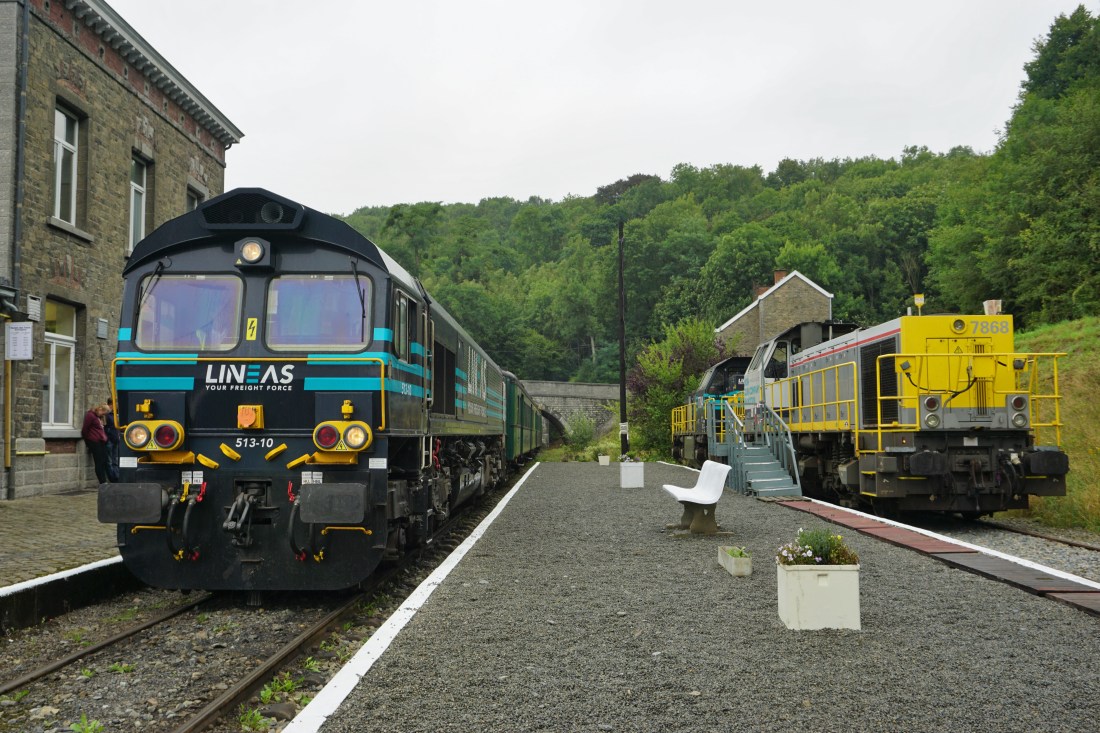
DSC03033.JPG

513-10 (266 037), 7784 and 7868, all visitors from Lineas, at Spontin, 12/08/17 (JW)

2018 Event

The 2018 event is to be held on Saturday 11th, Sunday 12th and Wednesday 15th August 2018 – although I would expect the main line visitors to only be present over the weekend.  Traditionally, the weekday has been aimed more at photographers.

Negotiations are already underway for main line freight locos to attend this event and work trains at it.  Confirmed at this point in time are 266 117 (a class 66) from HSL Logistik, a DB Cargo class 6400, three class 62s from Infrabel (one yellow, one blue, and 6219 in green), along with – hopefully – a class 55.

The PFT/TSP will again be providing a variety of diesel locomotives from its stable to work at this event – 518352057402 and “202.020” (CFL 1602) edit: “202.020” is no longer available to participate.

The “Festivals” are traditionally mixed traction event and 2018 will be no different, with the steam visitor being TKh 5387 from Maldegem – this loco may be familiar to some British visitors as a former resident of the Northampton & Lamport Railway!

DSC03000.JPG

6506 from DB Cargo at Dorinne/Durnal, 12/08/17 (JW)

Sunday 12th August 2018 – European Traction-coordinated diesel event

Last year, I arranged a low-key diesel day at Stoomcentrum Maldegem on the Sunday of the Bocq “Festival” weekend, which allowed those who had visited the Bocq railway on the Saturday to further add to their tally of Belgian diesel loco classes had for haulage over the weekend.  7408 and 8040 worked passenger trains for us, and 9131 was available for footplate rides, during a relaxed few hours which concluded in time for participants to get to mid-afternoon Eurostars, flights etc to return (mostly!) to the UK.

This year, I have organised a Sunday morning event at the PFT/TSP’s facility at St Ghislain, about an hour’s travel time by rail from Brussel.  Subject to the usual caveats, this will feature 7005, 73588428 and CFL 806 hauling an M1 carriage within the confines of the site.  All efforts will be made to provide 7349 and/or 8320 on the day as well.  For those with cars, I hope for it to also be possible for you to reach the Chemin de fer de l’Aa at Arques, not too far from Calais, for the 15:00 round trip with former Polish “Kriegslok” Ty2-6690.

The Bocq Railway

Running, as it does, through such a scenic rural area, Line 128 was never really an important passenger railway, losing its timetabled service in 1960, but did have a strategic role as a freight route – not least during World War 2.
DSC01479.JPG

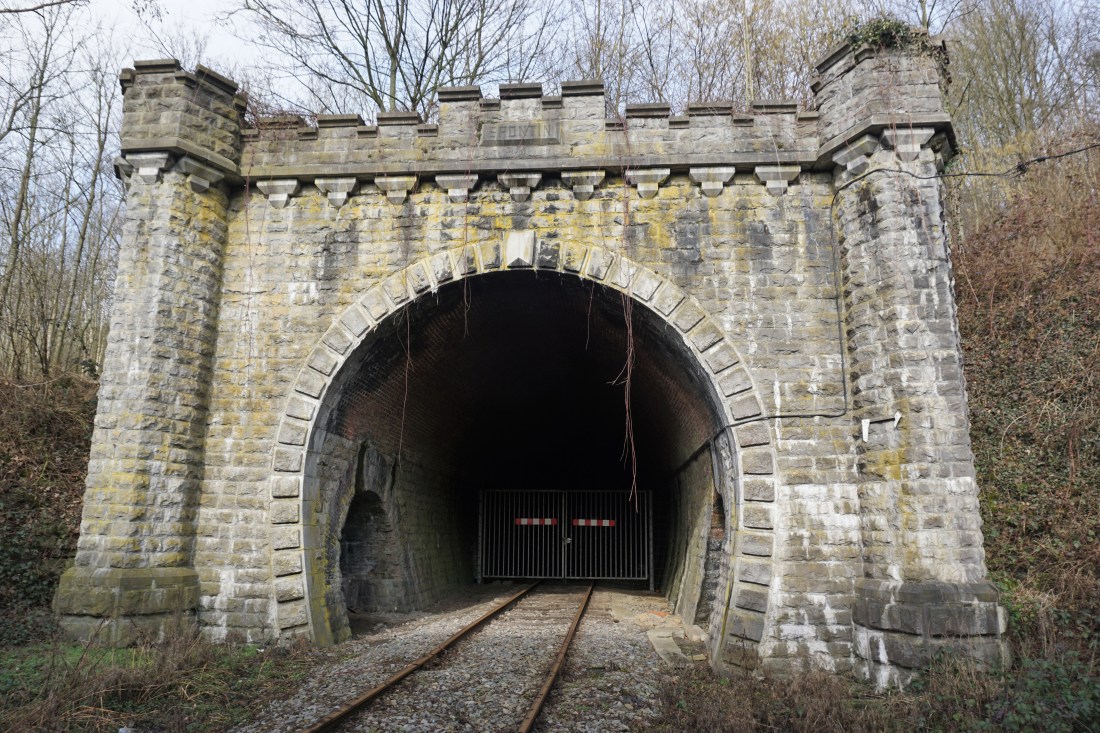
Tunnel de Spontin (JW)

19th July 1944 saw the Tunnel de Spontin – one of the most impressive engineering features of the route – enter the history books as the site of an extraordinary act of wartime resistance.

At the time, this area of Belgium was still under German occupation.  The Luftwaffe held an air base at Florennes, about 20 miles to the south-west, and brought in the aviation fuel for its Junkers, Focke-Wulf and Messerschmitt aircraft by rail, including over Line 128.  One such train was known to be stabled in the Tunnel de Spontin, so as not to be a target for overhead bombers.

It was, however, a target for the local Resistance.  The line climbs very steeply away from Spontin towards Ciney, and on the night in question, they hijacked the loaded Spontin to Ciney limestone tripper on the incline and attached explosives to it, before sending it unmanned and unbraked back down the hill, through the station and into the tunnel, where it impacted with the stabled fuel train at a significant speed.  The tunnel burned for eight days and nights and, as Florennes’ store of fuel dwindled, severely impacted upon its ability to dispatch aircraft.  The Allied liberation of Belgium, of course, began only six weeks later.

Just something to think about as you pass through it!
DSC01524.JPG

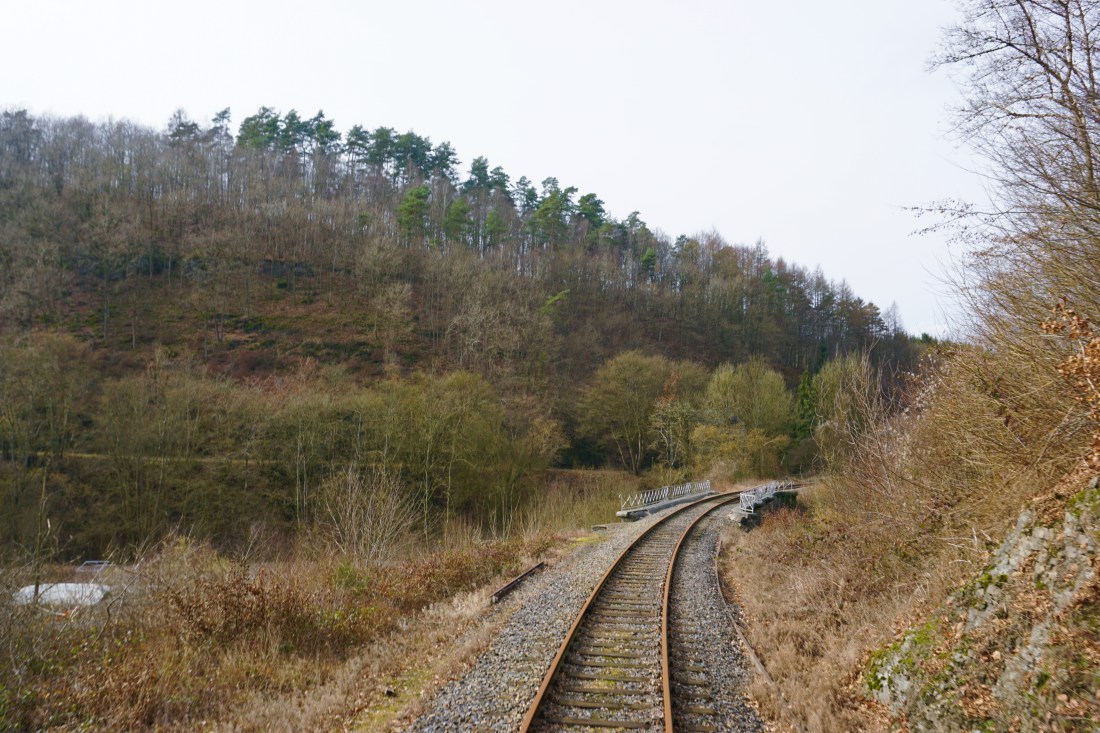
Line 128 near Purnode (JW)

Tickets

Travel will be possible by day rover (just like galas of a similar nature in the UK); fares in 2017 were a remarkably reasonable €15.

Getting There

The Bocq railway shares a station – Ciney – with the national network.  It is expected that trains during this gala will service Ciney at the 2018 “Festival”; the 2017 event saw trains only reach Braibant (with a bus connection to Ciney) due to engineering work; Bocq trains returned to Ciney as of the second week of July 2018.

Ciney is easily accessible from the outside world, sitting on Line 162, the main artery between Brussel and Luxembourg.  Some of the expresses on this route even remain loco-hauled, in the capable hands of SNCB class 13 “Alstom Tractis” electrics.  Both capital cities are approximately 1hr 30min by train from Ciney, and both still see significant amounts of loco haulage themselves.  However, please note that engineering work has closed the section of route into Luxembourg on the weekend in question.


Friday 11th May 2018 – Museum Buurtspoorweg diesel day

The Museum Buurtspoorweg, based at Haaksbergen, approximately 10 miles south-west of Enschede in the Netherlands, is holding a diesel event in May.

Friday 11th May 2018 sees the Museum Buurtspoorweg (MBS) preserved railway host its “Dag van de Verbrandingsmotor”, a day on which its fleet of diesels takes centre stage.

The above is a link to a YouTube video uploaded by user Fermon Bosman showing operations at a similar event held by the MBS in 2009.

Operations

Although all obviously subject to change, the current plan is for passenger trains to be shared by two notable locomotives – “Brommer” 451 and “Bakkie” 660.  There will be three round trips during the day – the first and third being in the hands of 451 and the second hauled by 660.

In between the passenger-carrying runs, “Sik” 259 will haul a demonstration goods train.

The Locos

The MBS has a fantastically varied collection of ex-NS diesel shunting locomotives, with several varieties of “Sik” locotractor, a Werkspoor-built class 450, and one of the English Electric class 600 0-6-0 diesel shunters.

The two machines planned to be used on passenger trains are both of particular interest – 451 is the sole survivor of a class of ten machines built in the 1950s, whereas 660 will be instantly familiar to British enthusiasts, built to a design largely similar to British Rail’s Class 11 (by English Electric at the Vulcan Foundry in 1956).

Getting There

The railway’s base is at Haaksbergen.  Although neither end is connected to the Dutch national network, it is easy to reach by public transport.  The no.53 bus from Hengelo railway station reaches Haaksbergen in 24 minutes, whereas the no.74 bus from Enschede station gets there in 20 minutes.

To note that the bus station in Haaksbergen is about 10 minutes’ walk from the station, whereas the no.53 stops on Meester Eenhuisstraat which is much closer.

Hengelo, of course, is situated on the main line between Amsterdam and Germany, which sees a class 1700-hauled Intercity train in each direction every two hours.

Saturday 25th August 2018 – V75 018 and T435 0145 to Chodová Planá

Saturday 25th August 2018 sees an unusual railtour operated from the former East Germany into the Czech Republic and return, featuring the sole surviving ex-Deutsche Reichsbahn class 107 diesel loco and a Czech sister machine.

With an urgent need to replace its fleet of 21 inherited class 80 steam locos, and without a proven home-grown diesel design, 1962 saw the East German Deutsche Reichsbahn procure a fleet of 20 type “V75” diesel-electric locos from the Czechoslovakian manufacturer CKD (Ceskomoravska Kolben Danèk).  These were identical to the type T435.0 “Hektor” design which had been successfully supplied by CKD to the Czechoslovakian state railway, ČSD.

These 750hp, six-cylinder Bo-Bos operated primarily in the Leipzig and Halle area, almost exclusively on local freight work.  Under the renumbering scheme of 1970, V75 001 to V75 020 became 107 001 to 107 020.

The 107s were largely ousted by class 106 in the late 1970s and early 1980s, and the majority were then scrapped.  However, two – 107 004 and 107 018 – passed into industrial use at the Karsdorf cement works, giving them a stay of execution that took them through German reunification, and they then passed to the KEG (Karsdorfer Eisenbahngesellschaft) in 1991, who used them on works trains on the main line.

107 004 was cut up in 2011, but 107 018 now belongs to Railsystems RP GmbH and spends most of its time on engineers trains across Germany.

The above is a link to a video uploaded to YouTube by the user LudmillaPOWER featuring scenes of a railtour hauled by 107 018 in 2015.

The railtour

Roughly once a year – usually in late summer – as befits its lack of train heating capability – 107 018 ventures out on railtour duty with the Eisenbahnmuseum Schwarzenberg.  Last August, it was partnered by one of its Czech cousins – T435 0145 (ČD 720 145) – some of Ian Ross’s excellent photos of the day can be found on his website here.  It will again be paired with T435 0145 on the 2018 tour.

Fittingly for a train hauled by DR and ČD locos, this one runs from the former East Germany into the Czech Republic.  Last year’s tour did similarly and headed for the small town of Chyše for a brewery visit, engineering works having necessitated a diversion from the originally intended destination of the beautiful spa town of Mariánské Lázně.

This year’s tour, therefore, is another effort to get to Mariánské Lázně, but the train also continues the short distance further to terminate at Chodová Planá, again ostensibly for a visit to a brewery.

Times and fares

Tickets are €88 (€82 if only travelling to Mariánské Lázně) and can be obtained by emailing fahrkarten@vse-eisenbahnmuseum-schwarzenberg.de.

The tour departs from Schwarzenberg at 07:25 (arrive back 21:19), calling at Antonsthal at 07:40 (21:00) and Johanngeorgenstadt at 08:02 (20:26), running over steeply-graded routes via Karlovy Vary to Mariánské Lázně (11:20/16:15) and ultimately Chodová Planá (11:35/15:50).

Getting to the tour

Schwarzenberg is a fairly large town, however its location in the Ore Mountains (Erzgebirge) is perhaps not the best to base yourself.  However, it is possible to access this tour from Zwickau, the fourth-biggest city in Saxony (via RB23857, the 06:09 ex-Zwickau which is a +30 onto the tour); equally there is a +40 off the tour onto RB23888, the 22:00 to Zwickau.

Zwickau is no longer on the Intercity network – in fact, it has no booked loco hauled services at all any more – but is easily accessible from Leipzig, Chemnitz and Dresden, as well as across the erstwhile Iron Curtain into Bavaria.

The destination(s)

Mariánské Lázně (website here) is an excellent place to spend a few hours and turns this tour into a viable family day out.

Chodová Planá (website here) is best known as the home of the Chodovar brewery (“the oldest in west Bohemia) and this is indeed where participants are encouraged to spend their time, with the fare to this destination including a tour of the brewery and a beer tasting session – although this is limited to 100 participants.

“Die Lückenfüller” – temporary Deutsche Reichsbahn timewarp

8th January 2018 to 2nd March 2018 saw an interesting temporary loco-hauled passenger diagram operate in the former East Germany.

Erfurter Bahnservice (EBS) stepped into the fray to provide a public service on the Pfefferminzbahn route, which lost a sizeable proportion of its (already limited) passenger services at the end of 2017 amidst great controversy, when the contract was re-let from DB Regio to the similarly-named Erfurter Bahn.  The decision to cut the number of services along the line was ostensibly based on low passenger utilisation, but a fightback from the locals – including a petition signed by over 4,000 people – gave rise to two additional services (one each way) each weekday under the semi-official title of the “Lückenfüller” (literally, “gap filler”).

The above is a link a to 23-minute video uploaded to YouTube by Stationsvorsteher Roßwein forming a nice souvenir of the final day’s operation (including the “control relief” to Naumburg).  A couple of good friends of mine – and possibly of other users of this site – can be seen and heard within it!!

The diagram

From 8th January 2018 to 2nd March 2018, EBS operated a Monday to Friday loco-hauled commuter service on the 22.5 km (14 mile) stretch between Buttstädt and Sömmerda as follows:-

DPE6600 07:43 Buttstädt – Sömmerda 08:16
DPE6601 16:45 Sömmerda – Buttstädt 17:19

Operation

The main enthusiast interest in this operation came from the variety of locomotives used, all of which came from EBS’s stable of ex-Deutsche Reichsbahn diesels.  Four such machines featured during the course of the diagram, from class 232class 202 and latterly class 228:-

Monday 8th January 2018 – Thursday 25th January 2018 – 232 690
Thursday 25th January 2018 – Tuesday 13th February 2018 – 232 334
Tuesday 13th February 2018 – Tuesday 27th February 2018 – 202 738
Tuesday 27th February 2018 – Friday 2nd March 2018 – 228 719

Travel in the service’s final week was free when a donation to the local food bank was made – as per a news article here.

Last day

The afternoon working on Friday 2nd March 2018, hauled by 228 719, was extended from Buttstädt to Großheringen and Naumburg as a “control relief”, upon which travel was free, departing at 17:30.  This was essentially the ECS move taking the carriage “home” to Karsdorf at the conclusion of the operation, and covered the route between Buttstädt and Großheringen which no longer sees a booked passenger service.  Upon arrival at Naumburg, 202 738 joined in the fun, coupling up to the rear to lead the formation empty up to Karsdorf.

Booked Austrian class 2091 haulage in East Germany to end

If you would like some Austrian class 2091 haulage on the narrow-gauge Döllnitzbahn in the former East Germany, best get your skates on.

They have acquired more modern ÖBB diesel traction in the form of 760mm diesel railcar 5090 015.  This is currently going through works at Ostritz, however will emerge as “137 515” and will be put to work on the diesel turns on the Döllnitzbahn with a trailer vehicle from Summer 2018.

Currently the regular diesel workings on this pleasant line, situated roughly midway between Leipzig and Dresden, and which connects into and out of the main line at Oschatz, are in the hands of two pre-war centre-cab 1-Bo-1 Austrian diesel-electric locos.  199 030 (ex-ÖBB 2091 010) and 199 031 (ex-ÖBB 2091 012) are two of the nine extant members of a once twelve-strong class, built between 1936 and 1938.

Currently, 199 030 is away for repairs to collision damage sustained on 6th November 2017 when it struck a badly parked lorry (link to news article here); consequently 199 031 is quite busy at the moment!

IMGP4477.JPG

199 030 (ex-ÖBB 2091 010) at Oschatz Südbahnhof, 27/05/13 (JW)

The Döllnitzbahn enjoys a daily service, with one loco and set of stock in use each day.  There are occasional days when the 2091s get a rest and a steam loco comes out to play instead, but these are clearly advertised, so planning a trip to take in the diesel traction is not difficult.  Timetable detail for 2018 can be found here.

The two 2091s are intended to be kept in reserve, however if you want to sample them in service, you really need to make plans to visit before the DMU arrives.

More detail on the new acquisition can be found here (in German):-