Saturday 17th June 2017 sees an open day at the PIKO model railway factory in Sonneberg, in Thüringen.
In connection with this, four railtours using examples of former Deutsche Reichsbahn diesel and electric traction now all but wiped away from the main line scene will be heading for this corner of the former East Germany.
At least three of them cannot, however, reach Sonneberg itself – as construction work in connection with the construction of the new high-speed line near Creidlitz has closed the line from Lichtenfels towards Sonneberg for the weekend. Instead, these tours’ destination will be Pressig-Rothenkirchen, for onward bus transport to the factory. This is a quick run-down of the traction and the tours involved, if you are tempted to head along too.
DR Class 118 / DB Class 228
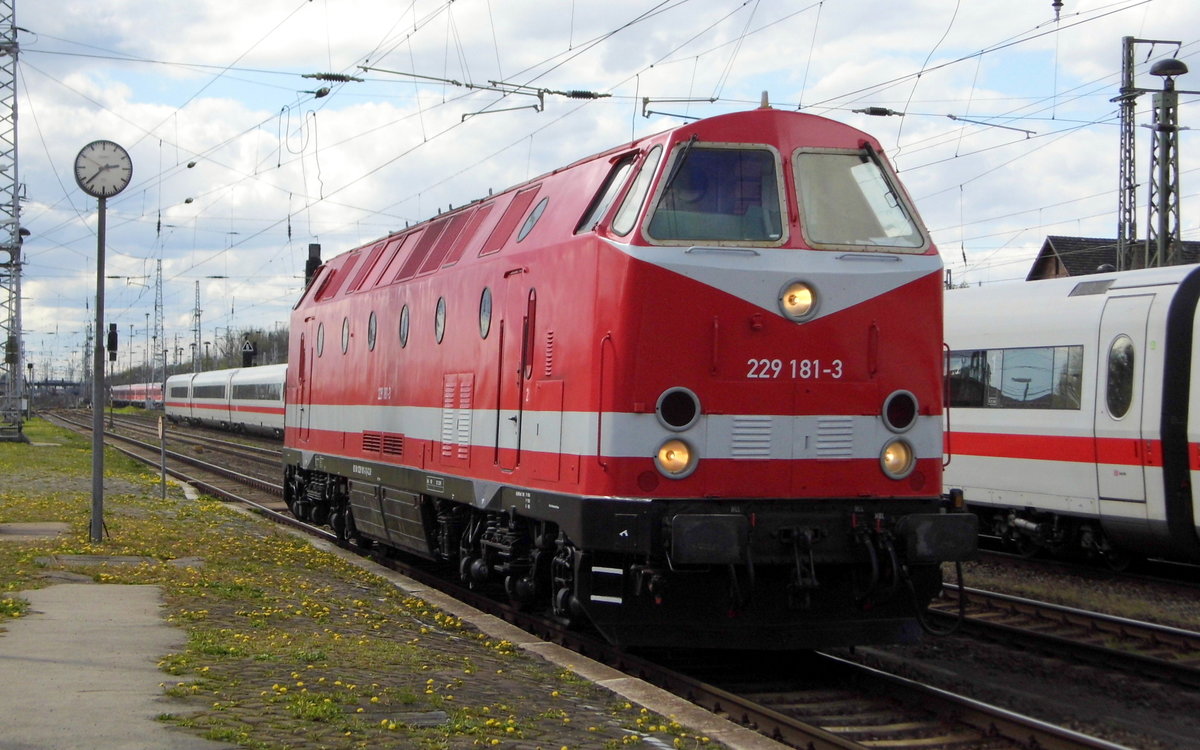
This tour is possibly the most interesting from the haulage enthusiast’s point of view, but as of yet (18/05/17) it retains a degree of uncertainty as traction is advertised as either“228 321” (ex-DB 228 721)or229 181 (video of 229 120 here for sound purposes!). Although both are “rare” these days from a haulage point of view, the 228 would surely be the bigger draw. The 229 – as part of a small number of class 219s re-engined after unification with MTU power units – is perhaps less interesting.
This tour kicks off from Magdeburg Hbf at 06:24 and runs via some solidly unit-only (these days) routes via Stassfurt and Sandersleben towards its last pick-up at Erfurt. It looks as if this one will actually make Sonneberg, as there is no mention in any publicity of bus involvement. Indications on the net are that it will run via Oberhof, Grimmenthal and a reversal at Rauenstein, but this has not been confirmed. It’s being operated by the Eisenbahnmuseum Stassfurt, fares range from €69 to €84 depending on where you board, and some more details can be found here.
DR Class 119 / DB Class 219
Edit 12/06/17: Less than a week before the tour, this was re-advertised as using electric loco no.155 110 of Wedler Franz Logistik, for reasons unknown at present. The rest of 119 158’s commitments for the rest of 2017 are still advertised to use it.
On the other hand, what is certainly booked for a 119 is Berlin macht Dampf’s tour from Berlin-Schöneweide – although, even then, their machine – 119 158 (ex-DB 219 158) was the sole member of the class to receive experimental Caterpillar 3512 series power units, and therefore its sounds aren’t classic ones.
Despite that, it still looks a decent tour, with some decent main line mileage to be had. This will deposit its passengers at Pressig-Rothenkirchen on the Frankenwaldbahn for bus transport forward. The third class fare is €94. More details here.
DR Class 250 / DB Class 155
The DR class 250 locos, known since 1992 as DB class 155 – nicknamed “Containers” due to their boxy shape – are powerful electrics that have not had routine passenger diagrams for about the last 15 years – although 155 110 recently hauled the “Berlin Malmo Express” and it looks as if they may be the new booked traction for this through the summer.
This tour takes an LEG example – 155 137 – via a straightforward route via Naumburg, Jena and the steeply-graded route over the Frankenwaldbahn to Pressig-Rothenkirchen, again for buses forward. It’s operated by the Eisenbahnmuseum Leipzig and standard class tickets are €76. More info at this link.
DR Class 254 / DB Class 194
Strictly speaking, I’m cheating with this one, as the electric loco concerned (E94 158) was never a Deutsche Reichsbahn class 254, but a Deutsche Bundesbahn class 194 the other side of the Iron Curtain. However, built in traffic during wartime – ‘158 entered traffic on 2nd January 1945 – both classes began life as class E94 for the “1921-1945” Reichsbahn.
This tour starts in the former West – Veitshöchheim, near Würzburg – and runs main line, reversing at Bamberg, to Pressig-Rothenkirchen. It’s operated by the Eisenbahnmuseum Würzburg and standard class fares range from €30 to €39, depending on where you board. More info at this link.
What can I combine with it?
On both Saturday 17th and Sunday 18th June, there is a large-scale open day at the DB Museum at Koblenz. Each day sees two circular “mini tours” using the Trans Europe Express stock. Fares are dirt cheap and short leaps between stations are catered for in the fare structure. Both of Saturday’s tours are in the hands of 103 113, whereas Sunday sees the first hauled by the 103 and the second by 110 239 (now as E10 1239).
20/06/17: Nürnberg S-Bahn. Sighted at Leipzig Hbf on 16/01/18 in the consist of a Pbz – bound for Dessau for repair.
143 973
DB Regio – Dresden (S2 pool)
08/06/17: Dresden S2
Info collated from personal sightings and many online sources including: the posters to European Rail Gen and DB Loco Info, Drehscheibe-Online and Revisionsdaten.de.
(Additionally, of course, the frame of 143 873 is now in its second life as the so-called 114 009II; everything above the solebar including the bodyshell being used as a replacement for the original 114 009, which was destroyed in a fire at Berlin Ostbahnhof on 26/07/11).
If you’re enjoying the content of this website, please could I invite you to have a look at how you could support it? Thanks!
Important Update 25/11/17 – The organisers have unfortunately had to concede that E18 047 will not be ready in time to work the tour, and therefore the motive power will instead be 243 005, the 33-year-old ex-DB class 143 electric loco preserved by the DB Museum. Proceeds will go towards repairing the E18.
Saturday 9th December 2017 sees a 78 year old electric loco make one of its occasional mainline passenger outings.
The E18 class was built for the pre-war Deutsche Reichsbahn and with the interesting wheel arrangement of 1-Do-1 – spoked wheels at that! – they have next to nothing in common with the electric locos of today, visually at least.
There are 6 survivors from this class of 55 machines. All but one are static exhibits in museums – the exception being E18 047 (DB 118 047), which is owned by the DB Museum and kept in mainline condition under the care of the “Traditionsgemeinschaft Bw Halle P e. V.” in Halle (Saale). Notably, this loco entered traffic on 12th August 1939 – less than a month before the outbreak of World War 2.
E18 047 currently has just one railtour advertised this year – for Saturday 9th December 2017. This is being promoted by the Traditionsgemeinschaft Halle (link) and will allow it to stretch its legs properly, running from Leipzig Hbf (depart 07:00) via the direct route over the hills via Probstzella to Bamberg (for a 7hr 30min break) and Nürnberg Hbf (5hr 45min), before returning as outward. Fares start at €79.
This tour is one of many organised to visit the huge number of Christmas markets in Germany, so are especially family-friendly! Bamberg is especially worth a visit – the whole city is a UNESCO World Heritage Site and is particularly renowned for its beer!
What can I combine it with?
The next day (Sunday 10th December) sees a class 232 “Ludmilla” diesel loco work an 08:14 Erfurt Hbf to Goslar and 18:08 return charter for the bargain fare of €33, operated by Bahn-Nostalgie Thueringen (link).
The above is a link to a video on YouTube by Bahnatiker showing it on railtour duty five years ago.
075 at Westport on its first passenger train post-rebuild following accident damage, 29/03/99 (JW)
One class of diesel loco outside the UK that has a dedicated following is the Iarnród Éireann 071 Class.
This 18-strong, 2,250hp General Motors design has been phenomenally successful. Built in 1976, they worked out of the box, have frequently given 100% availability, and remain in traffic even today. This post is not, however, intended to give a comprehensive history of the class – that will follow at another time.
The days when we used to charge around Ireland behind these locos on service trains at design speed are long gone. Happily, there are a number of railtours planned to use them during 2017.
Class leader no.071 has been repainted in something approximating the livery it was built in (photo here) and no.073 is currently (17/05/17) in the Inchicore paint shop being painted back into the Irish Rail livery of the late 1980s and early 1990s. It’s likely, therefore, that these tours may feature these two machines – indeed, the October tour booked for a pair is almost guaranteed to, barring failures.
Sunday 28th May 2017 – 11:25 / 13:35 / 16:35 Howth to Dublin Connolly top and tail with steam locos (no.461 starts, to be replaced by no.85 “Merlin” at some point during the day), €10 per trip, €27 day rover. Operated by RPSI. Link.
Saturday 12th August 2017 – 09:35 Dublin Connolly to Howth and back, then to Sligo and back, £65. Operated by the Irish Railway Record Society. Link.
Sunday 20th August 2017 – 10:30 Dublin Connolly to Kilkenny and return, “Radio Train” vice steam loco. Operated by RPSI. Link.Cancelled.
Saturday 9th September 2017 – NIR 111 Class 07:30 Whitehead (Excursion Platforms) to Dublin Connolly for an 071 to Rosslare Strand and forward to Sligo and return as outward. Operated by the Modern Railway Society of Ireland. Link. UPDATED
Saturday 14th October 2017 – 2 x 071, Dublin Connolly to Cork and Tralee and return, £57.50. Operated by the RPSI. Link. (This is planned to be the first occasion that two JT22CWs have powered a train together for over 21 years – since this tour, in fact!)
The above is a link to an excellent video on YouTube by Metro Vick, giving a flavour of exactly what it was about these hellfire machines that made them so popular in their heyday.
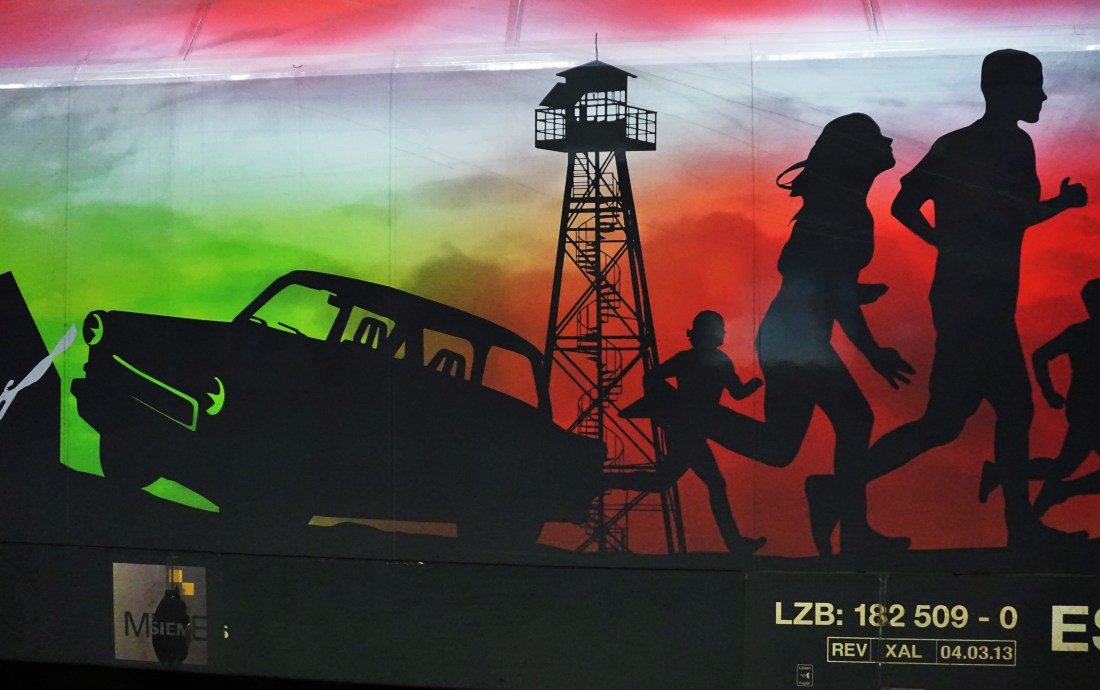
For four years, one of Europe’s fastest locomotives wore a unique livery prominently featuring the unmistakable shape of the infamous 23hp East German “Trabant” car. What was it all about?
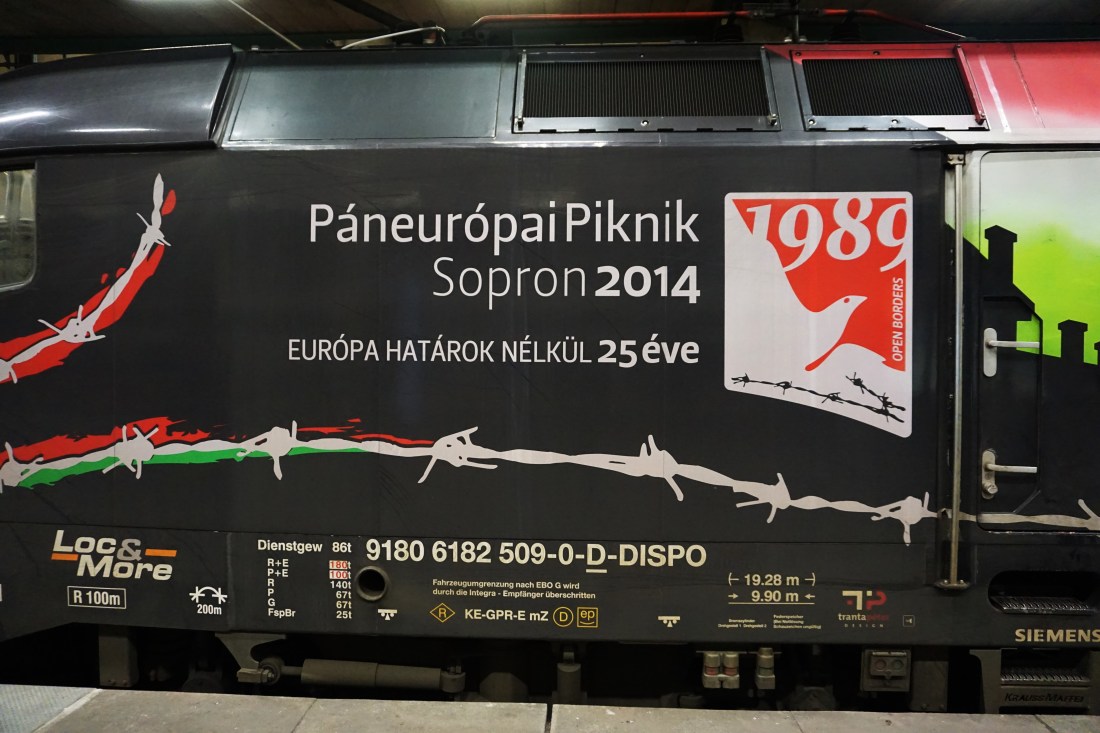
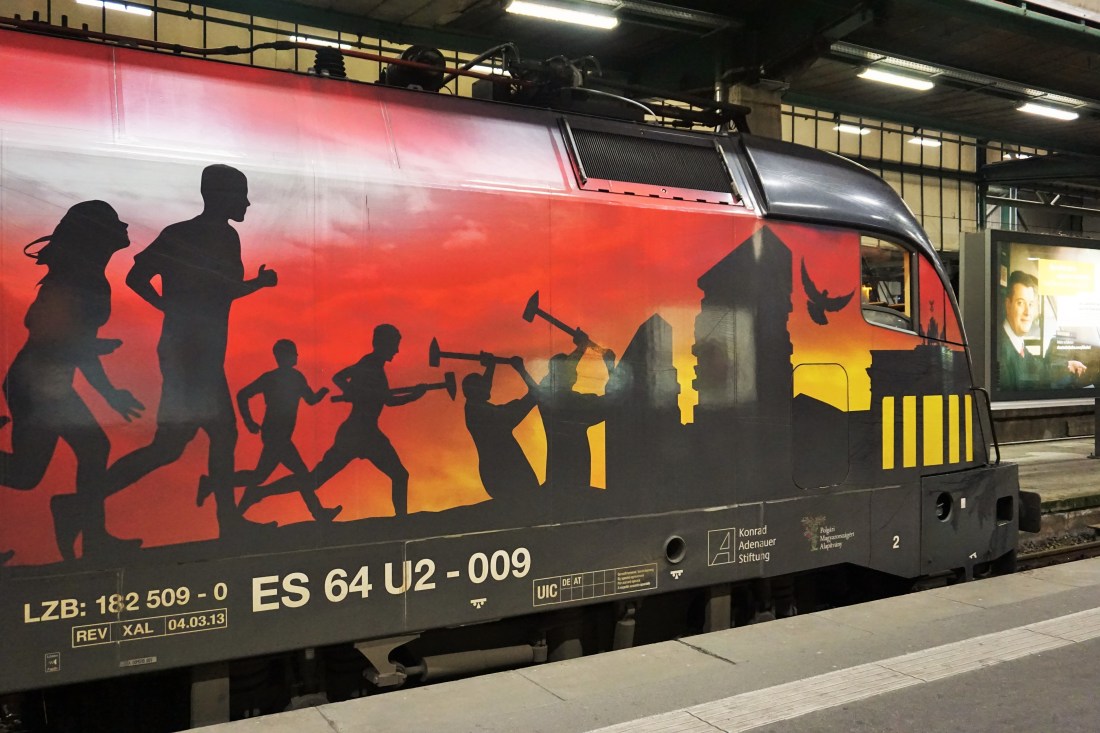
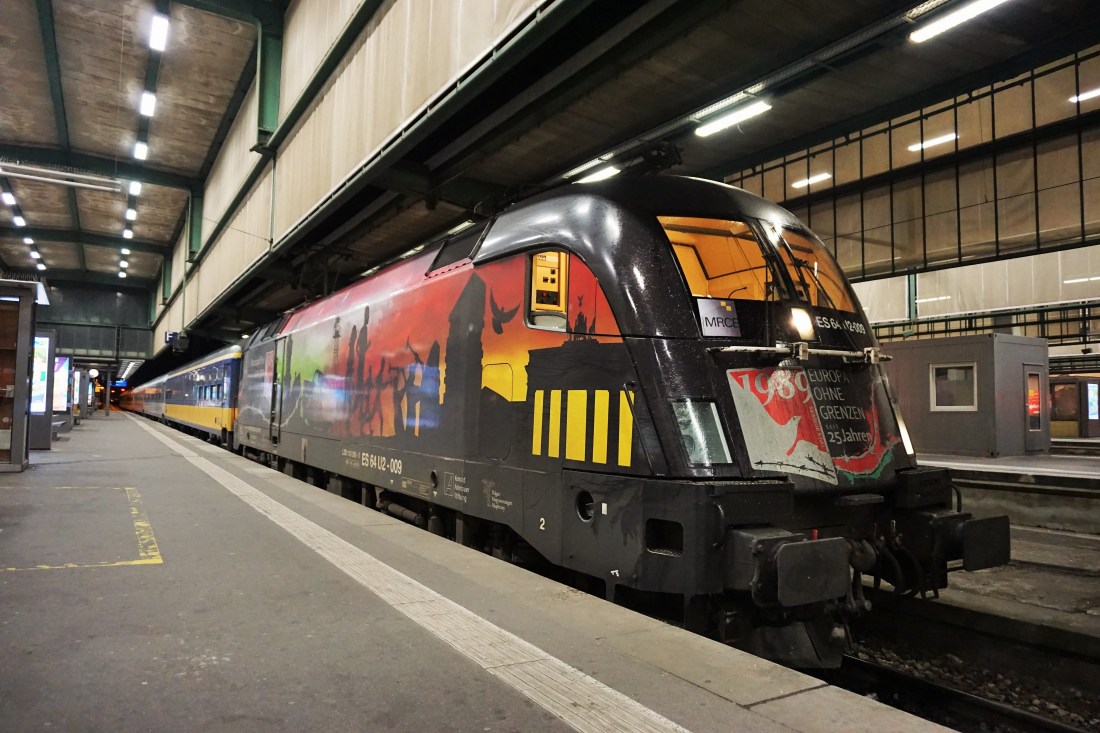
182 509 is a Siemens ES64U2-type loco, built in 2002 for their own spot-hire business, “Dispolok”, which was bought out by MRCE in 2006.
It was one of two such machines (182 509 and 182 560) to get unique specially-designed liveries – different on each side – in summer 2014, to mark the impending 25th anniversary of the fall of Communism in Europe. 182 560‘s was dedicated solely to the fall of the Berlin Wall, whereas 182 509‘s was on the theme of the “Pan-European Picnic”, arguably a lesser-known event – whilst still featuring symbolism of Berlin and of the actions of those at the Picnic leading to what eventually happened there.
182 509 livery detail, seen on 05/05/17 (JW)
So, what was the “Pan-European Picnic” and what was the livery all about? As I described in my article on the Flüchtlingszüge from Prague, 1989 saw burgeoning unrest through the Communist states behind the Iron Curtain, and history tells us that this resulted in the systematic collapse of the regimes in each of these countries by the end of the year. It was a watershed year but these momentous events were characterised not by shows of aggression (except in Romania) but by demonstrations of peace.
One of the main characteristics of Eastern Europe in 1989 was the gathering pace of Mikhail Gorbachev’s policy of perestroika, of not interfering in the internal affairs of the Communist states. It was in this climate that the Hungarian Minister of State Imre Pozsgay and the Austrian Otto von Habsburg, an MEP and President of the International Pan-European Union, sponsored an event to be held near Sopron, a Hungarian town near to the Austrian border, on Saturday 19th August 1989.
The theory was that the border between Hungary and Austria would be opened for a few hours, allowing people from both sides of the Iron Curtain to mingle, eat together (i.e. the picnic) and generally show that despite decades of propaganda to the contrary, those on both sides of the previously impregnable border between ideologies were not so different.
182 509 livery detail, seen on 05/05/17 (JW)
What was not planned for, however, was the additional attendance of 600 enterprising East Germans who had been on their summer holidays in Hungary, had heard about the event and had decided to seize their opportunity to escape to the West. The border guards turned a blind eye to this and their “Republikflucht” had been successful.
Again, history informs us that the border between Hungary and Austria was finally opened properly on 11th September and East Germans headed there in their droves in an attempt to leave – and (again, as described here) the dominoes had begun to fall that eventually resulted in the breach of the Berlin Wall – hence the liveries on 182 509 and 182 560 each commemorate events that neatly book-end what are probably the most significant twelve weeks in European history in the second half of the 20th century.
And what of the “230km/h Trabant” in the title? These little two-stroke cars, manufactured by VEB Sachsenring in Zwickau, were ubiquitous in East Germany, and indeed through other countries behind the Iron Curtain; they are still particularly present in Hungary. But they were also the vehicles that East German families drove in to Hungary in their attempts at escaping, that were left abandoned on the streets of Prague as their owners crammed into the West German Embassy, and that smokily and noisily inched across the Berlin Wall when it was first opened on that landmark night in November 1989. As a result, Trabants became one of the most instantly-recognisable symbols of the events of 1989, and so it’s entirely appropriate that one was included in this design. The irony was that a vehicle that struggled to hit 100km/h in real life could be “seen” flashing through the German countryside at well over double that!
182 509, Stuttgart Hbf, 05/05/17 (JW)
As a Dispolok machine, the “Pan-European Picnic” loco lived a somewhat nomadic existence, but since it gained its special livery it worked predominantly for DB (both on regional passenger services for DB Regio, and on Intercity expresses for DB Fernverkehr) and, from January 2017, it was hired to the Swedish firm of Hector Rail.
Although Hector Rail is based in Sweden, 182 509 is as yet only passed for use in Germany and Austria. As well as a number of freight flows across the former, Hector Rail held the contract to provide motive power for the crowd-funded open-access train operator Locomore, which operated a Stuttgart to Berlin and return passenger service between December 2016 and May 2017 (this is now part of the Flixtrain operation). Although 182 517 worked the lion’s share of these trains, 182 509 did have a stint of a several days working this in May 2017, which is when the photos in this article were taken.
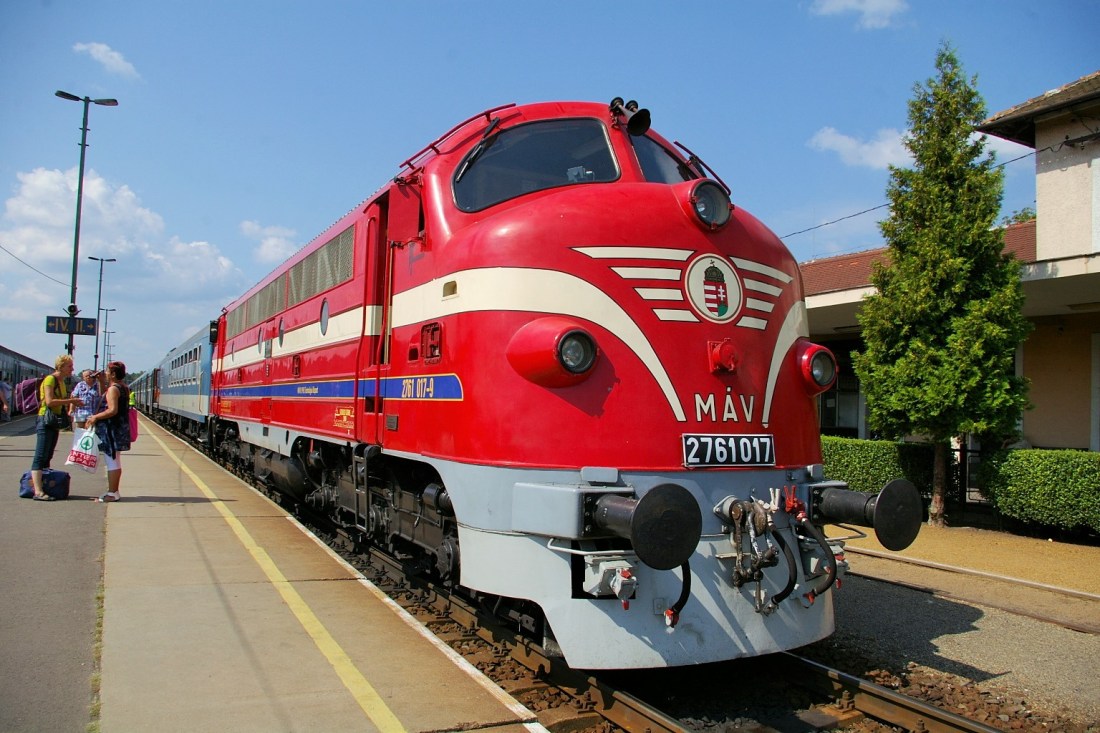
The tale of how the state railway of Communist Hungary came to procure American-engined locomotives, even as the Soviets affirmed their power over it, is an intriguing and obviously very politically-charged one.
The Hungarian State Railways (Magyar Államvasutak; MÁV) first dipped its toe in the water regarding diesel traction in the late 1930s but, in common with most other European countries in the same boat, any plans were put on indefinite hold by the advent of World War 2. Sadly, as much as an unfortunate consequence of geography as anything, Hungary was to suffer an astonishing amount of destruction during the conflict, and its railways were a key strategic target – indeed, 17% of all war damage sustained by Hungary was to its railways.
As a result, 1945 did not leave it in a position to pick up where it left off; significant reconstruction to merely return the railways to something approaching an operable state was the priority. As a result, it was well into the 1950s before MÁV could re-investigate main line diesel traction.
Hungary in the 1950s
It’s important to interject here that the 1950s did not bring harmony to Hungary. In common with the rest of Eastern Europe, it was subject to an enforced process of “Sovietisation”, with the political, ideological, social and economic norms of the Soviet Union being forced upon it. However, this was not universally popular in Hungary. Occupied by the Germans from the west, and invaded by the Russians from the east, the Hungarians had seen the worst of both sides and 600,000 of its civilians had died in the conflict between the two on its soil. Many saw the Red Army not as a liberating force but in the same light as they viewed the Nazis. The unnatural implementation of Soviet policies on Hungary led to a revolt by the Hungarian people in Autumn 1956. This challenge to their authority was ruthlessly crushed by the Soviets, resulting in the deaths of around 3,000 Hungarian civilians, and served to harshly underline the power that Moscow held over it.
A link to a British Pathe film from 1956, neatly describing the uprising (some disturbing scenes, but then again it was a disturbing event).
The forced industrialisation that “Sovietisation” brought to Hungary in the 1950s resulted in a drastically increased requirement for motive power for freight traffic, hitherto fairly quiet routes now became important freight arteries. Hungary was now a world of “five year plans”, where (often arbitrary) delivery targets were met regardless of how complete the product was. At the same time, with propaganda in mind, labour competitions were to be seen in many areas of Hungarian industry and the railways were no exception – one ambition was to have each working locomotive cover at least 500km each day in the name of keeping the wheels of industry turning (this turned out to be too ambitious by quite some margin). The upshot of all of this is that more and more trains were required to be run, and as a result, more motive power was required. The obvious solution was diesel traction, which could result in increased efficiency and reduced costs compared to the ubiquitous steam traction in use at the time. Modern traction would also provide ideal propaganda in a country that was being rapidly modernised.
Initial development
MÁV naturally turned its attention domestically; to the primary Hungarian rolling stock manufacturer – Budapest-based Ganz – which after a period building tanks and Messerschmitt Bf109s during the war, was now returning to the railway market. However, it was primarily turning out electrics, such as the Co-Bo class V55s. Diesels were not its forte – however, in 1957, it was able to turn out the M601 – a 2,000hp, 141t 1-Co-Co-1 diesel-electric prototype.
The M601 was not a success by any stretch of the imagination. It survived less than a year; a catastrophic crankshaft failure on this unique locomotive during trials effectively ended not only its career, but Ganz’s hopes of contracts to provide locomotives to other Communist nations in the early years of dieselisation on the spot.
None of this helped MÁV in its increasingly-urgent search for diesels, though. Bitten once, they were twice shy in trying unproven traction, and wished for something “off the shelf”. With only diesel shunters being successfully produced in its own country, it looked to elsewhere in the Communist Bloc; with most of Eastern Europe similarly engaged in rebuilding decimated railway networks, only mother Russia was building main line diesels in any numbers. Indeed, off the back of the M601 debacle, the Soviet Union offered a version of their TE3 diesel-electric locomotive, but MÁV quickly declined this offer, deeming it entirely inappropriate for their needs – being too big and too heavy.
Having fruitlessly looked east, MÁV naturally swivelled its eyes to the west, where diesels were increasingly ousting steam, and with significant success. At the time (the late 1950s), arguably the two most successful main line diesel locomotive types in Western Europe were the General Motors-engined diesel-electrics built under licence by Nydqvist & Holm AB (“NoHAB”) in Trollhättan, Sweden and meeting the challenges that Scandinavia threw at them, and the Maybach-engined diesel-hydraulics from Krauss-Maffei that were revolutionising the Deutsche Bundesbahn in West Germany. In February 1960, arrangements were finalised for MÁV to receive demonstrators of both.
The above is a link to a 17-minute MÁV promotional video from 1978 (“Hív a vasút! Vár a MÁV!”) focussing on the fruits of the efforts that had gone into the modernisation of the Hungarian railways in the 1950s, 1960s and 1970s – it makes very interesting viewing four decades on.
The demonstrators
First to arrive, that May, was the NoHAB. This 1,950hp machine was not strictly a manufacturer’s demonstrator, as it had been intended for sale to Finland, but VR (Finnish State Railways) did not take up the order. This green-liveried locomotive undertook a two-week tour of Hungary, being comprehensively put through its paces on a variety of duties, both freight and passenger, exceeding requirements in all areas. It was also demonstrated in Romania, Bulgaria and the DDR (East Germany); there are some really interesting photos of its brief spell in the latter in July 1960 on this link. The loco returned to Scandinavia at the end of its tour, and in the August joined the books of NSB (Norwegian State Railways), numbered Di3.623, with whom it served for the next 40 years.
As a brief aside, Di3.623 is thought not to be the first NoHAB diesel to traverse Hungarian metals. Back in 1955, Di3.602 (now preserved in Norway) passed through whilst undertaking its own demonstration tour, visiting Yugoslavia, Greece and Turkey, an itinerary also followed by Krauss-Maffei’s V200 005 the same year. Whilst in Turkey, the NoHAB certainly worked as far as Ankara, and is even reported to have reached the Syrian border! Not bad for a loco that went on to earn its keep working into the Arctic Circle!
The Krauss-Maffei loco arrived in Hungary for its period of testing in the July. This loco was broadly based on the V200 class of diesel-hydraulics, but took advantage of several years’ worth of technological development – it being a six-axle variant of the four-axle V200 design – although still clocking in at only 101t. It had been built as an add-on to the order of three such locos supplied to Jugoslovenske Železnice in 1957 to power Marshal Tito’s private “Blue Train”, but had been rebuilt in 1958 as a truly unique demonstrator – losing its two Maybach MD650 power units of 1,100hp each in favour of two 1,500hp MD655s. Speaking in British Rail metaphors, it was turned from a “Warship” into a “Western” (albeit with Mekydro transmissions). It had proven itself an exceedingly capable machine throughout testing in Austria and Bavaria, but had thus far resulted in no orders.
For its Hungarian testing, it received the number “M61.2001”. It again was a tremendous success in terms of the specific tests carried out in Hungary; however, MÁV were discouraged by its two-engine design, which was entirely alien to anything it had clapped eyes on before, and also its hydraulic transmission – after it’d had bad initial experiences with its M31s (although history shows that it did successfully embrace hydraulic transmission eventually). As a result, the order was placed with NoHAB, initially for 20 machines.
Delivery
NoHAB built them at Trollhättan and, as if to underscore their “out of the box” quality, they delivered themselves to Hungary between May 1963 and March 1964. In ones and twos, they were worked via the Trelleborg to Sassnitz train ferry, thence the DDR and Czechoslovakia, with journeys taking up to twelve days. As well as themselves, they brought copious amounts of spares, occasionally in volumes filling complete wagons.
The locos were emblazoned with signage trumpeting “Noch eine NoHAB-GM lokomotive nach Ungarn”: “Another NoHAB-GM loco to Hungary”. This can only have been for the benefit of the East German Deutsche Reichsbahn; the message was not in Czech, or Hungarian for that matter! However, regardless of the success or otherwise of their experience with Di3.623, DR did not declare any interest.
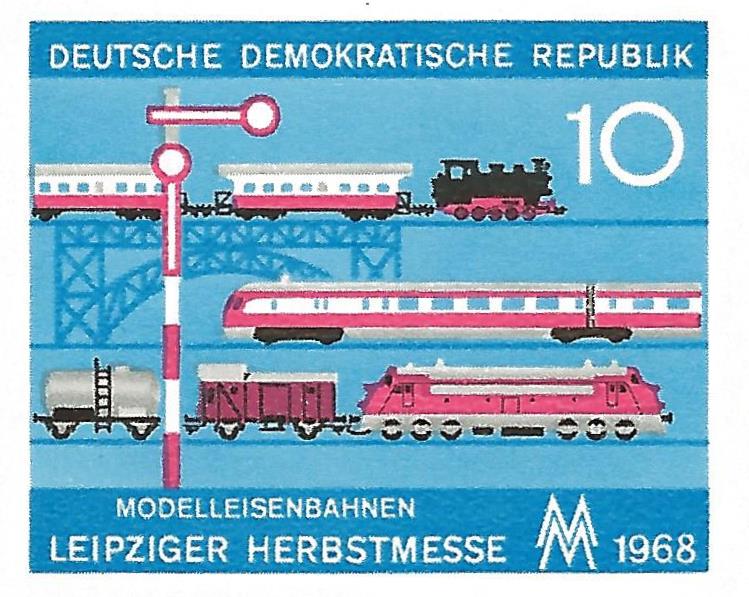
East Germany may not have procured its own NoHABs, but in 1968 – a number of years after the opportunity had presented itself – it did (perhaps oddly) select an M61 as one of the trains featured on a postage stamp produced for the Leipzig autumn fair.
A conflict of interest?
At this point it’d be prudent to mention the elephant in the room – given the incredibly delicate political situation at the time, and with the Soviet Union unhesitatingly resorting to using force to assert its power in Hungary – how was MÁV getting away with procuring traction built outside Moscow’s sphere of influence to a design from the “wrong” side of the Iron Curtain?
Firstly, it must be established that the Iron Curtain was not a solid barrier. Goods and services crossed it all the time. This extended to rolling stock too; for example, PKP (Polish State Railways) had obtained its twenty EU06 class electrics from English Electric at their Vulcan Foundry in Newton-le-Willows in 1962; the trade even went the other way, an obvious example being Electroputere in Craiova, Romania, being sub-contracted to construct the first thirty Class 56 locos for British Rail in the mid-1970s.
That is not to say that trade across the black-and-white divide between “Capitalist” and “Communist” countries was straightforward or even encouraged. Conspiracy theories continue to circulate that the sinking of the MV Magdeburg in the Thames Estuary in October 1964, whilst conveying 42 British-built Leyland Olympic buses bound for Cuba, was orchestrated by the CIA – the USA having imposed a trade embargo on Cuba, which it “encouraged” its allies to follow, in the wake of the Cuban Missile Crisis. The supply of 10 diesel locomotives to Cuba the following year by Brush Traction was deemed so politically sensitive by Brush’s parent company Hawker-Siddeley, keen to protect its business opportunities in the USA, that all references in publicity were not to Brush but to the innocuous Clayton Equipment Co. of Hatton, Derbyshire and the machines were constructed not at Brush’s Falcon Works in Loughborough, but at Internal Combustion’s site in Derby. It was business that these companies in the “capitalist West” wanted, but depending on the circumstances, they did not necessarily want it to be common knowledge.
However, Sweden was not necessarily the “wrong” side of the Iron Curtain, depending on your viewpoint. It was ostensibly neutral in the Cold War, and as such maintained trade links with both sides with minimum concern to either side. Its very neutrality had a strategic purpose – forming, as it did, something of a tangible, physical barrier between “East” and “West”, although this barrier would surely have counted for nothing in the event of nuclear conflict!
The fallout
Despite all this, the decision to source traction from the Swedes was not popular with the Soviets. The award of a contract to even a “neutral” country was seen as taking work away from the Comecon nations; that is, those who had joined the “Council for Mutual Economic Assistance”, the economic union of nations aligned with Moscow.
This would perhaps have been negated if GM/NoHAB had granted Ganz a licence to construct a production batch of locos in Budapest; as they had in the 1950s when the Belgian company AFB (Anglo-Franco-Belge) had built the class 202, 203 and 204 locos for SNCB and the class 16s for CFL in Luxembourg. This is what had happened with the English Electric EU06 design (the first 20 locos were supplied complete from England; but nearly 500 Polish licence-built examples followed); it is what was eventually done for the 18-cylinder Pielstick power units for MÁV’s class M63 diesels in the 1970s (see a stunning photo by Philip Wormald here), for example, and also for the Fiat power units for PKP’s SP45s. This would have been a win-win solution; the workers’ jobs seen to be protected, professional dignity preserved, and arguably superior locomotives provided. That licence, however, was not forthcoming.
At roughly the same time, the Russians finally reached a position to provide a diesel loco that, on paper at least, began to meet MÁV’s needs. 1964 saw an order for twenty machines; 1965 saw a follow-on order for another 32. These were the first 52 locomotives of the type that went on to be known, not just on MÁV but also worldwide, as “M62s”.
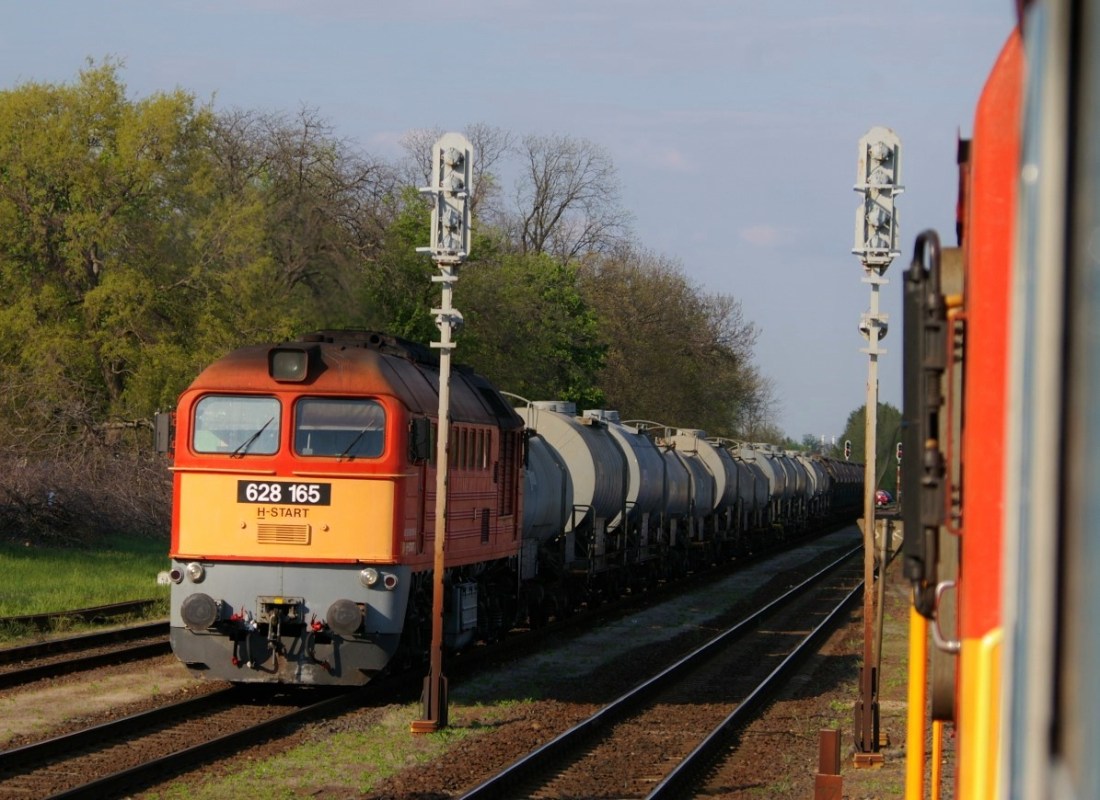
M62 loco no.628165 is seen at Győrszabadhegy, being passed by M41 no.418108 on a passenger train, 24/04/15 (JW)
The M62s were not the immediate across-the-board success that the NoHABs had been – developed as they were in the Soviet Union, and not specifically for Hungary’s requirements, they did not feature any sort of train heating capability (Russian convention being to heat each coach individually). As a result, steam vans had to be cobbled together – initially using boilers retrieved from withdrawn class 275 2-4-2T steam locos – and then electric train heating vans, in order to make them viable motive power for passenger trains through Hungary’s colder months.
In contrast, the M61s proved ideal “out of the box” and met all expectations, and MÁV was very pleased with them. It is no secret that those involved in their operation would have liked more. NoHAB were certainly equipped to build them, and even offered a more powerful version (using a 20-cylinder 645-series power unit, as in the DSB MZ class, as opposed to the M61s’ 16-pot 567-series power units).
However, as these would need to be sourced from a non-Comecon nation, and as a loco of the equivalent power classification was now available from the Soviet Union, any further orders were always going to go to Lugansk and not Trollhättan – regardless of the real-world differences in MÁV’s early experiences of the two. Further M62 teething troubles required ironing out even as further batches were ordered and delivered, although it must be conceded that the locos eventually settled down to give good service over many decades.
MÁV’s M62 fleet eventually totalled 288 machines, by far and away Hungary’s most numerous diesel locomotive type. Eventually, over 7,000 production series M62-type locos went on to be produced, for markets as far afield as Cuba, Mongolia and North Korea – but MÁV’s M62.001 (still going today) was the very first of them. It’s an interesting “what might have been”, though, to consider how different Hungary’s motive power scene would have looked over the last half a century if the circumstances or timeline had been slightly different.
The above is a link to a video uploaded to YouTube by Becsky András featuring some interesting M61 scenes from 1996.
Legacy
The last M61 was withdrawn from normal service in 2000, however seven survive – all still in Hungary – and can semi-frequently be sampled on mainline railtours and occasional seasonal service trains.
As an aside, Di3.623 – the demonstrator from 57 years ago that led to the M61 order – was withdrawn from private use in Sweden following fire damage in 2014. It was purchased the following year by the Hungarian NOHAB-GM Foundation and “repatriated” to Budapest where, after repair, it will join their operational fleet, ostensibly as “M61.623”.
If you’re enjoying the content of this website, please could I invite you to have a look at how you could support it? Thanks!
Edit: On Saturday 3rd June 2017 it was announced that these duties would now be covered by 203152 – ex-DB 202818. 218387 is currently based at Hamburg along with 218460 “Conny” ostensibly in order to haul IRE18447 06:55 Hamburg Hbf to Berlin Ostbahnhof on Monday mornings until 31/07/17 due to a diversion via the non-electrified slow line east of Stendal. This article will be left up for historical interest.
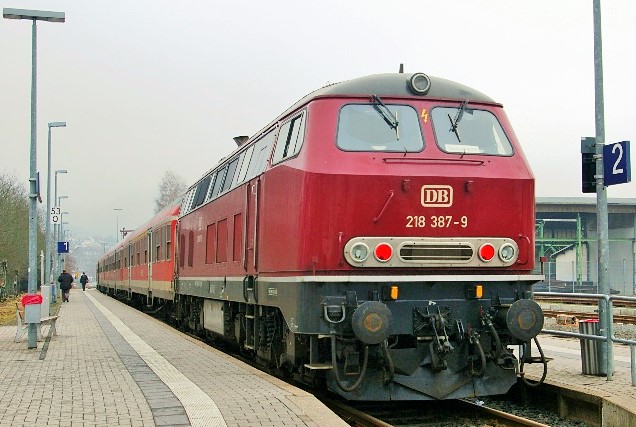
Ex-DB class 218 no.218387 will be working special trains in connection with a special event near Frankfurt over two days at Whitsun.
In connection with a special event at Königstein for Pfingsten (Whitsun), two shuttle trains will operate along the 9-mile branch line between there and Frankfurt-Höchst on Sunday 4th and Monday 5th June 2017 – one with steam haulage and one with diesel.
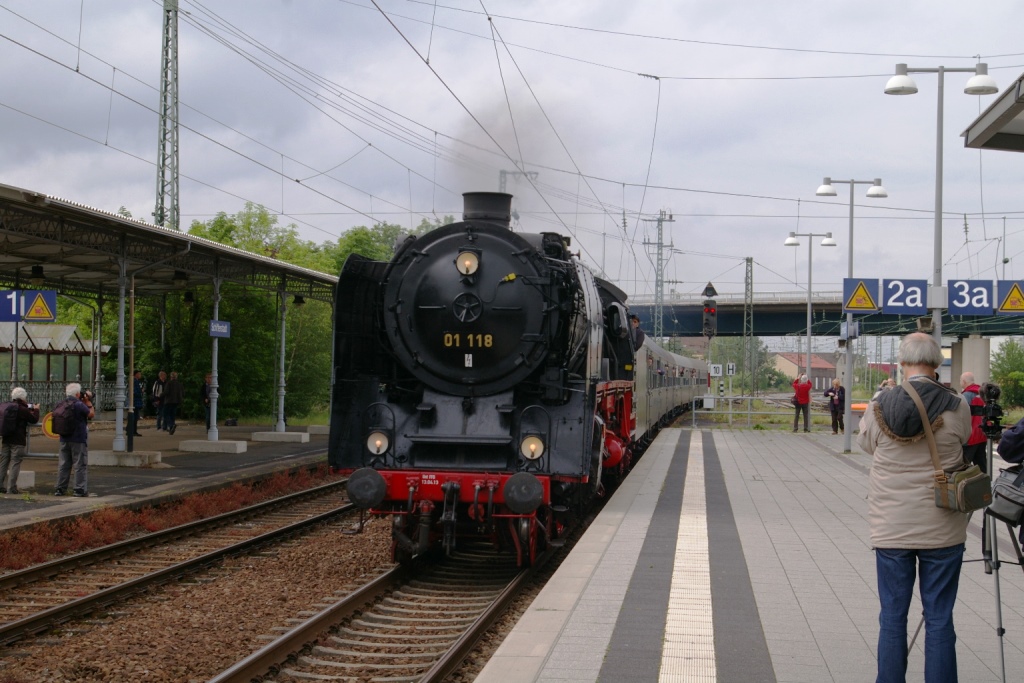
The traction for the steam shuttle will be 2-10-0 “Kriegslok” 52.4867, and/or Pacific 01.118. The diesel shuttle is arguably of more interest to the haulage fan, as it is planned to be powered by class 218 “rabbit” diesel loco no.218387.
Built by Henschel in 1975, 218387 was allocated to Kaiserslautern and Regensburg depots for the majority of its life, before it passed to the Kurhessenbahn (a DB Regio subsidiary) in 2008. This being an entirely DMU-worked operation, its appearances on passenger trains in the last decade have been restricted to special events and sporadic hires to other depots.
These have included a stint in early 2011 where 218387 (by now painted in the “heritage” livery of DB altrot) and a rake of stock substituted for DMUs on certain services between Marburg (Lahn), Bad Laasphe and Erndtebrück; a short spell at Niebüll later that year where it was used on Marschbahn Intercity workings and at least one to Fehmarn Burg; and a couple of months in 2013 when it joined Kempten’s 218 fleet, working regional services in Bayern.
218387 trying to brighten up a very gloomy Bad Laasphe, whilst on “vice DMU” workings from Marburg, 16/02/11 (JW)
Its last known passenger workings were in September 2015 at the “Kurhessenbahnfest” event – since then, ownership has passed to the Brohltalbahn, but it is being hired back by its former operators. Obviously time will tell what the future holds for it.
218387 is planned to work the following shuttles on both days:-
11:27 Frankfurt-Höchst to Königstein
12:25 Königstein to Frankfurt-Höchst
13:27 Frankfurt-Höchst to Königstein
14:25 Königstein to Frankfurt-Höchst
15:27 Frankfurt-Höchst to Königstein
16:25 Königstein to Frankfurt-Höchst
The timings for the steam shuttle are as follows:-
09:42 Königstein to Frankfurt-Höchst
10:27 Frankfurt-Höchst to Königstein
11:25 Königstein to Frankfurt-Höchst
12:27 Frankfurt-Höchst to Königstein
13:25 Königstein to Frankfurt-Höchst
14:27 Frankfurt-Höchst to Königstein
15:25 Königstein to Frankfurt-Höchst
16:27 Frankfurt-Höchst to Königstein
17:25 Königstein to Frankfurt-Höchst
18:08 Frankfurt-Höchst to Königstein (Sunday Only)
01.118 steams into Schifferstadt during a “Plandampf” event, 30/05/14 (JW)
Practicality
Special tickets are required for travel on the service and are available to buy on the train; €15 for a round trip, and a number of single-ticket options are also available.
It will be possible to change trains at the quite brief connections at the “crossing point” of Kelkheim, should you so desire. The “timetabled” unit-worked local trains will also continue to run up and down the branch; these being extras inserted into the timetable.
In addition, Königstein will see an exhibition from 10:00 to 17:00 each day, including a number of items of rolling stock on static display, and the all-important beer garden! Cab rides will also be provided on an (as yet unspecified) diesel loco.
Monday 5th June also sees another low-price, short-distance heritage traction working in the general area. Ex-ÖBB class 1020 electric, 1020.010 (as DRG E94.088), a “Krokodil” dating from 1943, is advertised to work three short circular tours from Ludwigsburg top and tail with a steam loco, departing at 10:20, 12:20 and 14:20 and taking roughly 90 minutes. It would be easy to combine the first of these with the event at Königstein.
218387 at Buchloe after working a commuter train from München, 10/10/13 (JW)
Updated 05/08/17: 7341 is now unavailable to work at the gala, but work is progressing on preparing 7305 to replace it.
Updated 24/07/17: I am now quoted all three Lineas locos as below. 6077 has sadly been pulled from the line-up, however. The TUC Rail 55s have also been declined.
Updated 22/06/17: Lineas (the former NMBS Logistics) have confirmed their presence at the festival – they will be bringing a class 77 in original livery. If available (I am quoted a 70% chance), then a class 77 in new livery and also a class 66 will also be dispatched. More nearer the time.
Update 16/06/17: All freight locomotives remain subject to confirmation at the current time – there is heavy-duty diversionary work in the Montzen area on the weekend in question which will require a lot of diesel locos – once the requirement for this is known, the details of what can be spared for the Bocq gala will be known more clearly. Please keep checking back here for updates.
The format will be three train running with all sets top-and-tailed. It should be very possible to ride behind at least 6-8 different locos during the course of the day. I will have a roster to share in advance of the gala, but due to the above, this may only be a couple of days ahead of time.
British-style diesel galas are rare on the Continent, but a weekend in August 2017 will see a preserved line in Belgium buck that trend.
The Chemin de Fer du Bocq is a 10-mile long preserved railway in south-central Belgium, deep in the scenic Ardennes forest. Following the course of the Bocq river (from which the railway takes its name), the former Line 128 weaves its way along the valley from Ciney, through the operating centre of Spontin, to Purnode and the current end of the line at Evrehailles. It formerly ran through to a junction at Yvoir, and hopefully one day trains will once again arrive there from Ciney.
The railway is run by volunteers of the PFT/TSP, a national society dedicated to railway preservation, and some of their locos are based at the Bocq railway, whereas others are displayed in the museum at Saint-Ghislain and others under repair at Schaarbeek.
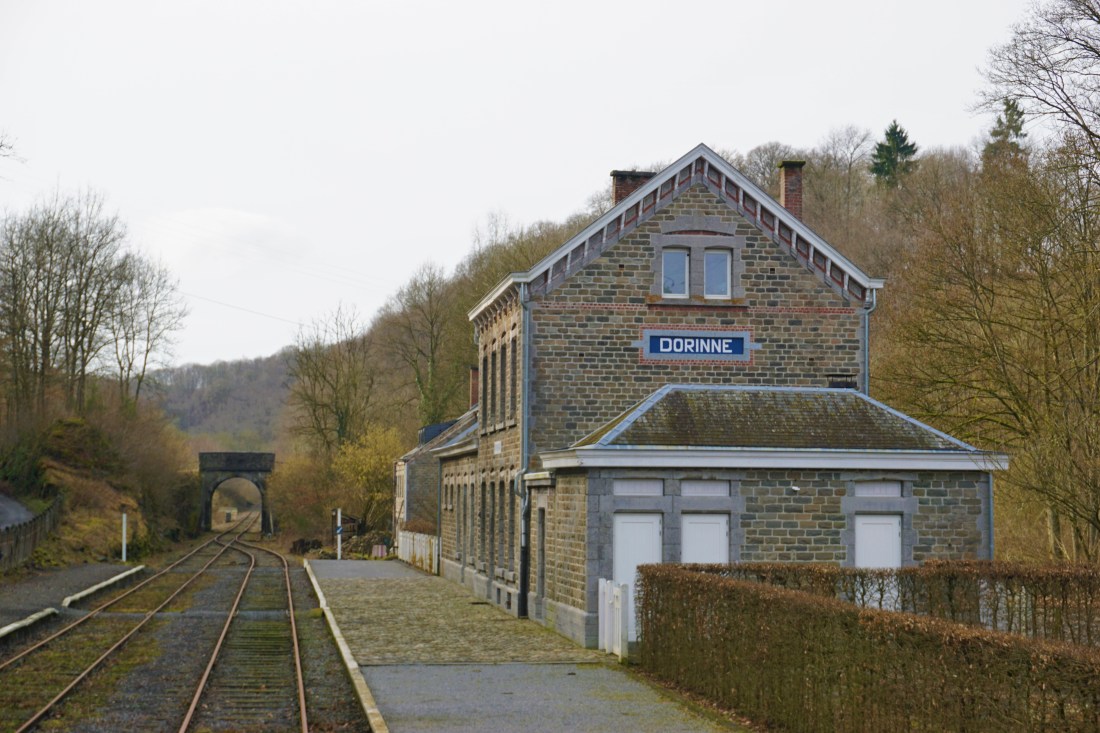
Dorinne/Durnal station on the Bocq railway (JW)
August Festivals
The railway tends to hold a special event each August-time, and these are always imaginative and, consequently, well-attended. Whilst it’s de rigeur these days in the UK for preserved railway galas to feature visiting main line freight locomotives, this is not a trend that has yet really travelled over the Channel; the Bocq railway is one of the forward-thinking exceptions.
Although a couple other Belgian preserved lines have recently hosted main line guests to their galas, these have generally been of older classes that were once synonymous with passenger work, now cascaded onto freight duties (such as ex-SNCB class 51 or 62). The Bocq is different in that it is aiming generally for more modern locos that have always, and will always be, freight locos – due to the relative scarcity of haulage opportunities behind such machines, any such gala attendance could conceivably be the only time that a loco ever hauls passengers in its life. Previous visitors to the Bocq have included Crossrail Class 66 no.PB03 (266 018) in 2012 (see video here) – as well as an impressive selection of PFT/TSP traction from their other sites.
2017 Event
The 2017 event is to be held on Saturday 12th, Sunday 13th and Monday 14th August 2017 – although the Sunday will be a day aimed at photographers.
Traditionally, the Festivals at the Bocq railway have featured a good mixture of diesel and steam traction, operating to an intensive timetable based on Spontin. However, primarily due to the current dearth of operational steam locos in Belgium, this gala will predominantly focus on diesels.
Lineas (the former B-Logistics) have confirmed their presence at the 2017 gala and will be providing an MaK diesel-hydraulic class 77 in original livery, a different class 77 in the new black and green livery, and also a General Motors class 66.
A DB Cargo class 6400 (from the 6500-6520 series) is also lined up for this event. This is a loco type built for Nederlandse Spoorwegen, the Dutch railways, between 1988 and 1994 and are MaK-built, centre-cab 1,580hp MTU-engined machines.
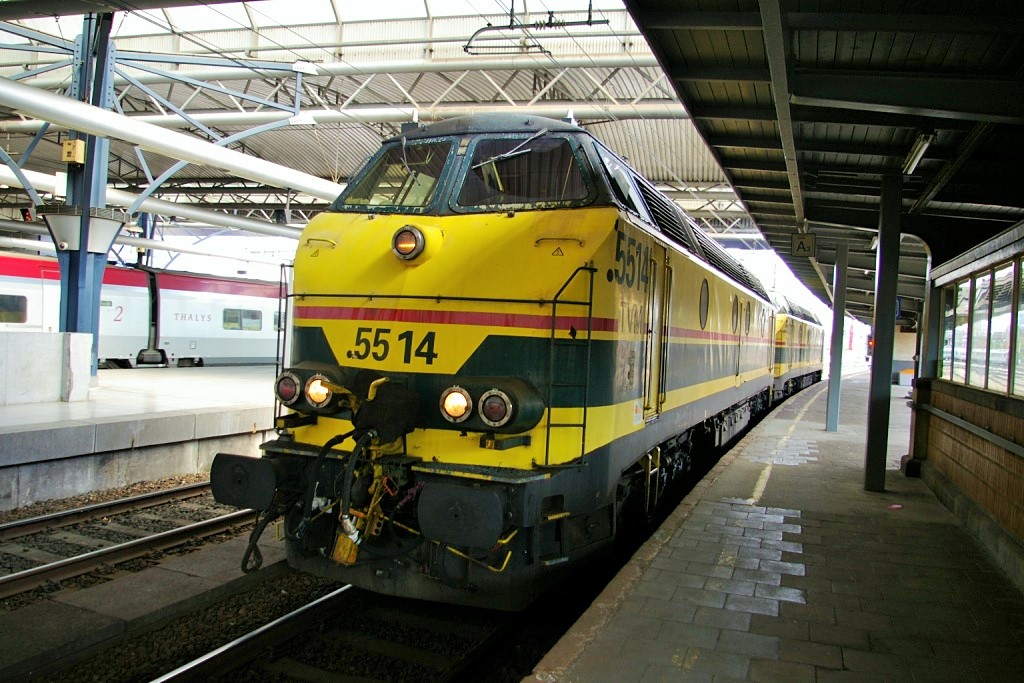
5514 and 5512 at Brussel-Zuid, 23/05/14 (JW)
There will be more, although I stress that none of the following are yet confirmed (and more detail will be provided nearer the time). This information is shared in order to let you as much as possible about the railway’s hopes and plans for the event, but please do not consider this as a cast-iron guarantee that all of these will come to pass!
It is hoped that an ex-SNCB class 55 will attend from TUC Rail. This once 42-strong class are General Motors-powered machines, having 16-cylinder 567-series power units, and were built by the Belgian firm BN in 1961/62.
Further General Motors diesels of a much more modern type are also hoped to attend, in the form of Class 66-type machines – possibly from the Ruhrtalbahn and Railtraxx – but this is certainly subject to confirmation.
PFT/TSP will again bring in traction from their other sites – 5183, 6077 and “202.020” (ex-CFL no.1602).
Steam will be represented by “Energie 507”, a machine built in the war for industrial use, and attending from the Train 1900 organisation in Luxembourg, and ex-War Department “J94” Austerity 0-6-0T WD 196, from Maldegem. Rovers are €15.
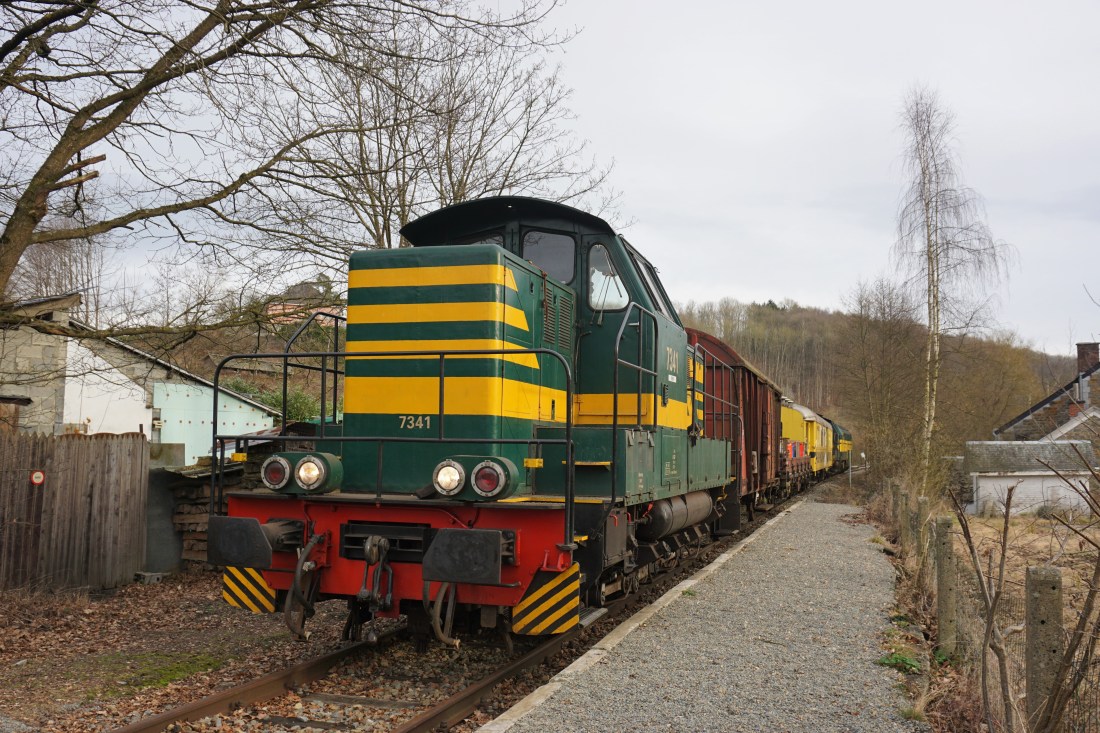
7341 at Evrehailles, 25/02/17 (JW)
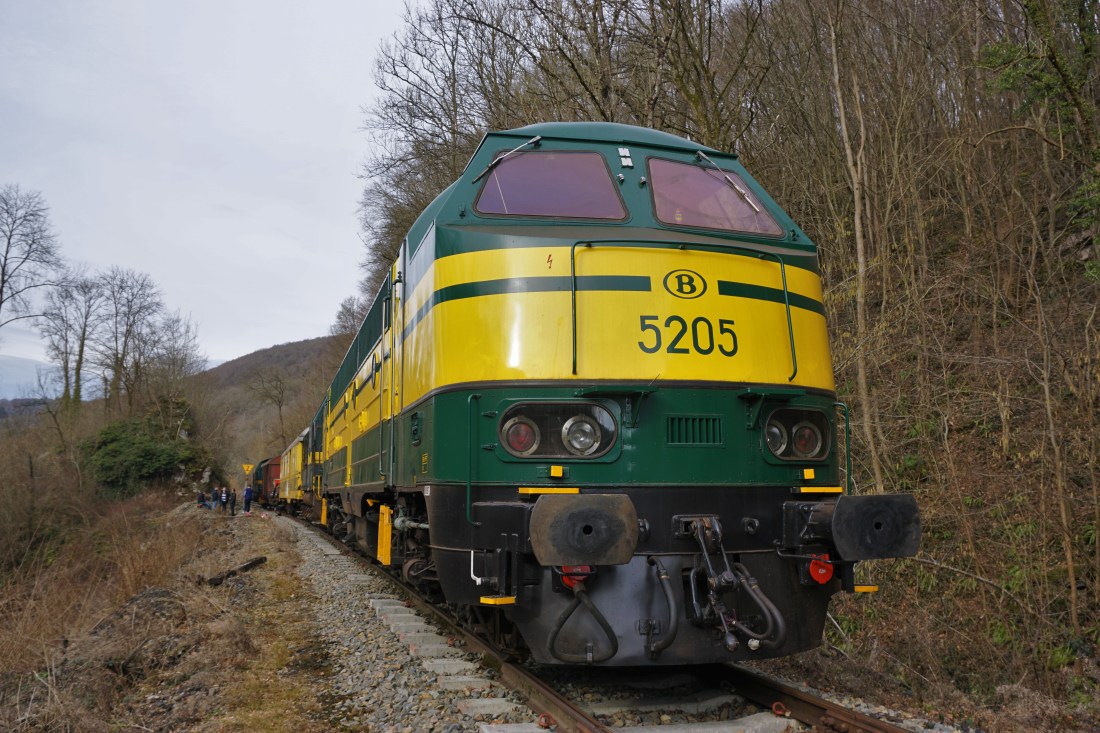
Of the current “home fleet”, 5205 and 7341 are also expected to work at the event.
5205 entered traffic in June 1955, and is one of the 40 General Motors diesel-electrics built for SNCB by Anglo-Franco-Belge (AFB), under licence from the Swedish firm of NoHAB, based broadly on their successful designs for Norway (Di3) and Denmark (MY). It’s a 1700hp machine, again with a 16-cylinder 567-series GM power unit. Although it had a classic NoHAB-style round nose when built, most locos of this class were rebuilt during their careers with “comfort cabs”, this one included, that more resemble the later BN-built GMs.
This video on YouTube features some classic sounds from this venerable machine, filmed last year on the Bocq railway. It’s hard to believe that it will shortly be 62 years old!
7341 is one of a 95-strong class built by BN in the 1960s and 1970s. They are basically big diesel-hydraulic shunters; being of approximately 750hp and featuring 6-cylinder Cockerill engines with Voith transmission.
The following video, uploaded to YouTube by user “ROKKO1953”, is a neat little video diary of the 2013 event, and serves as an interesting taster of the sort of thing to expect.
The Railway
Running, as it does, through such a scenic rural area, Line 128 was never really an important passenger railway, losing its timetabled service in 1960, but did have a strategic role as a freight route – not least during World War 2.
Tunnel de Spontin (JW)
19th July 1944 saw the Tunnel de Spontin – one of the most impressive engineering features of the route – enter the history books as the site of an extraordinary act of wartime resistance.
At the time, this area of Belgium was still under German occupation. The Luftwaffe held an air base at Florennes, about 20 miles to the south-west, and brought in the aviation fuel for its Junkers, Focke-Wulf and Messerschmitt aircraft by rail, including over Line 128. One such train was known to be stabled in the Tunnel de Spontin, so as not to be a target for overhead bombers.
It was, however, a target for the local Resistance. The line climbs very steeply away from Spontin towards Ciney, and on the night in question, they hijacked the loaded Spontin to Ciney limestone tripper on the incline and attached explosives to it, before sending it unmanned and unbraked back down the hill, through the station and into the tunnel, where it impacted with the stabled fuel train at a significant speed. The tunnel burned for eight days and nights and, as Florennes’ store of fuel dwindled, severely impacted upon its ability to dispatch aircraft. The Allied liberation of Belgium, of course, began only six weeks later.
Just something to think about as you pass through it!
Line 128 near Purnode (JW)
Getting There
The Bocq railway shares a station with the national network, although at the moment (May 2017) the last bit into Ciney is not open to passengers due to engineering work. Ciney is easily accessible from the outside world, sitting on Line 162, the main artery between Brussel and Luxembourg. Some of the expresses on this route even remain loco-hauled, in the capable hands of SNCB class 13 “Alstom Tractis” electrics. A historic shuttle bus will operate from Ciney to Braibant to connect with the trains.
Both capital cities are approximately 1hr 30min by train from Ciney, and both still see significant amounts of loco haulage themselves.
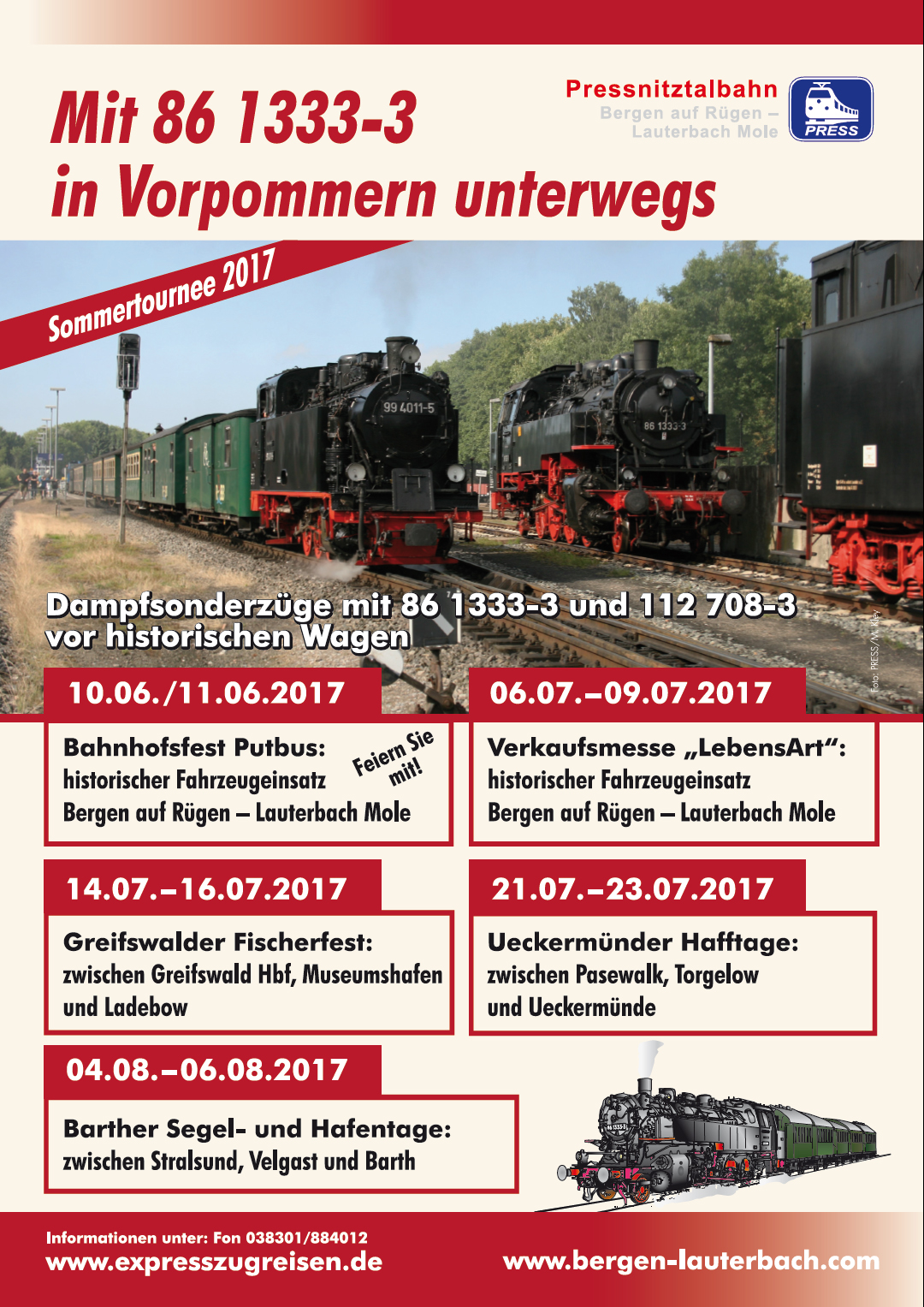
The Pressnitztalbahn’s 2-8-2 steam loco 86.1333, dating from 1939, normally resident in Glauchau, will spend Summer 2017 in the far north-east of the former East Germany, and is advertised to work a number of special trips top-and-tail with V100 class diesels.
The first advertised workings are specials on the island of Usedom, featuring the 86 working top-and-tail with 110 001, a centre-cab diesel-hydraulic of the former Deutsche Reichsbahn – which later became 201 001 of DB after reunification. More details here. (To note that the Intercity services that previously brought a class 218 “rabbit” onto the island of Usedom on summer weekends does not run this year).
Friday 12/05/17
Four round trips from Seebad Heringsdorf to Zinnowitz.
Saturday 13/05/17
Four round trips from Seebad Heringsdorf to Zinnowitz.
Sunday 14/05/17
Four round trips from Seebad Heringsdorf to Zinnowitz.
The rest of 86.1333’s summer workings are advertised as being top-and-tail with a different V100 – 112 708 (DB 202 708). They cover a number of different branch lines in their area of Vorpommern, none of which usually see loco haulage these days, and one of which is freight-only. Details for all of these can be found here.
Saturday 10/06/17
Shuttles between Bergen auf Rügen and Lauterbach Mole.
Sunday 11/06/17
Shuttles between Bergen auf Rügen and Lauterbach Mole.
Friday 07/07/17
Shuttles between Bergen auf Rügen and Lauterbach Mole.
Saturday 08/07/17
Shuttles between Bergen auf Rügen and Lauterbach Mole.
Saturday 09/07/17
Shuttles between Bergen auf Rügen and Lauterbach Mole.
Friday 14/07/17
Shuttles over the freight line between Greifswald and the docks at Ladebow.
Saturday 15/07/17
Shuttles over the freight line between Greifswald and the docks at Ladebow.
Sunday 16/07/17
Shuttles over the freight line between Greifswald and the docks at Ladebow.
One of the most popular European diesel locomotive types is the “Ludmilla” family; powerful machines built in the Soviet Union for the Deutsche Reichsbahn of East Germany. Of a total fleet of 873 locos, only 242 are thought to remain extant – roughly a sixth of which have now left Germany.
One of the machines now in Romania is 232653, seen here at Berlin Schönefeld Flughafen on a very long freight train, 21/04/06 (JW)
This article is not intended as a history of these locos, although I am in the process of writing one. Rather, this is a roll-call of those that have survived to the current date (01/05/17), with details of where they can now be found, plus dates of recent photographs and sightings, with links to them.
This list is correct and up-to-date to the best of my knowledge, but trying to keep tabs on several hundred locomotives spread across the continent can be like herding cats – so if you’re aware of any corrections required, please let me know!
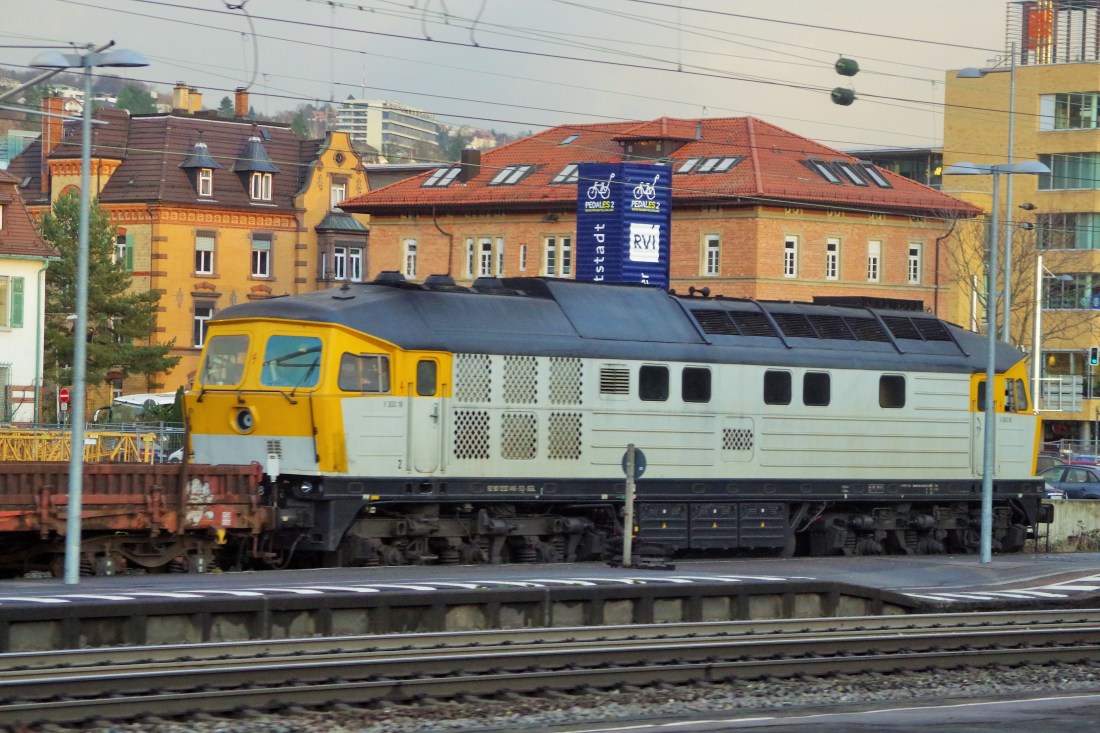
Today, there are two 232s that carry variations of the number “232446”, but neither of them are the original! SGL (Schienen Güter Logistik GmbH)’s V300.18, the UIC number of which is 92 80 1232 446-5 D-SGL, is the body of 232387 with the innards donated by the real ‘446. More confusingly, the former 232227, now working for Ecco Rail in Poland, carries “BR232-446”. The SGL machine is seen here on an engineers train at Esslingen, near Stuttgart, 28/11/15 (JW)







 European Traction