Latest Posts

Visit to Saint-Ghislain – Update

Hello everyone,

Firstly – this is not at all bad news! – hopefully quite the opposite.  However I would be very interested as a matter of some urgency in the thoughts of those planning to attend.

I have received an update today (08/08/18) that the four ‘confirmed’ locos – i.e. CFL 80670057358 and 8428 – remain confirmed, and as of right now are available for traffic.

The extra locos…

You will be aware that our hope all along has also been to use 7349 and/or 8320 – however these have not to date been operational.  I am pleased and very grateful to say that the PFT/TSP volunteers have been working like trojans on them with a view to having them available to haul our train.

However, numerous parts (including at least one full set of batteries) have had to be purchased and some work remains to be done, by people who I speculate may possibly rather be helping with preparations for the Bocq “Festival”.  They are however very willing to do this, but have asked that – if these locos are to be used and turn out on the day – a supplement of €5 is levied per locomotive for their use to cover the work and parts involved and the extra cost incurred in operating them.  This would not be charged if 7349 or 8320 did not work.  For clarity – if one of these locos worked, then the fare for the day would be €30, and if both worked, €35.

Additionally, we have been offered Cockerill Bo-Bo 6106 for our train, within the same timeframe in addition to the other locos, which would equally come at a small additional price (I expect this to also be €5 and will confirm ASAP).

I am very keen for this not to be seen as any kind of cynical move either by the PFT/TSP or myself in ‘suddenly’ asking for more money at the last minute.  That is not the case at all; any and all extra fare money will be specifically to cover further expenses in providing what I hope would make a more enjoyable event.  That is also why I am asking you, as the participants, for your input to the decision making process on this – the options seem to me to be:-

  • We plan to use 806, 6106, 7005, 7349, 7358, 8320 and 8428 at a fare of €40 (TBC, see above)
  • We plan to use 806, 7005, 7349, 7358, 8320 and 8428 at a fare of €35 (€30 if one of the ‘extras’ could not work)
  • We remain with the four confirmed locos (806, 7005, 7358, 8428) at €25 as advertised

Please do contact me as soon as possible at jw218344@gmail.com to let me know your thoughts as I would be interested in everyone’s opinion.  I can’t promise that the eventual outcome will please everybody, but I am keen not to make the decision for people, and to give everyone a voice.  I emphasise that it remains very much an option to proceed with just the four locos you were expecting at the price initially advertised.

Beer

A fine stock of Belgian triples and strong beer will be available at Saint-Ghislain for you to purchase on site, either to consume straight away or to take home.

Shop

There is indeed usually a shop at Saint-Ghislain however understandably the stock will all be at the Bocq railway for the weekend, so this will be closed.  I can highly recommend perusing this whilst you are at Spontin!

Reminder

Please can I remind you that a yellow (not orange, or any other colour I am afraid) high-vis vest will be required for admittance to the event.

I extend my sincere thanks to the PFT/TSP and all of their hardworking volunteers for everything that has been done to date.  I very much look forward to a sociable event on Sunday, to catch up with many good friends and hopefully make new ones.

Jonathan Wilcox
Albanian Passenger Haulage

The small Balkan country of Albania has no passenger rail connection to any other country and is one of the least visited by railway enthusiasts.  It would be fair to say that its rail system is struggling, but it is still worth a visit.

Timetable

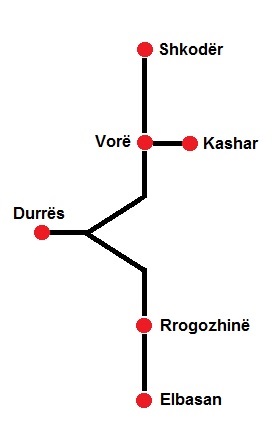
Albania has a skeleton of a rail network and a sparse service.  Travel is generally quicker by road.  As if that was not enough, its capital – Tiranë – lost its rail service in 2013, the trains now running only as far as Kashar.  The station in Tiranë is allegedly being rebuilt on another site and the service will return there, but this does not look likely to be any time soon.

The timetable as currently understood (July 2018) is as follows:-

Shkodër 05:45
Kashar 07:15 08:30 15:30
Durrës 06:30 07:59 08:15 09:13 09:35 14:45 16:13
Rrogozhinë 07:40 ??:?? ??:??
Elbasan 10:58 17:30
Elbasan 06:10 13:53
Rrogozhinë ??:?? ??:?? 16:00
Durrës 07:00 08:57 13:00 14:30 16:36 17:00 17:10
Kashar 07:42 15:13 17:43
Shkodër 16:50

Below is a map of the current passenger routes currently thought to see a service.  Not to scale.albania

Traction

All trains are hauled by Czechoslovakian-built class T669 diesel-electrics, formed nowadays generally of ex-East German carriages in deplorable condition.

Tickets

There are no rover tickets valid for travel in Albania.

Eurotunnel Car Trains

Although not strictly within the remit of this website, I thought I would also cover the Eurotunnel car trains under the Channel, as they do provide an element of loco haulage to and from the Continent.

From its opening in 1994, the Channel Tunnel gave two new ways for passengers to travel between the UK and the Continent – by Eurostar between London and Paris and Brussels, and on the car-carrying “Le Shuttle” between Cheriton (Folkestone) and Coquelles (Calais).  This article looks briefly at the latter.

37958597_10156733425999379_9153045937407393792_n

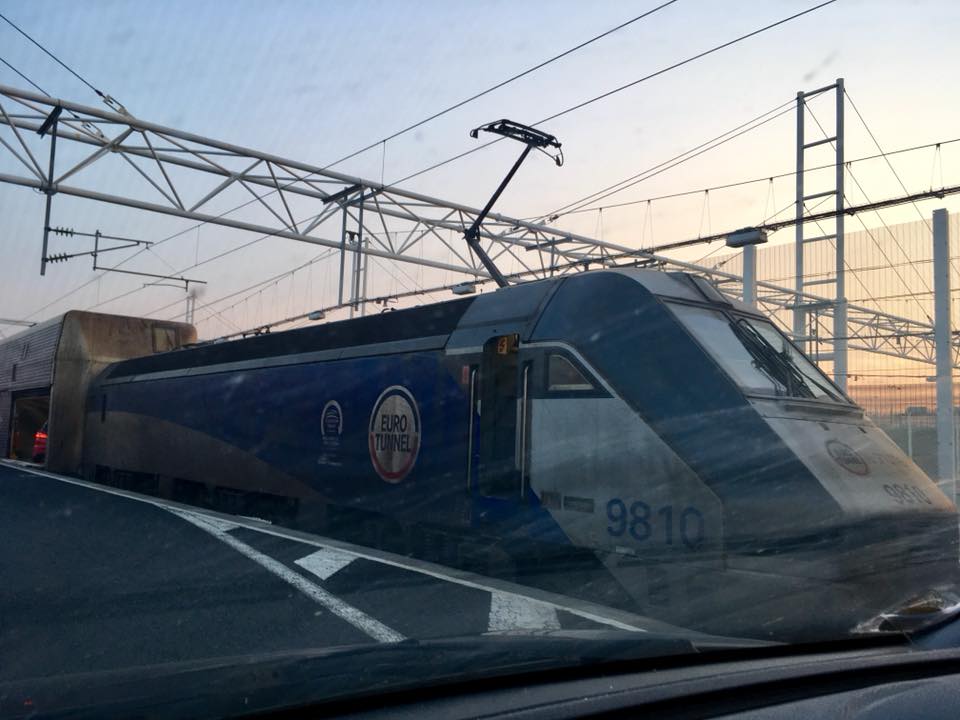
The view from a car boarding a train at Coquelles of 9810 on the rear of a car train to Cheriton.  Taken by my lovely fiancee Nic as I was driving at the time!

The car shuttle service

The car-carrying shuttle is operated by Eurotunnel and operates to a fixed timetable 24 hours a day, 7 days a week, 365 days a year, with up to four departures an hour in each direction.  There is no provision for foot passengers – all passengers need to be in cars or coaches.  Certain commercial coach services do use the shuttle (whereas others use the Dover to Calais ferry).  The journeys take approximately 35 minutes.

Access to both terminals is directly from each country’s motorway network – the M20 in England and the A16 in France.  As such, it’s probably best considered not so much as a train service at all but as a tolled section of motorway on which vehicles happen to be conveyed on board trains and pre-booking of a slot gives a cheaper fare.

The traction

The trains are worked in top-and-tail fashion by Bo’Bo’Bo single-cabbed electric locos assembled by Brush Traction in Loughborough from the early 1990s.  The initial batch dating from 1992 were numbered 9001 to 9038.  One of these – 9030 – was destroyed in a catastrophic fire in the Channel Tunnel on 18th November 1996, and was replaced by a new-build loco, 9040.  Since 2004, these locos have been going through a comprehensive upgrade programme, from which the locos so treated are emerging as 7 MW (9,400hp) machines and renumbered in the 98xx series (with the last two digits remaining the same).

There are also 20 similar locos dedicated to the freight shuttles (9101 to 9113, and 9701 to 9707), but these are outside the scope of this article.

“Bashability”

Such a service is inherently “unbashable” in that you cannot wait for a “winner”, in fact not only do you not see the identity of one of the locomotives at all until you are driving down the ramp towards the train, but you never actually see the other locomotive at all.

However, the on-board staff are invariably very helpful in advising you of what its number is.  They walk through after departure and as long as you are sensible and polite about how and when you ask them if they could find out for you and above all explain why you want to know, they tend to ask the question and come back with the answer and a smile.

Do also note that (in my experience) if you travel out and back from the UK on the same day in your car – even if the outward was by ferry – you are likely to get pulled by UK Customs back at Coquelles for a thorough interrogation and search of your vehicle.

Off the beaten track: 2060 009 at Stammersdorf

Austria is another country to see withdrawn locomotives plinthed at unlikely locations well away from the nearest operational railway line.

1955-built ÖBB class 2060 diesel shunter 2060 009 is, however, on former railway property – the site of Stammersdorf station, on the northern outskirts of Wien (Vienna), which closed in 1988 (see photo here).  Almost all trace of the railway has been obliterated from Stammersdorf, with the exception of the station building (now dilapidated and with little by way of betraying its former purpose) and two track panels on the site of the former platform area, upon one of which the 2060 now sits (upon the other are a pair of steam loco wheels).

How to get there

The 2060 is easily viewed and is permanently on accessible public display.  It is precisely adjacent to the platforms of the terminus of the no.30/31 tram line operated by Wiener Linien.  These both serve Wien-Floridsdorf railway station – a 13-minute ride away.  A little trip to see the 2060, therefore, might provide you with a useful diversion in amongst sampling the loco haulage to be found in the city, for example on the Wiener Stammstrecke.

To see the Google Maps map and street view of 2060 009‘s location, click here.

Amtrak X995 and X996 – European locos in 1970s America

The remit of this site allows me to write about many of my great interests, but I might not have expected American railroads to be among them!

The flow of locomotives across the North Atlantic has always been much more from America to Europe than vice versa.  However the 1970s did see two particular European locomotives make a brief sojourn to the USA (and I’m not talking about “Flying Scotsman”!).

The 100mph streamlined Art Deco 2-Co-Co-2 “GG1” electric locos built for the Pennsylvania Railroad in the 1930s were, by all accounts, highly impressive machines, but by the time of the creation of Amtrak on 1st May 1971, they were showing their age.  Consequently, the nascent organisation quickly sought to replace them with new traction.  At the time, there was nothing appropriate “off the shelf” in the States, but procurement of a suitable fleet from Europe would have taken years.  Amtrak therefore looked to General Electric to rapidly develop an express (120mph) passenger version of its brutal-looking “E60” locos – 6,000hp machines under construction at that time for heavy freight work on the Black Mesa and Lake Powell Railroad.  The initial E60 order was placed by Amtrak in early 1973.

The E60s were not a success.  Their fate was largely sealed on Monday 24th February 1975 when loco no.950 derailed at 102mph in Elkton, Maryland whilst on test, and the cause was traced to fundamental wheelset issues.  The fleet were restricted to 85mph.  Behind the scenes, steps were made almost immediately to pursue the European route after all…

The 1976/1977 Trials

Amtrak therefore selected two modern electric locomotive designs from Europe to test on its famed Northeast Corridor: one from Sweden (which they numbered X995) and one from France (X996).  These plans were formalised in October 1975 with both locos to arrive roughly a year later.

The “Swedish Meatball” – X995

The first to arrive, in August 1976, was brand-new SJ Rc4 electric loco, Rc4 1166, built by Allmänna Svenska Elektriska Aktiebolaget (ASEA).  This was painted in Amtrak livery and numbered X995.  Until April 1977, it was tested on the Northeast Corridor between New York and Washington DC at up to 200km/h.

Upon return to Sweden, it was painted into SJ’s red livery and entered service.  As a reminder of its early travels, it obtained a cabside plaque (photo here), although this is understood to have been stolen.  Rc4 1166 remains in service to this day with Green Cargo (see photo here).

The “French Fry” – X996

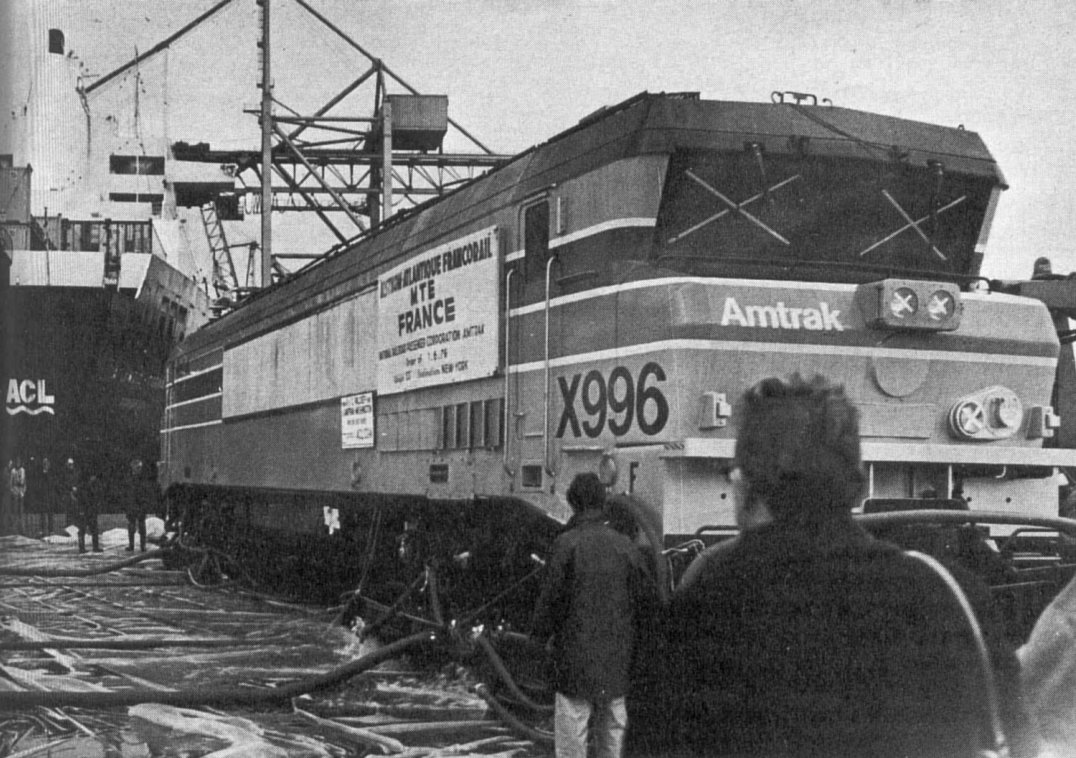
By comparison, although the nominated French machine was relatively new, it was not fresh off the production line.  CC21003 was one of a fleet of four dual-voltage machines built to the classic Paul Arzens “nez cassé” (“broken nose”) design; it had entered service with SNCF in June 1974.  During 1976, the loco was lent back from SNCF to its builders – Alsthom, in Belfort – from where it was turned into an American demonstrator (no mean feat considering the significant modifications involved – not least a new transformer for the different voltage of 11kV a.c. used over there).  CC21003 – by now X996 – was ready by the end of the year and was shipped to the States from Le Havre in January 1977 (see photo here).

X996 was put to work being tested under the same conditions as the Swedish machine.  However, these tests were not as successful.  Following the debacle with the E60s, Amtrak were understandably tetchy about locomotive suspension, ride quality and wheelsets, and X996 did not shape up in this respect.  The Americans concluded that the loco’s design did not pass muster for their needs; the French maintained that the loco was fine but the condition of the track was the issue.  The loco was only used in anger over there for a month, between March and April 1977; the testing was then terminated and the loco was returned to Belfort in the June.

It was promptly converted back to the dual-voltage loco it had been when SNCF had returned it there in 1976.  CC21003 returned to French metals.  In the mid-1990s, along with its three sisters, it lost its a.c. capability and was reclassified accordingly as a CC6500; it became CC6577.  It was withdrawn in 2005 and then quietly scrapped.

The Verdict

Predictably, given the issues identified with X996, the lightweight Swedish machine won out with the Americans – and indeed an order for a fleet was forthcoming.  These were manufactured under licence by General Motors’s Electro-Motive Division (EMD) in La Grange, Illinois, with bodyshells from Budd and bogies and electricals from Sweden.  This fleet, which was delivered to Amtrak from 1980, was designated AEM-7 (ASEA Electro-Motive – 7,000 hp) and eventually numbered 54 machines.  Commuter rail operators MARC and SEPTA also purchased small fleets.

Amtrak’s AEM-7s gave sterling service up until the withdrawal of their last examples in Summer 2016.  MARC’s followed suit in 2017 and SEPTA’s examples are expected to be gone by the end of this year; ending over four decades of Rc4 technology on American metals.

Off the beaten track: Germany’s “EsS Bahn”

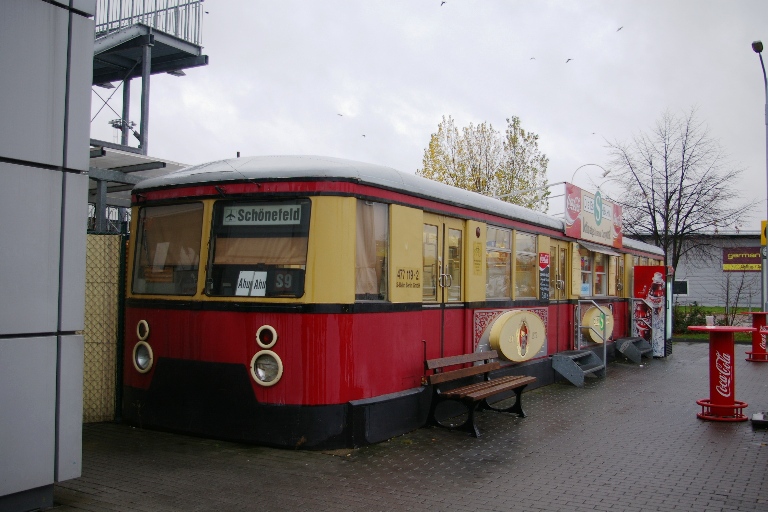
One enterprising business to have “repurposed” former railway rolling stock is “EsS Bahn”, which uses redundant former Berlin S-Bahn class 475 and class 477 vehicles – the name being a play on both S-Bahn and the German verb “essen”; to eat.  These are housed at airports and are used to sell sausages; in particular currywurst, sliced Bratwurst in a curry ketchup-based sauce.  Currywurst is said to have been invented in Berlin in the immediate post-war years, therefore both remaining Berlin airports have “EsS Bahn” booths.  The third that uses a former railway vehicle is at Stuttgart.

Here are some of my photos – of varying quality! – of the three vehicles concerned.  Just something for you to keep an eye out for next time you pass through any of these airports on your way in or out of Germany!

Berlin-Tegel Airport

Tegel Berlin.jpg

475 079 at Berlin Tegel Airport, 19/06/17 (JW)

Berlin-Schönefeld Airport

5773023241_b2d4ef57e7_o

477 119 at Berlin Schönefeld Airport, 06/11/10 (JW)

Stuttgart Airport

35297270_10155254565935356_4652284171023024128_n

475 608 at Stuttgart Airport, 08/06/18 (JW)

Others

There are also “EsS Bahns” airside at two more airports – Köln/Bonn and Shanghai(!).  However, these use mock-ups and not genuine former S-Bahn vehicles.

Off the beaten track: 104 020 in Frankfurt am Main

This article is the latest in my occasional series about the plethora of European locomotives that can be found in (occasionally surprising) places away from railway property.

The locomotive in question is ex-DB class 104 electric 104 020, a 1-Co-1 machine built by AEG in 1934, initially as Deutsche Reichsbahn E04 20.  Withdrawn from use at the start of 1977, it passed to the collection of the DB Museum, and did indeed power railtours on the main line.

However, since 3rd November 2002, it has had a purely static existence.

The view of E04 20 in its current resting place, as per Google Maps!

It – along with Mitropa coach WR4ü 1189 – is on display on a short length of track outside the DB Headquarters on Idsteiner Strasse in Frankfurt am Main (see street view and link to map above).

How to get there

This must be one of the easiest such locomotives to visit – it cannot be seen from a train, but it is on permanent public display and just a 300 metre walk from the nearest station – in this case Galluswarte, on the S3, S4, S5 and S6 S-Bahn routes.  Galluswarte is just a matter of minutes’ ride from Hauptbahnhof and indeed – as long as you don’t hang around(!) – it’s actually possible to get out to see 104 020 and return in a 30-minute layover there.


Do you find this type of article useful or interesting?  I tend to try to focus on haulage-related subjects with this website, but I’d like to try to gauge interest in things that are a little outside of that remit.

Sunday 12th August 2018 – Diesel haulage event at St Ghislain

I am pleased to advertise a modest diesel haulage event at the PFT/TSP’s facility at St Ghislain on the morning of Sunday 12th August 2018.  This has been arranged to coincide with the much-anticipated “Festival” at the Chemin de Fer du Bocq occurring over the same weekend.

The event will consist of all operational diesel locomotives giving rides in an M1 coach for short distances within the confines of the depot site.  As of this week, the man on the site advises that these consist of ex-SNCB locomotives 7005, 7358, 8428 and ex-CFL 806.  All attempts will be made to also use ex-SNCB 7349 and/or 8320, but this will not be able to be confirmed until the morning itself.

Meeting Point & Times

We will meet at St Ghislain SNCB station promptly at 09:10, immediately after the arrival of the 09:02 arrival from Charleroi (ICT6704) which is booked for class 18 haulage – although if you could get there earlier, I would recommend doing so.  A PFT/TSP representative will take us to the train, a distance of approximately 100 metres’ walk.  Each of the available locomotives will then haul the carriage in turn within the depot site.  We will endeavour to return to the station by 13:30.  It will not be possible to join or leave the event between these times as there will be no access to the depot site other than on the train with the rest of the group.

Fares

Fares for the event at St Ghislain – which do not cover any travel to/from it – will be €25 for adults (€15 for under 16s) payable in cash on the day.  I would very much appreciate the correct fare being tendered please.  All proceeds will go directly to the PFT/TSP to help their preservation projects, and none to me.

Even if you have already registered your interest, please send me details of the names of all members of your party, specifying if any are already members of the PFT/TSP, by 1st August.  These details will be kept safely and privately with myself shared only with the PFT/TSP for the purpose of enrolling every individual as a temporary member for insurance purposes.  As a result, it’s an event that will require compulsory pre-booking with me, although the money will be collected on the day.  My intention is to retain your information on my personal secure database, which is not shared with anybody, to keep you informed of similar further events I organise – if you wish your details to be deleted after this event, please advise me by email and I will do so.

You will need to bring a yellow (NOT orange) high visibility vest to take part in the event.  Brand new ones are available for less than £2.00 on eBay.  Please get in touch with me if you encounter any issues procuring one.

Caveats & Notes

The availability of any of these locos is subject to the usual caveats that you would apply to machines that are up to 64 years old!  We can be sure that our Belgian friends will pull out all the stops to do their best for us.

Although I have tried my best to plan the event to permit connections into and out of main line services e.g. from Namur and Brussels – both of which allow loco haulage for some of the journey – I cannot be held in any way responsible for delays or cancellations of these.  In anticipation of questions, the event has been timed so early for a number of reasons; but most importantly because the PFT/TSP volunteers facilitating our visit are working at the Bocq railway gala later that day.  Of course, this is also convenient for UK-based enthusiasts who need to return home afterwards.

Refreshments will not be available on site so please ensure that you bring your own – but please take all rubbish with you.  I like to foster a relaxed and friendly atmosphere at my events and therefore I do not intend to draw up lists of ‘rules’ or impose any restrictions on behaviour; I trust attendees to exercise common sense and obey any instructions from our hosts.

If you do have any further questions, please do not hesitate to get in touch.  I look forward to a sociable day!

My sincere thanks to Simon de Ridder and Simon Moore for their help in obtaining the opportunity to do this.

Future European Traction Events

The success of this event and positive publicity/funds generated for our hosts will pave the way for similar events in the future, and I have several irons in the fire for 2019.  Please do feel free to have a chat with me if there is anything in particular you would be interested in.

Firstly, however, please may I also take this opportunity to bring to your attention the next in my calendar of rare haulage events – a visit to the Chemin de Fer Touristique du Rhin, near Colmar, in France on Sunday 9th September 2018 to ride behind 1946-built ex-SNCF Baldwin diesel-electric A1AA1A 62029.  Aside from ad-hoc short-distance shunt releases, no other opportunities to ride behind this class of loco are anticipated for the foreseeable future.  Additionally, subject to its repairs being completed in time, ex-SNCF Decauville shunter Y2402 may also haul our coaches for a short distance.  This event can easily be combined with numerous events elsewhere over the same weekend; most notably the much-anticipated gala event at Blonay-Chamby and the use of BLS Ae6/8 electric loco 205 on an additional service train in Switzerland.  It would be great if you could join us.

Jonathan Wilcox

Forthcoming German Maybach railtours

Since setting up this website I’ve become aware that there are many enthusiasts within the UK who are keen to experience the Maybach diesel-hydraulic power in Germany, but would appreciate a pointer as to how to find the requisite information.

Consequently, I’ve decided to put together this little guide covering the second half of 2018 which may be of some assistance.  Please do not hesitate to contact me if you are considering planning a trip and require assistance in planning an itinerary.

Here is not the place to give any kind of history of Deutsche Bundesbahn Maybach power (although I am working on one), but suffice to say that there are two locos currently in use on the German main line that will really excite British hydraulic enthusiasts – V160 002 and V200 033.  A fair variety of other traction (including DMUs) featured Maybach power units, but I am not aware of any with forthcoming workings in the calendar.  There are also diesel shunters with Maybach power units and Voith transmissions, but I am treating them as outside the scope of this article.

Below is a chronological listing of all known forthcoming tours of these two locos – I would recommend looking at the Haulage Calendar elsewhere on the site for more information and further links if one piques your interest.

V160 002

IMGP4886.JPG

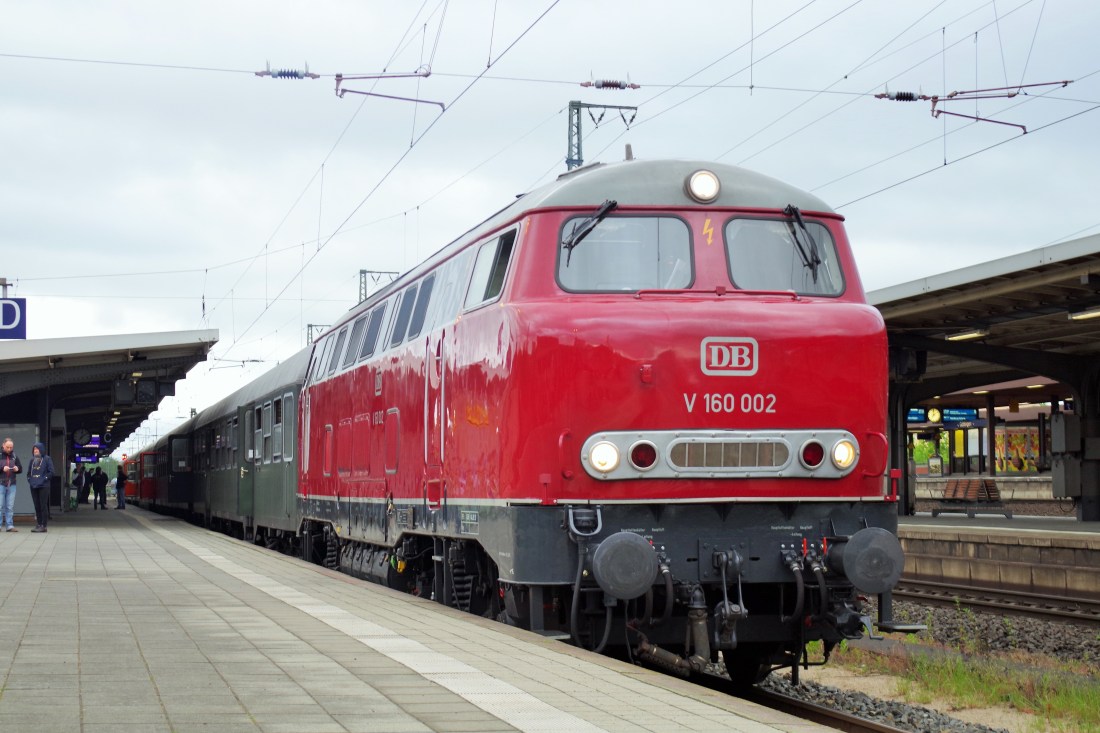
“Lollo” V160 002 pauses at Göttingen on a Treysa to Klein Mahner railtour, 15/05/16 (JW)

A relatively recent, but very welcome, returnee to the German main line is V160 002 (post-1971 number 216 002).  Built by Krupp in Essen in 1960, it’s one of the ten prototype V160s – nicknamed “Lollos” – commonly described as being “German Hymeks” due to their MD870 engines.  The comparison is not a direct one, however, as the “Lollos” had Voith as opposed to Mekydro transmissions – which does make an appreciable audible difference to the hydraulic connoisseur – but it is hellfire all the same!

Do note that some of the “Lollo”‘s forthcoming outings are as a package with 4-6-4T steam loco 78 468 (Henschel works no.20166 of 1923) – either top and tail with the 95-year-old veteran (either as insurance or to offer a helping hand up to linespeed) or handing over to it at some point during the journey.  The destination of the three December tours of Christmas markets may be a good one to drag the family along on!

Forthcoming Tours

At the time of writing, I am advised that V160 002 remains at Delmenhorst awaiting authorisation of engine repairs following a failure on 1st December 2018.  The below is reproduced in good faith, please bear in mind that it may not be repaired before some or all of these run.

9th February 2019 – V160 002 and V200 033 Köln to Wernigerode and return.  Operated by Nostalgiezugreisen.

15th June 2019 – V160 00278 468, Buchholz to Westerland and return.  Not yet sure of the diesel/steam split.  Operated by Nostalgiezugreisen.

31st August 2019 – V160 002 Buchholz to Westerland and return.  Operated by Nostalgiezugreisen.

19th 26th October 2019 – V160 00278 468, Münster to Koblenz and return.  Not yet sure of the diesel/steam split.  Operated by Nostalgiezugreisen.

Here is a write-up of a tour that I travelled on in May 2016 with this fine machine which may whet your appetite, including a 24-minute video of my footage taken during the day with plenty of MD870 thrash!

V200 033

DSC03990.JPG

V200 033 awaits departure from Stuttgart Hbf with a railtour to Donaueschingen, 09/06/18 (JW)

The “main attraction” for Maybach fans in Germany has long been V200 033 (220 033), built by Krauss-Maffei in 1956 – one of the class that were the forerunners of our D800 “Warships”, and featuring two MD650 power units, just like them.  Since the destruction of prototype series machine V200 002 in the tragic fire at Nürnberg-Gostenhof in 2005, it is now the last Maybach V200 left in operation.  It also still has an operational steam heat boiler.

Forthcoming Tours

9th February 2019 – V160 002 V200 122 and V200 033 Köln to Wernigerode and return.  Operated by Nostalgiezugreisen.

23rd March 2019 – V200 033 Hamm to Braunschweig and Wolfsburg and return.  Operated by Museumseisenbahn Hamm.

1st June 2019 – V200 033 Lippstadt to Emden and return.  Operated by Museumseisenbahn Hamm.

22nd June 2019 – V200 033 Hamm to Koblenz and return in connection with the Sommerfest at the DB Museum.  Operated by Museumseisenbahn Hamm.

27th July 2019 – V200 033 Hamm to Lengerich for 78 468 forward to Eystrup.  Return as outward.  Operated by Museumseisenbahn Hamm.

30th November 2019 – V200 033 Hamm to Christmas markets at Goslar, Wernigerode and Quedlinburg and return.  Operated by Museumseisenbahn Hamm.

East German Pioneer Railways

Work in progress…

An interesting feature of the former Eastern European countries – particularly East Germany – were the “Pioniereisenbahnen” (“Pioneer Railways”).

The Pionierorganisation Ernst Thälmann was a youth organisation in the GDR for children between the ages of 6 and 14.  Founded in 1948, the majority of such children in the country were “Pioneers” by the mid-1950s.  They took part in interesting activities, although there was a strong political slant to the movement as these activities were often crafted in such a way that emphasised the ideology and principles of socialism to the keen young minds of its members.  In the Summer, the Pioneers spent time in special Pioneer activity camps situated across the GDR and other socialist countries.

Many of these Pioneer camps were home to Pioniereisenbahnen.  These were narrow-gauge railways that were operated as far as practicable by the Pioneers themselves.  As well as a fun activity, the serious side to this was to prepare them for a career on the railway in later life, as an industry that required not only specialist skills, but – in the specific case of the GDR – a strong sense of loyalty to the regime, given, for example, that duties could involve routinely crossing the Iron Curtain with the corridor trains (and so on).  As they had seen in December 1961 with Harry Deterling (article to follow!), railway staff given an opportunity to cross the inner-German border could not always be relied upon to return.

The children were generally permitted to carry out all duties involved in running a railway short of maintaining and driving the trains.  The older children were given the opportunity to work towards these grades, however.  They wore railway uniform and largely worked to the “big railway” rule book.

In contrast to similar railways in the other socialist countries (and the reason why I have given the Pioniereisenbahnen their own separate article here), the East German ones were not generally museum operations and were thoroughly modern railways, both in terms of traction and signalling – in some cases more so than parts of the Deutsche Reichsbahn that the Pioneers were being primed to work on.  Indeed, the Pioniereisenbahn at Plauen was actually overhead electrified!

The Pioneer Railways Today

The Pioneer organisation dissolved with German reunification; its reason for existing being removed.  With it, went the need for the Pioneer camps and their railways.

However, many of the camps have found a new purpose as parks for more general enjoyment, with many of the railways forming an interesting centrepiece to them.

They tend to now be known as “Parkeisenbahnen” (“park railways”), their political heritage removed from the names to reflect their current usage.  Although some retain the involvement of children, many are now operated by adults.

Below is a list of all of the GDR’s Pioniereisenbahnen, and over time I will add individual articles for each of them covering how you can experience the remaining ones yourself.  Even now, they are certainly not “toy railways” and have something to offer to even the most stubbornly grown-up enthusiast!


Pioniereisenbahnen in the GDR

Parkeisenbahn Chemnitz

Parkeisenbahn Cottbus

Ferienlandeisenbahn Crispendorf

Dresdner Parkeisenbahn

Parkeisenbahn Gera

Parkeisenbahn Görlitz

Parkeisenbahn Halle

Parkeisenbahn Krumbholz

Parkeisenbahn Lauchhammer

Parkeisenbahn Leipzig

Pioniereisenbahn Magdeburg (closed)

Parkeisenbahn Plauen

Pioniereisenbahn Prerow (closed)

Parkeisenbahn Vatterode

Parkeisenbahn Wuhlheide