Latest Posts

Near miss at Worowo involving EP07-1035

A potentially nasty event occurred at Worowo in Poland at approximately 13:30 today, 17th October 2017 – TLK81104, the “Rybak” from Szczecin to Bialystok, hauled by EP07-1035, passed a signal at danger and was brought to a stand only after an emergency radio broadcast from the traffic controller – just 100 metres from a head-on collision with the oncoming “Zulawy” which was crossing into the loop ahead of it.

The driver of EP07-1035, which had the SPAD, is currently held on charges that carry a potential custodial sentence of between 6 months and 8 years.  Understandably, the incident remains under investigation.

It must be said that the safety performance of the Polish railways is possibly a cause for concern.  The last six weeks alone have seen EP07-395 and EP08-006 severely damaged in collisions with other trains, and this could have been so much worse – luckily, there were no injuries.

There are some hair-raising photos in the article here.

Lausitzer Dampflokclub provisional 2018 railtour dates

Here is a list of provisional railtour dates for the Lausitzer Dampflokclub for 2018.  As far as I am aware, some of these have yet been advertised, let alone bookings opened, so please therefore treat this list in the spirit it is intended – purely to help you with as much advance warning as possible over what they are trying to do.  I do not want the LDC on the receiving end of any negativity if these plans do not come to fruition in the hoped-for way.

The group is currently engaged in fundraising to repair their steam loco 23 1019 after damage sustained at Chemnitz.  Should you wish to book on any of these, you will be helping them in this aim, when indeed bookings open.


17th March 2018

V60 diesel: 07:30 Cottbus to Schwarze Pumpe power station area and Cottbus  Sold out

24th March 2018

Class 232 Cottbus to Dresden for 50 3648 (steam) forward to Hradec Kralove.  Link.

7th April 2018

52 8079 (steam): Cottbus – Elsterwerda – Dresden for the Dampfloktreffen event, and return.

14th April 2018

V100: Cottbus – Niederfinow and return.

28th April 2018

52 8079 (steam): Cottbus – Guben – Wolsztyn for the Dampflok-Parade.

5th May 2018

03 2155 (steam): Cottbus – Wroclaw and return.

10th May 2018

Class 772 “pig taxi” DMU – or V100+stock “bei Bedarf” (if necessary): Cottbus – Weisswasser for a trip on the Bad Muskau Waldeisenbahn (not currently advertised – TBC)

19th May 2018

Class 143 Cottbus to Dresden for 50 3648 (steam) forward to Mlada Boleslav

26th May 2018

18 201 (steam) – Cottbus – Elsterwerda – Dresden Hbf – Bad Schandau and return (not currently advertised – TBC)

9th June 2018

03 2155 (steam) – Cottbus – Forst – Wroclaw and return (not currently advertised – TBC)

10th June 2018

03 2155 (steam) – Cottbus – Görlitz and return

23rd June 2018

35 1097 (steam) – Cottbus – Görlitz – Liberec – Tanvald – Harrachov and return

30th June 2018

Class 772 “pig taxi” DMU: Cottbus – Calau – Senftenberg – Schwarzkollm and return

7th July 2018

143 559: Cottbus – Frankfurt (Oder) – Berlin Hohenschönhausen – Ostseebad Binz (optional trip to Lauterbach with 86 1333 (steam) then on the “Rasender Roland” narrow gauge steam line)

15th July 2018

V60: Cottbus – Calau – Senftenberg – Schwarzkollm and return

11th August 2018

Class 772 “pig taxi” DMU: Cottbus – Finsterwalde and return

11th August 2018

01 509 (steam): Cottbus – Lübben – Berlin Lichtenberg – Berlin Gesendbrunnen – Warnemunde and return for Hanse Sail 2018

1st September 2018

18 201 (steam) last working before withdrawal from traffic for major overhaul: Cottbus – Falkenberg – Halle (Saale) to Meiningen for Dampfloktagen and return (not yet advertised – TBC)

1st September 2018

Class 143 electric: Cottbus – Frankfurt (Oder) – Berlin Stadtbahn – Potsdam Hbf – Wittenberge for Brandenbergtag and return (not yet advertised – TBC)

29th September 2018

52 8131 (steam): Cottbus – Elsterwerda – Coswig – Meissen and return (not yet advertised – TBC)

6th October 2018

“Class 245 diesel” (may mean Class 285 on previous form): Cottbus – Falkenberg – Wittenberg – Dessau – Wernigerode for a trip up the Brocken with a narrow gauge steam loco (not yet advertised – TBC)

3rd November 2018

V100 diesel loco: Cottbus – Senftenberg – Pulsnitz for the Pfefferkuchenmarkt and return (not yet advertised – TBC)

1st December 2018

03 2155 (steam): Cottbus – Görlitz – Wroclaw and return (not yet advertised – TBC)

8th December 2018

“Class 245 diesel” (may mean Class 285 on previous form): Cottbus – Falkenberg – Wittenberg – Dessau – Quedlinberg for Christmas market or optional Christmas journey on the Harzer Schmalspurbahn (not yet advertised – TBC)

15th December 2018

52 8079 (steam): Cottbus – Görlitz and return (not yet advertised – TBC)

2143 056 on the comeback trail

Some good news from Austria is the imminent return to traffic of diesel-hydraulic loco 2143 056.

If you followed this site’s Haulage Calendar through the summer of 2017 you will doubtless have been familiar with the tireless use of Regiobahn’s blue and orange machine 2143 062, which has put in many shifts on special trains from Wien to Ernstbrunn.

Regiobahn/Verein Neue Landesbahn are now soon to restore sister machine 2143 056 to traffic, which will be in “blood orange” livery with its original number of 2143.56.

It appears that ‘056 is intended to complement, rather than replace ‘062, as the video linked below (from Facebook) shows them engaged in a multiple-working test on shed at Mistelbach in July 2017 – prior to work on ‘056’s repaint commencing.  I reckon the pair sound pretty good!

Verein Neue Landesbahn also have 2143 070 in 1980s-era livery which is currently in the works at St Pölten – but it is possible that next year may see a fleet of three 2143s available for use on the special trains to Ernstbrunn.

Check out this article which was a preview of Summer 2017’s heritage diesel operations in Austria, to give an indication of what may be in store in 2018!


Kosovo’s railways – the story so far

IMGP2662

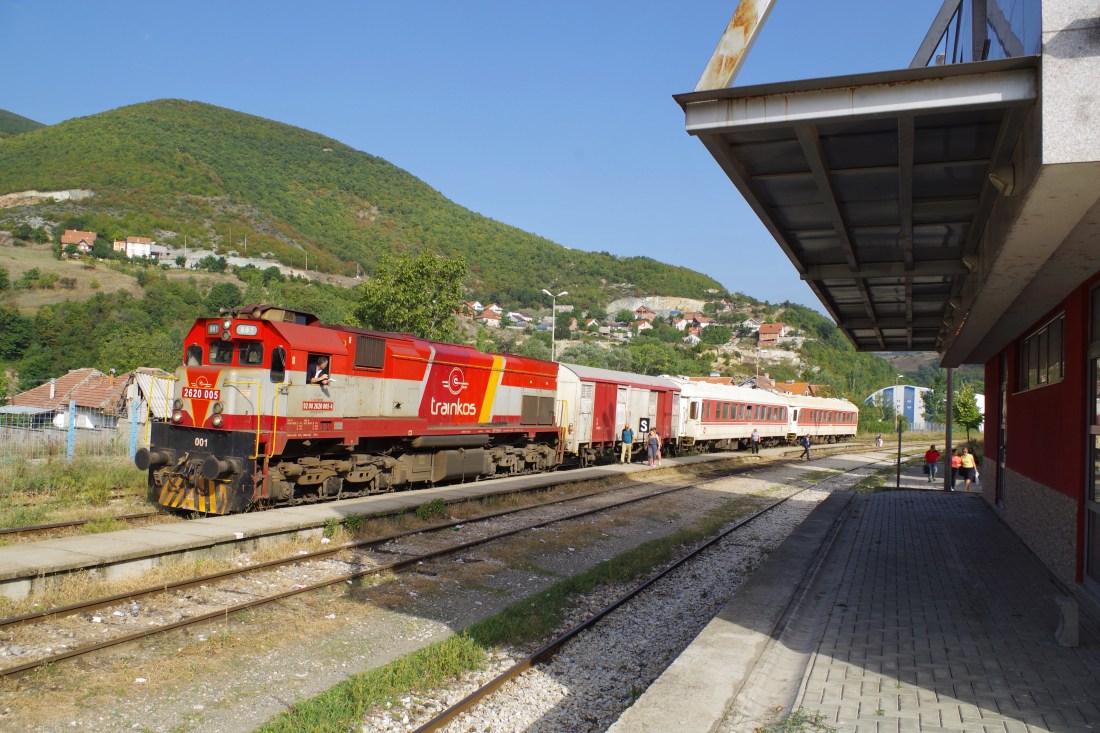
2620 005 (ex-HŽ 2044 031) at Hani i Elizit, 20/09/15 (JW)

Standing at the erstwhile crossroads of the Yugoslavian railway network, Kosovo Polje – or Fushë Kosovë, to use its Albanian name – is a town approximately five miles west of Pristina, the capital of the disputed state of Kosovo.  It has had a turbulent past riddled with conflict – not least in the last 20 years – but, on a breezy afternoon in September 2015, it cut a peaceful figure.

Fushë Kosovë remains a railway crossroads, but its services are much curtailed from the Yugoslavian heyday – ethnic and political tensions have severed hitherto-vital links and reduced former main lines to branch line status.  One thing that Fushë Kosovë does retain, however, is a railway depot of significant size.  It is where the entire fleet of the Kosovan railway is based and maintained.

As well as maintaining the operational rolling stock, the depot at Fushë Kosovë contains a padlocked compound at its southern end, in which 20 locomotives are parked – rusty, faded, battered and derelict.  These actually hold the key to telling us a fair amount about the history of Kosovo since the war of 1998/99, so rather than a straightforward “spotters’ fleet list”, I’ll try and cover a bit more general history.

IMGP2023.JPG

2640 007 (ex-661 228) trundles into Ferizaj, a small microcosm of the multicultural state that Kosovo is – with a mosque dominating the skyline but a church steeple peeking over the trees too.  1605 Fushë Kosovë – Hani i Elizit, 17/09/15 (JW)

Kosovo, as a former territory of the Socialist Federal Republic of Yugoslavia, benefited from being a small cog in the big wheel of a relatively homogeneous Balkan railway network; Jugoslovenske Železnice (Yugoslavian Railways).  Rolling stock procurement was done on a national (i.e. Yugoslavian) scale and therefore you would not necessarily have expected to find different types of train in each republic/province.  However, the break-up of the former Yugoslavia has certainly changed this.  It’s just one more way that each republic has, consciously or otherwise, cemented its independence.

However, one thing that has all but disappeared from the public eye in most other parts of the former Yugoslavia is any trace of the JŽ logo, or indeed many reminders at all that the constituent parts used to be part of the federation with each other.  The Fushë Kosovë compound is one exception.  Here, the locomotives sit rotting, Kosovan purely by dint of being unserviceable there when the federation collapsed.  Nobody especially wants them, and in a cash-strapped environment, nobody really sees a need to spend any money on them, or more importantly, as their problem to do so.  Some of these locomotives will have not seen use since Yugoslavian days, many have certainly not seen heavy maintenance since then, as the faded painted dates on their bodysides attest.  The vast majority – if not all – will never pull a train again.

IMGP2528.JPG

Traces of Yugoslavia in the scrap line (JW)

Kosovo will be most well-known – certainly to people of my generation – as being the scene of deep-set tension between ethnic Albanians and ethnic Serbs, and most notably, the attempt of Slobodan Milosevic’s government to brutally suppress the Kosovo Liberation Army’s campaign for independence which erupted into civil war in 1998/99.  Between March and June 1999, our TV screens were full of images of the 78-day NATO bombing campaign – “Operation Allied Force” – carried out with the intention of removing Milosevic’s forces from Kosovo.  Milosevic accepted the terms of an international peace plan, and the UN deployed a security presence in Kosovo, the “United Nations Interim Administration Mission in Kosovo” (UNMIK); NATO also deployed peacekeepers – the Kosovo Force (KFOR).  KFOR supported UNMIK’s work, but, as befitted their parentage, there was no chain of command between the two.

IMGP2471.JPG

KFOR and UN logos on the side of ex-SNCF BB63018 (JW)

KFOR were up against a difficult task and it became clear that, dilapidated as they may be, the Kosovan railways would be integral to their operations.  Initially, the British Army (79 Railway Squadron of the Royal Logistic Corps) was in charge of railway operations for KFOR.

79 Railway Squadron had been present in West Germany during the Cold War which, had it turned “hot” and escalated into conflict between East and West, would have seen the squadron operate a support network of railway services using Class 216 diesel-hydraulic locomotives (on which the crews had been fully trained).  Sadly, the British Army no longer maintains a railway operating capability – if required in the future, these duties will need to be carried out by civilians instead.
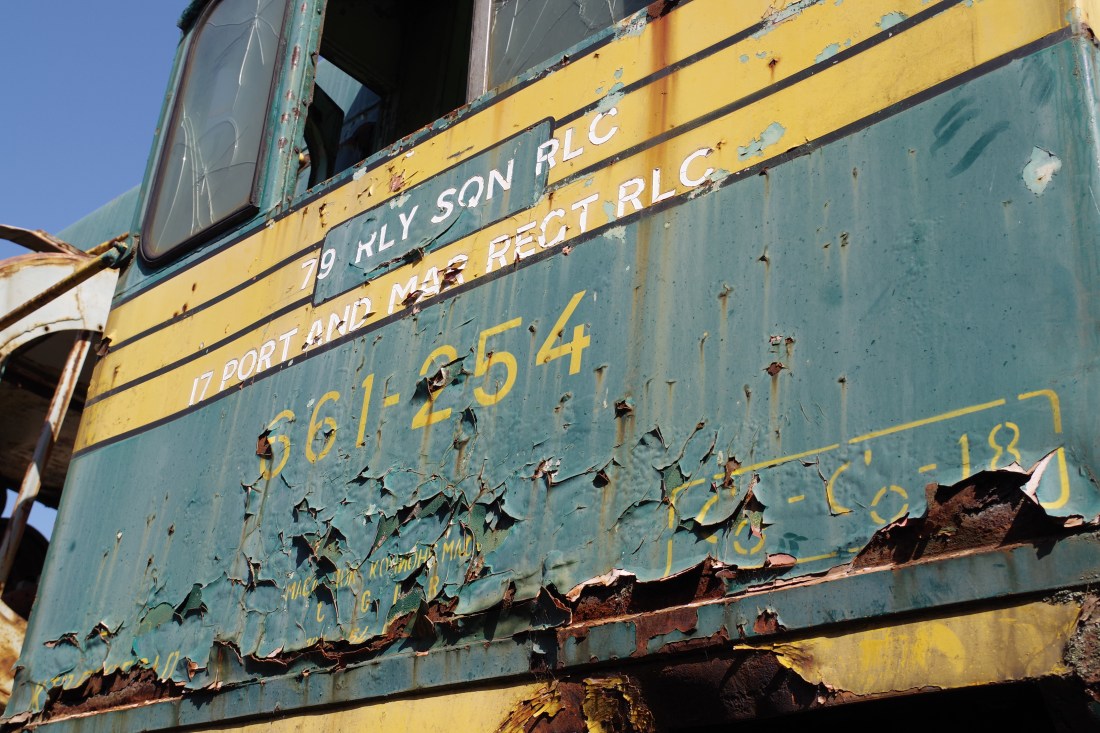
IMGP2490.JPG

79 Railway Squadron lettering as worn by accident-damaged 661 254 (JW)

The Italian Railway Regiment took over in the September, providing 120 specially-trained railwaymen and women, who were veterans of the Bosnian railway rebuilding earlier in the decade and therefore more than able to carry out what was required of them.  They brought their own train, the Rapid Reaction Train, in order to assist, which arrived in the October.

As an aside, this wasn’t the first train of the era to run all the way through to Kosovo.  A remarkable train had operated in September 1999 in connection with the KFOR operations, all the more special as it was a charity endeavour.  What was called the “Train for Life” took three ex-British Rail Class 20 diesel locomotives and their train from London all the way through to Kosovo, arriving in Fushë Kosovë – not without some resistance en route! – on 27 September.  It was conveying 15 carriages of donated clothes, food and medical supplies, as well as educational material and other items to assist with the rebuilding of Kosovo.  Key to this was the train itself.  The three British locomotives then remained in Kosovo for a while, operating trains for KFOR, eventually returning to Britain where they re-entered service on less prestigious duties.

sept-nov2005 104.jpg

Back in the UK after its Balkan adventure, 20901 is seen at Bury Bolton Street during a diesel gala at the East Lancashire Railway, 12/09/05 (JW)

The reconstruction and recommissioning of the railway network in Kosovo continued.  At this point, it’s important to point out that not all the work was done by soldiers – at all points they were assisted by railwaymen who had previously worked for the JŽ and gave their labour for free.  In the same way that railwaymen have in divided communities the world over, from Belfast to Berlin, ethnic Albanian railwaymen worked alongside ethnic Serb railwaymen – the common bond of the railway proving strong.

Piece by piece, the damaged and severed railway lines were brought back into use, predominantly for the transportation of supplies (both of a construction and a humanitarian nature).  As well as assisting in the general rebuilding of Kosovo, this proved great for morale.  A NATO article in 1999 quoted Pejë stationmaster, Muharrem Ukaj, as saying on the event of the first train back to his station after the reopening of the line: “This is a big day.  I am full of feeling, almost about to cry”.  The recommencement of trains was one very forceful sign that life might be returning to normal (whatever “normal” was).

In December 1999, the railways were opened up for the use of civilian passengers – for free; 20,000 people travelled in the first three months.

UNMIK’s mandate was, and is, “to help ensure conditions for a peaceful and normal life for all inhabitants of Kosovo and advance regional stability in the Western Balkans”.  This included the eventual transition of the management of the railways (along with other services) back to civilians.  The operation of the trains remained under the control of KFOR, until it was handed over to UNMIK in March 2001, and then on to local civilian management.

Kosovan Traction Policy

One notable thing about Fushë Kosovë, and the Kosovan railways in general, is the remarkable variety of rolling stock that can now be found there.  This can largely be attributed to KFOR.  Only three ex-JŽ locomotives were fit to be used for KFOR’s post-war railway operations.  All of the others – which remain in the compound – were simply no prospect for renovation, having stood neglected for too long, or suffered severe mechanical failure or damage in the past (or both!).

It was therefore up to KFOR (and, it transpired, its successors) to source alternative rolling stock to use.  Some of the nations working as part of KFOR came up trumps here.  Locomotives and railcars were donated or borrowed from service in the UK, France, Italy and Germany; although it followed that as these were the ones most easily spared from their “day jobs”, they were generally near to the end of their service lives or already surplus to requirements.  The British and German rolling stock was repatriated for further use, whereas the French and Italian rolling stock is still at Fushë Kosovë – depressingly, it was used until it broke down and then was unceremoniously dumped amidst the weeds, its purpose served.
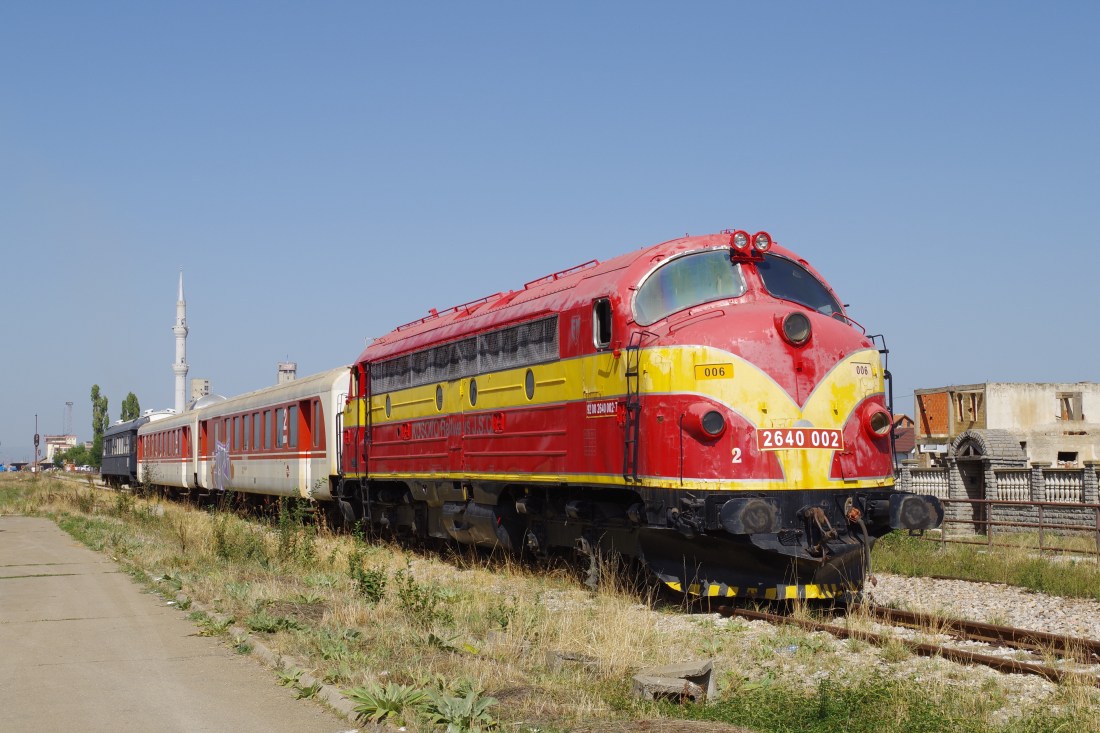
IMGP2458

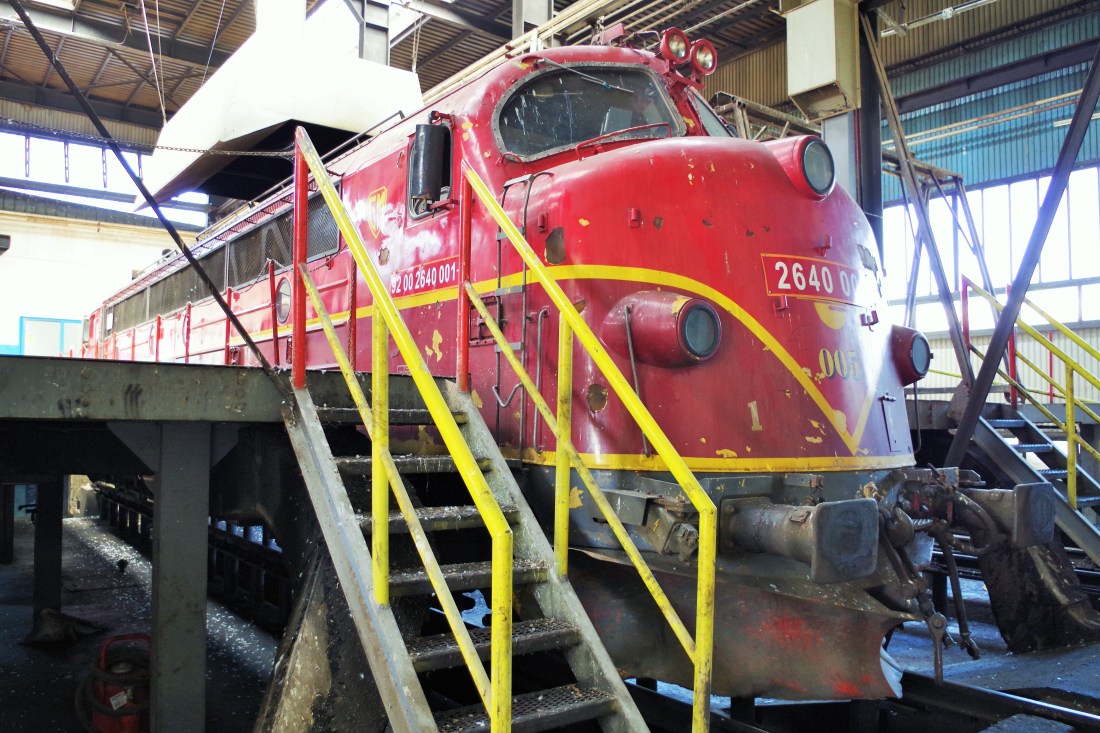
Ex-Norwegian NoHAB Di3.633 (now 2640 002) at Fushë Kosovë (JW)

Four Norwegian Di3 NoHAB diesel locomotives were donated to Kosovo as “start-up aid” in 2001.  These, too, are thought to all now out of service (although the former Di3.641 has been reported in limited use recently).  In addition, a fairly extensive amount of Swedish rolling stock was acquired towards the middle of the decade (mainly railcars and carriages, and a shunter).  The network appears to go through cycles of acquiring another country’s cast-offs, using it until it breaks, then repeat ad nauseam. This may seem wasteful on the face of it, but it makes commercial sense for such a small, cash-strapped organisation to operate in this manner – especially if it can negotiate to acquire the replacement stock as an economic donation.
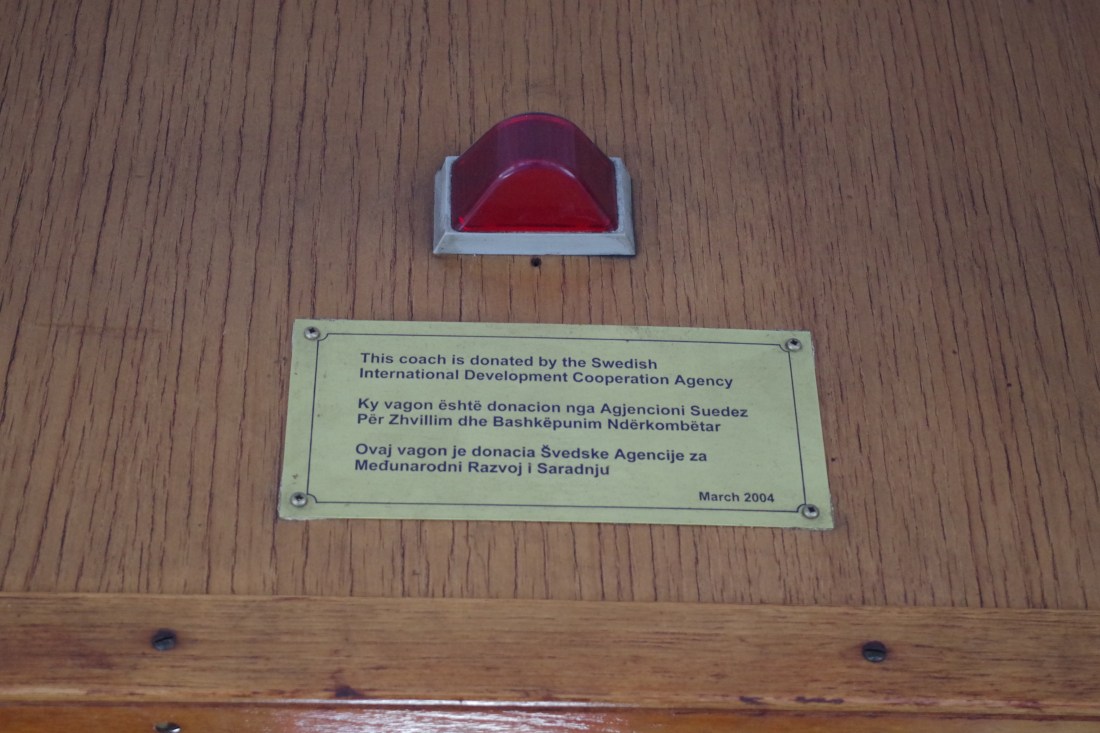
IMGP2055.JPG

A plaque inside ex-Swedish carriage no.5163 denoting its heritage (JW)

Kosovo declared their independence from Serbia in February 2008, and although this has not been universally recognised, it certainly did mark a watershed in the evolution of the former Yugoslavia.  “The youngest country in Europe” certainly feels as if it is developing, and although parts of it seem crushingly down-at-heel, its people are on the whole positive, the younger generations multi-lingual and technology-literate with a clear yearning to better both themselves and their environment.

It would be misleading to intimate that Kosovo has been a calm place since the end of the civil war, over 17 years ago.  Violent clashes are frequently seen in response to what might be seen by outsiders as relatively innocuous stimuli.  Some claim that Kosovo is a hotbed of Islamic extremism and recruitment for Isis; although it is considered as one of the most pro-American societies in the world, its citizens still grateful for NATO’s efforts to remove the Serbian oppressors in 1999.  One thing is for certain, Kosovo has changed much for the better since Pristina was a daily fixture on the TV news, but it will continue to develop, and the manner in which it does so remains to be seen.

The majority of these locomotives have remained largely untouched in their compound through numerous conflicts and changes of ideology.  Ultimately, I suspect that they will stay there until such a time as the price of scrap metal picks up.  However, until that time, a small snapshot of both the former Yugoslavia, and the collective effort to help rebuild Kosovo after the civil war, will continue to decay in a padlocked compound in Fushë Kosovë.

IMGP2072.JPG

2640 003 (ex-NSB Di3.641) on a Mercia Charters railtour, 18/09/15 (JW)

Locomotives in Kosovo

For a photographic summary of the locomotives currently to be found in Kosovo, please click here (Part 1 – ex-JŽ GM diesels); here (Part 2 – other ex-JŽ locos); and here (Part 3 – imported and new traction).

Additionally, the following locomotives were provided for use in Kosovo, but have now returned to their home countries.

BR Class 20 – 20901, 20902, 20903

DB Class 202 – 202 318, 202 432, 202 516, 202 613, 202 615, 202 637, 202 658, 202 786

Saturday 7th October 2017 – Norwegian NoHAB power to Åndalsnes

DSC_0273.JPG

The “‘Stålvogntoget” is ready for departure from Åndalsnes. Photo: Mette Larsen

Saturday 7th October 2017 sees a very interesting railtour in Norway using classic diesel traction.

The Norsk Jernbanemuseum are taking their class Di3 loco, Di3.642 from Hamar to Åndalsnes and return.  The timetable will be published on their website as soon as it is available, but the intention is to have a departure from Hamar at the very sociable time of 09:30, returning around 21:00.

Fares are 600 NOK (£59) for adults and 400 NOK (£39) for children – fantastic value for a return journey that is in the region of 420 miles.  Tickets are available by sending an email to post@norsk-jernbanemuseum.no, and are valid for entry to the museum itself (also at Hamar) on the Sunday.

The Locomotive

Di3.642 is one of the 35-strong Di3 class of 1,750hp General Motors 567 series-engined diesel-electrics supplied by the Swedish firm of Nydqvist & Holm AB (NoHAB) to Norges Statsbaner (NSB; the Norwegian State Railways) between 1954 and 1969.  This well-loved class were loyal servants to the Norwegians, being finally withdrawn at the turn of the century.

Di3.642, built in 1960 and withdrawn in July 2000, is one of the three members of the “Di3b” subclass which were built with an A1A-A1A wheel arrangement (as opposed to the Co-Co Di3a), and were longer, heavier and faster than their forebears. They were actually built for the Finnish market, but the Finns never took up the order.  Di3.642 is unique, however, in being the only one of this subclass still to remain in Norway; the other two – Di3.641 and Di3.643 – now eking out their existence in Kosovo.

Di3.642 will have a good opportunity to sing as it will be hauling load five – carriage numbers BF14 21728, B5-2 26021, B3-2 25579, BC5 26029 and FR3 21265.

The Route

To those of us who live in areas where a scenic railway can often be defined by a single feature along its length, it is perhaps difficult to imagine a route which consists of 70 continual miles of such features!  Indeed, the route from Dombås to Åndalsnes – the Raumabanen – has been named by Lonely Planet as the most scenic in Europe.

This is traditional Di3 territory, and the climb out of Åndalsnes – situated right at the edge of a fjord – is quite a steep one, soaring to 2000ft above sea level in little over 30 miles.  Sadly, however, the route no longer has any loco-hauled passenger trains, so this is surely a perfect opportunity for locomotive enthusiasts to travel over it.

tnDSC03534_fargeredigert.jpg

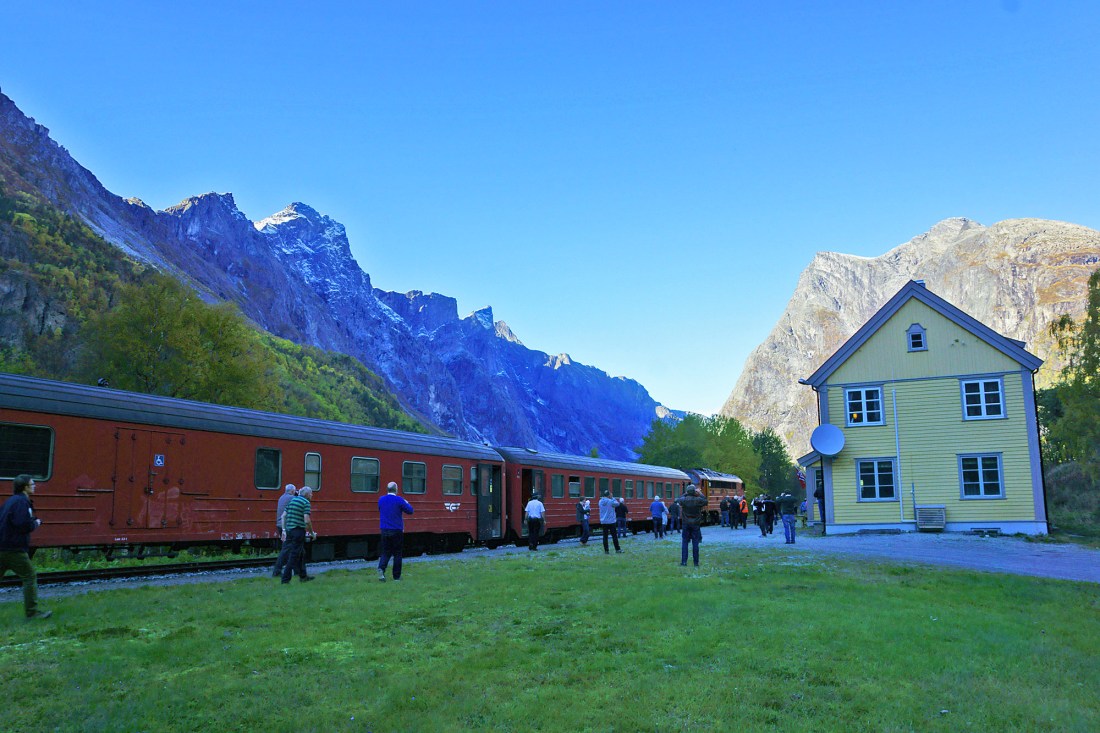
On our way to Åndalsnes. A short stop at Marstein station with the famous “Trollveggen” in the background. Photo: Kjetil Naess

It is the intention for this special train to have a number of photo stops along the way, to take full advantage of this.

Getting There

Norway may seem like a far-off land to those of us in the UK, but it is actually less than an hour’s flight from these shores!  Admittedly I am talking about the flights from Aberdeen to Bergen and Stavanger, but this route to Norway may interest you if you combine it with a northbound Caledonian Sleeper.  There are, of course, direct flights from most other sizeable UK airports.

The projected times for this railtour are superb, in that it should be possible to reach it by train from Norway’s capital city of Oslo (on the 07:34 departure) and connects back into a train back there at night (22:07) – both with a journey time of about 80 minutes.  However, if you intend to stay in the Hamar area, the museum recommend referring to this website: http://www.hamarregionen.no, which I echo.

This tour promises to be very popular – I am already aware of at least two British enthusiasts who have decided to go since I first put some information out about it! – so get your bookings in soon!


My sincere thanks to Mette Larsen and the Norsk Jernbanemuseum for the information on this event, and their assistance with this article.

10 years ago…

Switzerland 07 283

BB15024, Paris Nord, 02/09/17 (JW)

This relatively unremarkable photo of BB15024 on the blocks at Paris Gare du Nord was taken 10 years ago this week – Saturday 2nd September 2007.

What makes it noteworthy is that I didn’t intend to be there. In fact, I didn’t even intend to be in France. This train was the Hamburg-Paris overnight, which after five consecutive overnights mainly chasing 218s in Germany, I was using as my taxi from Hamburg to Brussels, for my pre-booked Eurostar back to Waterloo, home for a de-rance and then a ticket for Aston Villa v Chelsea… What could go wrong?

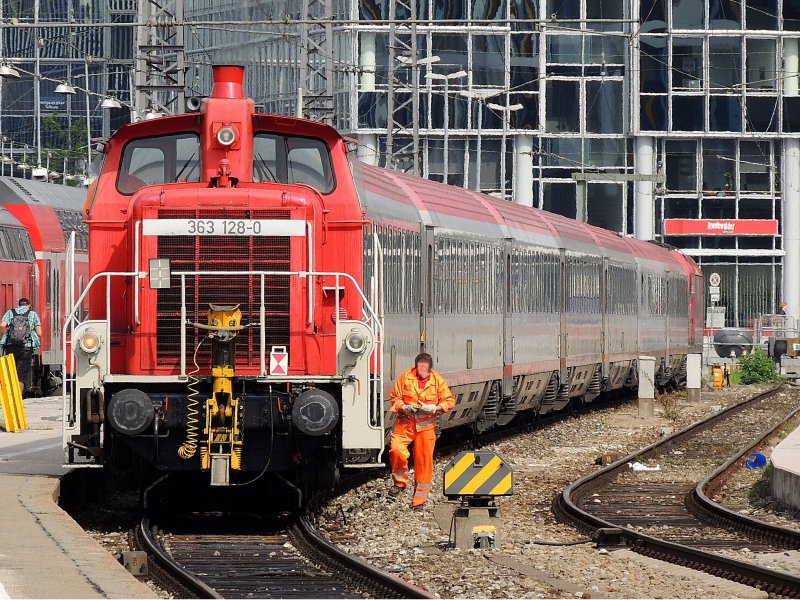
Anyway, a DB class 101 powered us south from Hamburg to Dortmund, where I ensured I was awake to see 363 128 shunt our portion onto the coaches from Berlin. We were then 120-powered via Mönchengladbach to Aachen. I again ensured I was awake to see not only our relieving Belgian loco (2705) but also our banker, which was the big Ludmilla 241 805 (ex-232 284) and to walk to the far end of the train to enjoy the Kolomna sounds as it gave us a good shove up to Aachen West. After grabbing a bit of a cat nap, I again made sure I was awake at Liège to see 1954-built 2229 buffer up to the rear of the train to bank us away. I then got my reading book out as we sped west through the darkness, to make sure I was awake to get off at Brussels…

…I woke up to the sound of a loud “clunk”. My book was was on the floor, broad daylight illuminated the compartment and the word “Quévy” was sitting outside the window… Bowled!! The clunk had been the shackle as 2705 was removed at the Belgian/French border – I’d slept completely through Brussels and out the other side. Not stopped at a platform, I was unable to get off, and was then trapped seething on board the train as BB15024 backed on, to take us non-stop the last 150-odd miles to the French capital. My move was in tatters and it was only through the booking office staff taking pity on such gormlessness that I got home via Eurostar with minimal issues.

I missed the Villa win 2-0 though!

In retrospect, it saddens me most that such traction variety that we took entirely for granted is now a thing of the past. In one seat, over the course of only a few hours, I was powered by 7 different locos – from modern high speed electrics, to elderly post-war machines, to 4000hp freight diesels, to shunters. Even some of the route that my overnight traversed is no longer used by passenger trains. Banking and shunting locos remarshalling passenger trains are virtually unheard-of in Western Europe these days.

Locomore – A German Open-Access Operator

182517_Stuttgart Hbf_110217_J Wilcox

182 517 at Stuttgart Hbf with the Locomore service to Berlin, 11/02/17 (JW)

Today, Thursday 24th August 2017 has seen the recommencement of an interesting loco-hauled service in Germany, which has not run since May.

The instigation of the “Locomore” open-access service from Stuttgart to Berlin and return in December 2016 was especially noteworthy as it was crowdfunded; the first railway operation of this type.

Running via Heidelberg, Darmstadt, Frankfurt-Süd, Kassel, Hannover and Wolfsburg, the operation consists of one out-and-back diagram running Thursdays to Sundays inclusive (LOC1818 06:21 Stuttgart Hbf to Berlin Lichtenberg and LOC1819 14:28 return).

From its introduction on 14th December 2016, the service was notable for being frequently reported as being fantastic from a customer service perspective, but also being quite poorly loaded, although this was improving as the service became better-known.

Motive power has always been provided by Class 182 (Siemens “Taurus”) electric locos from Hector Rail (in turn hired by them from MRCE Dispolok).  The locomotives to work the train were (in numerical order): 182 501, 182 509, 182 517 and 182 534.  182 509 is notable as the loco painted in the “Pan-European Picnic” livery; however, both it and 534 have now left the Hector Rail fleet.  Locos would stay with the train sometimes for months on end!

DSC02107 (2)

182 509 sits on the blocks at Stuttgart Hbf, 05/05/17 (JW)

Unfortunately, in May 2017, Locomore GmbH & Co. KG filed for insolvency and the operation ceased, with the locos going back to Hector Rail and the stock heading for store at Neustrelitz works.

Happily, LEO Express (the Czech open-access operator known for running Stadler FLIRT EMUs mainly between Praha and Bohumín) has acquired the operation, and as of today, the service has restarted – using the same paths, locos and carriages.  The loco on LOC1819 from Berlin to Stuttgart today was, again, 182 517!

Hopefully this interesting service now has a stable and successful future ahead of it.

Sunday 13th August 2017: Diesel Running Day at Stoomcentrum Maldegem

DSC03100 (2)

23 British enthusiasts turned out to ride behind the diesels of Stoomcentrum Maldegem – unfortunately, not all of them are in this picture as some had already gone for a ride behind the steam loco (JW)

The first European heritage diesel haulage opportunity which I organised was on Sunday 13th August 2017, at the Stoomcentrum Maldegem in the Oost-Vlaanderen area of Belgium.

Organised to coincide with the Festival at the Chemin de Fer du Bocq in the south of the country, this was a relaxed affair that allowed participants the opportunity to have travelled behind an impressive total of 9 different classes of diesel loco in Belgium over the two days (with footplate rides available on a 10th).

DSC03110.JPG

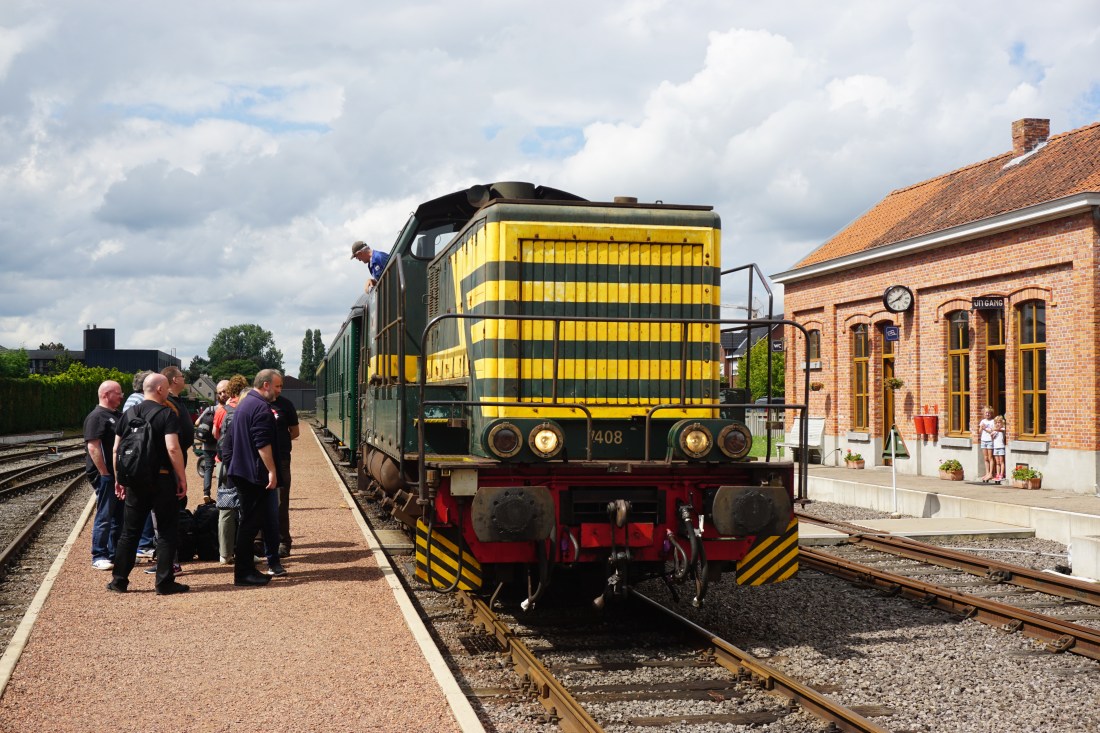
The railway was accommodating enough to agree to replace the booked diesel railcar with their class 74 and class 80 diesel locomotives sandwiching two carriages on the first round trip of the day.  The 11:30 departure time meant that it was possible to easily reach Maldegem via public transport from all over Belgium (regardless of where the previous day’s Bocq attendees spent the night), and also gave ample opportunity to get home to the UK before the end of the day.

In addition, the railway was using Avonside-built 0-4-0ST steam loco “Fred” (formerly of Buxton Quarry) on the booked steam diagram, along with a Hanomag 0-4-0WT on the 600mm narrow gauge line.

23 British enthusiasts visited Maldegem purely because of the use of the diesel locomotives, which meant that €276 extra reached their farebox – supplemented by sales of souvenirs, and not least the beers and refreshments that the railway had kindly laid on for us on board the train!

DSC03080.JPG

The railway has a third ex-SNCB diesel locomotive – diminutive General Motors-powered “locotractor”, no.9131.  This cannot haul passenger trains, on account of having no train brakes.  However, our new friends at the railway were kind enough to have placed it near the station for photographs, and then provided it for footplate rides upon our return from Eeklo.  9131 took interested participants up to the carriage shed, and we were treated to a brief guided tour of the rolling stock that we would not otherwise have seen.  One of these was the now-unique Flanders-built standard gauge steam loco, 0-6-0 no.41.195, built in Tienen in 1910 to a distinctly Scottish-flavoured McIntosh design – which the railway is trying to raise funds to one day restore.  This will form the basis of a future article on this website – although the main focus of this site is heritage diesels and electrics, I would dearly love to see this important locomotive one day run again.

As a token of our appreciation of the railway “going the extra mile” for us and using the class 91, we conducted a whip-round and were able to present them with an extra €100 before we left.

DSC03105.JPG

All in all, our brief visit to the railway led to them receiving at least €400 extra cash on the day, for what I hope was relatively little (but all very much appreciated) extra effort on their part.  The opportunity to travel behind diesel locomotives – no matter how “ordinary” – is something that British enthusiasts will certainly support and, importantly, pay for.

Every single person went away extremely happy, impressed and appreciative of the SCM, its people and rolling stock.  Many of us are already making plans to attend their steam festival in 2018, which is held in early May, and I would certainly encourage you to make a trip there as part of a visit to Belgium.

Haulage Opportunities

260.040 (ex-8040) – 11:30 Maldegem – Eeklo SCM (7408 on rear)
7408 – 12:20 Eeklo SCM – Maldegem
9131 – cab rides within station limits at Maldegem
7408 – 14:40 Maldegem – Eeklo SCM
260.040 (ex-8040) – 15:20 Eeklo SCM – Maldegem (7408 on rear)

My sincere thanks to Koen, Rik and Jan at Stoomcentrum Maldegem for their assistance in providing us with a truly fantastic day out, and to those of you who supported it.

Q&A – August 2017 Interrail ideas

IMGP2438

James is travelling around Europe on an Interrail ticket from 7th to 14th August 2017 and has asked for some pointers on interesting routes and traction to include in his itinerary.

A week-long Interrail ticket with the flexibility of travelling anywhere in the continent is a fantastic thing to have.  One of the defining moments of my life was as the stereotypical backpacked teenager, walking out of Paris Gare du Nord with the endless possibilities of travel to, from and through 30 countries that my ticket afforded me.

It’s purely a personal view, but I’ve always preferred to maximise haulage and travel when I am on rovers such as this, rather than to go spotting or photographing whilst I have a fairly expensive ticket burning a hole in my pocket.  Similarly, I’ve tended to shy away from “insect leaps” with the sole aim of travelling behind as many locos as possible whilst on global Interrails, preferring to make longer journeys over interesting routes that don’t have cheaper ticketing options for another day.  I also find that a global Interrail is a good way of “testing” out countries I’ve not been to before.

With that in mind, I’d recommend a fairly fast-paced adventure around the continent, not spending much time in any particular place, but taking in as much as possible in the short amount of time.

Overnight Trains

A good way to cover as much ground as possible is to use overnight trains, which both give you the “immediacy” of finishing a day in one place and being able to start the next somewhere else, and also save the money of a hotel booking.  I certainly wouldn’t recommend a week of solid overnights though – I had a phase of doing them in my late teens, and it did me no favours!  Reservations and/or supplements are compulsory on most overnights, so do check before travel with the information you get with your Interrail and/or the operator.

The amount of overnights on offer across the continent reduces year-on-year, but there are still a few useful ones.  A useful run-down of sleeper trains can be found here, although there are plenty of seated-only overnights all over the continent.  These can be entirely variable in quality, however.

One of the most interesting overnights in Europe, though, is EN300/EN301, the “Berlin Night Express” between Berlin and Malmö (Sweden), which travels on the Sassnitz to Trelleborg train ferry overnight.  The section on German metals is currently the only place to travel behind one of the 7,200hp class 155 heavy freight electrics – 155 110 and 155 159 of Wedler Franz Logistik are currently the staple motive power for these.  For the 2017 season, these replaced the previously-booked class 109 “Holzrollers” that had worked this diagram for years, as none of the 109s were serviceable – however 109-3 (109 073) had a test run with 155 159 today (20th July 2017) so this may lead to a reprieve.

The “Berlin Night Express” leaves Berlin Hbf at 19:07 on Wednesdays, Fridays and Sundays, and Malmö at 17:00 on Mondays, Thursdays and Saturdays – until 14th August.

Train Ferries

Sassnitz to Trelleborg is not the only passenger train ferry in Europe, indeed there are two others, both of which see daytime services.

The other one in the area is that from Rødby (in Denmark) to Puttgarden (in Germany), due to be replaced in the next decade by a fixed link, however the only trains that use this are now DMUs; those on the København to Hamburg route.  However, on weekends, Puttgarden also sees a loco-hauled service on Saturdays and Sundays – a DB class 218 works the 08:21 and 14:26 from Hamburg Hbf, returning from Puttgarden at 11:10 and 17:10 – although it must be said that this stopping train across the slow-paced flatlands of Schleswig-Holstein does not exactly give the loco the opportunity to stretch its legs.

In theory, you could travel on the Friday night Berlin to Malmö, arriving in Sweden on the Saturday morning – then crossing to København in Denmark before catching an ICE via the Rødby train ferry to Puttgarden, dropping back onto the 17:10 Puttgarden to Hamburg 218.

The third European passenger train ferry runs between Villa San Giovanni in Italy and Messina on the island of Sicily.  Due to the time involved in getting to the very foot of the Italian “boot” and back to sample it, I might not recommend it for a week’s global Interrail, but it is still well worth experiencing.

Interesting Haulage

In terms of traction, it would be easy to say “well, all the best stuff is withdrawn now” and indeed that sentence could probably have been said (with some truth) for the last 50 years.  My honest opinion is that there is still plenty to go and experience on the continent – indeed, that’s the reason I set this website up.

I shan’t cover absolutely everything, as that would not be possible, but I will pick out selected highlights that I feel should be covered in a week’s Interrail.  If you think I’ve missed anything, please comment below!

In terms of heritage diesel and electric loco haulage, do check out the haulage calendar on this very site, which lists a number of railtours, galas and events that are happening – although, again, if I was in possession of an Interrail I’d probably prefer to spend my time travelling on trains it was valid on, rather than specials.  However, I would strongly recommend the Bocq railway diesel gala on 12th and 13th August in Belgium, and you can also join us for 7408 and 8040 at the heritage railway at Maldegem on the Sunday morning.

James expressed a particular interest in sampling the DB class 218 diesel-hydraulics, and I can’t recommend the 06:55 Hamburg Hbf to Berlin Ostbahnhof highly enough.  This is a temporary diagram running to the end of August 2017 (excluding Sundays) and really gives the locos a chance to show what they’re made of.  It’s definitely the best diagram to experience them on; they can also be found on Intercity workings between Itzehoe and Westerland, the weekends-only Puttgarden regional diagram as mentioned above, trains between Ulm and Lindau, Eurocity workings from Lindau to München, as well as one or two other routes where they either are not taxed or can be hard to pin down at times.

Another diesel loco type with a sizeable following amongst British enthusiasts is the class 749/751/752 of the former Czechoslovakia.  In terms of passenger diagrams, there is now very little.  The best bet is the “Rakovnický rychlík” Saturdays only service: 08:42 Praha hl n to Rakovník (R1581) and 15:32 return (R1580), which has produced the booked loud 749 on all but one occasion that it has operated so far this year.  749 107, 121 and 264 also see limited use around Praha, mainly at weekends – link to spreadsheet here.  749 259 has also recently seen use on a daily diagram for Regiojet between Komarno and Bratislava in Slovakia, however it looks as if motive power for this has reverted to a KDS “goggle” now, with 753 197 hauling the train on 24th July 2017.

Heading south-west, the Iberian peninsula has a lot of interesting diesel loco haulage to offer you.  This summer sees a diagram for the English Electric class 1400 diesels in Portugal, along with a turn for metre-gauge Alsthom diesel no.9004 on Saturdays only not too far away.  Spain still has a fair amount of main line long-distance diesel loco haulage too, which can be sampled on the way to and from Portugal quite easily.

The south-east of the continent also has plenty of traction interest, although given the distance and time involved in getting there and back, I might not recommend much of an excursion into the Balkans for a week’s Interrail.  However, it’s difficult not to endorse the Croatian class 2044 GMs on the scenic route out of Split.

Interesting Routes

This leads me on nicely to the scenic routes of Europe.  Sadly, the “perfect marriage” of fantastic scenery and decent diesels does not occur in many places on the continent these days; the Split route probably being the best remaining example.

This list of scenic rail routes in Europe is hard to argue with, many of which do see loco haulage, but solely of the electric variety.

Switzerland is often described as the most scenic country in the world, and it is home to plenty of scenic railways, many of which are narrow gauge – although check if your Interrail is valid if you intend to travel on any of them.

I would be tempted to head to Scandinavia, as an astonishingly scenic region, but also one that is notoriously expensive to travel in whilst on “normal” tickets, and also one where long distances are involved.  A possible itinerary would be to travel up the Nordlandsbanen in Norway, 453 miles from Trondheim to Bodø, in the Arctic Circle with GM Di4 diesel power, then by bus or plane to Narvik, before returning electrically-hauled through Sweden.  Getting there and back would, however, take up most of your week – although it would be a proper Interrail adventure.

Whatever you end up doing, please post what you see and travel behind to the various appropriate gen groups!


If you’re enjoying the content of this website, please could I invite you to have a look at how you could support it?  Thanks!

Kosovo’s locomotives, in photographs (Part 3 – imported and new traction)

IMGP2370

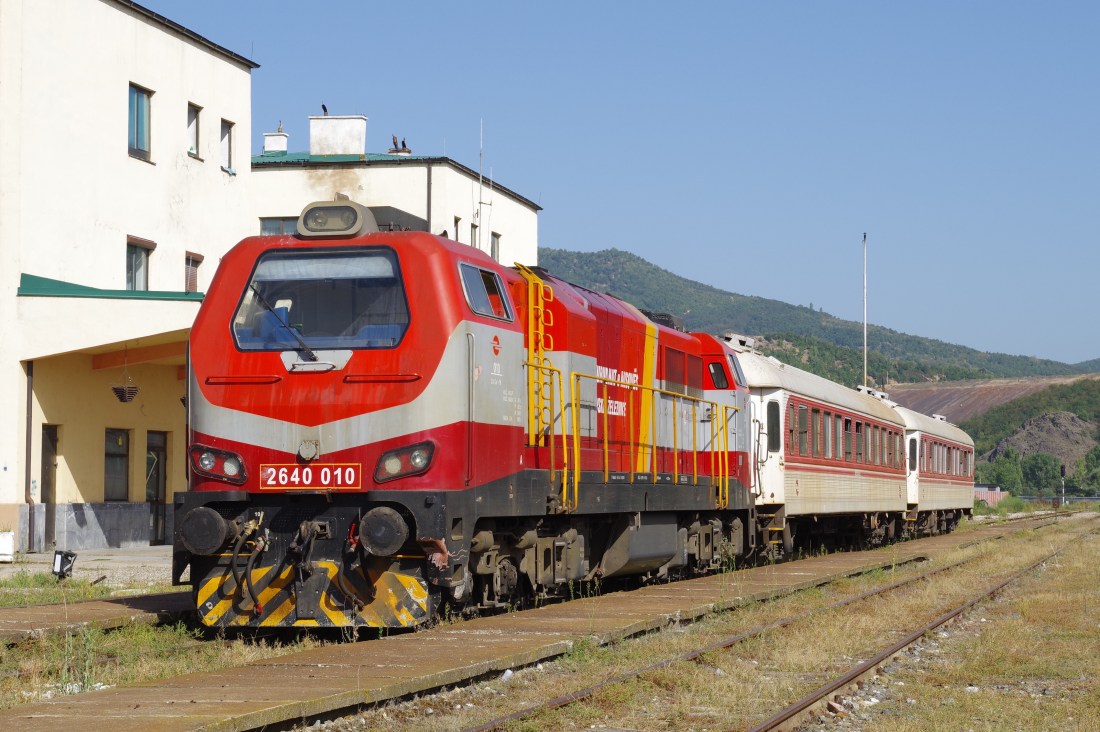
2640 010 in the divided town of Mitrovicë, 19/09/15 (JW)

In Part 1 and Part 2, we looked at the locomotives of the former Jugoslovenske Železnice (Yugoslavian Railways, JŽ) that are now to be found in Kosovo.  However, as I will explain in a future article, political developments in the Balkans in the 1990s directly led this small disputed territory to now possess what may well be the most diverse selection of locomotives to be found anywhere in Europe.

Locos now to be found in Kosovo hail from Norway, Sweden and France – and that’s not to mention the British and German diesels that have spent time there in recent decades, as part of the combined effort to rebuild post-war Kosovo, nor the German V60 shunters that were bought by JŽ before the break-up of the federation.  There are also a handful of locomotives that have been delivered to Kosovo from new.  Here is a photographic record of them, all taken 17-20/09/15.

Ex-NSB Class Di3

2640 001 (ex-Di3 619)

IMGP2543

2640 002 (ex-Di3 633)

IMGP2458

2640 003 (ex-Di3 641)

IMGP2175

2640 004 (ex-Di3 643)

IMGP2536

Ex-SJ Z65

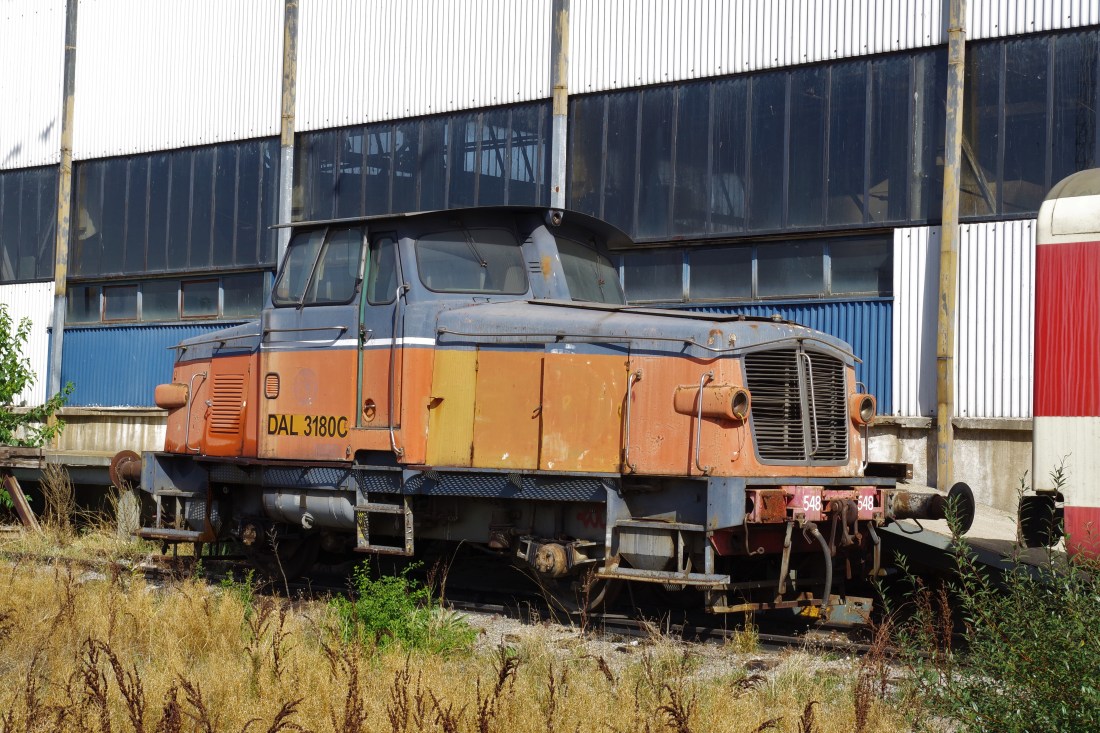
DAL 3180C (ex-Z65 548)

IMGP2555.JPG

Ex-SNCF BB63000

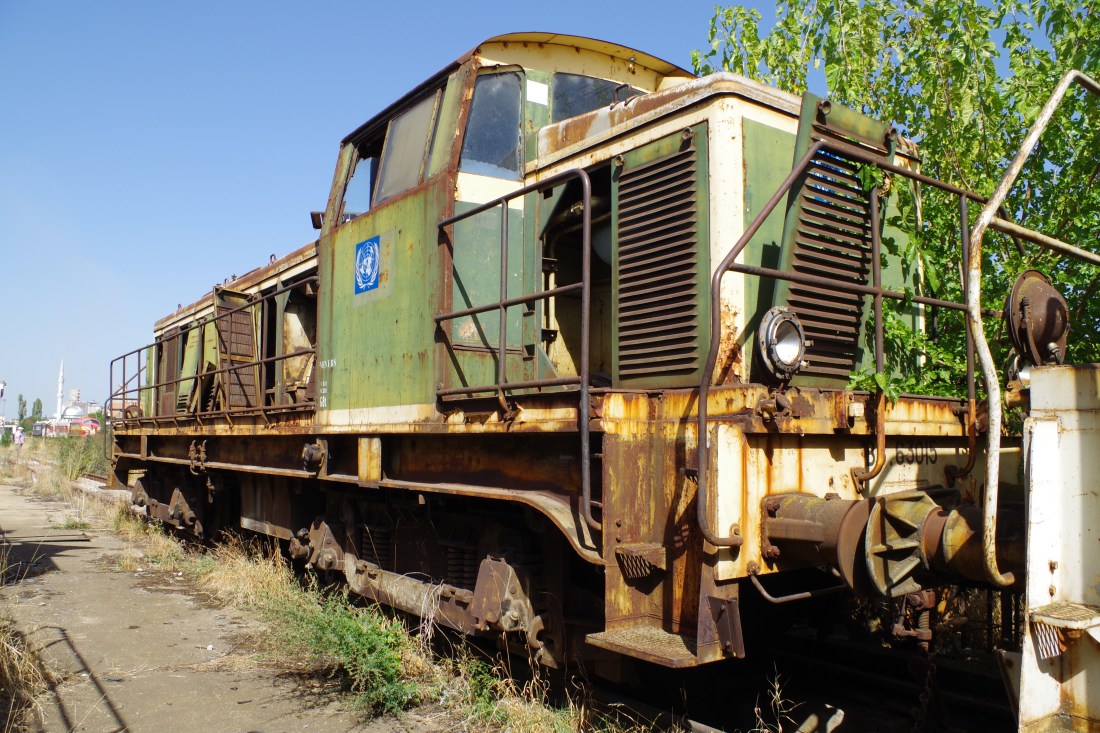
BB63015

IMGP2510.JPG

BB63018

IMGP2514.JPG

New build JT38CW-DC

2640 010

IMGP2370.JPG

New build G1700BB

2710 009

IMGP2577.JPG

New build MDD3

2760 001

IMGP2235.JPG

2760 002

IMGP2537.JPG


If you’re enjoying the content of this website, please could I invite you to have a look at how you could support it?  Thanks!