8th October 2017: A Russian repatriate in East Germany

Important Note: This tour was cancelled on 13/09/17 due to engineering works on the route.

Sunday 8th October 2017 sees an opportunity to travel behind E77.10, a well-travelled machine that was ceded to the Russians as war reparations.

Following the end of World War 2, or specifically the Potsdam Conference that set out how the “spoils” would be distributed amongst the Allied nations, the orders of the Sowjetische Militäradministration in Deutschland (SMAD) dictated that much of the infrastructure in the Russian zone of occupation of Germany (later East Germany, the DDR) was dismantled by Spring 1946 and taken to the Soviet Union as war reparations.  Included in this was the vast majority of electrified railway – including rolling stock.  Some of these routes have remained unelectrified ever since.

Quite what the intention of this move was – apart from opportunistic cynicism on the part of the Russians – is not entirely clear.  Certainly, huge swathes of mother Russia had been devastated during the conflict – not only its railways, but much of its industrial capacity, housing and even whole towns had simply ceased to exist, and needed to be recreated almost entirely from scratch.  However, a high proportion of this German railway equipment was simply never used.  A major factor in this is that the Russian track gauge is 1520mm (as opposed to the “standard gauge” of 1435mm used in Germany) necessitating complex regauging; these machines were 15kV a.c. as opposed to the then Russian standard of 3kV d.c.; but above that, the locos and catenary simply were not suited to the harsh environment – certainly not where they wished to use it.

It had apparently been intended to use a portion of this “recovered” German equipment to build a freight-only line at Vorkuta, deep into the Arctic Circle, over 1000 miles north-east of Moscow.  The Soviets also wanted to electrify a route from Tobul to Akmolinsk in Kazakhstan with the German system.  However, it soon became apparent that there was no obvious way to generate electricity for a system in this location and/or then get it into the overheads.

In 1953, the USSR largely gave up and gave the Deutsche Reichsbahn of East Germany the opportunity to purchase much of this material back.  This they did, although a lot of it was simply no longer usable; in truth, after its thuggish dismantling in 1946 and conveyance across the continent in questionable conditions, it never would have been.  The first newly-(re)electrified route to open in the DDR was that from Halle (Saale) to Köthen, on 1st September 1955.  However, progress with re-electrification was slow until after the 1972/73 oil crisis; again, this policy had been born of Moscow, who had a vested interest in selling cheap oil to the DDR through the Družba pipeline.

It’s fair to say that there is not much detail out there on this whole story, as throughout the “DDR times” it remained something of a taboo subject; not wishing to rock the boat with the Soviets or indeed point out any flaws in their reasoning.  As such, a lot of this history has simply been lost.

What is known is that locomotives of classes E04, E44, E77 and E94 were taken to Russia, along with some class 52 “Kriegslok” steam locos and some rolling stock from the Berlin S-Bahn system.

The above is a link to a YouTube video uploaded by user SuperJanH1 of E77.10 at work in 2011.

Although attempts are thought to have been made to operate the other classes in the Soviet Union, it is thought that the class E77s were simply housed in a facility at Babushkin in the Moscow area and were never used.  42 complete E77s, plus parts of 8 others, had survived the war and were taken away; 38 returned, although only 10 were returned to DR capital stock.  These were all scrapped by 1966, with the sole exception of E77.10, which survived in use as a train heating unit at Halle (Saale).  This machine – dating from 1924 – still makes occasional forays onto the mainline at the head of railtours.

The next of these is on Sunday 8th October 2017, when E77.10 hauls a short railtour from Leipzig-Plagwitz to Altenburg and return.  Operated by the Eisenbahnmuseum Leipzig, it departs from Leipzig-Plagwitz at 09:57 for an approximately 75-minute journey to Altenburg.  During the 3 hours there, participants are encouraged to visit the Altenburger Brauerei (brewery) where a beer tasting session and food are included in the tour ticket price of €62 second class/€78 first class.  The E77 departs back at 14:00, arriving back at Leipzig-Plagwitz at 15:15.

What can you combine it with?

There are not currently any other railtours of particular haulage interest in Germany advertised to run on that weekend, but do keep an eye on the Haulage Calendar section of this website for any new additions.  (Edit 25/06/17: a tour has now been advertised with 2,500hp diesel 118 770 (ex-DB 228 770) and 4-6-2 steam loco 01.0509 fairly nearby, the previous day).

Leipzig – or “Hypezig” as it is now known in some quarters – has recently rapidly gained a reputation as Germany’s creative capital.  Indeed, Plagwitz (the suburb from which this tour runs) has been transformed from run-down industrial wilderness to arty hotspot.  The city retains plenty of history, from 16th century Renaissance architecture to the sites widely recognised as the cradle of the 1989 revolution, and it definitely works as a destination for a “normals” holiday – as does the short, destination-focused nature of this tour.


If you’re enjoying the content of this website, please could I invite you to have a look at how you could support it?  Thanks!

Summer 2017 – DB “Rabbits” return to Berlin

DSC02429

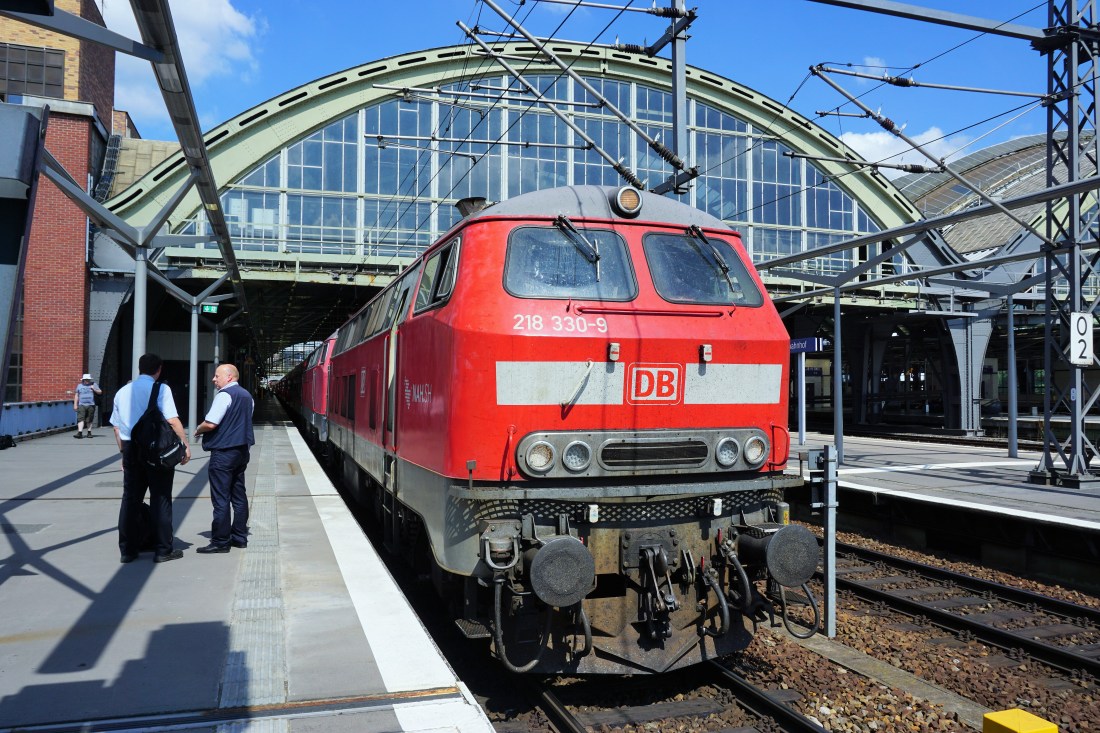
218 330 and 218 474 at Berlin Ostbahnhof, 19/06/17 (JW)

An intriguing service operated in northern Germany on selected days through Summer 2017, in some ways winding the clock back 20 years.

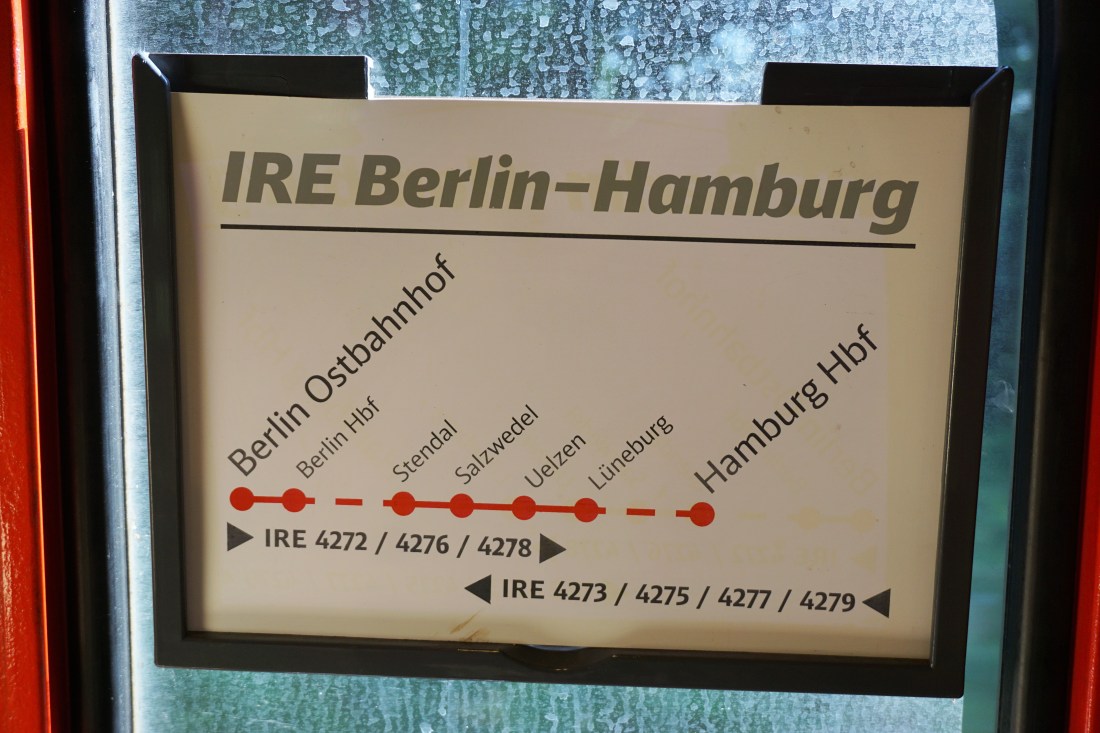
In mid-May, in a move that seemed out of the blue to many, IRE18447, the 06:55 Hamburg Hbf to Berlin Ostbahnhof, usually hauled by a class 182 electric, became a diesel diagram on Mondays only.  This is because for those days only, it was booked to run over the non-electrified classic “slow” lines between Stendal and Rathenow.  There was a recurring Sunday night possession on the Neubaustrecke which was not given up in one direction until mid-morning on Monday, meaning that single line working needed to be implemented; this train being diverted onto the non-electrified section to keep it out of the way of the ICEs.

This was a one-way diagram retaining the booked electric dead in the consist, the diesel(s) returning from Berlin to Hamburg light engine.

DSC02404.JPG

The traction

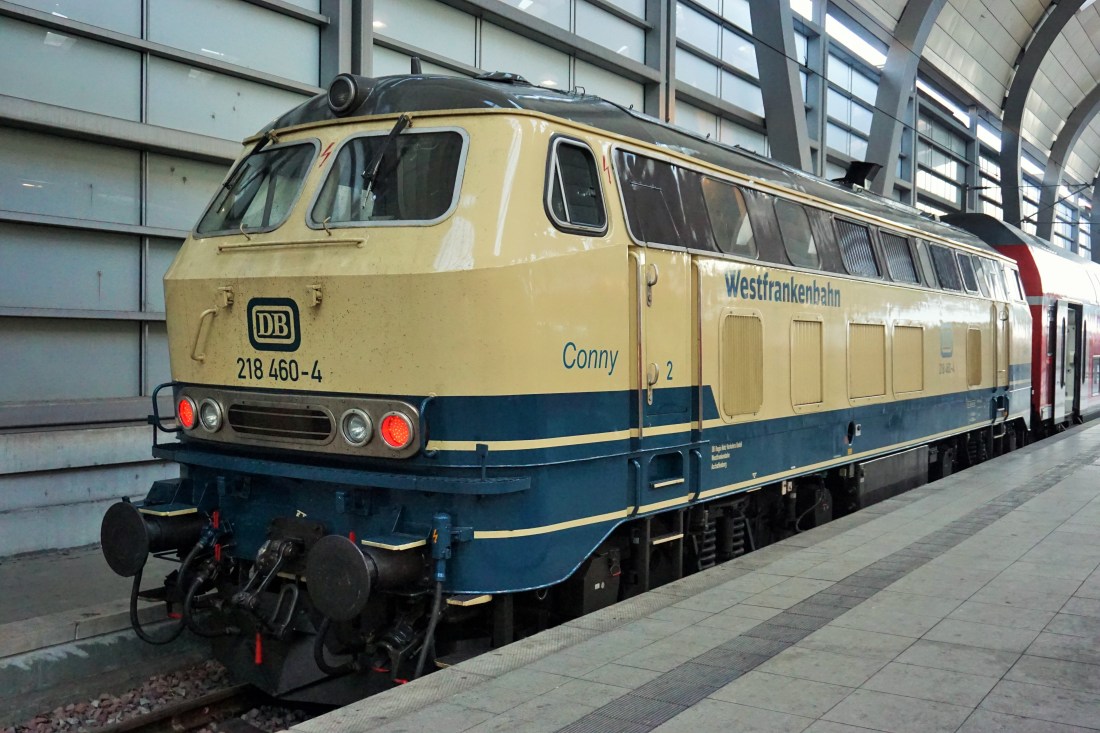
The two “celebrity” class 218 “rabbit” diesel-hydraulics – altrot liveried 218 387 of the Brohltalbahn (currently on hire to the Kurhessenbahn), and ozeanblau-beige liveried 218 460 “Conny” of the Westfrankenbahn – were moved north to Hamburg to act as motive power for these trains.

This provided a welcome return to the north for 218 460, which is “northerner” through and through, having been allocated to Lübeck depot from new in 1978 until 2007, before migrating south to Kempten.  Indeed, in 1996/97, it was numbered 210 460, denoting that it was one of the twelve Lübeck 218s renumbered into the 210.4 subclass.  The need for these came about as part of the development of the post-reunification cross-country network; DB wanted to create a Hamburg – Berlin – München InterCity axis, but the former cross-border section from Hamburg to Berlin via Ludwigslust had not yet been electrified.  Lübeck depot selected the 12 of its “rabbits” in the best condition and re-plated them from 140km/h (87mph) to 160km/h (99mph) to work this section in pairs at high speed.

Although 2017’s temporary diesel services were more sedate – and via the fairly-recently-reopened through route via Uelzen, Salzwedel and Stendal, rather than via Ludwigslust – it was still nice to be able to have ‘460 from Hamburg to Berlin once again.

DSC02398.JPG

Heritage-liveried 218 460 “Conny” at Kiel Hbf, 18/06/17 (JW)

However, ‘387 (especially) and ‘460 sadly proved somewhat less than reliable – certainly in the early days.  Ostensibly all 39 trains were meant to be worked by the pair of them, but it only made it to Berlin with the pair of celebrities (powering) four times, for various reasons.

In total, seven different 218s were used on the turn – 218 329 / 330 / 387 / 460 / 473 / 474 / 484.  Arguably the standout there was 218 474 from S-Bahn Hamburg, which – making its first passenger workings in nearly three years – was drafted in to work the train with ‘330 on 19th June 2017, and they put in an absolutely storming run, waiting time at every station along the way until being held at Rathenow to take additional passengers from a failed ICE.  218 474 took charge of the train solo the week after, arriving in Berlin less than 10 minutes late.

17th July 2017 was also lined up to see hit-listed 218 314 from Niebüll partner 218 460, however the failure (again) of the latter prior to departure time meant that by the time the defect had been diagnosed, ‘460 failed and the pair split, the train was sufficiently late to not require diesel haulage at all.  Indeed, 182 021 worked alone under its own power, and we reached Stendal after the possession had been lifted.

There were only two other occasions when the train did not enjoy the booked 218 power – 11th and 12th August 2017 – when the engineering work on the NBS was not being carried out, so there was no need to divert it.  On both dates, the train ran with just the booked 182 on the train, in the booked path and via the Neubaustrecke.

Times & Fares

This one-way 190-mile journey took just over 3 hours and definitely wound the clock back decades.  It required the locos to work at design speed for most of the way, and it was lovely to be able to sit in a compartment with an opening window behind a pair of more than 40-year-old diesels on a long distance service that late in the day.  At the time on this site, I recommended it as the place to experience 218s in 2017, and that is something I certainly stand by!

The train itself ran at an almost unsociably early hour, and short leaps were theoretically not too possible (the first stops being pick-up only and the last set-down only), but the train was best done throughout.  As one of the Berlin-Hamburg Express services, DB offered a €19.90 single fare (£17.54 at the time) – with a limited number of €14.90 fares if booked online very much in advance.  If returning later in the day (necessarily by electric), a return ticket could be purchased for €29.90 (£26.36).

If on a holiday in the Hamburg area, this was an ideal way to have a day trip to the capital, and allowed you over six and a half hours in what I believe to be the world’s most interesting city, before returning on the 16:52 with the class 182.

The route the train took is quite an interesting one.  Heading south from Hamburg, it left the main line at Uelzen and took the cross-country route through Salzwedel to Stendal.  This route – part of the former “Amerikalinie”, the erstwhile trunk route between Berlin and the great sea port of Bremerhaven and its opportunities for trans-continental import and export – was severed, literally, from 1946 as it crossed what was to become known as the Iron Curtain.  It was only reopened as a through route in 1999, and is now a fantastic bit of fast railway, although most of it is still only single track.  Even now, although the exact line of the former “inner-German border” is barely discernible, the atmosphere still feels a little different once you cross into the former DDR.

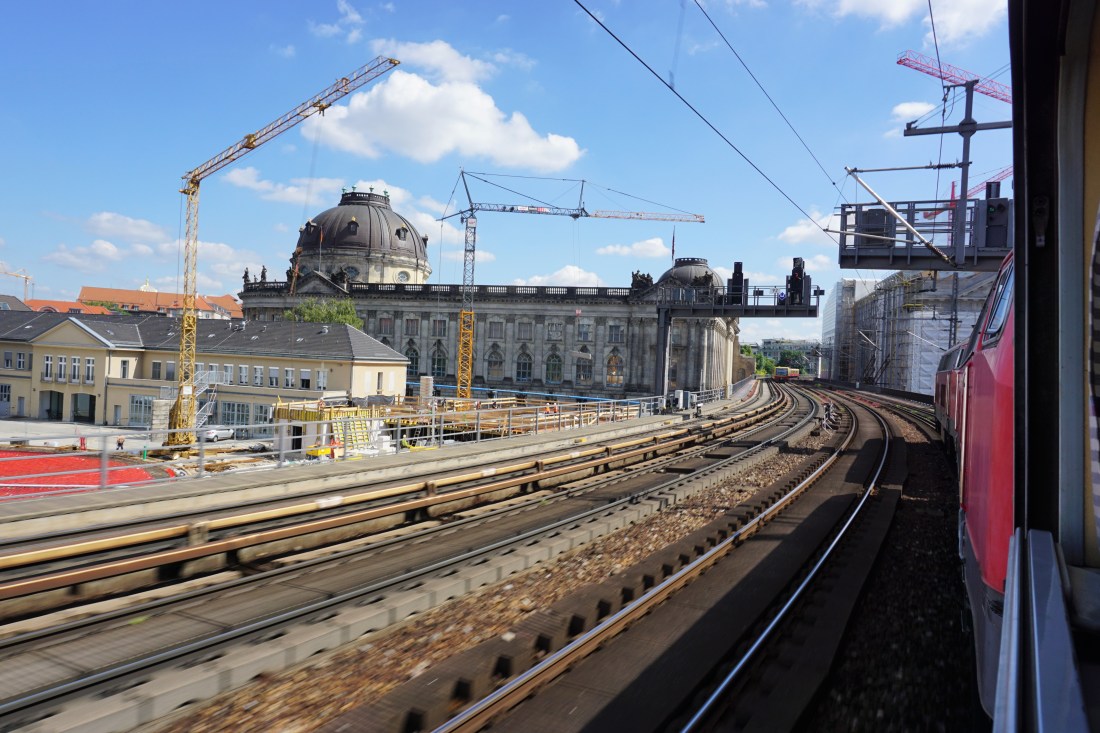
After a brief stop at Stendal, the train took line 6107, the classic route towards Berlin which is not electrified, running adjacent to the Neubaustrecke high-speed double-track railway.  It regained the electrified stretch after Rathenow, before making its grand entrance into Berlin, running right through the former West Berlin and out the other side before terminating at Berlin Ostbahnhof station, within sight of a remaining section of the Berlin Wall, at 10:11.

DSC02427.JPG

Sweeping right through the middle of reunited Berlin, along its elevated “Stadtbahn” (JW) 

Although this service was initially booked for 218 haulage on Mondays only, throughout the month of August this train was booked to be 218-hauled on Mondays to Saturdays.

Traction Log

Monday 15/05/17 218 460 218 387 failed with pre-heat defect
Monday 22/05/17 218 460 218 387 remained defective
Monday 29/05/17 218 460 + 218 387
Tuesday 06/06/17 218 387 218 460 used for Schleswig-Holstein RE services. Ran on 06/06 as 05/06 was a public holiday.
Monday 12/06/17 218 387 + 218 460 218 387 failed en route, shoved the rest of the way by 218 460
Monday 19/06/17 218 330 + 218 474 218 387 unserviceable, 218 460 on Kieler Woche services
Monday 26/06/17 218 474 218 387 still unserviceable, 218 460 on RE21602
Monday 03/07/17 218 473 + 218 460 218 387 still unserviceable
Monday 10/07/17 218 330 + 218 460 218 387 undergoing repairs at Niebüll
Monday 17/07/17 182 021 Planned for 218 314 + 218 460, but ‘460 failed before departure.  By the time they had been split for ‘314 to go alone, there was no need to diesel-haul it – ran sufficiently late to go main line from Stendal
Monday 24/07/17 218 330 + 218 460
Monday 31/07/17 218 330 218 460 failed before departure
Tuesday 01/08/17 218 330 218 460 still defective
Wednesday 02/08/17 218 330 + 218 460
Thursday 03/08/17 218 460 + 218 330
Friday 04/08/17 218 330 + 218 460
Saturday 05/08/17 218 460 + 218 329
Monday 07/08/17 218 329 + 218 460
Tuesday 08/08/17 218 460 + 218 329
Wednesday 09/08/17 218 329 + 218 387 218 460 had run north light to Niebüll
Thursday 10/08/17 218 387 + 218 329
Friday 11/08/17 182 001
Saturday 12/08/17 182 001
Monday 14/08/17 218 387 + 218 484
Tuesday 15/08/17 218 484 + 218 387
Wednesday 16/08/17 218 387 + 218 484
Thursday 17/08/17 218 460 + 218 387
Friday 18/08/17 218 387 + 218 460
Saturday 19/08/17 218 460 + 218 387
Monday 21/08/17 218 387 + 218 484 Via Magdeburg due to signal damage at Spandau
Tuesday 22/08/17 218 484 + 218 387 Via Magdeburg due to signal damage at Spandau
Wednesday 23/08/17 218 387 + 218 484
Thursday 24/08/17 218 484 + 218 387
Friday 25/08/17 218 387 + 218 484
Saturday 26/08/17 218 484 + 218 387
Monday 28/08/17 218 387 + 218 484
Tuesday 29/08/17 218 484 + 218 387
Wednesday 30/08/17 218 387 + 218 484
Thursday 31/08/17 218 484 + 218 387


If you’re enjoying the content of this website, please could I invite you to have a look at how you could support it?  Thanks!

Various dates in 2017: DB V200 class “Warship” railtours

IMGP3076

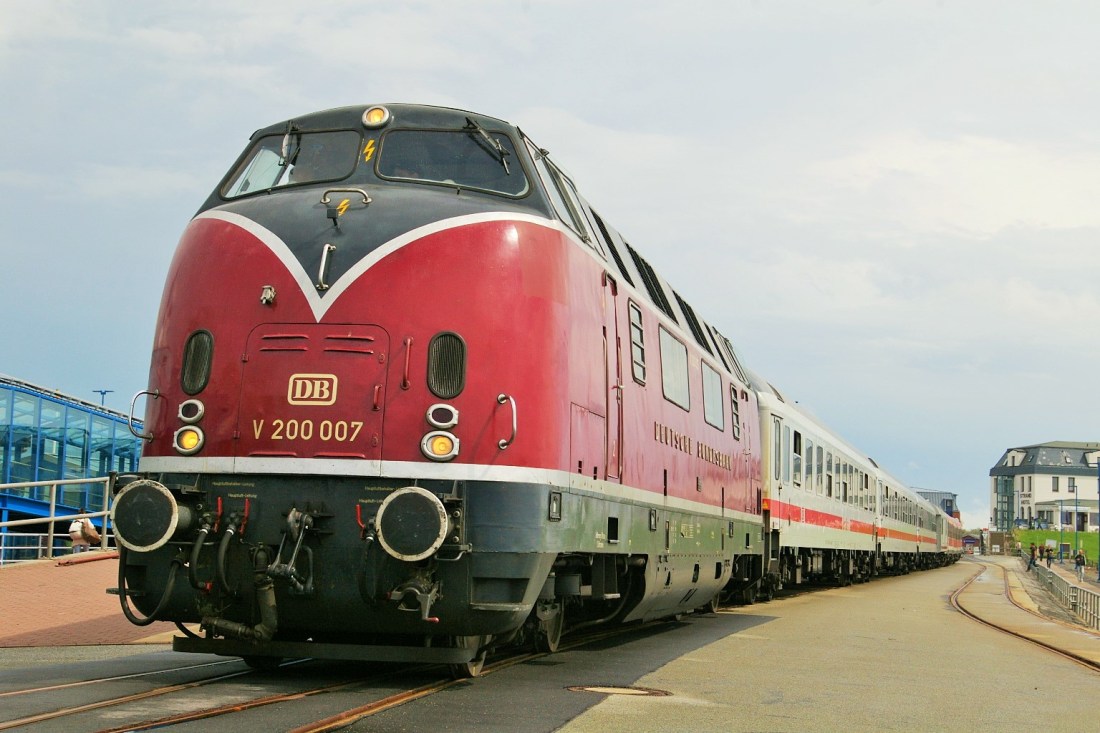
V200 007 (220 007) at Dagebüll Mole, 05/08/12 (JW)

My recent article regarding the current locations of the remaining ex-Deutsche Bundesbahn V200 class diesel-hydraulics attracted a great deal of interest.  This brief blog post will look at where and when you can travel behind them in 2017.

The two locos in operation this year are V200 033 – which is a “classic” V200 in that it retains its Maybach MD650 power units and Voith transmissions – and also V200 007 which is now Mercedes engined.

These are the tours in the haulage calendar currently advertised for their use during the rest of 2017, along with links to more information about each:-

Saturday 24/06/17

V200 033 (ex DB 220033), 06:30 Unna via Hagen, Bochum, Recklinghausen to Munster Hbf, for 78.468 (steam) forward to Emden and back, then V200 033 back to the pick-up points but in the same order as the morning, terminating at Munster, €84.  Operated by Eisenbahnfreunde Witten.  Link.

Saturday 19/08/17

V200 033 (ex-DB 220033), Nürnberg area to Chemnitz, details TBC.  Operated by Fränkische Museums-Eisenbahn.  Link.  Update 21/07/17: booking form has come out stating 216 224 to Plauen for 50 3648 forward, no mention of V200 any more.  No traincrew available for the V200.

Saturday 02/09/17

V200 007 (ex DB 220007), Lübeck to Westerland and return.  Operated by Historische Eisenbahnfahrzeuge Lübeck.  Link.

V200 033 (ex DB 220033), Recklinghausen Hbf to Cuxhaven and return, €79.  Operated by Eisenbahnfreunde Witten.  Link.

Saturday 09/09/17

V200 033 (ex DB 220033), Nürnberg via Bamberg, Gemünden, Aschaffenberg, Frankfurt Ost to Oberwesel and return.  In connection with the “Rhein in Flames” event.  Operated by Eisenbahn Nostalgiefahrten Bebra.  More details awaited.  Some here: Link.  Advised very reliably on 04/09/17 that this is cancelled, but the promoter’s page still carries booking information for it!

Saturday 23/09/17

V200 033 (ex DB 220033) and 01.202 (steam), Rosenheim via München and Garmisch-Partenkirchen to Innsbruck, then return via Rosenheim to München.  Operated by Eisenbahn Nostalgiefahrten Bebra. More details awaited.  Some here: Link.

Saturday 30/09/17

V200 033 (ex-DB 220033), 07:45 Stuttgart Hbf to Titisee and return, €85.  Operated by UEF.  Link.

Saturday 09/12/17

V200 033 (ex DB 220033), Hamm to Bremen and return, €55.  Operated by Museumseisenbahn Hamm.  Link.

There is also to be a Christmas special with V200 007, although details of date or destination have not yet been made public.

München to Kufstein “Meridian vice turn” – May 2016 to December 2017

21273732_10212059859786715_1494005136427339991_o

189 935 pauses at München Ost on the evening turn, 05/09/17 (Jordan Allen)

May 2016 to December 2017 saw an unusual loco-hauled passenger diagram in south-east Germany, born in tragic circumstances but which gave haulage enthusiasts something to plan their day around when visiting the area.

Firstly, a bit of background.  In December 2013, the private operator Meridian took over a number of routes in the Bayern region from the incumbent DB Regio, with a fleet of brand new Stadler FLIRT (“Flinker Leichter Innovativer Regional Triebzug”) EMUs.  Tragically, on Tuesday 9th February 2016, a mistake by a signaller led to a head-on collision between two such units on the single-line section at Bad Aibling – resulting in 12 deaths and 85 injuries, but also (trivially by comparison) the destruction of both units.

In order to plug this unforeseen rolling stock shortage, from May 2016, Meridian hired in electric locomotives and stock to work a train from Kufstein, just over the Austrian border, to München each weekday morning, returning in the evening.  This settled on the following diagram:

M79060 06:29 (SX) Kufstein – München Hbf
M79081 17:11 (FX) / M79077 16:09 (FO) München Hbf – Kufstein

It ran until 29th December 2017, by which point replacement EMUs for the pair written off in 2013 had been built, commissioned and were ready for service.

The particularly intriguing aspect of this operation was that it represented the only true “freight loco kick-out” left in western Europe.  Motive power was in the form of electric locomotives, primarily from the freight operator Lokomotion.  Locos often swapped at both the Kufstein and München end, and conceivably an appearance by a particular machine might even have reflected the only passenger train it ever hauls in its entire career.

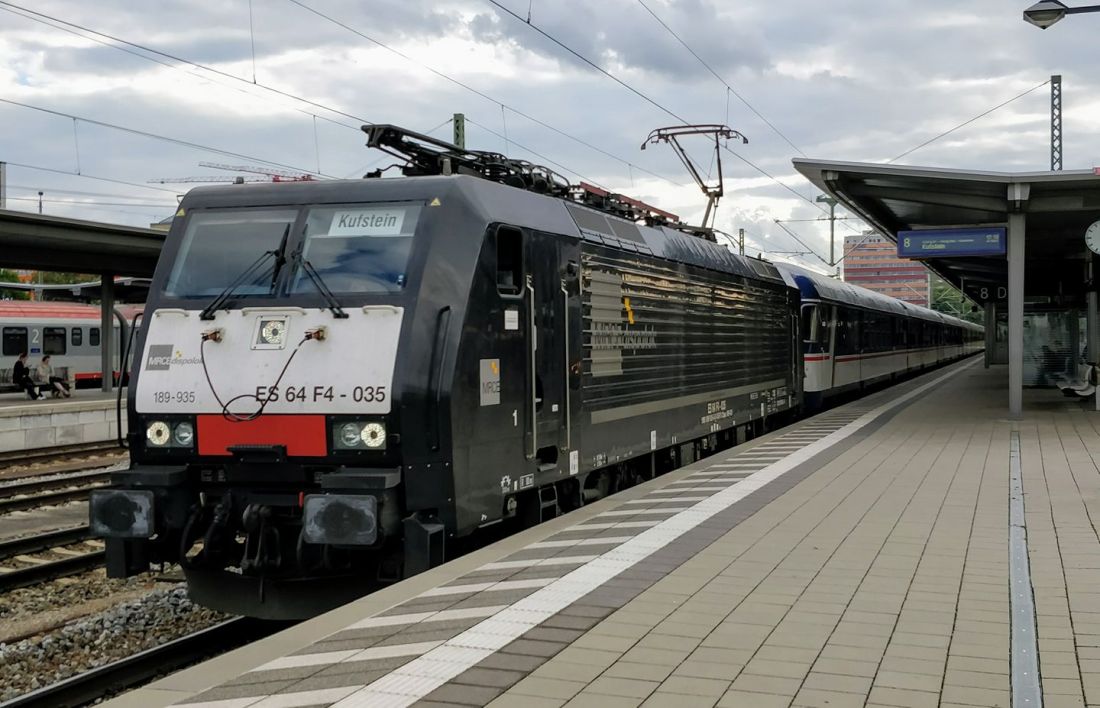
Reports on this train have been inconsistent, however I am aware of 83 different machines working on the “Meridian vice turn” – 65 of which were known to be on hire to, or owned by Lokomotion at the time (exceptions are marked with an asterisk below).   The majority of them are brand-new machines – some of which literally only days old at the time of working – but the oldest, 139 177, dates from 1958.  12 of the locos recorded on the trains so far are ex-DB (the class 110, 139s, 151s, and 189 903-905); the rest have always been privately-owned freight machines.

The breakdown by class is as follows:-

Class 110 – 110 469*

Class 139 – 139 133, 139 177, 139 213, 139 311, 139 555

Class 151 – 151 056, 151 060, 151 074

Class 182 – 182 511*

Class 185 – 185 661, 185 662, 185 663, 185 664, 185 665, 185 666, 185 679, 185 686

Class 186 – 186 102, 186 107*, 186 110, 186 141, 186 251, 186 281, 186 282, 186 283, 186 284, 186 285, 186 286, 186 287, 186 290, 186 440, 186 441, 186 442, 186 443, 186 444

Class 187 – 187 308, 187 312

Class 189 – 189 151, 189 841*, 189 901*, 189 902*, 189 903*, 189 904*, 189 905*, 189 907, 189 912, 189 914, 189 917, 189 918, 189 924*, 189 926, 189 927, 189 935*

Class 193 – 193 208, 193 238*, 193 244*, 193 264, 193 286, 193 615, 193 661, 193 662, 193 663*, 193 664*, 193 666, 193 669*, 193 770, 193 771, 193 772, 193 773, 193 774, 193 775, 193 776, 193 777, 193 801, 193 804, 193 813, 193 824*, 193 873, 193 874*, 193 876

Class 471 – 471 502*

Class 475 – 475 404

The loco to have been reported most often is 185 662 (17 trains), followed by 186 286 and 193 772 (16 trains each).  However, as there are so many gaps in my workings record (below), the picture of what has actually worked may be different.  If you can fill in any gaps in the table below, please contact me, your help will be much appreciated!

Date AM PM
Tue 10/05/16 185 686 185 661
Wed 11/05/16 193 208 193 208
Thu 12/05/16 186 287 189 917
Fri 13/05/16 186 287 185 665
Mon 16/05/16 Holiday Holiday
Tue 17/05/16 186 141
Wed 18/05/16
Thu 19/05/16
Fri 20/05/16
Mon 23/05/16
Tue 24/05/16
Wed 25/05/16
Thu 26/05/16 Holiday Holiday
Fri 27/05/16
Mon 30/05/16
Tue 31/05/16 193 208
Wed 01/06/16
Thu 02/06/16 186 444
Fri 03/06/16 185 665
Mon 06/06/16 186 286 186 286
Tue 07/06/16 186 282
Wed 08/06/16 185 664
Thu 09/06/16 186 102
Fri 10/06/16
Mon 13/06/16
Tue 14/06/16 186 141
Wed 15/06/16 185 664
Thu 16/06/16 186 251 186 281
Fri 17/06/16 185 666
Mon 20/06/16
Tue 21/06/16 139 177 151 060
Wed 22/06/16 189 903 151 074
Thu 23/06/16 139 133 193 873
Fri 24/06/16 189 926 151 060
Mon 27/06/16
Tue 28/06/16 151 060
Wed 29/06/16 139 177
Thu 30/06/16 193 264 185 666
Fri 01/07/16 189 927 193 244 + 193 873
Mon 04/07/16
Tue 05/07/16 186 441
Wed 06/07/16 151 074
Thu 07/07/16 186 286 189 841
Fri 08/07/16
Mon 11/07/16 139 555 186 286
Tue 12/07/16 186 287
Wed 13/07/16 189 841 193 208
Thu 14/07/16 186 287
Fri 15/07/16 189 914 193 824
Mon 18/07/16
Tue 19/07/16 189 902
Wed 20/07/16 193 824
Thu 21/07/16 193 824
Fri 22/07/16 193 824
Mon 25/07/16
Tue 26/07/16
Wed 27/07/16 186 440
Thu 28/07/16 189 914 185 663
Fri 29/07/16 193 873 186 286
Mon 01/08/16
Tue 02/08/16 186 286
Wed 03/08/16 186 286 186 286
Thu 04/08/16 185 679 186 286
Fri 05/08/16 151 056 193 208
Mon 08/08/16 189 902 186 286
Tue 09/08/16
Wed 10/08/16
Thu 11/08/16
Fri 12/08/16
Mon 15/08/16 Holiday Holiday
Tue 16/08/16
Wed 17/08/16 186 286
Thu 18/08/16 186 286
Fri 19/08/16
Mon 22/08/16 186 287 189 927
Tue 23/08/16 193 208 186 440
Wed 24/08/16 185 662
Thu 25/08/16
Fri 26/08/16
Mon 29/08/16 193 873 193 873
Tue 30/08/16 189 907
Wed 31/08/16 186 284 189 914
Thu 01/09/16 185 663 189 918
Fri 02/09/16 186 251
Mon 05/09/16 186 251 193 876
Tue 06/09/16 186 251
Wed 07/09/16 186 286
Thu 08/09/16 186 281
Fri 09/09/16 193 876
Mon 12/09/16
Tue 13/09/16 189 914
Wed 14/09/16 186 251
Thu 15/09/16
Fri 16/09/16
Mon 19/09/16
Tue 20/09/16 193 874
Wed 21/09/16 151 074
Thu 22/09/16
Fri 23/09/16 189 902
Mon 26/09/16 186 285 185 661
Tue 27/09/16 189 902
Wed 28/09/16
Thu 29/09/16
Fri 30/09/16 193 238 186 442
Mon 03/10/16 Holiday Holiday
Tue 04/10/16
Wed 05/10/16
Thu 06/10/16
Fri 07/10/16
Mon 10/10/16
Tue 11/10/16 189 904
Wed 12/10/16 189 917
Thu 13/10/16 193 873
Fri 14/10/16
Mon 17/10/16 193 801
Tue 18/10/16 193 801
Wed 19/10/16 185 661
Thu 20/10/16 186 110
Fri 21/10/16 185 662 189 907
Mon 24/10/16 185 663
Tue 25/10/16 186 444
Wed 26/10/16 189 151 189 926
Thu 27/10/16
Fri 28/10/16 193 208
Mon 31/10/16
Tue 01/11/16 Holiday Holiday
Wed 02/11/16 193 801 193 208
Thu 03/11/16
Fri 04/11/16
Mon 07/11/16
Tue 08/11/16
Wed 09/11/16 186 285
Thu 10/11/16 189 918
Fri 11/11/16 185 661
Mon 14/11/16
Tue 15/11/16 193 801 193 801
Wed 16/11/16 CAPED 186 290
Thu 17/11/16
Fri 18/11/16
Mon 21/11/16 186 440
Tue 22/11/16 151 060
Wed 23/11/16
Thu 24/11/16
Fri 25/11/16 189 151
Mon 28/11/16 186 441 189 907
Tue 29/11/16 151 060
Wed 30/11/16 189 907 189 907
Thu 01/12/16 189 907 189 907
Fri 02/12/16 186 110
Mon 05/12/16
Tue 06/12/16 186 443
Wed 07/12/16 189 907 189 907
Thu 08/12/16 189 907 186 110
Fri 09/12/16 189 905 189 901
Mon 12/12/16 189 907
Tue 13/12/16
Wed 14/12/16 182 511
Thu 15/12/16 186 102 189 151
Fri 16/12/16 139 311 139 213
Mon 19/12/16 110 469
Tue 20/12/16 110 469 110 469
Wed 21/12/16 187 312
Thu 22/12/16 189 912
Fri 23/12/16
Mon 26/12/16 Holiday Holiday
Tue 27/12/16 185 666 185 661 + 185 662
Wed 28/12/16 185 661 + 185 662 185 661 + 185 662
Thu 29/12/16 185 661 + 185 662 185 661 + 185 662
Fri 30/12/16
Mon 02/01/17
Tue 03/01/17
Wed 04/01/17 185 661 + 193 772
Thu 05/01/17
Fri 06/01/17 Holiday Holiday
Mon 09/01/17 193 772
Tue 10/01/17 187 308
Wed 11/01/17
Thu 12/01/17 193 772
Fri 13/01/17 193 772
Mon 16/01/17
Tue 17/01/17 189 917
Wed 18/01/17 186 283
Thu 19/01/17
Fri 20/01/17
Mon 23/01/17 189 912 189 912
Tue 24/01/17 185 663
Wed 25/01/17
Thu 26/01/17
Fri 27/01/17
Mon 30/01/17 185 663 185 663
Tue 31/01/17 193 772 193 772
Wed 01/02/17 193 772 193 772
Thu 02/02/17 187 312
Fri 03/02/17 187 312
Mon 06/02/17 189 907 189 907
Tue 07/02/17 187 312 189 901
Wed 08/02/17 185 662 189 914
Thu 09/02/17 185 662 185 662
Fri 10/02/17 151 074 151 074
Mon 13/02/17
Tue 14/02/17
Wed 15/02/17 186 441 185 664
Thu 16/02/17 139 177
Fri 17/02/17 185 662 187 308
Mon 20/02/17 187 308
Tue 21/02/17
Wed 22/02/17 151 074 151 074
Thu 23/02/17 186 286
Fri 24/02/17
Mon 27/02/17
Tue 28/02/17
Wed 01/03/17
Thu 02/03/17
Fri 03/03/17 186 441
Mon 06/03/17 186 441
Tue 07/03/17 186 440
Wed 08/03/17 139 555
Thu 09/03/17 185 664 151 074
Fri 10/03/17
Mon 13/03/17 186 443
Tue 14/03/17 139 133 189 902
Wed 15/03/17 185 662 185 662
Thu 16/03/17 185 662 186 284
Fri 17/03/17 185 662
Mon 20/03/17 189 914
Tue 21/03/17 189 905
Wed 22/03/17 193 771 193 208
Thu 23/03/17 193 208 193 208
Fri 24/03/17
Mon 27/03/17 186 290 187 312
Tue 28/03/17 187 312 187 312
Wed 29/03/17 187 312 185 663
Thu 30/03/17 189 914
Fri 31/03/17 185 661 186 441
Mon 03/04/17 193 772
Tue 04/04/17 185 661 185 661
Wed 05/04/17
Thu 06/04/17 193 772 186 281
Fri 07/04/17
Mon 10/04/17 185 662
Tue 11/04/17 193 813
Wed 12/04/17
Thu 13/04/17 CAPED 185 666
Fri 14/04/17 Holiday Holiday
Mon 17/04/17 Holiday Holiday
Tue 18/04/17 193 771
Wed 19/04/17 193 771 193 813
Thu 20/04/17
Fri 21/04/17 193 772
Mon 24/04/17 187 308
Tue 25/04/17
Wed 26/04/17 193 773
Thu 27/04/17 193 773
Fri 28/04/17
Mon 01/05/17 Holiday Holiday
Tue 02/05/17 185 663
Wed 03/05/17
Thu 04/05/17 185 662 189 902
Fri 05/05/17
Mon 08/05/17 189 918
Tue 09/05/17 186 286
Wed 10/05/17 186 285
Thu 11/05/17 193 804
Fri 12/05/17
Mon 15/05/17 186 441
Tue 16/05/17 193 770 193 770
Wed 17/05/17 151 060
Thu 18/05/17 189 907
Fri 19/05/17 151 060
Mon 22/05/17 186 282
Tue 23/05/17 139 213
Wed 24/05/17
Thu 25/05/17 Holiday Holiday
Fri 26/05/17 193 771
Mon 29/05/17
Tue 30/05/17 193 774 193 774
Wed 31/05/17 186 443
Thu 01/06/17 151 060 193 772
Fri 02/06/17 185 663 BLS 475 404
Mon 05/06/17 Holiday Holiday
Tue 06/06/17 189 907
Wed 07/06/17
Thu 08/06/17 189 912
Fri 09/06/17 193 775
Mon 12/06/17
Tue 13/06/17 186 440
Wed 14/06/17
Thu 15/06/17 Holiday Holiday
Fri 16/06/17 186 441
Mon 19/06/17 193 773
Tue 20/06/17 193 773 193 770
Wed 21/06/17 193 770 193 771
Thu 22/06/17 475 404 475 404
Fri 23/06/17 186 442
Mon 26/06/17
Tue 27/06/17
Wed 28/06/17
Thu 29/06/17
Fri 30/06/17
Mon 03/07/17
Tue 04/07/17
Wed 05/07/17 193 774
Thu 06/07/17 193 775
Fri 07/07/17 193 771
Mon 10/07/17 193 775
Tue 11/07/17 186 284
Wed 12/07/17
Thu 13/07/17
Fri 14/07/17 193 773 189 904
Mon 17/07/17
Tue 18/07/17
Wed 19/07/17 193 615 186 444
Thu 20/07/17 193 776
Fri 21/07/17 193 662 193 777
Mon 24/07/17
Tue 25/07/17
Wed 26/07/17 193 777 186 444
Thu 27/07/17 151 060
Fri 28/07/17
Mon 31/07/17
Tue 01/08/17 189 902
Wed 02/08/17 151 060
Thu 03/08/17 193 777 193 772
Fri 04/08/17 193 615 189 902
Mon 07/08/17
Tue 08/08/17
Wed 09/08/17 186 283
Thu 10/08/17 186 281
Fri 11/08/17 193 771
Mon 14/08/17 186 284
Tue 15/08/17
Wed 16/08/17 186 284
Thu 17/08/17 193 772
Fri 18/08/17 193 772 186 283
Mon 21/08/17
Tue 22/08/17 193 661
Wed 23/08/17 186 444
Thu 24/08/17 189 904 189 905
Fri 25/08/17 186 107 193 662
Mon 28/08/17 186 282 189 924
Tue 29/08/17 189 924 186 284
Wed 30/08/17 475 404 185 666
Thu 31/08/17 193 770 193 772
Fri 01/09/17 186 286
Mon 04/09/17 193 664 185 663
Tue 05/09/17 193 770 189 935
Wed 06/09/17 193 777 189 935
Thu 07/09/17 193 661
Fri 08/09/17 189 912 189 917
Mon 11/09/17 193 663 193 663
Tue 12/09/17 193 773
Wed 13/09/17 186 441 193 663
Thu 14/09/17 193 773 185 661
Fri 15/09/17 186 444
Mon 18/09/17
Tue 19/09/17
Wed 20/09/17 471 502
Thu 21/09/17 189 935
Fri 22/09/17
Mon 25/09/17
Tue 26/09/17 193 286
Wed 27/09/17
Thu 28/09/17
Fri 29/09/17
Mon 02/10/17
Tue 03/10/17
Wed 04/10/17
Thu 05/10/17
Fri 06/10/17
Mon 09/10/17 189 912
Tue 10/10/17
Wed 11/10/17
Thu 12/10/17
Fri 13/10/17
Mon 16/10/17
Tue 17/10/17
Wed 18/10/17
Thu 19/10/17
Fri 20/10/17
Mon 23/10/17
Tue 24/10/17
Wed 25/10/17
Thu 26/10/17
Fri 27/10/17
Mon 30/10/17
Tue 31/10/17
Wed 01/11/17
Thu 02/11/17
Fri 03/11/17
Mon 06/11/17
Tue 07/11/17
Wed 08/11/17
Thu 09/11/17
Fri 10/11/17
Mon 13/11/17 193 775
Tue 14/11/17 193 770 193 770
Wed 15/11/17 193 770 151 060
Thu 16/11/17
Fri 17/11/17
Mon 20/11/17
Tue 21/11/17 193 666
Wed 22/11/17 193 775 186 441
Thu 23/11/17 193 774 185 666
Fri 24/11/17
Mon 27/11/17
Tue 28/11/17
Wed 29/11/17 189 903
Thu 30/11/17 193 773
Fri 01/12/17
Mon 04/12/17 185 661 185 661
Tue 05/12/17 193 664
Wed 06/12/17
Thu 07/12/17 193 664
Fri 08/12/17
Mon 11/12/17 139 311
Tue 12/12/17
Wed 13/12/17
Thu 14/12/17
Fri 15/12/17 193 669 193 669
Mon 18/12/17
Tue 19/12/17
Wed 20/12/17
Thu 21/12/17
Fri 22/12/17
Mon 25/12/17
Tue 26/12/17
Wed 27/12/17
Thu 28/12/17
Fri 29/12/17 185 665


If you’re enjoying the content of this website, please could I invite you to have a look at how you could support it?  Thanks!

DB Class V200 “Warships” – survivors and where to find them

IMGP3076

V200 007 (220 007) at Dagebüll Mole, 05/08/12 (JW)

As the forerunners to our own D800 “Warship” class diesel-hydraulics, the famous Deutsche Bundesbahn V200 class have always commanded a great deal of interest among British enthusiasts. Most are aware of the esteemed V200 033, which frequently hauls railtours in Germany, but this article will be a concise round-up of where all of the V200 survivors are now to be found.

Of the 86 Maybach-engined V200.0s (class 220), 26 are thought to remain in existence – although most of these have since been re-engined.  In common with many retired German diesel-hydraulics, 10 of them are now working in Italy – all for the private freight operator Ferrovie Emilia-Romagna.

Here is a link to a list of forthcoming haulage opportunities, which is at present limited to Maybach-engined V200 033 and Mercedes-engined V200 007.

V200 001 Fränkische Museums-Eisenbahn e.V., Nürnberg Nordostbahnhof
V200 006 Ferrovie Emilia-Romagna, Italy – as 220R01
V200 007 Historische Eisenbahnfahrzeuge Lübeck e.V.
V200 009 Eisenbahn & Technikmuseum Rügen, Binz
V200 011 Ferrovie Emilia-Romagna, Italy – as D220.011
V200 013 Railconsult? – last reported stored at Nymburk, Czech Republic, overhaul abandoned
V200 015 Hammer Eisenbahnfreunde – masquerading as “220 023” in ozeanblau-beige livery
V200 016 GES Stuttgart, stored at Kornwestheim
V200 017 Eisenbahnmuseum Bochum
V200 018 Deutsches Technikmuseum, Berlin
V200 028 GCF, Italy – as D220.028ER
V200 029 GCF, Italy – as D220.029ER
V200 031 COMSA, Spain – location/fate unknown
V200 033 Hammer Eisenbahnfreunde
V200 039 COMSA-GMF, stored at Constantí, near Tarragona, Spain.  Link to Google Maps street view.
V200 041 Ferrovie Emilia-Romagna, Italy – as D220.041ER
V200 045 GCF, Italy – as D220.045ER
V200 048 SNTF, Algeria – stored at Constantine Depot
V200 049 Ferrovie Emilia-Romagna, Italy – as D220.049ER
V200 051 Ferrovie Emilia-Romagna, Italy – as D220.051ER
V200 053 Deutsche Privatbahn, Altenbeken
V200 058 Technik Museum Speyer
V200 060 GCF, Italy – as D220.060ER
V200 071 Technik Museum Speyer
V200 074 Ferrovie Emilia-Romagna, Italy – as D220.074ER
V200 077 dumped derelict at premises of WLH Reuschling near Hattingen – future uncertain

A similar percentage of the 50 Mercedes-engined V200.1s (class 221) have fared better – with 16 still extant.  However, this is largely thanks to a fleet of 20 of them being exported to Greece in 1989/90 to plug a traction shortage with OSE.  Their withdrawal by OSE in the late 1990s coincided with interesting developments on the railways back in Germany and, to cut a long story short, the Prignitzer Eisenbahn GmbH ended up purchasing and repatriating the entire fleet, to strip them back to the frames and effectively use them as the basis of brand new machines.  Some were scrapped (as recently as 2012) but many continue to work on the main line today – admittedly with little original details inside, but ensuring that the classic shape of a V200 can still be seen on the main line over 60 years on.

V200 101 Eisenbahnmuseum Heilbronn
V200 105 Rail Transport Service GmbH
V200 106 Eisenbahngesellschaft Potsdam
V200 112 Prignitzer Eisenbahn GmbH – stored and robbed at Neustrelitz?
V200 116 DB Museum – partway through overhaul at Neustrelitz?
V200 117 EfW-Verkehrsgesellschaft
V200 120 Eisenbahnmuseum Heilbronn
V200 121 Schienen Güter Logistik – as V270.09
V200 122 EfW-Verkehrsgesellschaft
V200 124 Schienen Güter Logistik – as V270.10
V200 125 HSH, Albania – dumped in scrap line at Prrenjas
V200 134 Rail Transport Service GmbH
V200 135 Bahnlogistik24
V200 136 Eisenbahngesellschaft Potsdam
V200 145 Prignitzer Eisenbahn GmbH
V200 147 Bentheimer Eisenbahn

IMGP4421

221145 at Kempten (Allgäu) Hbf, 02/11/14 (JW)


If you’re enjoying the content of this website, please could I invite you to have a look at how you could support it?  Thanks!

103 106 and the Rheinweiler Derailment, 21st July 1971

IMGP9697

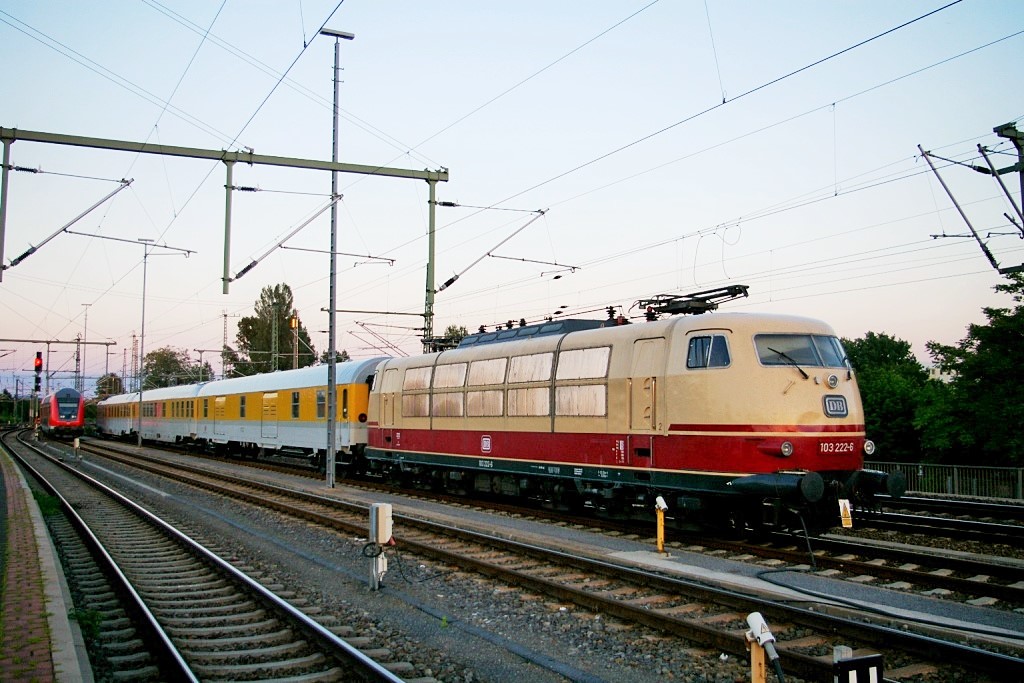
103 222 at Dresden Hbf on a test train, 25/05/14 (JW)

The Deutsche Bundesbahn class 103 electrics are one of the few locomotive types to have truly earnt the epithet “iconic”. 

During an illustrious career, these 200 km/h, 9,980 hp machines can take the credit for putting the railways of West Germany prominently on the high-speed map.  They firmly entered the public psyche there, being conspicuous features of most DB publicity throughout the 1970s and 1980s.  They were also astonishing performers.  These locos took a consistent thrashing in their stride, with most class members averaging around 1,000 km a day for nearly three decades.

In addition to four prototype locos built in 1965, 145 class 103s entered traffic between 1970 and 1974.  However, this does not tell the full story – the whole fleet never operated simultaneously.  There has been one particular glaring gap in the fleet list from almost the very start; when only three months old, 103 106 was destroyed in a tragic derailment at Rheinweiler in 1971.  Despite the significance of this event in German railway history, it is not well covered in histories, it being regarded as a truly black day and something of a taboo subject in some quarters.

103245_Munchen Hbf_171016

103 245 sits on the blocks at München Hbf, 17/10/16 (JW)

The context

To understand the accident in context requires a little examination of the situation that Deutsche Bundesbahn (DB) – the state railway of West Germany – found itself in in the early 1970s.

West Germany experienced an economic boom in the wake of the Second World War, and industrial output and living standards rose dramatically.  But this is not to say that its railways were a profitable operation.  By 1971, DB was reported to be 15 million Deutschmarks in debt.

Steam traction remained fairly widespread and many pockets of the system had changed little since before the war.  Yet the need for modernisation was keenly felt, and DB made the conscious decision to actively compete with long-distance road and air travel.  The Germans had a long tradition of exploring the opportunities presented by high-speed rail and following experience with the prototypes, DB placed an order in 1969 for a production fleet of 103s.  This fleet was to form the keystone of a magnificent high-speed cross-country network.

1971 was not, however, to be a magnificent year.  By the end of May, there had already been three major disasters on West German railways – at Aitrang on 9th February, Illertissen on 18th May and Dahlerau on 27th May – with a total of 80 people killed in them.  Tragically, July was to see a fourth disaster, and the death toll was also to rise.

The fateful day

At precisely 13:00 on Wednesday 21st July 1971, D370, the “Schweiz-Express” service slipped out of Basel Bad en route to København.  The train was formed of fourteen carriages with approximately 300 passengers on board.  It was hauled by 103 106, with 52-year-old Mannheim driver Karl Mitsch at the controls.

Save for being snapped by a lone railway photographer stood at the lineside at Efringen-Kirchen – this photo can now be found in a number of Eisenbahn Kurier publications – the train proceeded uneventfully for 19 minutes.  At that point, approaching the village of Rheinweiler, the train began to sway fiercely from side to side, luggage tumbled from the overhead racks and, a split second later, it violently left the rails.

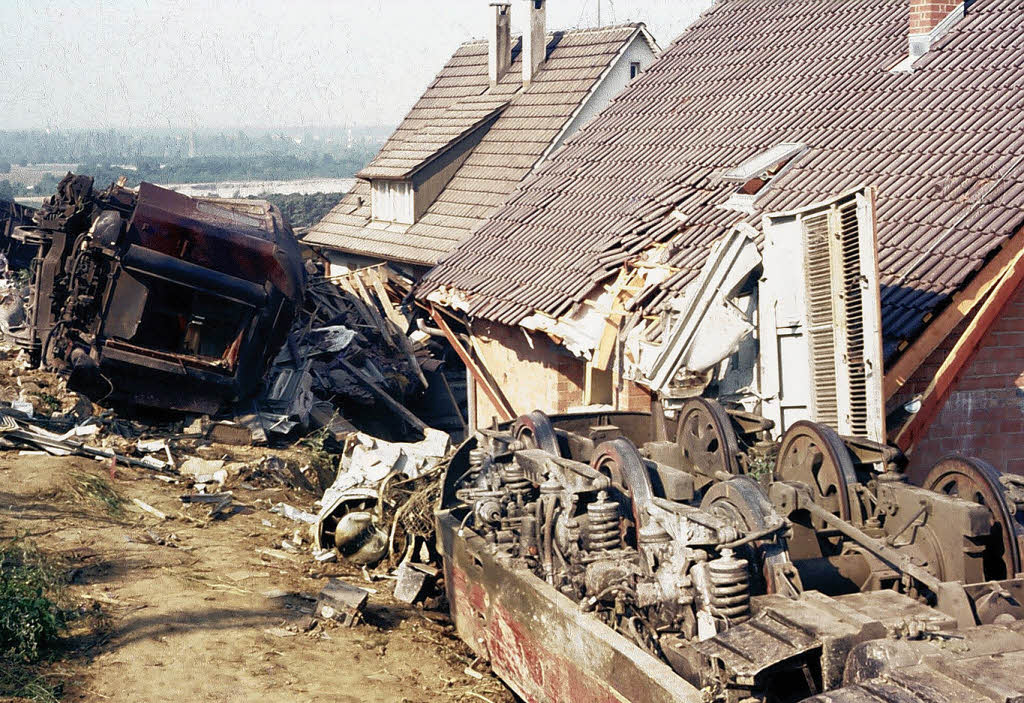
The loco had only entered service on 8th April, and now, after just 105 days in traffic, “number 106” had been practically destroyed, lying upside down and unrecognisable in the wreckage some distance from the railway line.

The accident

The train had derailed on a tight curve which had a maximum speed of 75 km/h.  The loco and six of the carriages plummeted down a 5 metre high embankment into a residential area, leaving a trail of absolute destruction.  Tragically, it had completely destroyed a house, instantly killing both a 5-year-old boy and a 90-year-old man inside.  In total, 23 died and 121 were injured.  Amongst the dead was Driver Mitsch.

As with many railway accidents, the death of the driver – who was the only person on the footplate – made it very difficult indeed to establish the circumstances of the derailment.  Analysis of the loco’s Fahrtenschreiber (“tachograph”) revealed that it had been driven in accordance with the route’s varying linespeeds as far as Kleinkems, approximately a minute before it reached the curve.

At Kleinkems, the linespeed dropped to 120 km/h, however the Fahrtenschreiber showed that Driver Mitsch had set the loco’s AFB (Automatische Fahr und Bremssteurung – effectively, semi-automatic cruise control) to 140 km/h instead.  Two kilometres later, the linespeed dropped further, to 75 km/h for the curve, but no alteration was recorded to the AFB setting at that point.  Intriguingly, nor did the loco appear to have been braked.

The train’s excess speed at the curve led to an inevitable catastrophe.

The cause

The train was single-manned in accordance with the rulebook as it was not booked to exceed 140 km/h.  Anything at higher speeds was to have two on the footplate, as was anything on specific lines with particularly vicious gradients and varying speed restrictions.  Although the route through Rheinweiler route had numerous speed restrictions, it did not have this requirement.

Karl Mitsch had been a driver since 1950, had worked on electric locos since 1956, and over the route in question very frequently since 1958.  However, he had only recently passed out on class 103 traction; an article in Der Spiegel in October 1973 claimed that this was only his third solo turn on the new locomotives.

Although the 103s were thoroughly modern machines, one of the only significant differences from the electric traction he had been working on for the previous 15 years was the presence of the AFB system.  The Fahrtenschreiber printout appeared to show that this had been incorrectly programmed, with an excessive speed set on the run-up to the derailment.  With Mitsch’s route knowledge beyond question, it must be wondered why this occurred.

His relative inexperience on the traction might lead to an obvious conclusion. However, this may be a dangerous assumption to make.  It came to light in the wake of the accident that some serious issues with the AFB system on class 103s had already been identified.  For example, a train had been reported to have been exceeding the speed at which the AFB had been set by 25 km/h on at least one occasion.

The predominant safety feature at work in the train’s final minutes would have been the Sifa – the loco’s driver vigilance device – which required operation every 50 seconds.  Were this not done, the brakes would have automatically been applied.  Mitsch continued to operate the Sifa correctly right until the moment of derailment.

DB had for many years employed the “Indusi” system – similar to our own Train Protection and Warning System, in the sense that it was designed to operate via track-based electromagnets to apply the train’s brakes in the event of a train passing a signal at danger or approaching a speed restriction too quickly.  However, this was not universally applied, mainly due to reasons of cost.  The curve at Rheinweiler was not fitted with Indusi.

However, regardless of how the AFB behaved, and given the lack of Indusi magnets, the curve on which the train derailed still followed 400 metres of straight track.  In broad daylight, if not incapacitated – and Mitsch’s consistent operation of the Sifa would indicate that he was not – the driver should have been more than able to slow the train sufficiently before reaching it, preventing the derailment.

In truth, the evidence-gathering surrounding the accident probably posed more questions than it provided answers.  Indeed, although the finger of blame was pointed at the driver, a truly detailed cause has never been established.  This mystery is unlikely to ever be solved.

IMGP0714

103 113 backs onto IC118 at Stuttgart Hbf, 30/05/14 (JW)

The effect

Irrespective of its cause, the effects of the Rheinweiler derailment were significant, immediate and widespread.  The German popular press made repeated and vocal calls to stop increasing speeds on the Bundesbahn.  It perceived there to be a safety risk where trains fit for the 21st century were in many cases being put to work on 19th century infrastructure.

In the wake of the accident, the Minister of Transport, Georg Leber, cut short his family holiday in Austria, and soon announced that the routes, timetables and speeds of all trains were to be investigated in detail in order to ensure that safety was not being compromised.  One of the consequences of this was that the maximum speed of all DB trains was indefinitely restricted to 160 km/h, which must have been a bitter blow to the cash-strapped organisation as its 200 km/h flagship flying machines continued to roll off the production line.  AFB was put out of operation until further notice.

Impressive efforts were made to ensure that all bases were covered in order to try to prevent a repeat of the accident.  DB bowed to the longstanding demands of its drivers’ union, and Indusi was rolled out far more widely.  The time interval required between the operation of the Sifa device on class 103 locos was reduced from 50 to 30 seconds.

In an attempt to secure drivers’ retention of situational awareness when driving, particularly during fog and darkness, significant alterations were made to the trackside kilometre posts across the network.  Small stone posts at track level were superseded by raised signs at driver’s eye level on reflective backgrounds every 200 metres or so, and these remain a prominent feature of German railways today.

The class 103 cab environment also received attention.  Some elements of the cab design had been criticised in the accident investigation, and therefore the final batch of 30 locos were constructed with slightly different cabs.  They were also equipped with an additional speed control device (EFB) which was retro-fitted to the other class members in due course.

By 1979, Deutsche Bundesbahn was ready to rise again.  As part of the “Intercity 79” project, maximum speeds were again raised to 200 km/h, and it would be no exaggeration to say that West Germany’s cross-country network of high-speed express trains became the envy of the world.  Both safety and punctuality gained a reputation as being exemplary.  The 103s, now permitted to truly stretch their legs, also cemented their reputation as one of the finest locomotive types of all time.

Their star began to fall in the late 1980s when the 60 new class 120.1 locos began to make their presence felt on the Hamburg-München route, the express backbone of the country.  The 103s continued to be flogged, however, and continued to provide sterling service.  But by the mid-1990s, they were beginning to show their age, and their almost like-for-like replacement by a fleet of 145 Bombardier-built class 101s commenced in February 1997.

Tragically, history was to repeat itself, in a way.  Just 20 months into its service life, on 6th February 2000, a misunderstanding regarding a temporary speed restriction and bi-directional working led the driver of 101 092 to enter a 40 km/h turnout at Brühl at 122 km/h, causing it and several coaches to plunge down an embankment into a house.  Nine people died.  This is a link to a 43-minute documentary about that accident (in German).  The loco was a write-off, but a 146th frame was constructed, and the so-called “101 092II” remains in service to this day.

But perhaps the strangest coincidence of all was that 101 092’s train also carried the “Schweiz-Express” name…

IMGP0629

The “new” 101 092, at Stuttgart Hbf, 30/05/14 (JW)

Today

Intriguingly, after 103 132 sustained accident damage in 1976, part of 103 106’s frame was used in its repairs.  103 132 was one of the last 103s to remain in traffic, and is one of the 14 production 103s to still remain intact – owned by the DB Museum and stored at Dessau Works since 2009.

The legacy of the accident at Rheinweiler is still visible right across the German railway network even today.  Perhaps this is some compensation for the fact that it seems to be very rarely mentioned.

However, the tragedy is still acutely remembered in Rheinweiler.  Far fewer trains pass the spot nowadays – the freight and expresses have been diverted via the new Katzenberg Tunnel since 2012 – but the locals continue to tend to a modest memorial to the victims of the accident on that fateful day in 1971.


If you’re enjoying the content of this website, please could I invite you to have a look at how you could support it?  Thanks!

17th June 2017 – East German traction heads for Sonneberg

Saturday 17th June 2017 sees an open day at the PIKO model railway factory in Sonneberg, in Thüringen.

In connection with this, four railtours using examples of former Deutsche Reichsbahn diesel and electric traction now all but wiped away from the main line scene will be heading for this corner of the former East Germany.

At least three of them cannot, however, reach Sonneberg itself – as construction work in connection with the construction of the new high-speed line near Creidlitz has closed the line from Lichtenfels towards Sonneberg for the weekend.  Instead, these tours’ destination will be Pressig-Rothenkirchen, for onward bus transport to the factory.  This is a quick run-down of the traction and the tours involved, if you are tempted to head along too.

DR Class 118 / DB Class 228

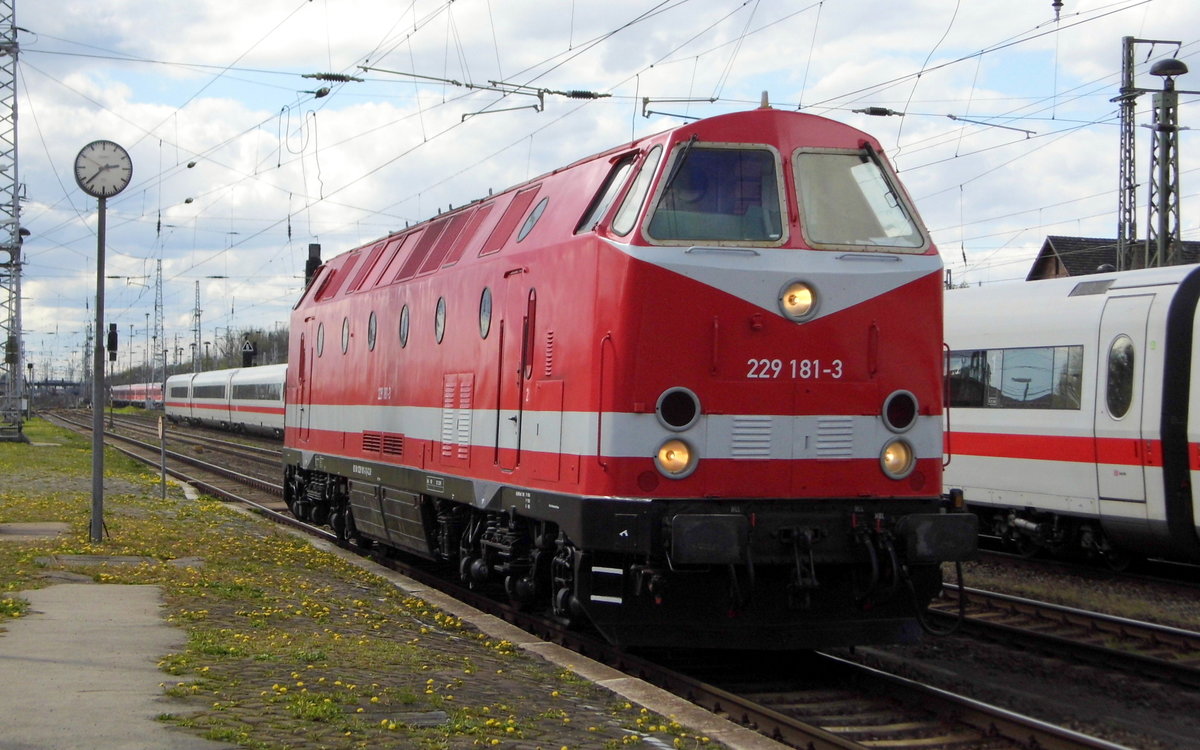
This tour is possibly the most interesting from the haulage enthusiast’s point of view, but as of yet (18/05/17) it retains a degree of uncertainty as traction is advertised as either “228 321” (ex-DB 228 721) or 229 181 (video of 229 120 here for sound purposes!).  Although both are “rare” these days from a haulage point of view, the 228 would surely be the bigger draw.  The 229 – as part of a small number of class 219s re-engined after unification with MTU power units – is perhaps less interesting.

This tour kicks off from Magdeburg Hbf at 06:24 and runs via some solidly unit-only (these days) routes via Stassfurt and Sandersleben towards its last pick-up at Erfurt.  It looks as if this one will actually make Sonneberg, as there is no mention in any publicity of bus involvement.  Indications on the net are that it will run via Oberhof, Grimmenthal and a reversal at Rauenstein, but this has not been confirmed.  It’s being operated by the Eisenbahnmuseum Stassfurt, fares range from €69 to €84 depending on where you board, and some more details can be found here.

DR Class 119 / DB Class 219

Edit 12/06/17: Less than a week before the tour, this was re-advertised as using electric loco no.155 110 of Wedler Franz Logistik, for reasons unknown at present.  The rest of 119 158’s commitments for the rest of 2017 are still advertised to use it.

On the other hand, what is certainly booked for a 119 is Berlin macht Dampf’s tour from Berlin-Schöneweide – although, even then, their machine – 119 158 (ex-DB 219 158) was the sole member of the class to receive experimental Caterpillar 3512 series power units, and therefore its sounds aren’t classic ones.

Despite that, it still looks a decent tour, with some decent main line mileage to be had. This will deposit its passengers at Pressig-Rothenkirchen on the Frankenwaldbahn for bus transport forward.  The third class fare is €94.  More details here.

DR Class 250 / DB Class 155

The DR class 250 locos, known since 1992 as DB class 155 – nicknamed “Containers” due to their boxy shape – are powerful electrics that have not had routine passenger diagrams for about the last 15 years – although 155 110 recently hauled the “Berlin Malmo Express” and it looks as if they may be the new booked traction for this through the summer.

This tour takes an LEG example – 155 137 – via a straightforward route via Naumburg, Jena and the steeply-graded route over the Frankenwaldbahn to Pressig-Rothenkirchen, again for buses forward.  It’s operated by the Eisenbahnmuseum Leipzig and standard class tickets are €76.  More info at this link.

DR Class 254 / DB Class 194

Strictly speaking, I’m cheating with this one, as the electric loco concerned (E94 158) was never a Deutsche Reichsbahn class 254, but a Deutsche Bundesbahn class 194 the other side of the Iron Curtain.  However, built in traffic during wartime – ‘158 entered traffic on 2nd January 1945 – both classes began life as class E94 for the “1921-1945” Reichsbahn.

This tour starts in the former West – Veitshöchheim, near Würzburg – and runs main line, reversing at Bamberg, to Pressig-Rothenkirchen.  It’s operated by the Eisenbahnmuseum Würzburg and standard class fares range from €30 to €39, depending on where you board.  More info at this link.

What can I combine with it?

On both Saturday 17th and Sunday 18th June, there is a large-scale open day at the DB Museum at Koblenz.  Each day sees two circular “mini tours” using the Trans Europe Express stock.  Fares are dirt cheap and short leaps between stations are catered for in the fare structure.  Both of Saturday’s tours are in the hands of 103 113, whereas Sunday sees the first hauled by the 103 and the second by 110 239 (now as E10 1239).

DB Regio Class 143 – current status

IMGP2474

143 163 at Jübek, 20/05/12 (JW)

As of 17/01/18, DB Regio have 78 class 143 electric locos still in traffic.

This is a list of the current situation of DB Regio’s remaining 143s, along with the last reported passenger working of each (to be updated).

Loco Operator Last Reported Passenger Working
143 009 DB Regio – Trier 08/01/18: RB27
143 034 DB Regio – Halle (Saale) 20/06/17: Halle S7.
143 045 DB Regio – Nürnberg 10/01/18: Nürnberg S-Bahn
143 050 DB Regio – Halle (Saale) Transferred back to Regio pool 08/01/18.  Yet to be reported working passenger.
143 064 DB Regio – Frankfurt (Main) (Taunus pool) 06/12/17: RE15306
143 076 DB Regio – Frankfurt (Main) (RB75 pool) 12/01/18: RB75
143 107 DB Regio – Frankfurt (Main) (RB75 pool) 01/06/17: RB75
143 114 DB Regio – Trier 08/01/18: RB27
143 119 DB Regio – Nürnberg 02/01/18: S39588
143 120 DB Regio – Dresden 15/01/18: 08:04 Meißen Triebischtal to Dresden Hbf
143 135 DB Regio – Frankfurt (Main) (Taunus pool) 26/06/17: RB15418
143 138 DB Regio – Frankfurt (Main) (Taunus pool) 09/01/18: RE15214
143 141 DB Regio – Frankfurt (Main) (RB75 pool) 12/01/18: RB75
143 166 DB Regio – Frankfurt (Main) (RB75 pool) 06/12/17: RB75
143 168 DB Regio – Trier 17/01/18: RB12520
143 170 DB Regio – Frankfurt (Main) (RB75 pool) 18/06/17: RB75
143 181 DB Regio – Frankfurt (Main) (RB75 pool) 06/12/17: RB75
143 189 DB Regio – Frankfurt (Main) (Taunus pool) 23/02/17: Frankfurt REs
143 193 DB Regio – Cottbus 17/01/18: Berlin RB14
143 194 DB Regio – Trier 22/06/17: RB12580
143 215 DB Regio – Nürnberg 20/06/17: Nürnberg S-Bahn
143 227 DB Regio – Frankfurt (Main) (Taunus pool) 01/06/17: Frankfurt REs
143 228 DB Regio – Frankfurt (Main) (Taunus pool) 17/01/18: RE15224
143 231 DB Regio – Frankfurt (Main) (Taunus pool) 01/06/17: Frankfurt REs
143 238 DB Regio – Frankfurt (Main) (RB75 pool) 12/01/18: RB75
143 241 DB Regio – Düsseldorf 08/01/18: S1 31161 Soligen – Düsseldorf
143 242 DB Regio – Frankfurt (Main) (RB75 pool) 08/01/18: RB75
143 247 DB Regio – Nürnberg 10/01/18: Nürnberg S-Bahn
143 248 DB Regio – Frankfurt (Main) (RB75 pool) 18/06/17: RB75
143 259 DB Regio – Nürnberg 01/01/18: Nürnberg S-Bahn
143 263 DB Regio – Trier 17/06/17: RB27
143 267 DB Regio – Frankfurt (Main) (RB75 pool) 09/01/18: RB75
143 270 DB Regio – Frankfurt (Main) (Taunus pool) 18/06/17: Frankfurt Res
143 298 DB Regio – Nürnberg 03/01/18: Nürnberg S-Bahn
143 306 DB Regio – Cottbus 30/11/17: RE78952 Ruhland to Cottbus
143 333 DB Regio – Cottbus 20/06/17: RE18383
143 336 DB Regio – Nürnberg 01/01/18: Nürnberg S-Bahn
143 346 DB Regio – Frankfurt (Main) (Taunus pool) 10/05/17: Frankfurt REs
143 358 DB Regio – Nürnberg 03/01/18: Nürnberg S-Bahn
143 360 DB Regio – Dresden 15/01/18: 08:17 Meißen Triebischtal to Bad Schandau
143 568 DB Regio – Trier 02/06/17: RB27
143 591 DB Regio – Dresden 15/06/17: Dresden S1
143 628 DB Regio – Nürnberg 03/01/18: Nürnberg S-Bahn
143 632 DB Regio – Nürnberg 03/01/18: Nürnberg S-Bahn
143 637 DB Regio – Frankfurt (Main) (RB75 pool) 12/01/18: RB75
143 660 DB Regio – Düsseldorf 09/12/17: Dortmund footex
143 661 DB Regio – Trier 18/06/17: RB27
143 803 DB Regio – Frankfurt (Main) (Taunus pool) 17/01/18: RB15274
143 810 DB Regio – Halle (Saale) Transferred back to Regio pool 08/01/18.  Yet to be reported working passenger.
143 821 DB Regio – Dresden 02/06/17: Dresden S1
143 825 DB Regio – Trier
143 828 DB Regio – Dresden (S2 pool) 10/06/17: Dresden S2
143 850 DB Regio – Halle (Saale) Transferred back to Regio pool 08/01/18.  Yet to be reported working passenger.
143 853 DB Regio – Düsseldorf 04/04/17: Borussia Dortmund footex
143 854 DB Regio – Düsseldorf 20/05/17: Rhein-Ruhr S1
143 855 DB Regio – Nürnberg 03/01/18: Nürnberg S-Bahn
143 870 DB Regio – Nürnberg 10/01/18: Nürnberg S-Bahn
143 871 DB Regio – Halle (Saale) Transferred back to Regio pool 08/01/18.  14/01/18: Halle S7
143 875 DB Regio – Dresden 26/06/17: Dresden S1
143 883 DB Regio – Dresden 02/06/17: Dresden S1
143 884 DB Regio – Dresden 02/06/17: Dresden S3
143 885 DB Regio – Dresden 02/06/17: Dresden S1
143 893 DB Regio – Halle (Saale) Transferred back to Regio pool 08/01/18.  Yet to be reported working passenger.
143 903 DB Regio – Halle (Saale) 14/01/18: Halle S7
143 905 DB Regio – Nürnberg 03/01/18: Nürnberg S-Bahn
143 909 DB Regio – Dresden (S2 pool) 02/06/17: Dresden S2
143 910 DB Regio – Dresden 18/06/17: RB75
143 914 DB Regio – Nürnberg 10/01/18: Nürnberg S-Bahn
143 919 DB Regio – Dresden 04/06/17: Dresden S3
143 925 DB Regio – Trier 22/06/17: RB12504
143 932 DB Regio – Dresden 15/01/18: 10:47 Meißen Triebischtal to Schöna
143 933 DB Regio – Dresden (S2 pool) 15/01/18: 08:17 Dresden Flughafen to Pirna
143 949 DB Regio – Düsseldorf 21/06/17: Essen S1.  Seen passing Lehrte with ECS on 30/11/17.
143 957 DB Regio – Dresden 02/06/17: Dresden S3
143 959 DB Regio – Halle (Saale) Transferred back to Regio pool 08/01/18.  Yet to be reported working passenger.
143 967 DB Regio – Dresden (S2 pool) 15/01/18: 14:54 Pirna to Dresden Flughafen
143 970 DB Regio – Nürnberg 20/06/17: Nürnberg S-Bahn.  Sighted at Leipzig Hbf on 16/01/18 in the consist of a Pbz – bound for Dessau for repair.
143 973 DB Regio – Dresden (S2 pool) 08/06/17: Dresden S2

Info collated from personal sightings and many online sources including: the posters to European Rail Gen and DB Loco Info, Drehscheibe-Online and Revisionsdaten.de.

(Additionally, of course, the frame of 143 873 is now in its second life as the so-called 114 009II; everything above the solebar including the bodyshell being used as a replacement for the original 114 009, which was destroyed in a fire at Berlin Ostbahnhof on 26/07/11).


If you’re enjoying the content of this website, please could I invite you to have a look at how you could support it?  Thanks!
9th December 2017: E18 haulage in Germany (now 243 005)

5524075943_03d3d62e6a_o

E18 047 (118 047) at Hamburg Hbf, 09/05/09 (JW)

Important Update 25/11/17 – The organisers have unfortunately had to concede that E18 047 will not be ready in time to work the tour, and therefore the motive power will instead be 243 005, the 33-year-old ex-DB class 143 electric loco preserved by the DB Museum.  Proceeds will go towards repairing the E18.

Saturday 9th December 2017 sees a 78 year old electric loco make one of its occasional mainline passenger outings.

The E18 class was built for the pre-war Deutsche Reichsbahn and with the interesting wheel arrangement of 1-Do-1 – spoked wheels at that! – they have next to nothing in common with the electric locos of today, visually at least.

There are 6 survivors from this class of 55 machines.  All but one are static exhibits in museums – the exception being E18 047 (DB 118 047), which is owned by the DB Museum and kept in mainline condition under the care of the “Traditionsgemeinschaft Bw Halle P e. V.” in Halle (Saale).  Notably, this loco entered traffic on 12th August 1939 – less than a month before the outbreak of World War 2.

E18 047 currently has just one railtour advertised this year – for Saturday 9th December 2017.  This is being promoted by the Traditionsgemeinschaft Halle (link) and will allow it to stretch its legs properly, running from Leipzig Hbf (depart 07:00) via the direct route over the hills via Probstzella to Bamberg (for a 7hr 30min break) and Nürnberg Hbf (5hr 45min), before returning as outward.  Fares start at €79.

This tour is one of many organised to visit the huge number of Christmas markets in Germany, so are especially family-friendly!  Bamberg is especially worth a visit – the whole city is a UNESCO World Heritage Site and is particularly renowned for its beer!

What can I combine it with?

The next day (Sunday 10th December) sees a class 232 “Ludmilla” diesel loco work an 08:14 Erfurt Hbf to Goslar and 18:08 return charter for the bargain fare of €33, operated by Bahn-Nostalgie Thueringen (link).

The above is a link to a video on YouTube by Bahnatiker showing it on railtour duty five years ago.

The 230km/h Trabant!

DSC02114 (3)

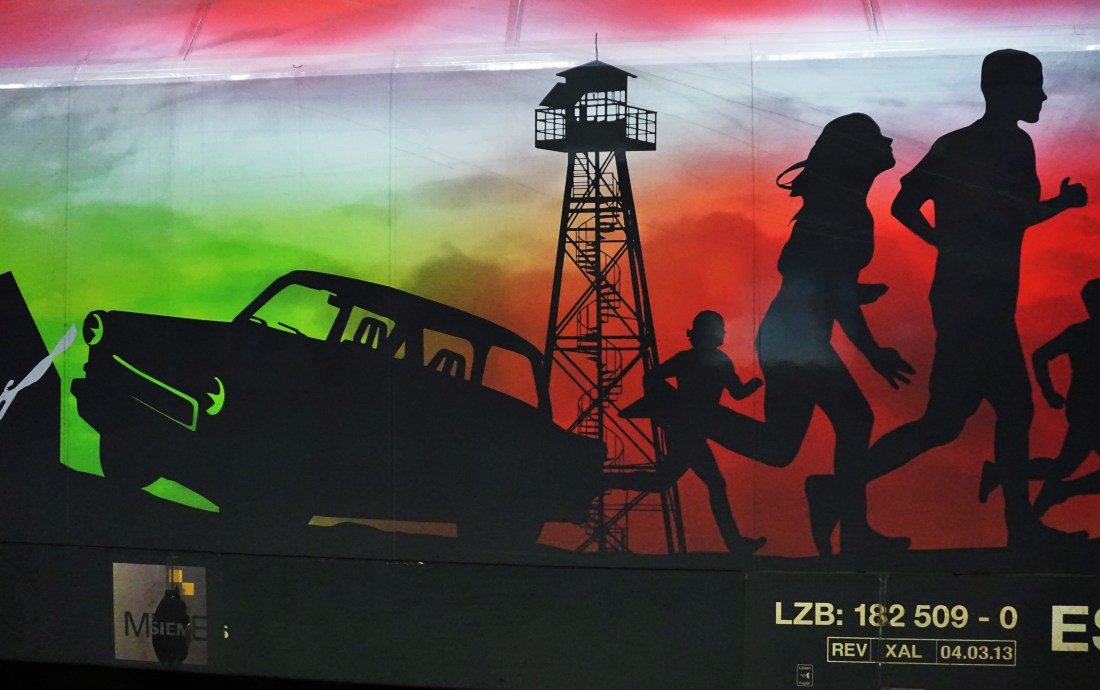
For four years, one of Europe’s fastest locomotives wore a unique livery prominently featuring the unmistakable shape of the infamous 23hp East German “Trabant” car.  What was it all about?

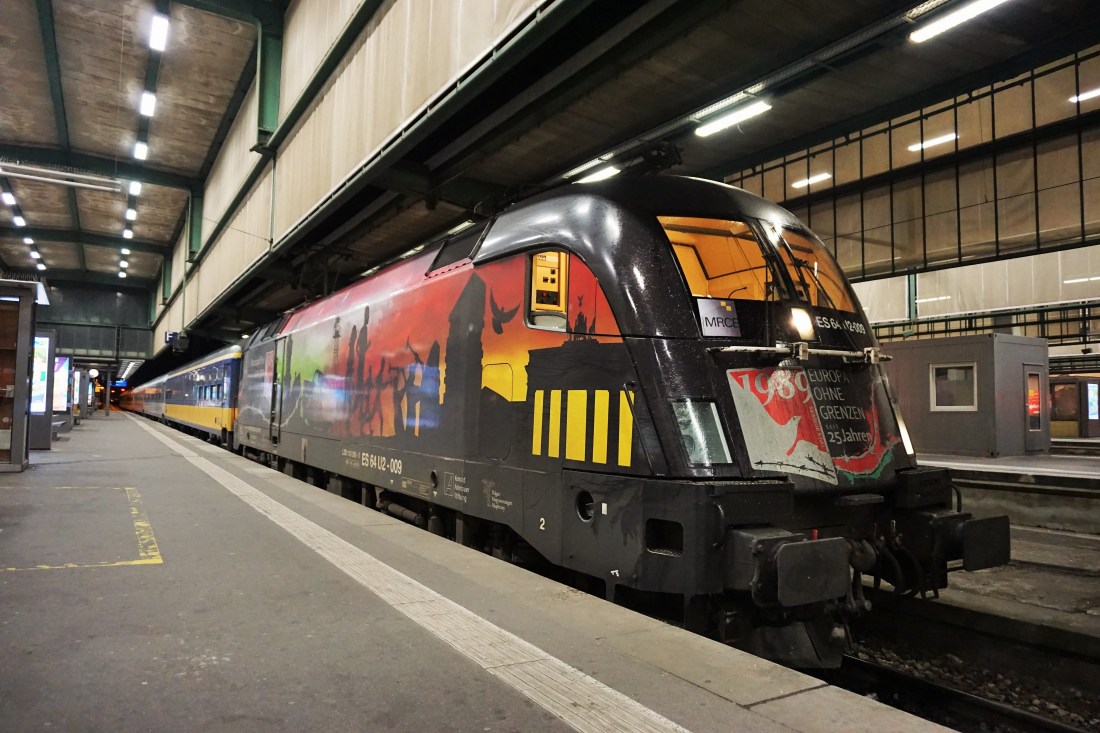
182 509 is a Siemens ES64U2-type loco, built in 2002 for their own spot-hire business, “Dispolok”, which was bought out by MRCE in 2006.

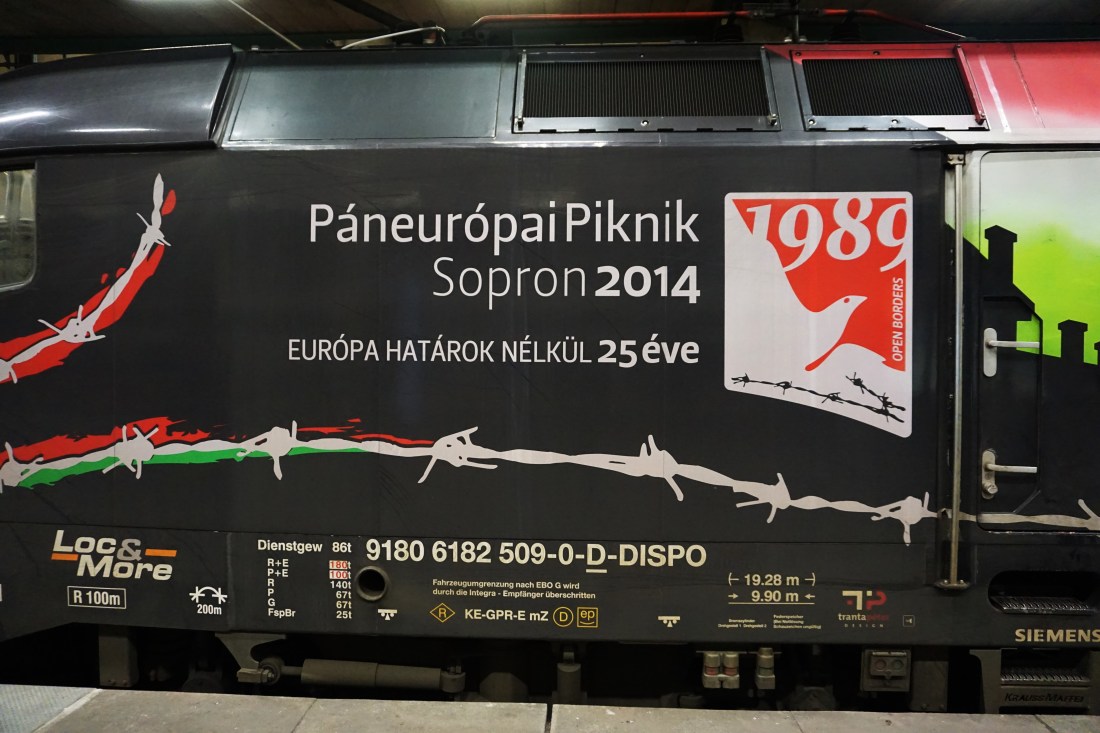
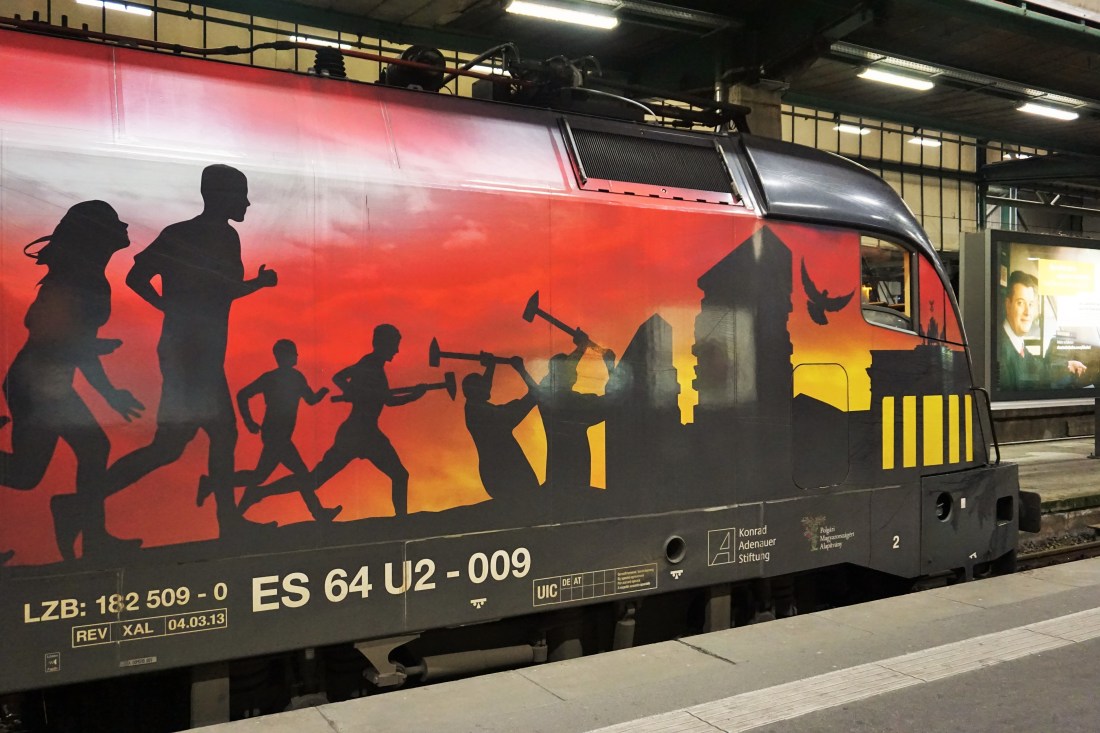
It was one of two such machines (182 509 and 182 560) to get unique specially-designed liveries – different on each side – in summer 2014, to mark the impending 25th anniversary of the fall of Communism in Europe.  182 560‘s was dedicated solely to the fall of the Berlin Wall, whereas 182 509‘s was on the theme of the “Pan-European Picnic”, arguably a lesser-known event – whilst still featuring symbolism of Berlin and of the actions of those at the Picnic leading to what eventually happened there.

DSC02113 (2).JPG

182 509 livery detail, seen on 05/05/17 (JW)

So, what was the “Pan-European Picnic” and what was the livery all about?  As I described in my article on the Flüchtlingszüge from Prague, 1989 saw burgeoning unrest through the Communist states behind the Iron Curtain, and history tells us that this resulted in the systematic collapse of the regimes in each of these countries by the end of the year.  It was a watershed year but these momentous events were characterised not by shows of aggression (except in Romania) but by demonstrations of peace.

One of the main characteristics of Eastern Europe in 1989 was the gathering pace of Mikhail Gorbachev’s policy of perestroika, of not interfering in the internal affairs of the Communist states.  It was in this climate that the Hungarian Minister of State Imre Pozsgay and the Austrian Otto von Habsburg, an MEP and President of the International Pan-European Union, sponsored an event to be held near Sopron, a Hungarian town near to the Austrian border, on Saturday 19th August 1989.

The theory was that the border between Hungary and Austria would be opened for a few hours, allowing people from both sides of the Iron Curtain to mingle, eat together (i.e. the picnic) and generally show that despite decades of propaganda to the contrary, those on both sides of the previously impregnable border between ideologies were not so different.

DSC02109 (2).JPG

182 509 livery detail, seen on 05/05/17 (JW)

What was not planned for, however, was the additional attendance of 600 enterprising East Germans who had been on their summer holidays in Hungary, had heard about the event and had decided to seize their opportunity to escape to the West.  The border guards turned a blind eye to this and their “Republikflucht” had been successful.

Again, history informs us that the border between Hungary and Austria was finally opened properly on 11th September and East Germans headed there in their droves in an attempt to leave – and (again, as described here) the dominoes had begun to fall that eventually resulted in the breach of the Berlin Wall – hence the liveries on 182 509 and 182 560 each commemorate events that neatly book-end what are probably the most significant twelve weeks in European history in the second half of the 20th century.

And what of the “230km/h Trabant” in the title?  These little two-stroke cars, manufactured by VEB Sachsenring in Zwickau, were ubiquitous in East Germany, and indeed through other countries behind the Iron Curtain; they are still particularly present in Hungary.  But they were also the vehicles that East German families drove in to Hungary in their attempts at escaping, that were left abandoned on the streets of Prague as their owners crammed into the West German Embassy, and that smokily and noisily inched across the Berlin Wall when it was first opened on that landmark night in November 1989.  As a result, Trabants became one of the most instantly-recognisable symbols of the events of 1989, and so it’s entirely appropriate that one was included in this design.  The irony was that a vehicle that struggled to hit 100km/h in real life could be “seen” flashing through the German countryside at well over double that!

DSC02107 (2).JPG

182 509, Stuttgart Hbf, 05/05/17 (JW)

As a Dispolok machine, the “Pan-European Picnic” loco lived a somewhat nomadic existence, but since it gained its special livery it worked predominantly for DB (both on regional passenger services for DB Regio, and on Intercity expresses for DB Fernverkehr) and, from January 2017, it was hired to the Swedish firm of Hector Rail.

Although Hector Rail is based in Sweden, 182 509 is as yet only passed for use in Germany and Austria.  As well as a number of freight flows across the former, Hector Rail held the contract to provide motive power for the crowd-funded open-access train operator Locomore, which operated a Stuttgart to Berlin and return passenger service between December 2016 and May 2017 (this is now part of the Flixtrain operation).  Although 182 517 worked the lion’s share of these trains, 182 509 did have a stint of a several days working this in May 2017, which is when the photos in this article were taken.

182 509 lost its unique livery in 2018.